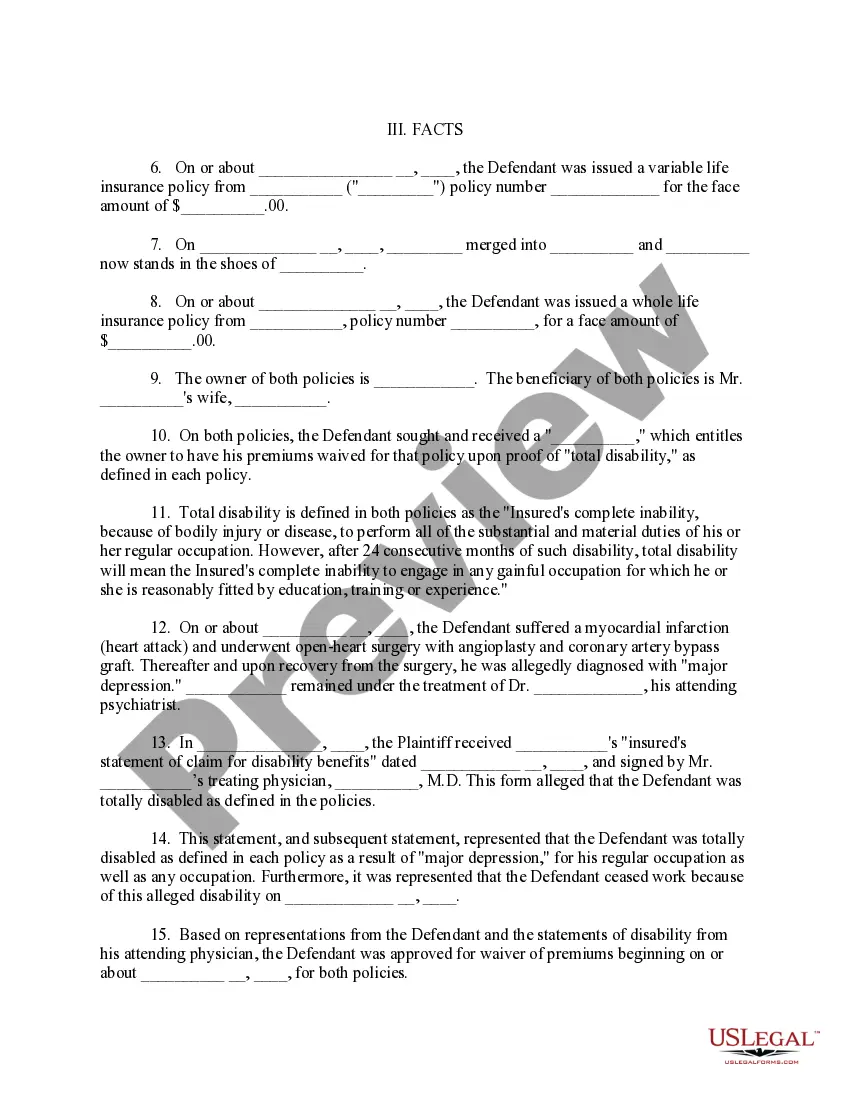
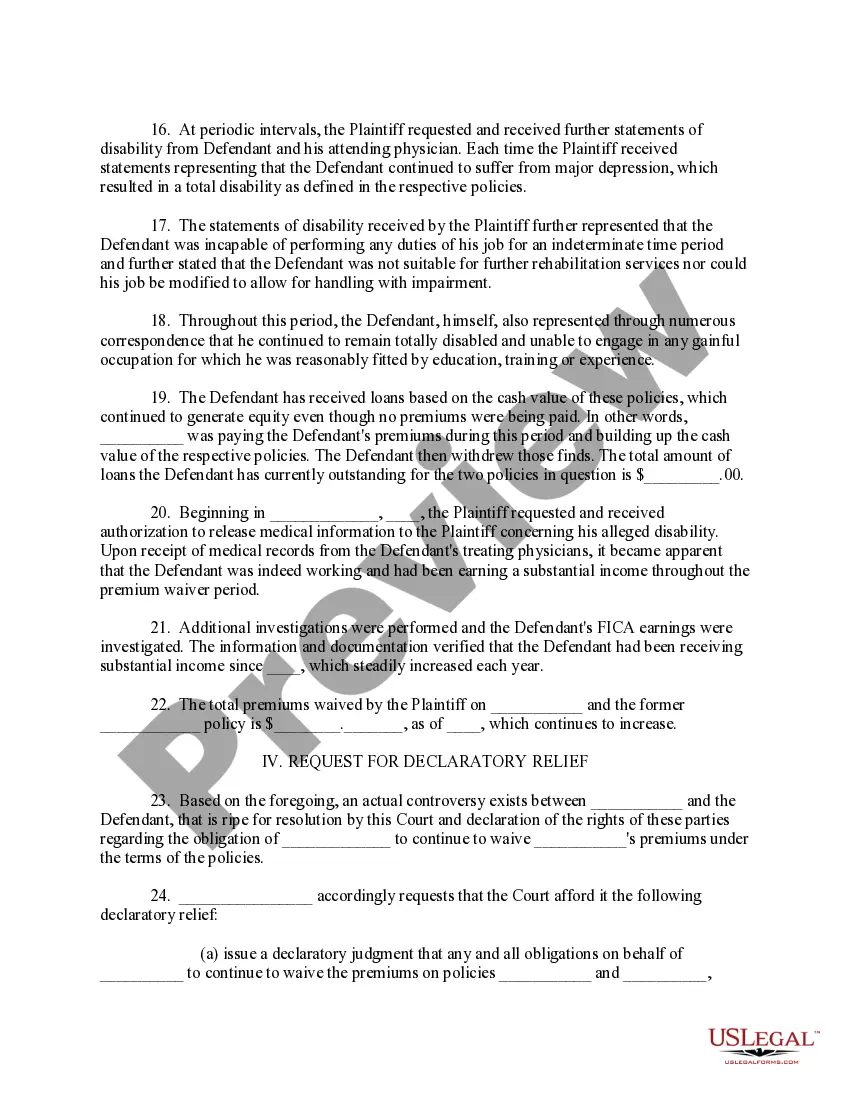
This form is a Complaint For Declaratory Judgment for Return of Improperly Waived Insurance Premiums. Adapt to your specific circumstances. Don't reinvent the wheel, save time and money.
Pennsylvania Complaint For Declaratory Judgment for Return of Improperly Waived Insurance Premiums
51 downloads
Description
Free preview





Get your form ready online
Our built-in tools help you complete, sign, share, and store your documents in one place.
Built-in online Word editor
Make edits, fill in missing information, and update formatting in US Legal Forms—just like you would in MS Word.
Export easily
Download a copy, print it, send it by email, or mail it via USPS—whatever works best for your next step.
E-sign your document
Sign and collect signatures with our SignNow integration. Send to multiple recipients, set reminders, and more. Go Premium to unlock E-Sign.
Notarize online 24/7
If this form requires notarization, complete it online through a secure video call—no need to meet a notary in person or wait for an appointment.
Store your document securely
We protect your documents and personal data by following strict security and privacy standards.

Make edits, fill in missing information, and update formatting in US Legal Forms—just like you would in MS Word.

Download a copy, print it, send it by email, or mail it via USPS—whatever works best for your next step.

Sign and collect signatures with our SignNow integration. Send to multiple recipients, set reminders, and more. Go Premium to unlock E-Sign.

If this form requires notarization, complete it online through a secure video call—no need to meet a notary in person or wait for an appointment.

We protect your documents and personal data by following strict security and privacy standards.
Looking for another form?


How to fill out Complaint For Declaratory Judgment For Return Of Improperly Waived Insurance Premiums?
You can dedicate hours online looking for the legal document template that fulfills the federal and state requirements you require. US Legal Forms offers thousands of legal forms that are vetted by experts.
You can easily download or create the Pennsylvania Complaint For Declaratory Judgment for Return of Improperly Waived Insurance Premiums from the service.
If you already have a US Legal Forms account, you can Log In and click on the Obtain button. After that, you can complete, modify, print, or sign the Pennsylvania Complaint For Declaratory Judgment for Return of Improperly Waived Insurance Premiums. Each legal document template you receive is yours indefinitely. To get another copy of the obtained form, go to the My documents tab and click on the relevant button.
Select the format of the document and download it to your device. Make modifications to your document if needed. You can complete, modify, sign, and print the Pennsylvania Complaint For Declaratory Judgment for Return of Improperly Waived Insurance Premiums. Download and print thousands of document templates using the US Legal Forms website, which provides the largest collection of legal forms. Utilize professional and state-specific templates to address your business or personal needs.
- If you are using the US Legal Forms website for the first time, follow the simple instructions below.
- First, make sure you have selected the correct document template for your area/city of choice. Review the form outline to ensure you have chosen the proper form.
- If available, use the Preview button to review the document template as well.
- If you want to find another variant of the form, use the Search field to locate the template that suits your needs and specifications.
- Once you have found the template you require, click Buy now to proceed.
- Choose the pricing plan you want, enter your details, and register for your account on US Legal Forms.
- Complete the transaction. You may use your credit card or PayPal account to pay for the legal form.
Form popularity
FAQ
A declaratory judgment in insurance is a court ruling that clarifies the rights and obligations of parties under an insurance policy. This type of judgment can help resolve disputes over coverage, premiums, and claims. If you're dealing with improperly waived insurance premiums, pursuing a Pennsylvania Complaint For Declaratory Judgment for Return of Improperly Waived Insurance Premiums can provide clarity and potentially restore your financial position.
The Supreme Court has ruled on various cases concerning insurance claims, often emphasizing the importance of good faith and fair dealing in insurance contracts. These rulings impact how courts interpret insurance policies and claims. If you believe your claim has been mishandled, a Pennsylvania Complaint For Declaratory Judgment for Return of Improperly Waived Insurance Premiums may serve as a helpful tool to ensure your rights are upheld.
An insurance company might seek a declaratory judgment when it needs clarification on its obligations under a policy before making a payout. This action often arises when there are contested claims or when the insurer believes it has valid grounds to deny a claim. Understanding these circumstances can be crucial, especially if you're considering a Pennsylvania Complaint For Declaratory Judgment for Return of Improperly Waived Insurance Premiums.
It may be appropriate to bring a declaratory judgment action when there is ambiguity in an insurance policy or when an insurer refuses to honor a claim. If you've experienced the improper waiver of insurance premiums, a Pennsylvania Complaint For Declaratory Judgment for Return of Improperly Waived Insurance Premiums can clarify your rights and obligations. This approach helps provide a clear resolution to disputes without the need for lengthy litigation.
To initiate a declaratory judgment action in Pennsylvania, you must demonstrate that there is an actual controversy regarding the rights of the parties involved. You also need to establish that the court has jurisdiction over the matter at hand. Filing a Pennsylvania Complaint For Declaratory Judgment for Return of Improperly Waived Insurance Premiums often meets these criteria, especially when there is uncertainty about insurance claims.
In Pennsylvania, a violation of insurance law may include the improper denial of a claim or the failure to provide policyholders with required disclosures. Specifically, actions that result in the improper waiver of insurance premiums can lead to legal repercussions. If you're facing such a situation, considering a Pennsylvania Complaint For Declaratory Judgment for Return of Improperly Waived Insurance Premiums could be a viable option.
To obtain a declaratory order in Pennsylvania, you must establish that your legal rights are in question and that a judicial determination is necessary for resolution. Your claim should be based on existing law, and you must specify the relief you seek regarding the Pennsylvania Complaint For Declaratory Judgment for Return of Improperly Waived Insurance Premiums. Additionally, the request needs to be presented to a court with proper jurisdiction. Engaging with uslegalforms can help you navigate these requirements effectively.
In a Pennsylvania Complaint For Declaratory Judgment for Return of Improperly Waived Insurance Premiums, the burden of proof lies with the party seeking the declaratory judgment. This means you must present sufficient evidence to convince the court of your legal rights or status in the matter. The evidence should be clear and convincing, demonstrating the necessity for a court ruling. Being prepared with thorough documentation can enhance your chances of a favorable outcome.
Filing a complaint with the Pennsylvania insurance commissioner involves submitting a written complaint detailing your concerns, including your contact information and any relevant policy details. You should clearly state your issues, particularly if they relate to a Pennsylvania Complaint For Declaratory Judgment for Return of Improperly Waived Insurance Premiums. It’s crucial to provide supporting documents to strengthen your case. Utilizing resources from uslegalforms can simplify this process and ensure you meet all necessary guidelines.
To pursue a Pennsylvania Complaint For Declaratory Judgment for Return of Improperly Waived Insurance Premiums, you must demonstrate an actual controversy between parties. Both parties should have opposing interests, and your complaint must outline specific legal rights that need clarification. Additionally, the court must have jurisdiction over the matter, ensuring that the issue is justiciable. Understanding these requirements helps streamline your legal process.