Pennsylvania Quitclaim Deed from a Limited Liability Company to an Individual
What this document covers
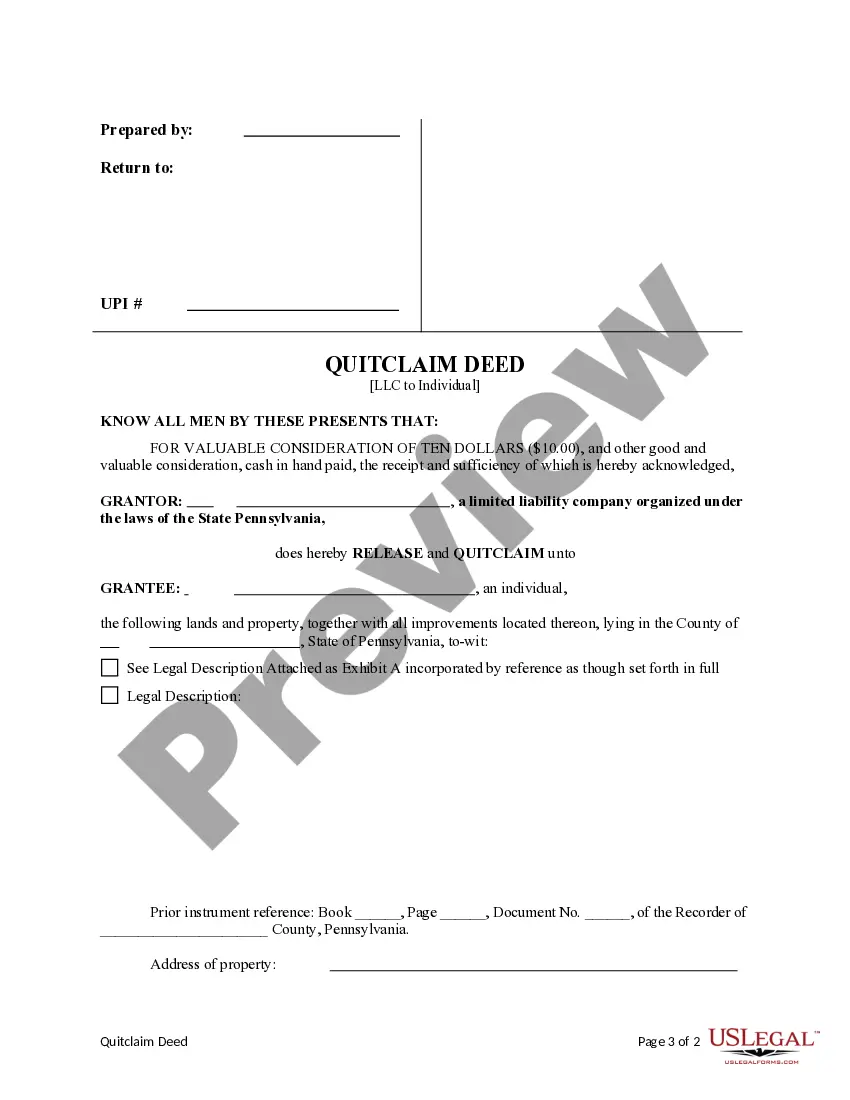
The Quitclaim Deed from a Limited Liability Company to an Individual allows a limited liability company (LLC) to transfer property ownership to an individual. Unlike warranty deeds, this quitclaim deed does not guarantee that the grantor has clear title to the property; it simply conveys whatever interest the LLC may have. This form is specifically tailored to ensure compliance with state laws governing property transfers.
Form components explained
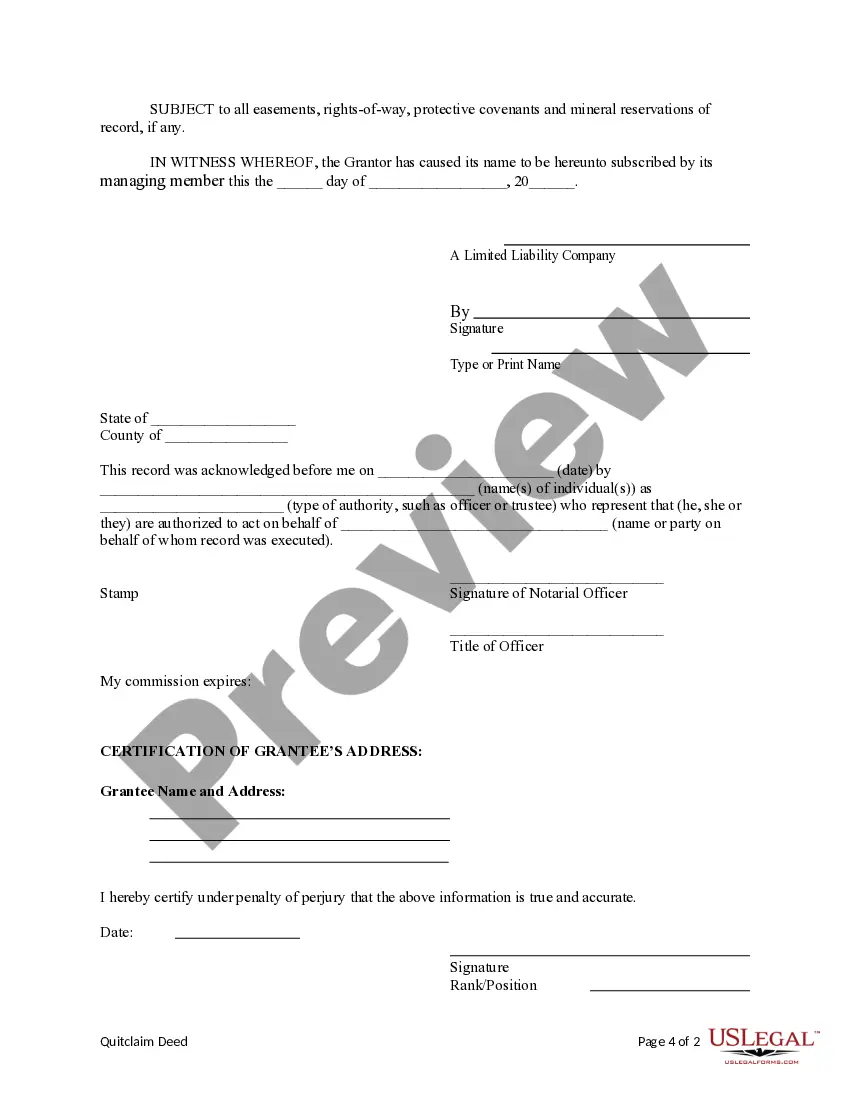
- Grantor information: Details about the limited liability company transferring the property.
- Grantee information: Details about the individual receiving the property.
- Property description: A legal description of the property being conveyed.
- Date of transfer: The date on which the transfer will take effect.
- Signature lines: Areas for the authorized representatives to sign on behalf of the LLC.




Situations where this form applies
This form is ideal when a limited liability company wants to transfer ownership of real estate to an individual without making warranties about the title. It is often used in informal transactions, such as family transfers, sales to friends, or when the transfer is made as part of estate planning.
Intended users of this form
This form is suitable for:
- Limited liability companies wishing to transfer property.
- Individuals receiving property from an LLC.
- Real estate professionals handling transactions involving LLCs.
How to complete this form
- Identify the grantor: Enter the name of the limited liability company transferring the property.
- Identify the grantee: Enter the name of the individual receiving the property.
- Specify the property: Provide a legal description of the property, including address and parcel number.
- Fill in the date: Indicate the date of the transfer.
- Sign the deed: Have an authorized representative of the LLC sign the document.
Does this document require notarization?
This form does not typically require notarization unless specified by local law. However, it is recommended to have the deed notarized to enhance its legal validity and ensure smooth recording with the county office.
Get your form ready online
Our built-in tools help you complete, sign, share, and store your documents in one place.
Make edits, fill in missing information, and update formatting in US Legal Forms—just like you would in MS Word.
Download a copy, print it, send it by email, or mail it via USPS—whatever works best for your next step.
Sign and collect signatures with our SignNow integration. Send to multiple recipients, set reminders, and more. Go Premium to unlock E-Sign.
If this form requires notarization, complete it online through a secure video call—no need to meet a notary in person or wait for an appointment.
We protect your documents and personal data by following strict security and privacy standards.

Make edits, fill in missing information, and update formatting in US Legal Forms—just like you would in MS Word.

Download a copy, print it, send it by email, or mail it via USPS—whatever works best for your next step.

Sign and collect signatures with our SignNow integration. Send to multiple recipients, set reminders, and more. Go Premium to unlock E-Sign.

If this form requires notarization, complete it online through a secure video call—no need to meet a notary in person or wait for an appointment.

We protect your documents and personal data by following strict security and privacy standards.
Avoid these common issues
- Failing to provide a complete legal description of the property.
- Not having the document signed by an authorized representative of the LLC.
- Missing the necessary witnesses or notarization as required by state law.
Benefits of completing this form online
- Convenience: Download and complete the form at your own pace.
- Editability: Easily fill in form fields electronically.
- Compliance: Ensure that the form adheres to legal requirements specific to your state.
Legal use & context
- This quitclaim deed is used for transferring ownership without guarantees of title clarity.
- It is commonly accepted in real estate transactions but may not be suitable in scenarios requiring warranties.
Key takeaways
- A quitclaim deed from an LLC to an individual is a straightforward transfer of property rights.
- Ensure all parties are properly identified and the property is clearly described.
- Notarization is generally not required but can enhance the document's validity.
Looking for another form?
Form popularity
FAQ
A Quitclaim Deed must be notarized by a notary public or attorney in order to be valid.Consideration in a Quitclaim Deed is what the Grantee will pay to the Grantor for the interest in the property.
But you might be wondering if an owner can transfer a deed to another person without a real estate lawyer. The answer is yes. Parties to a transaction are always free to prepare their own deeds.A quitclaim deed, for example, is far simpler than a warranty deed.
Fill in the deed form. Print it out. Have the grantor(s) and grantee(s) sign and get the signature(s) notarized. Fill out a Statement of Value form, if necessary. Get the Uniform Parcel Number (UPI) on the deed certified, if required by your county.
To transfer property in Pennsylvania, you'll need to prepare and execute a deed and record it in the county where the property is located. If the transfer was in exchange for money, you'll have to pay transfer tax.
A quitclaim deed is a legal instrument that is used to transfer interest in real property.The owner/grantor terminates (quits) any right and claim to the property, thereby allowing the right or claim to transfer to the recipient/grantee.
The State of Pennsylvania charges 1% of the sales price and the municipality and school district USUALLY charge 1% between them for a total of 2% (i.e. 2% X 100,000 = $2,000). By custom, the buyer and seller split the cost. 1% to buyer, 1% to seller; however payment is dictated by the sales contract.
A quit claim deed in the state of Pennsylvania is a legal document that allows a Grantor (the seller of a property) to transfer his or her ownership rights to a Grantee (the buyer).
You'll need to pay a fee, which varies from county to county. For example, in Montgomery County, near Philadelphia, the fee for recording a deed is $86.75 for up to four pages and up to four names, and $1 per additional name and $4 per additional page.