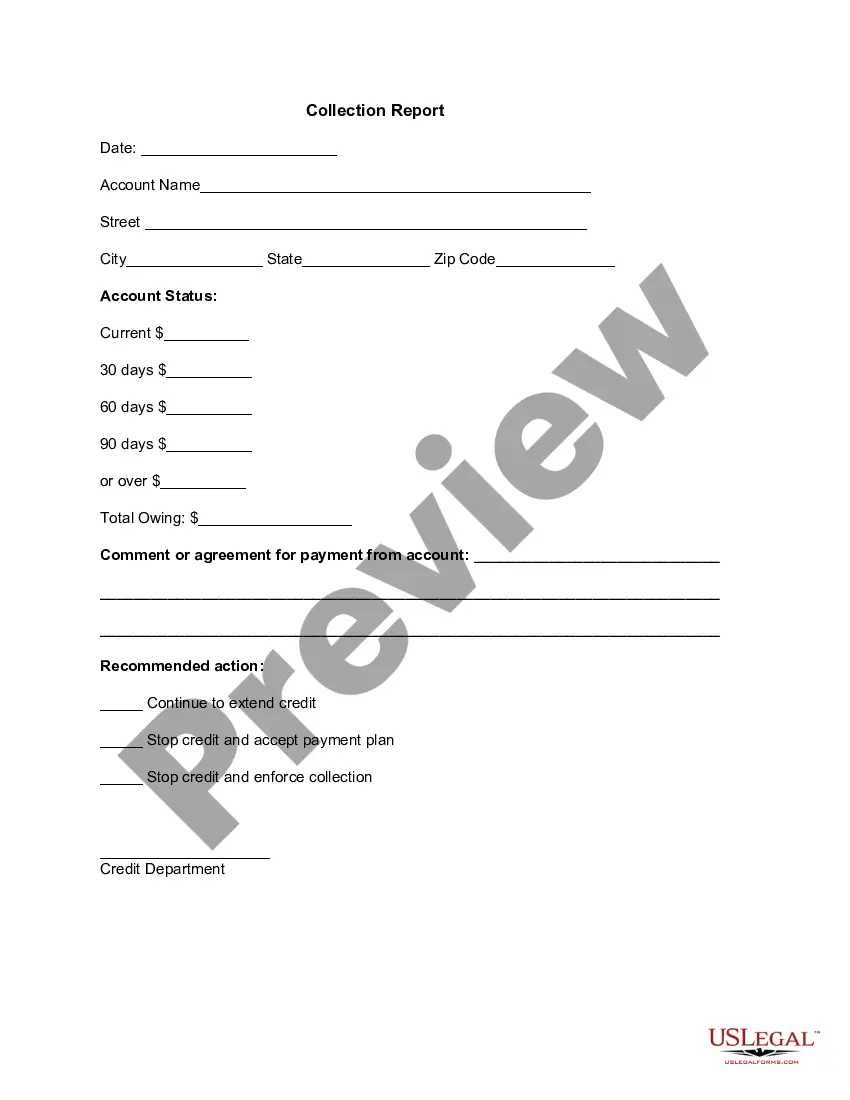
Ohio Collection Report
Description


Get your form ready online
Our built-in tools help you complete, sign, share, and store your documents in one place.
Make edits, fill in missing information, and update formatting in US Legal Forms—just like you would in MS Word.
Download a copy, print it, send it by email, or mail it via USPS—whatever works best for your next step.
Sign and collect signatures with our SignNow integration. Send to multiple recipients, set reminders, and more. Go Premium to unlock E-Sign.
If this form requires notarization, complete it online through a secure video call—no need to meet a notary in person or wait for an appointment.
We protect your documents and personal data by following strict security and privacy standards.

Make edits, fill in missing information, and update formatting in US Legal Forms—just like you would in MS Word.

Download a copy, print it, send it by email, or mail it via USPS—whatever works best for your next step.

Sign and collect signatures with our SignNow integration. Send to multiple recipients, set reminders, and more. Go Premium to unlock E-Sign.

If this form requires notarization, complete it online through a secure video call—no need to meet a notary in person or wait for an appointment.

We protect your documents and personal data by following strict security and privacy standards.
Looking for another form?

How to fill out Collection Report?
It is feasible to dedicate numerous hours online searching for the legal document format that complies with the federal and state standards you require.
US Legal Forms provides thousands of legal templates that have been reviewed by professionals.
You can effortlessly download or print the Ohio Collection Report from their services.
If available, use the Preview button to review the document format as well.
- If you have a US Legal Forms account, you can Log In and click on the Download button.
- After that, you can complete, modify, print, or sign the Ohio Collection Report.
- Every legal document format you purchase is yours indefinitely.
- To obtain another copy of any purchased document, go to the My documents tab and click on the relevant button.
- If you are using the US Legal Forms site for the first time, follow the simple instructions below.
- First, ensure you have selected the correct document format for your preferred county/region.
- Check the document description to confirm you have chosen the appropriate form.
Form popularity
FAQ
NOTE: For information on paying a tax debt or other debt owed to the state of Ohio, please contact the Attorney General's Collections Enforcement Section online or by calling 877-607-6400.
Highlights: Most negative information generally stays on credit reports for 7 years. Bankruptcy stays on your Equifax credit report for 7 to 10 years, depending on the bankruptcy type. Closed accounts paid as agreed stay on your Equifax credit report for up to 10 years.
For most debts, the time limit is 6 years since you last wrote to them or made a payment. The time limit is longer for mortgage debts. If your home is repossessed and you still owe money on your mortgage, the time limit is 6 years for the interest on the mortgage and 12 years on the main amount.
Accounts that you didn't pay, like a charged-off credit card or installment loan balance, can stay on your credit report for seven years from the date the debt was charged off. A charge-off is when the creditor officially writes your debt off its books as a loss.
Statute of Limitations in Ohio Ohio's statute of limitations is six years no matter the type of debt. And the six years is counted from the date a debt became overdue or when you last made a payment, whichever was more recent. If the timeframe is more than six years, a creditor cannot sue to collect the debt.
To find out what you have in collections, you will need to check your latest credit reports from each of the 3 credit bureaus. Collection agencies are not required to report their account information to all three of the national credit reporting agencies.
In Ohio, the statute of limitations is six years for most debts. However, the debt does not expire or disappear until it is paid or resolved. You still owe the debt, no matter how much time passes, which is why it stays on your credit report.
This means that although Ohio's statute of limitations for judgment enforcement is at least fifteen years, in reality the best practice is to act at least once every five years so that your judgment does not become dormant. Often judgments are against more than one judgment debtor.
Unpaid credit card debt will drop off an individual's credit report after 7 years, meaning late payments associated with the unpaid debt will no longer affect the person's credit score.
How long does information stay on my credit report? Delinquent/late payments - Indefinitely if the account is still open. If the account is closed, 7 to 10 years after the account is closed/paid in full.