Ohio Notice of Additional Bond Due
Understanding this form
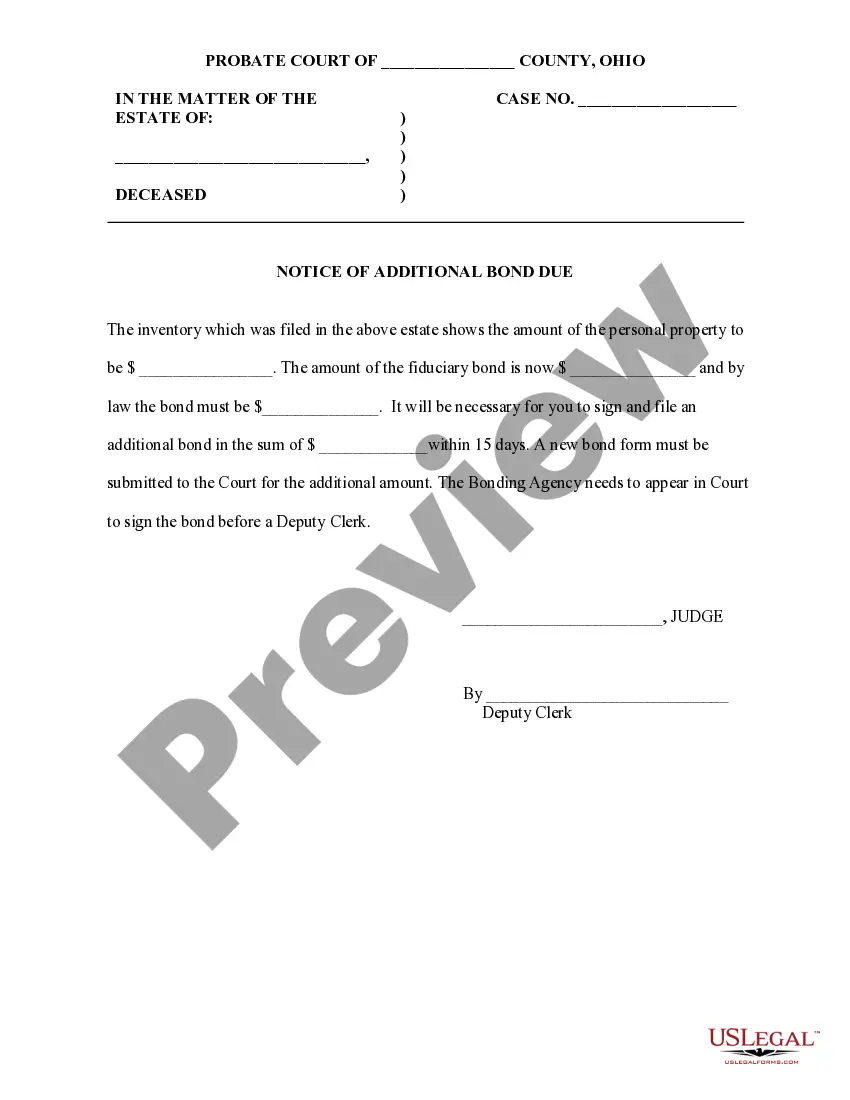
The Notice of Additional Bond Due is a legal document used in the administration of a decedent's estate in Ohio. This form serves to notify the fiduciary about the required increase in their bond amount, which is necessary when the personal property exceeds certain limits. Unlike other estate forms, this document specifically addresses the need for additional bonding to ensure proper estate management and protection of assets.
Key components of this form
- Case number: Identifies the unique court case related to the estate.
- Personal property value: Specifies the total value of personal property in the estate.
- Current bond amount: States the existing fiduciary bond amount.
- Required bond amount: Indicates the legal requirement for the new bond total.
- Deadline for additional bond: Specifies the time frame for filing the new bond.


Common use cases
This form is needed when the inventory of a decedent's estate reveals that the value of personal property has increased, requiring the fiduciary to adjust their bond amount. It is typically used in situations where estate assets have been reassessed or valued higher than initially recorded.
Intended users of this form
- Fiduciaries handling a decedent's estate in Ohio.
- Legal representatives or attorneys managing estate affairs.
- Estate administrators who need to amend bond amounts based on asset evaluations.
How to prepare this document
- Enter the decedent's name and case number at the top of the form.
- Provide the total value of personal property as shown in the estate inventory.
- Specify the current bond amount already filed with the court.
- Indicate the required new bond amount as mandated by law.
- Submit the completed form to the court within the designated deadline.
Notarization guidance
Notarization is required for this form to take effect. Our online notarization service, powered by Notarize, lets you verify and sign documents remotely through an encrypted video session, available 24/7.
Get your form ready online
Our built-in tools help you complete, sign, share, and store your documents in one place.
Make edits, fill in missing information, and update formatting in US Legal Forms—just like you would in MS Word.
Download a copy, print it, send it by email, or mail it via USPS—whatever works best for your next step.
Sign and collect signatures with our SignNow integration. Send to multiple recipients, set reminders, and more. Go Premium to unlock E-Sign.
If this form requires notarization, complete it online through a secure video call—no need to meet a notary in person or wait for an appointment.
We protect your documents and personal data by following strict security and privacy standards.

Make edits, fill in missing information, and update formatting in US Legal Forms—just like you would in MS Word.

Download a copy, print it, send it by email, or mail it via USPS—whatever works best for your next step.

Sign and collect signatures with our SignNow integration. Send to multiple recipients, set reminders, and more. Go Premium to unlock E-Sign.

If this form requires notarization, complete it online through a secure video call—no need to meet a notary in person or wait for an appointment.

We protect your documents and personal data by following strict security and privacy standards.
Common mistakes
- Failing to provide accurate values for personal property.
- Missing the deadline for filing the additional bond.
- Not obtaining the necessary signatures from the bonding agency.
Advantages of online completion
- Easy access to a correctly formatted legal document.
- Ability to edit and customize the form before printing.
- Instant download options in various formats, making it convenient for filing.
Looking for another form?
Form popularity
FAQ
Federal government bonds. Treasury bills. Treasury notes. Treasury bonds. Zero-coupon bond. Municipal bonds.
A bond is a debt security, similar to an IOU. Borrowers issue bonds to raise money from investors willing to lend them money for a certain amount of time. When you buy a bond, you are lending to the issuer, which may be a government, municipality, or corporation.
Bond: An Overview.A bond is a debt instrument that allows an investor to lend money to a corporation or government institution in return for an amount of interest earned over the life of the bond. A bond is essentially a loan issued by an entity and invested in by outside investors.
As a revenue bond is not backed by the full faith and credit of the issuing government, it does not require voter approval.
In finance, a bond is an instrument of indebtedness of the bond issuer to the holders. The most common types of bonds include municipal bonds and corporate bonds.Bonds provide the borrower with external funds to finance long-term investments, or, in the case of government bonds, to finance current expenditure.
A revenue bond repays creditors from income generated by the project that the bond itself is funding, such as a toll road or bridge. While a revenue bond is backed by a specific revenue stream, holders of GO bonds are relying on the full faith and credit of the issuing municipality.
A bond, especially a municipal bond, where the coupons and principal are paid with funding from the project the debt seeks to finance. It may be used, for example, to build a hospital or a toll bridge, and bondholders are repaid with the revenue the hospital or toll bridge derives.
The term bond resolution is typically applicable to bonds issued by municipalities. A bond resolution describes how much interest and principal will be paid to bondholders, when and how payments will be made, how bonds may be redeemed, and what happens in the event of default.
A bond is a fixed income instrument that represents a loan made by an investor to a borrower (typically corporate or governmental).Bonds are used by companies, municipalities, states, and sovereign governments to finance projects and operations. Owners of bonds are debtholders, or creditors, of the issuer.