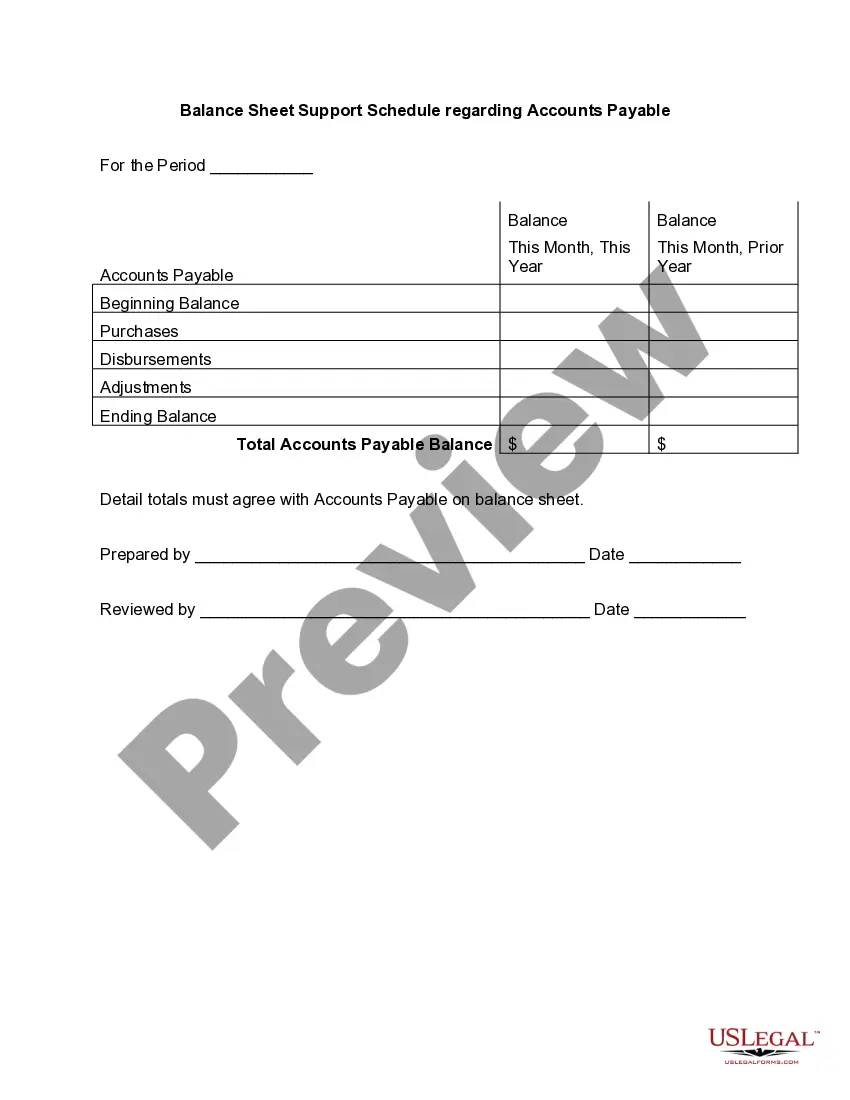
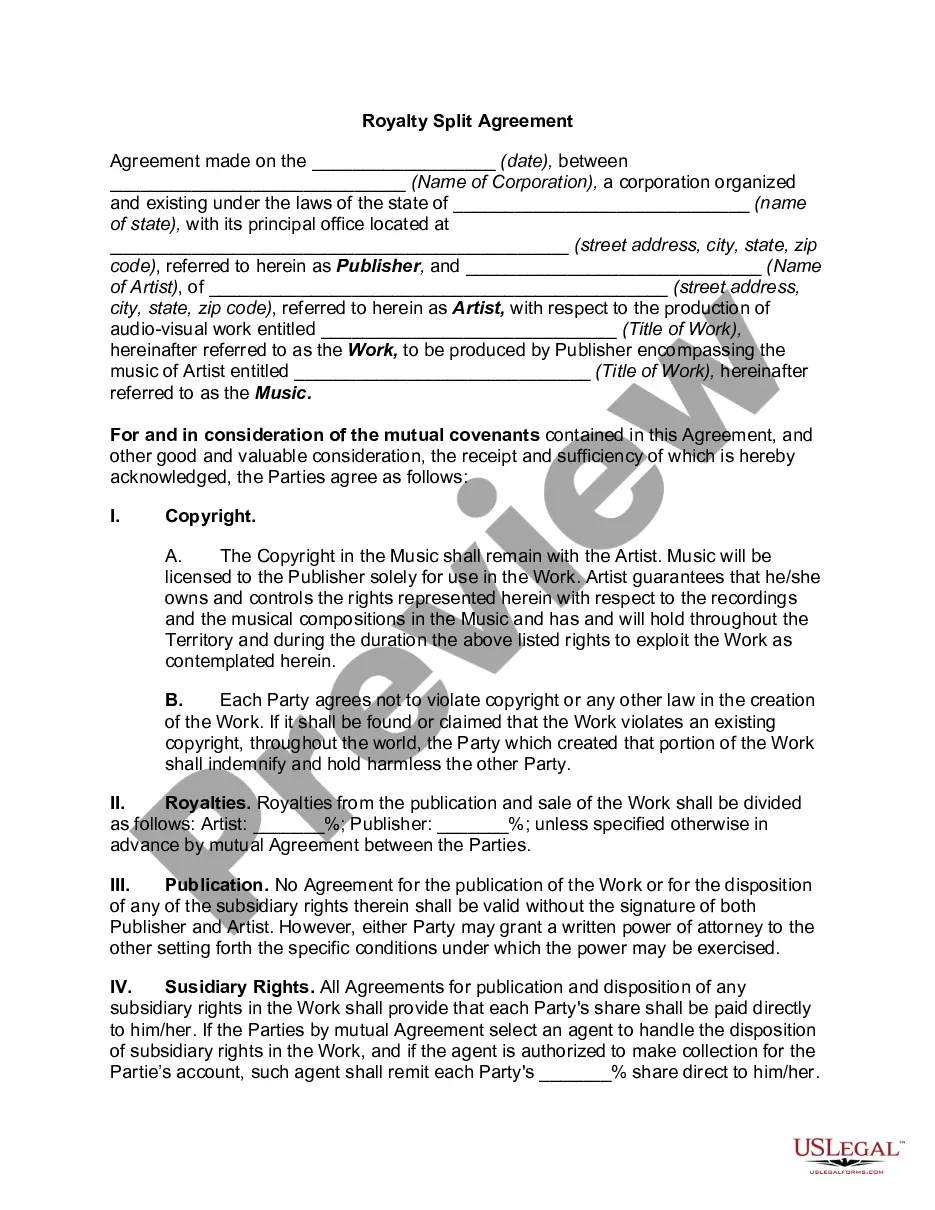
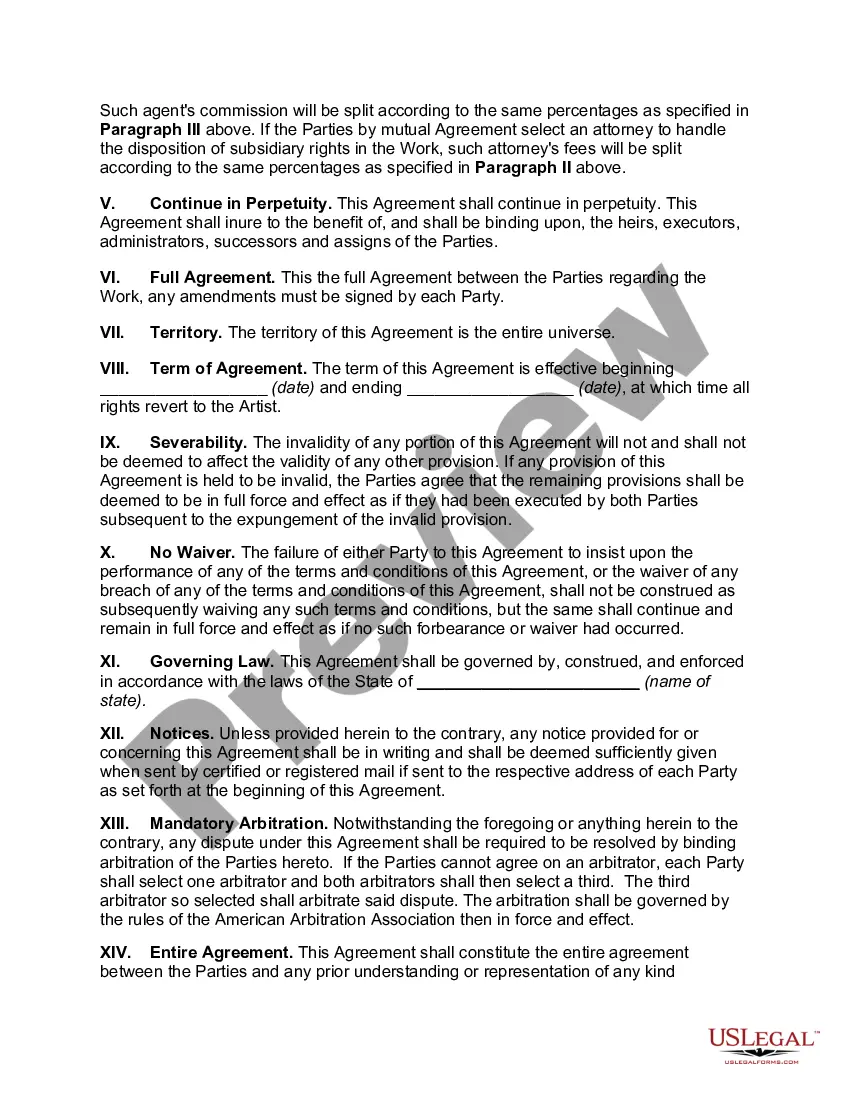
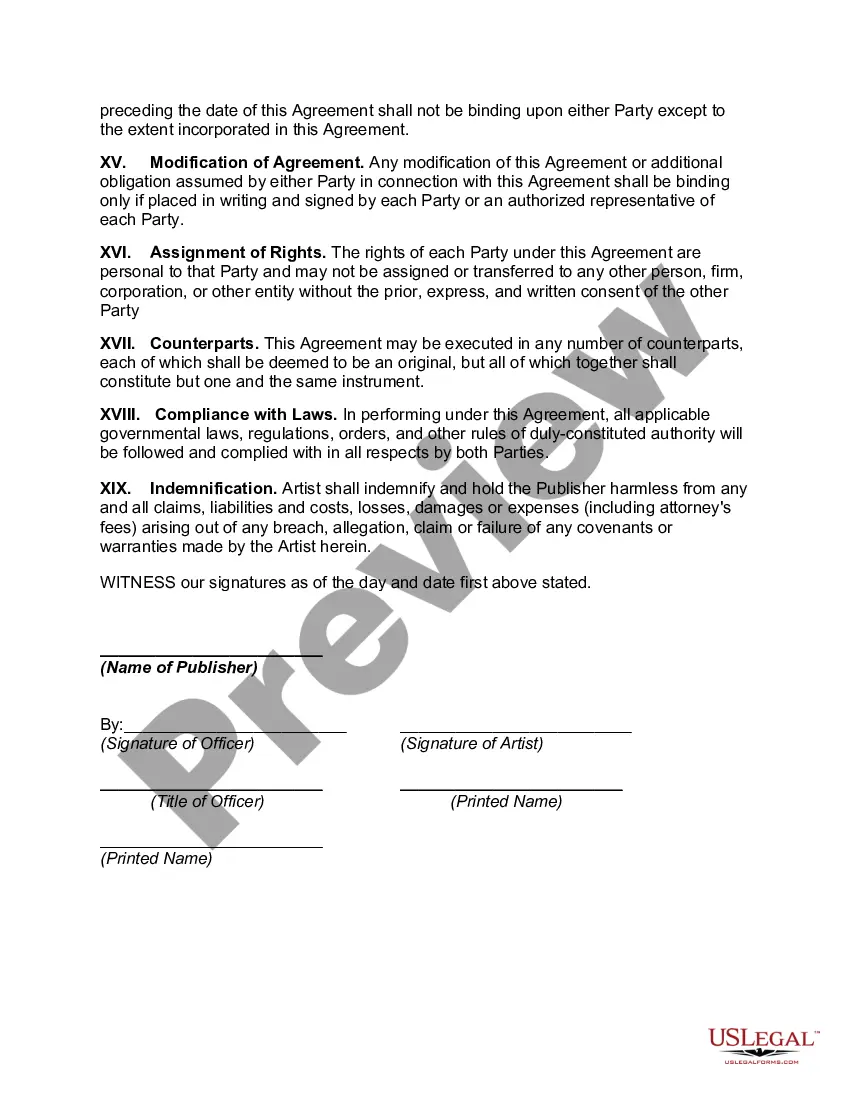
New York Royalty Split Agreement
Description
Get your form ready online
Our built-in tools help you complete, sign, share, and store your documents in one place.
Make edits, fill in missing information, and update formatting in US Legal Forms—just like you would in MS Word.
Download a copy, print it, send it by email, or mail it via USPS—whatever works best for your next step.
Sign and collect signatures with our SignNow integration. Send to multiple recipients, set reminders, and more. Go Premium to unlock E-Sign.
If this form requires notarization, complete it online through a secure video call—no need to meet a notary in person or wait for an appointment.
We protect your documents and personal data by following strict security and privacy standards.

Make edits, fill in missing information, and update formatting in US Legal Forms—just like you would in MS Word.

Download a copy, print it, send it by email, or mail it via USPS—whatever works best for your next step.

Sign and collect signatures with our SignNow integration. Send to multiple recipients, set reminders, and more. Go Premium to unlock E-Sign.

If this form requires notarization, complete it online through a secure video call—no need to meet a notary in person or wait for an appointment.

We protect your documents and personal data by following strict security and privacy standards.
Looking for another form?


How to fill out Royalty Split Agreement?
If you desire to finalize, obtain, or print authentic document templates, utilize US Legal Forms, the most extensive collection of official forms available online.
Employ the website's straightforward and user-friendly search feature to locate the documents you need.
Various templates for business and personal purposes are organized by categories and states, or keywords.
Step 4. Once you have found the form you need, click the Purchase now button. Choose the pricing plan you prefer and provide your information to create an account.
Step 5. Proceed with the payment. You can use your Visa or Mastercard or PayPal account to complete the transaction.
- Utilize US Legal Forms to find the New York Royalty Split Agreement in just a few clicks.
- If you are already a US Legal Forms user, sign in to your account and click the Download button to get the New York Royalty Split Agreement.
- You can also access forms you have previously downloaded in the My documents tab of your account.
- If you are using US Legal Forms for the first time, follow the instructions outlined below.
- Step 1. Ensure you have selected the form for the appropriate city/state.
- Step 2. Use the Review method to examine the form’s content. Don't forget to read the details.
- Step 3. If you are not satisfied with the template, use the Search field at the top of the screen to find other versions of the legal form template.
Form popularity
FAQ
Producers typically get anything from 3 to 7 Producer Points. That means that if the artist gets, for example, 20% of the royalties in a record deal and the producer gets 5 points, the producer is getting 25% percent of the artist's share of the royalties.
As explained by Tune Core, the split nods to how much copyright the individual deserves from that particular song. For example, if there are four songwriters working together and it's divided that everyone has an equal percentage, the songwriting split will work out at 25% each.
If the label is a major record company, the artist split can range from 13% to over 20%. These artist agreements will often come with album advances. For indie labels, the split can be as high as 50%, but will often not include an advance.
The record royalty for a producer is usually between 3% to 4% of the record's sales price or 20% to 25% of the artist's royalties. On a CD that sells for $10.98, the producer's royalty would be about 33 cents for each copy sold and for a digital download of an album priced at $9.98 the producer receives 30 cents.
Performance royalties are shared 50/50 between the publisher and the songwriter, so each gets 50% of the revenue. If you are both the songwriter and the publisher for your own music, you will receive 100% of performance royalties.
Royalties on the master side are typically split between the recording artists and the record labels, given there's a recording deal in place. Typically, record labels finance release marketing and/or production, taking a sizable stake in the future master royalties.
Performance royalties are typically split into two equal halves: a writer share (50%) and a publisher share (50%). Performing Rights Organizations (PROs) and Collective Management Organizations (CMOs) collect and account for each of these revenue sources separately.
MASTER: Generally, the artist and record company split income based on the terms of a recording contract. The exception is neighbouring rights, hometapping/private copy, and DART royalties. All of these royalties are collected and paid out by agencies directly to the artist and record company.
A distributor collects royalties directly from stores/streaming platforms on behalf of labels. An artist's label will then collect the recording royalties and distribute them to the artist. If an artist is not with a label, the artist will collect the recording royalties directly from the distributor.
Royalty splits when a song gets recorded and money starts rolling in2026 The publisher gets to first recoup the money they have paid a writer for advances and demo costs (for all songs, not just the one that got recorded). Therefore, they split royalties according to the contract.