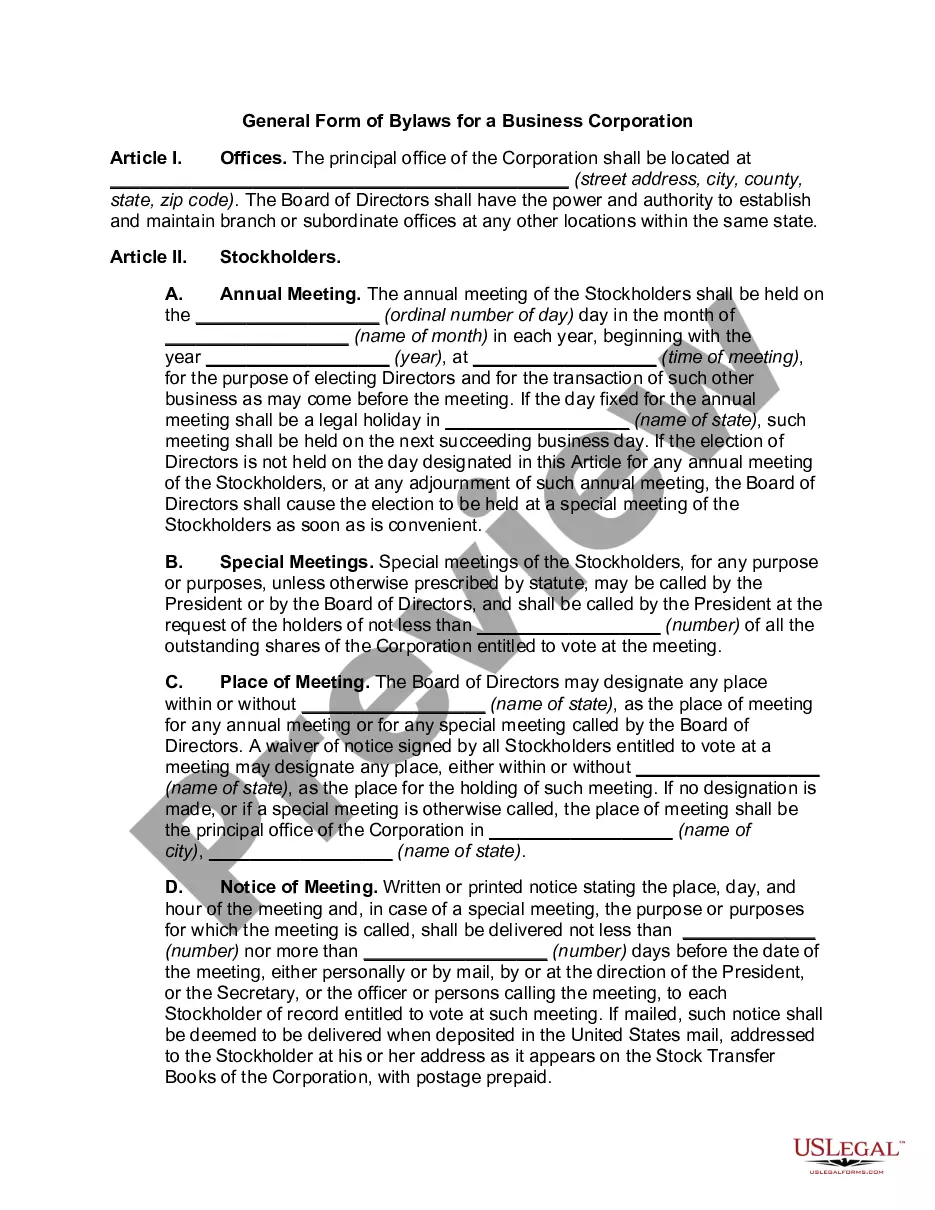
This By-Laws document contains the following information: the name and location of the corporation, the shareholders, and the duties of the officers.
New York Bylaws for Corporation
Instant download
Description
Free preview











Get your form ready online
Our built-in tools help you complete, sign, share, and store your documents in one place.
Built-in online Word editor
Make edits, fill in missing information, and update formatting in US Legal Forms—just like you would in MS Word.
Export easily
Download a copy, print it, send it by email, or mail it via USPS—whatever works best for your next step.
E-sign your document
Sign and collect signatures with our SignNow integration. Send to multiple recipients, set reminders, and more. Go Premium to unlock E-Sign.
Notarize online 24/7
If this form requires notarization, complete it online through a secure video call—no need to meet a notary in person or wait for an appointment.
Store your document securely
We protect your documents and personal data by following strict security and privacy standards.

Make edits, fill in missing information, and update formatting in US Legal Forms—just like you would in MS Word.

Download a copy, print it, send it by email, or mail it via USPS—whatever works best for your next step.

Sign and collect signatures with our SignNow integration. Send to multiple recipients, set reminders, and more. Go Premium to unlock E-Sign.

If this form requires notarization, complete it online through a secure video call—no need to meet a notary in person or wait for an appointment.

We protect your documents and personal data by following strict security and privacy standards.
Looking for another form?



How to fill out Bylaws For Corporation?
Locating the appropriate valid document template can be quite challenging.
Clearly, there is a multitude of templates available online, but how do you acquire the authentic form you require.
Utilize the US Legal Forms website. This service offers a plethora of templates, including the New York Bylaws for Corporation, suitable for both business and personal applications.
- All documents are reviewed by professionals and comply with state and federal regulations.
- If you are already a member, Log In to your account and click the Acquire button to obtain the New York Bylaws for Corporation.
- Use your account to search through the legal forms you have previously purchased.
- Go to the My documents section of your account to retrieve another copy of the document you need.
- If you are a new user of US Legal Forms, here are simple steps for you to follow.
- First, ensure you have selected the correct form for your city/region. You can preview the form by clicking the Preview button and reviewing the description to confirm it is the right one for you.
Form popularity
FAQ
Section 404 of the New York Business Corporation Law relates to the powers of corporations and the limitations on those powers. It specifies regulations regarding corporate actions and responsibilities of officers and directors. For businesses looking to draft informed and compliant New York bylaws for corporation, understanding this section is imperative in promoting good governance and operational integrity.
Section 719 of the New York Business Corporation Law pertains to the approval of corporate actions by shareholders. It details the requirements for conducting meetings and decision-making practices. Knowing this section helps corporations align their bylaws with state laws, providing structure and clarity, crucial elements in effective New York bylaws for corporation.
Section 407 A of the New York Limited Liability Company Law deals with the authority and responsibility of a limited liability company’s members or managers. This section clarifies who can act on behalf of the company and outlines necessary decision-making processes. Proper understanding of this section is vital when crafting effective New York bylaws for corporation to prevent disputes among members.
Section 1001 of the New York Limited Liability Company Law outlines the basic requirements for the formation of a limited liability company. This section includes the necessity to file a certificate with the state, which includes details of the company’s purpose and organization. Understanding this section is essential for anyone looking to establish New York bylaws for corporation, ensuring compliance and smooth operations.
Section 404 of the Companies Act addresses corporate governance standards and sets forth the requirements for a corporation's bylaws. It emphasizes transparency and accountability, ensuring that members understand their roles and responsibilities within the corporation. Adhering to this section is crucial for compliance and the effective operation of New York bylaws for corporation.
When drafting bylaws, avoid including overly detailed operational procedures or anything that could conflict with state laws. Steer clear of personal matters that are irrelevant to corporate governance or sensitive information that could expose the corporation to risks. Always ensure that the content aligns with the framework set by New York Bylaws for Corporation. To create effective and sound bylaws, you may want to use platforms like uslegalforms, which offer valuable insights on what to include and exclude.
An example of S Corp bylaws might include sections on meeting schedules, voting rights, and shareholder responsibilities. These bylaws typically outline how the corporation will handle profit distributions, how shares may be transferred, and how to resolve disputes among shareholders. When drafting bylaws for your S Corp, ensure they comply with New York Bylaws for Corporation to avoid potential legal issues down the line. Utilizing resources from uslegalforms can simplify the process by providing relevant examples and templates.
Writing corporate bylaws involves detailing the rules that will govern your corporation’s operations. Start by specifying the name, purpose, and the structure of the board of directors. Be sure to include provisions for shareholder meetings, voting methods, and amendment processes that align with New York Bylaws for Corporation. If you need help crafting comprehensive bylaws, consider using a platform like uslegalforms to access templates and guidance tailored to your needs.
To write a simple bylaw, start by outlining the basic rules governing the organization. Begin with the name of the corporation, followed by provisions for meetings, voting processes, and the roles of officers. Think about the specific requirements under New York Bylaws for Corporation to ensure compliance. Once drafted, review the bylaws to confirm they meet the needs of your business while adhering to state regulations.
Bylaws typically consist of several key sections that outline how a corporation will be governed. Common sections include the purpose of the corporation, details about the board of directors, shareholder meetings, and the process for amending bylaws. When creating New York Bylaws for Corporation, it’s essential to ensure clarity in each section to avoid confusion and legal issues. Overall, a well-structured set of bylaws facilitates smooth operations and adherence to state laws.