Nevada Visitor Nondisclosure Agreement
Description
Get your form ready online
Our built-in tools help you complete, sign, share, and store your documents in one place.
Make edits, fill in missing information, and update formatting in US Legal Forms—just like you would in MS Word.
Download a copy, print it, send it by email, or mail it via USPS—whatever works best for your next step.
Sign and collect signatures with our SignNow integration. Send to multiple recipients, set reminders, and more. Go Premium to unlock E-Sign.
If this form requires notarization, complete it online through a secure video call—no need to meet a notary in person or wait for an appointment.
We protect your documents and personal data by following strict security and privacy standards.

Make edits, fill in missing information, and update formatting in US Legal Forms—just like you would in MS Word.

Download a copy, print it, send it by email, or mail it via USPS—whatever works best for your next step.

Sign and collect signatures with our SignNow integration. Send to multiple recipients, set reminders, and more. Go Premium to unlock E-Sign.

If this form requires notarization, complete it online through a secure video call—no need to meet a notary in person or wait for an appointment.

We protect your documents and personal data by following strict security and privacy standards.
Looking for another form?
How to fill out Visitor Nondisclosure Agreement?
If you need to obtain, acquire, or print legal document templates, utilize US Legal Forms, the largest selection of legal forms available on the web.
Take advantage of the site's straightforward and convenient search to find the documents you need.
Various templates for business and specific purposes are organized by categories, states, or keywords.
Step 4. Once you've found the form you need, click the Purchase now button. Choose your preferred pricing plan and input your details to register for an account.
Step 5. Complete the transaction. You can use your credit card or PayPal account to finalize the payment.
- Use US Legal Forms to access the Nevada Visitor Nondisclosure Agreement in just a few clicks.
- If you are already a US Legal Forms user, Log In to your account and click on the Download button to locate the Nevada Visitor Nondisclosure Agreement.
- You can also retrieve forms you previously downloaded in the My documents tab of your account.
- If you are using US Legal Forms for the first time, follow these steps.
- Step 1. Ensure you have selected the form for the correct city/state.
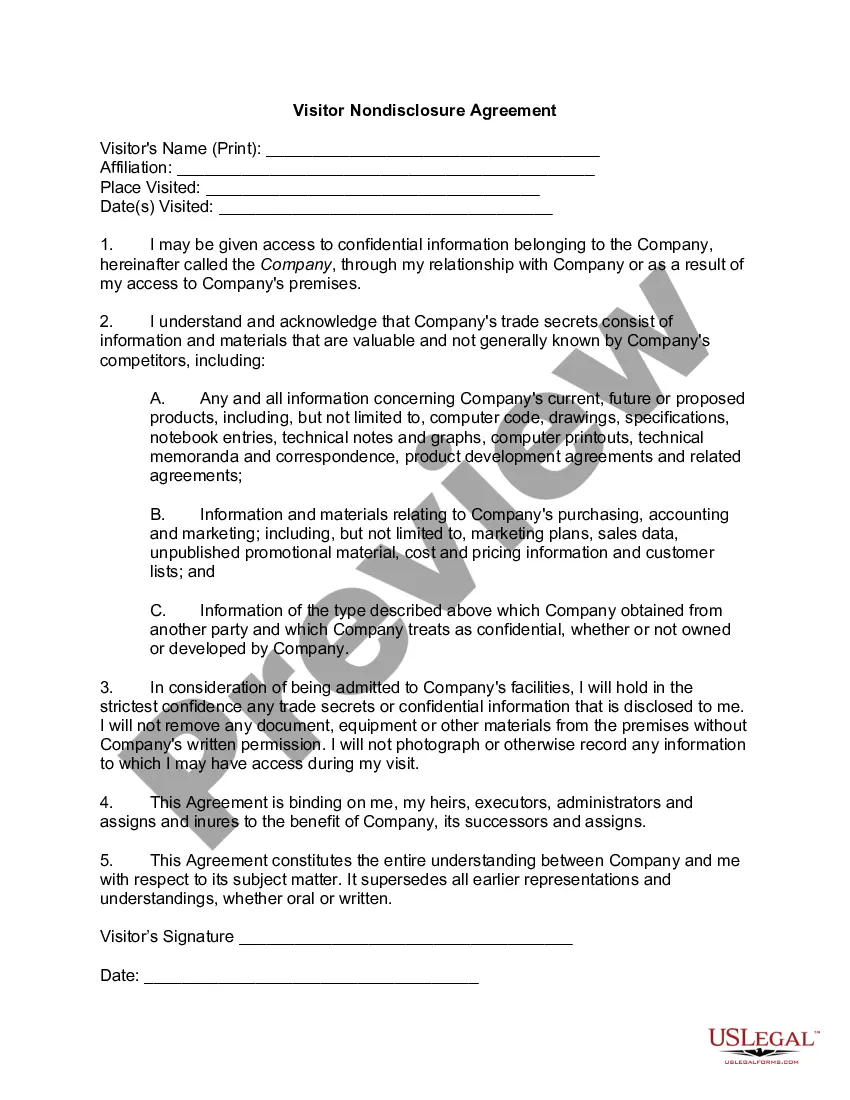
- Step 2. Use the Preview feature to review the form's content. Don't forget to read the description.
- Step 3. If you are not satisfied with the form, use the Search bar at the top of the screen to discover other forms in your desired legal format.
Form popularity
FAQ
A Nevada Visitor Nondisclosure Agreement is specifically designed for visitors who may encounter confidential information during their visit to a company or organization. This agreement ensures that visitors understand their obligation to keep shared information private. By signing this NDA, visitors help protect sensitive data, fostering a culture of trust and respect in professional settings.
Yes, nondisclosure agreements, including Nevada Visitor Nondisclosure Agreements, are generally enforceable in Nevada. However, the enforceability depends on how the NDA is structured and whether it meets state law requirements. It’s crucial that the terms are clear, reasonable, and protect legitimate business interests to ensure legal backing.
The three main types of nondisclosure agreements are unilateral, bilateral, and multilateral. A unilateral NDA involves one party disclosing information, while a bilateral NDA allows both parties to share sensitive data. Lastly, a multilateral NDA is used when three or more parties are involved. Understanding these types can help you choose the right format for your Nevada Visitor Nondisclosure Agreement.
Yes, you can write your own Nevada Visitor Nondisclosure Agreement, but carefully consider the terms to ensure they protect your interests. It is essential to include key elements such as confidentiality definitions, obligations, and duration. For added assurance, you might want to use templates available on platforms like USLegalForms to ensure your document aligns with legal standards.
Filling out a Nevada Visitor Nondisclosure Agreement involves several steps. First, you must clearly identify the parties involved and define the confidential information. Then, specify the duration of the confidentiality obligation and any exceptions. It’s advisable to consult a legal resource, like USLegalForms, to ensure that the agreement meets all legal requirements.
A violation of a Nevada Visitor Nondisclosure Agreement occurs when a party discloses confidential information covered by the agreement without authorization. For instance, if a visitor shares sensitive business information learned during a meeting, this action constitutes a breach. Such violations can have serious legal consequences, including financial penalties and loss of trust.
MNDA in the context of a Nevada Visitor Nondisclosure Agreement (NDA) refers to the Mutual Nondisclosure Agreement. This type of agreement not only protects the disclosing party but also safeguards the receiving party's sensitive information. This mutual protection can foster stronger relationships, making MNDA a preferred choice in many business scenarios where both parties wish to share proprietary knowledge.
In a Nevada Visitor Nondisclosure Agreement (NDA) versus a Mutual Nondisclosure Agreement (MNDA), the main distinction refers to the number of parties involved in sharing confidential information. An NDA involves one party revealing sensitive data to another party under confidentiality conditions. An MNDA implies both parties exchange vital information with the commitment to protect each other's secrets, enhancing trust in collaborative efforts.
When discussing a Nevada Visitor Nondisclosure Agreement (NDA) versus an MDNA, it is important to note that MDNA usually refers to a specific type of agreement related to mergers and acquisitions. NDAs are broader documents meant for general confidentiality purposes. In contrast, an MDNA often includes clauses tailored for business transactions, ensuring that both parties maintain secrecy regarding strategic information.
The primary difference between a Nevada Visitor Nondisclosure Agreement (NDA) and a Mutual Nondisclosure Agreement (MNDA) lies in the direction of the information disclosure. An NDA typically involves one party disclosing information to another while expecting confidentiality. In contrast, an MNDA allows both parties to share sensitive information with mutual obligations of confidentiality, making it ideal for partnerships and joint ventures.