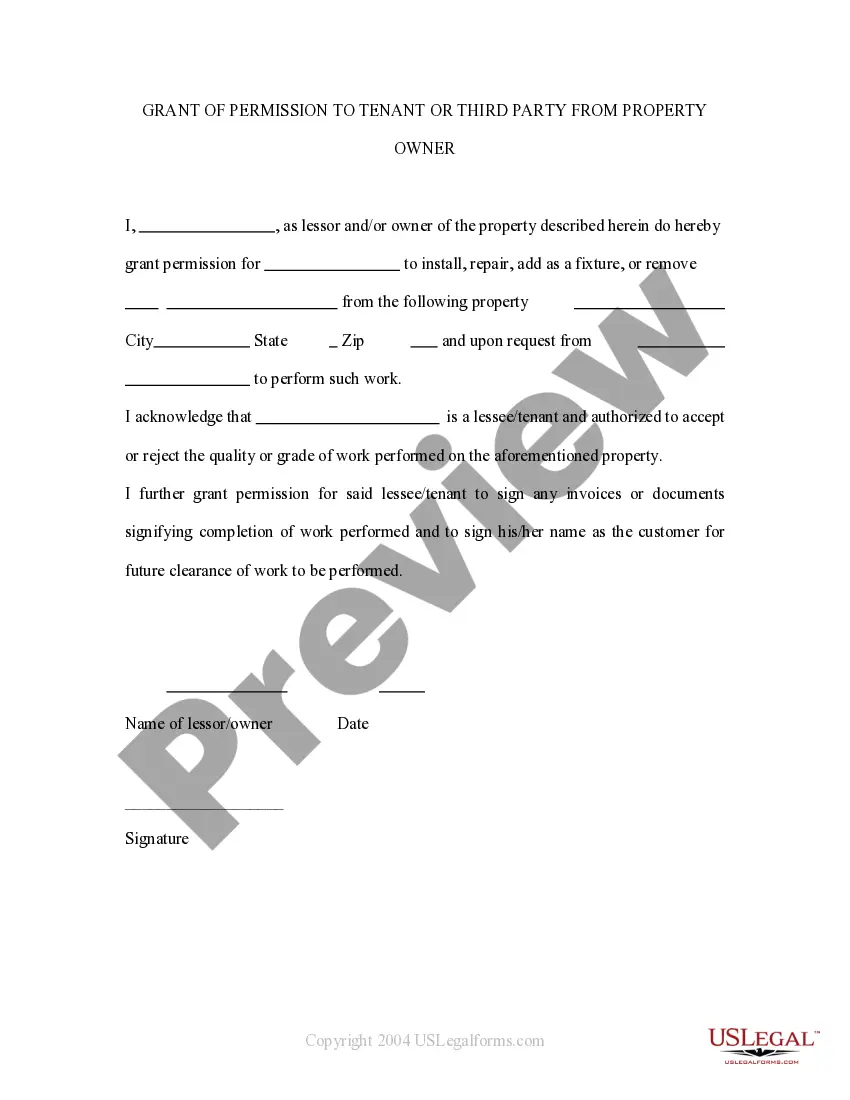
This is a grant of permission by a property owner to a third party to make repairs or install a fixture or cable television etc. on the property where the tenant lives
New Mexico Grant Of Permission To Tenant Or Third Party From Property Owner
Category:
State:
Multi-State
Control #:
US-PRM-30
Format:
Word;
Rich Text
Instant download
Description

How to fill out Grant Of Permission To Tenant Or Third Party From Property Owner?
You can spend multiple hours online searching for the legal document template that meets the state and federal requirements you will need.
US Legal Forms offers a wide array of legal documents that are reviewed by experts.
You can download or print the New Mexico Grant Of Permission To Tenant Or Third Party From Property Owner from your service.
If available, use the Preview button to browse through the document template as well. If you need to find another version of the form, use the Lookup field to find the template that fits your needs and specifications. Once you have found the template you desire, click Buy now to proceed. Select the pricing plan you want, enter your details, and register for your US Legal Forms account. Complete the transaction. You can use your credit card or PayPal account to pay for the legal document. Choose the format of the document and download it to your device. Make alterations to your document if necessary. You can complete, modify, sign, and print the New Mexico Grant Of Permission To Tenant Or Third Party From Property Owner. Download and print numerous document templates using the US Legal Forms Website, which offers the largest collection of legal documents. Utilize professional and state-specific templates to address your business or personal requirements.
- If you already have a US Legal Forms account, you can Log In and click the Download button.
- Then, you can complete, modify, print, or sign the New Mexico Grant Of Permission To Tenant Or Third Party From Property Owner.
- Every legal document template you obtain belongs to you indefinitely.
- To acquire an additional copy of the purchased form, go to the My documents tab and click the corresponding button.
- If you are using the US Legal Forms website for the first time, follow the simple instructions below.
- First, ensure that you have selected the correct document template for the state/city of your choice.
- Check the form outline to confirm you have chosen the appropriate form.
Form popularity
FAQ
Tenant rights in New Mexico include the right to a safe and habitable living environment, the right to privacy, and the right to receive proper notice for any changes to the lease. Additionally, you have the right to challenge illegal evictions and to seek repairs when necessary. Familiarizing yourself with the New Mexico Grant Of Permission To Tenant Or Third Party From Property Owner can help you understand your specific rights regarding permissions and access. Always stay informed to protect your interests.
In New Mexico, a lease agreement does not need to be notarized to be legally binding. However, having a notarized lease can provide additional security and clarity for both parties. Ensure that the lease outlines all necessary terms, including the New Mexico Grant Of Permission To Tenant Or Third Party From Property Owner if applicable. This documentation can protect your rights and help avoid disputes in the future.
No, a landlord cannot legally evict you without a court order in New Mexico. They must follow the proper legal procedures, which include providing notice and obtaining a judgment from the court. If you find yourself facing eviction, understanding the New Mexico Grant Of Permission To Tenant Or Third Party From Property Owner can be crucial for defending your rights. Always seek legal guidance if you feel your rights are being violated.
In New Mexico, tenants generally cannot withhold rent for repairs unless specific legal conditions are met. You must inform your landlord of the needed repairs and give them a reasonable time to address the issue. If the repairs remain unresolved, you may consider seeking legal advice, particularly regarding the New Mexico Grant Of Permission To Tenant Or Third Party From Property Owner, which can help clarify your options. Always document your communications with your landlord.
As a tenant in New Mexico, you have several important rights that protect you. You have the right to a habitable living space, meaning the property must meet basic health and safety standards. Additionally, you can expect your landlord to respect your privacy and provide proper notice before entering your unit. Understanding the New Mexico Grant Of Permission To Tenant Or Third Party From Property Owner can further clarify your rights regarding access and permissions.
The Owner Resident Relations Act in New Mexico governs the relationship between property owners and tenants. This law outlines the rights and responsibilities of both parties, ensuring fair treatment and clear communication. When it comes to the New Mexico Grant Of Permission To Tenant Or Third Party From Property Owner, this act provides a framework for property owners to grant access or permissions while protecting their interests. For those navigating these regulations, USLegalForms offers resources and forms to help you manage these relationships effectively.
In New Mexico, a person can refuse to show their ID in certain situations, but there are implications to consider. For instance, landlords may require identification to verify a tenant's eligibility or to issue a New Mexico Grant Of Permission To Tenant Or Third Party From Property Owner. It's important to understand your rights and obligations regarding identification requests. If you need further clarification on legal requirements, USLegalForms can provide the necessary resources to help you navigate these situations.
Statute 47 8 18 addresses the security deposit requirements in New Mexico. It defines how much a property owner can collect, the conditions for returning the deposit, and the timeline for these actions. Knowledge of this statute is essential for property owners who wish to grant permissions or manage tenant relations effectively. For templates and legal guidance, you can rely on USLegalForms to ensure you meet all statutory obligations while issuing a New Mexico Grant Of Permission To Tenant Or Third Party From Property Owner.
Statute 47 8 33 pertains to the procedures for lease agreements in New Mexico. It specifies the requirements for lease terms, including the conditions under which a property owner can grant permission to tenants or third parties. If you're looking to issue a New Mexico Grant Of Permission To Tenant Or Third Party From Property Owner, understanding this statute will help you comply with state laws. USLegalForms provides templates to assist you in creating compliant lease documents.
The Owner-Resident Relations Act in New Mexico establishes guidelines for interactions between property owners and tenants. This act outlines the rights and responsibilities of both parties, ensuring fair treatment and transparency. Understanding this act is crucial for property owners who wish to issue a New Mexico Grant Of Permission To Tenant Or Third Party From Property Owner. For further assistance, you can explore USLegalForms, which offers resources to navigate these regulations.