New Hampshire Agreement to Toll Statute of Limitations
Description
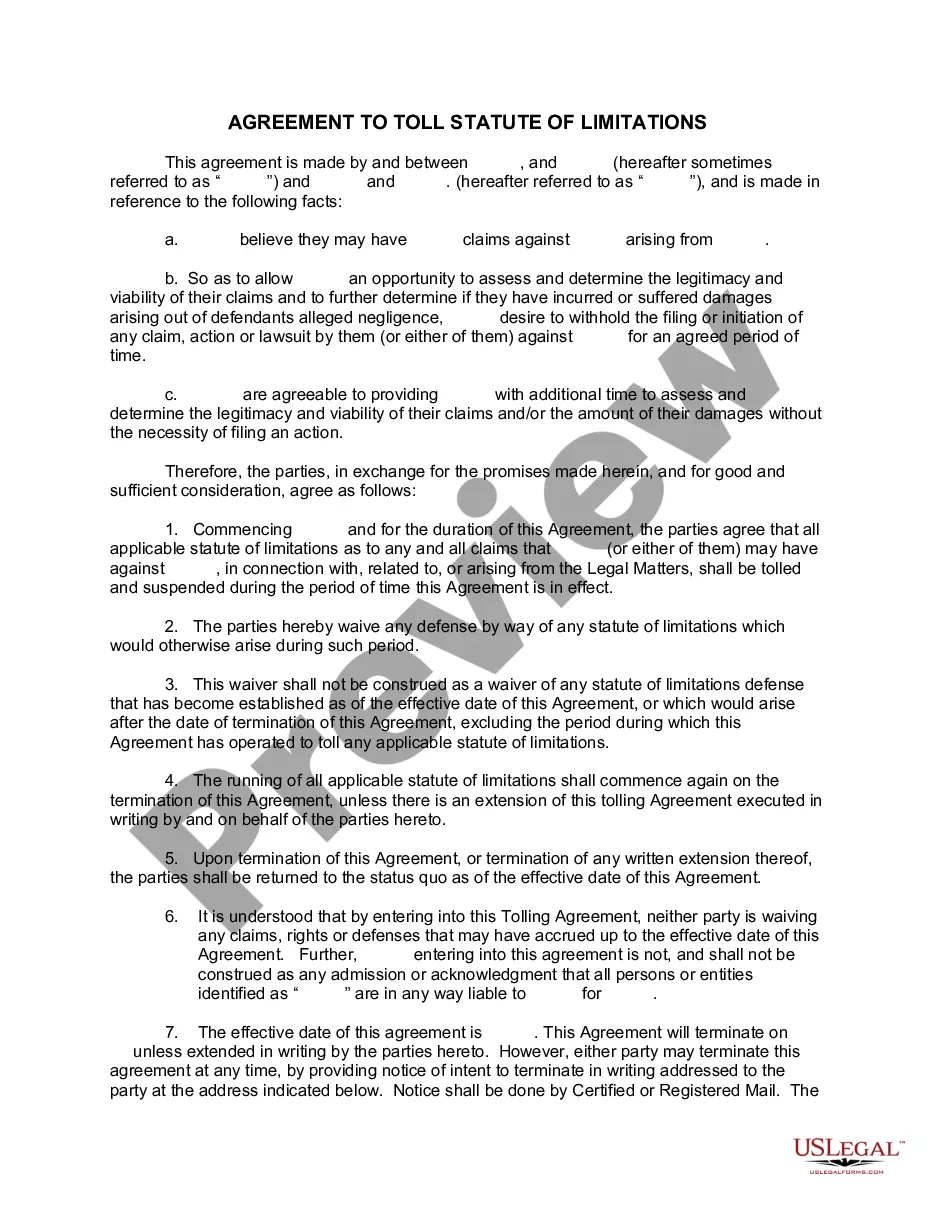
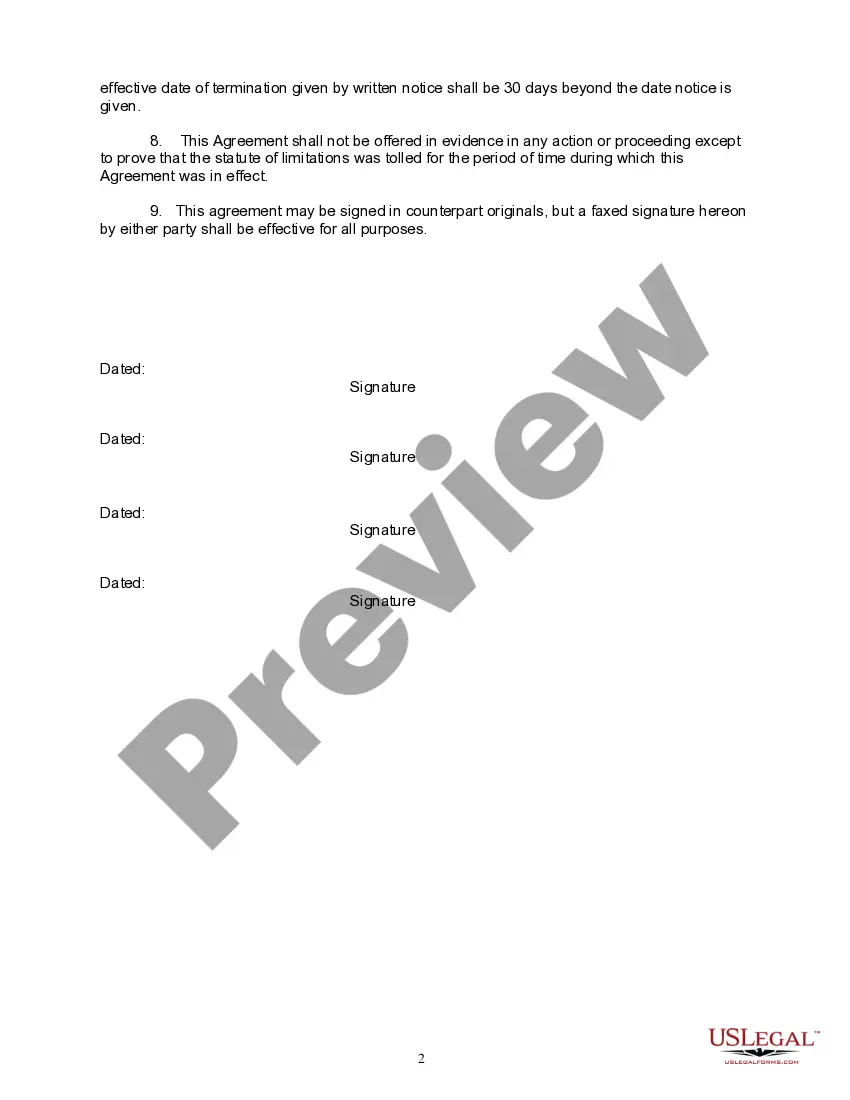

How to fill out Agreement To Toll Statute Of Limitations?
It is feasible to spend numerous hours online looking for the sanctioned document format that fulfills the state and federal requirements you will need. US Legal Forms offers thousands of legal templates that are assessed by professionals.
You can obtain or create the New Hampshire Agreement to Toll Statute of Limitations through our service. If you already possess a US Legal Forms account, you can Log In and click on the Download button. After that, you can fill out, modify, create, or sign the New Hampshire Agreement to Toll Statute of Limitations. Every legal document format you purchase is yours for a long time. To obtain an additional copy of a purchased form, go to the My documents tab and click on the corresponding button.
If you are accessing the US Legal Forms website for the first time, follow the straightforward instructions below: First, ensure that you have chosen the correct format for the county/town of your choice. Read the form description to confirm you have selected the appropriate document. If available, use the Preview button to review the format as well.
Avoid altering or removing any HTML tags. Only synonymize plain text outside of the HTML tags.
- To find another version of the document, utilize the Search field to locate the format that aligns with your needs and requirements.
- Once you have found the format you desire, click Acquire now to proceed.
- Select the pricing plan you prefer, enter your details, and register for your account on US Legal Forms.
- Complete the transaction. You can use your credit card or PayPal account to pay for the legal document.
- Select the format of the file and download it to your device.
- Make adjustments to the document if necessary. You can fill out, modify, and sign the New Hampshire Agreement to Toll Statute of Limitations.
- Download and print thousands of document templates using the US Legal Forms website, which provides the largest collection of legal forms. Use professional and state-specific templates to address your business or personal needs.
Form popularity
FAQ
In New Hampshire, the statute of limitations for collecting most debts is typically three years. After this period, creditors may find it challenging to collect on the debt legally. Utilizing a New Hampshire Agreement to Toll Statute of Limitations can provide a means to extend this time, allowing for negotiations or settlements before the debt becomes uncollectible.
Yes, a contract can potentially override the statute of limitations in some cases. Parties involved may agree to extend the time frame for bringing a lawsuit through a legal contract. This is where the New Hampshire Agreement to Toll Statute of Limitations becomes relevant, as it allows parties to pause the statute of limitations, giving them additional time to resolve disputes without the pressure of expiration.
Yes, a New Hampshire Agreement to Toll Statute of Limitations can effectively extend the time frame within which you can initiate a legal claim. By entering into this agreement, parties can pause the statute of limitations, allowing for negotiations or further investigations without the pressure of a ticking clock. This can be particularly beneficial in complex cases where gathering evidence takes time. Utilizing platforms like USLegalForms can help you draft a clear and enforceable tolling agreement tailored to your situation.
The statute of limitations in New Hampshire varies based on the nature of the claim. For instance, personal injury claims typically fall under a three-year limit, while property damage claims may have a similar timeframe. It is essential to understand these limits to protect your rights effectively. Utilizing a New Hampshire Agreement to Toll Statute of Limitations can help you manage these deadlines better and ensure you do not miss your opportunity for legal recourse.
Generally, you cannot sue someone 10 years after an incident due to the statute of limitations. In most cases, the time limits are significantly shorter, often ranging from three to six years. However, if you have a New Hampshire Agreement to Toll Statute of Limitations, it may allow you to extend that time frame. Consulting with a legal expert can provide clarity on your specific situation.
In New Hampshire, the statute of limitations varies depending on the type of case. Typically, personal injury claims have a three-year limit, while breach of contract cases can extend to three to six years. Understanding these timelines is crucial for anyone considering legal action. The New Hampshire Agreement to Toll Statute of Limitations can be useful in extending these time limits under certain circumstances.
No, you can't sue after the statute of limitations runs out. But there are situations where the statute of limitations begins late. For example, in a case of medical malpractice, the injury may have occurred weeks, months, or possibly years before the harm and cause of harm are discovered.
In the Commonwealth of Massachusetts, most lawsuits have a civil statute of limitations of three years. This applies to fraud, libel/slander, injury to property, trespass, and rent collection.
For lawsuits dealing with contracts in Massachusetts, the statute of limitations is typically six years after the contract was broken.
Statute of Limitations for Breach of Written Contract For a written contract, under the California Code of Civil Procedure section 337(a), the time given to file a lawsuit is four years.