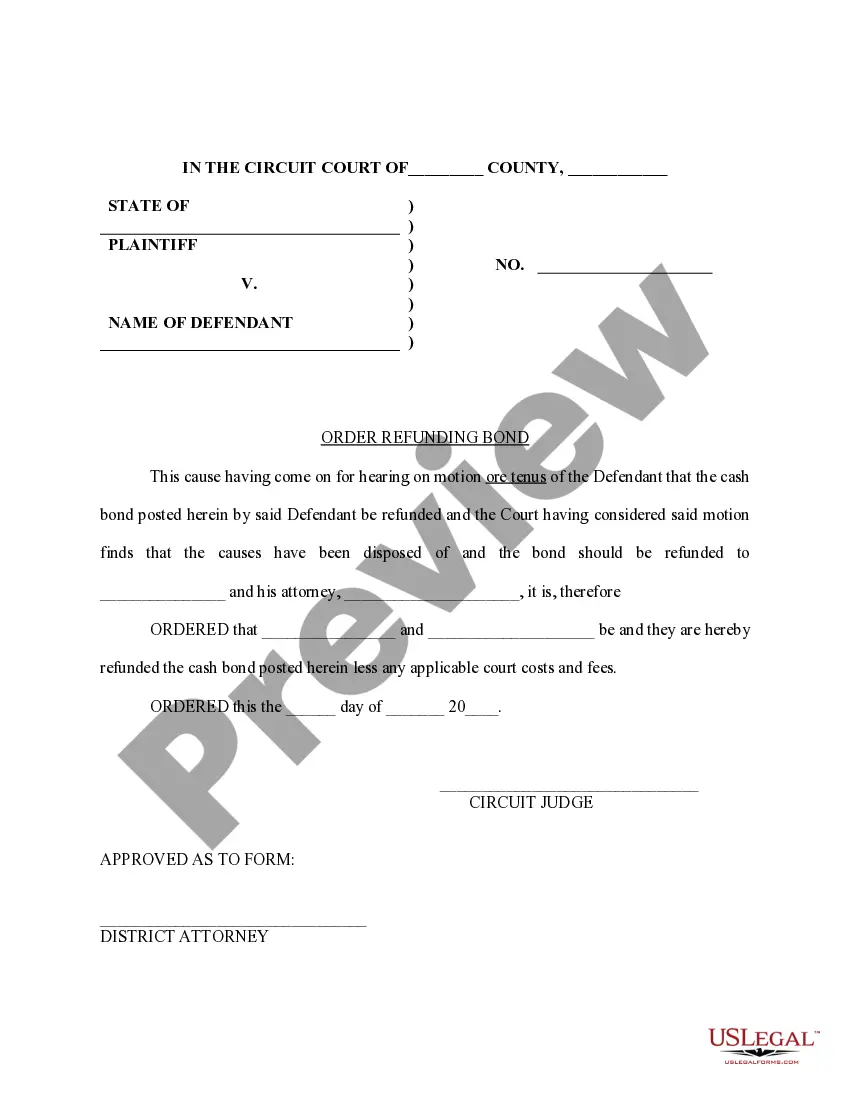
Nebraska Order Refunding Bond
Description
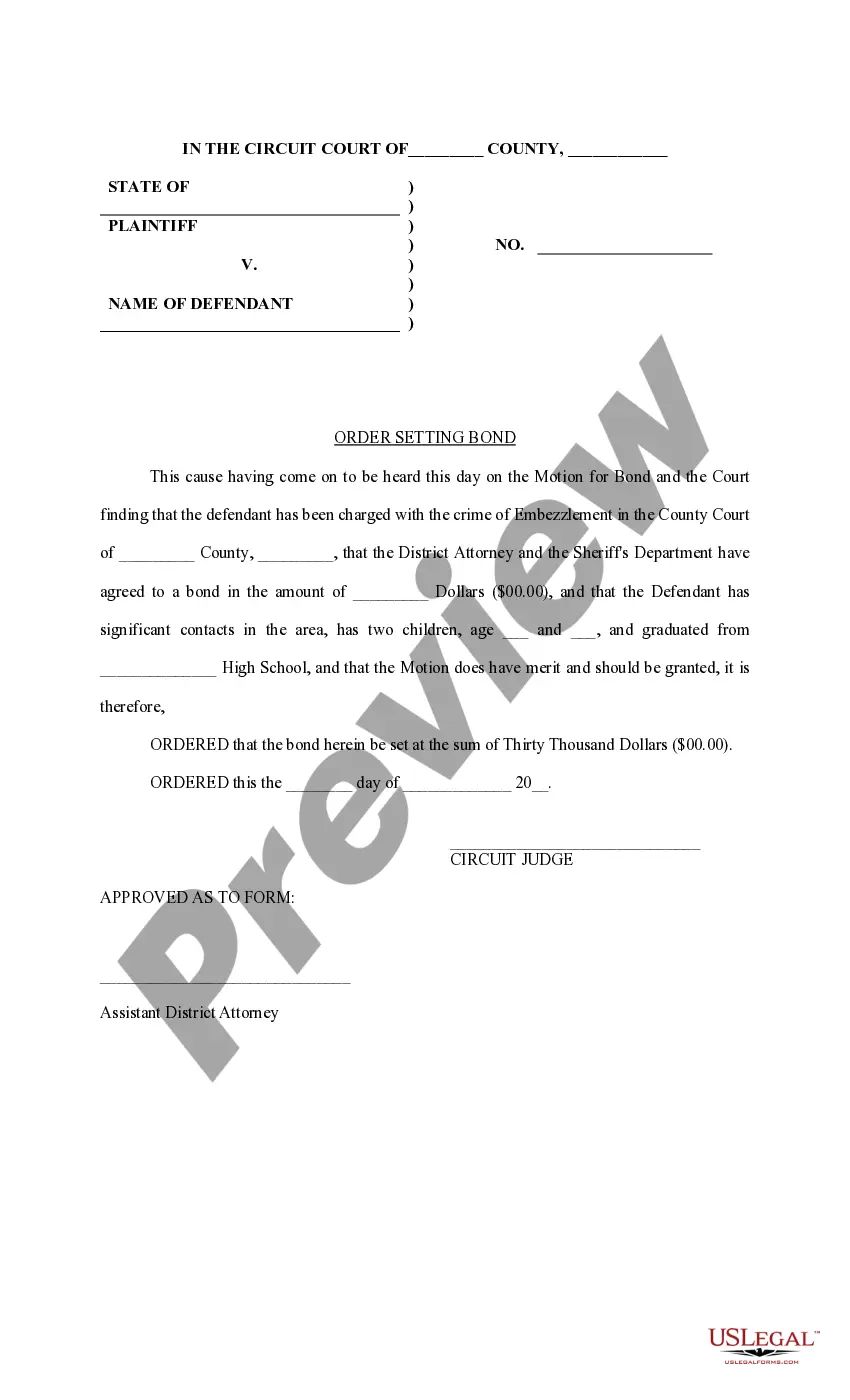
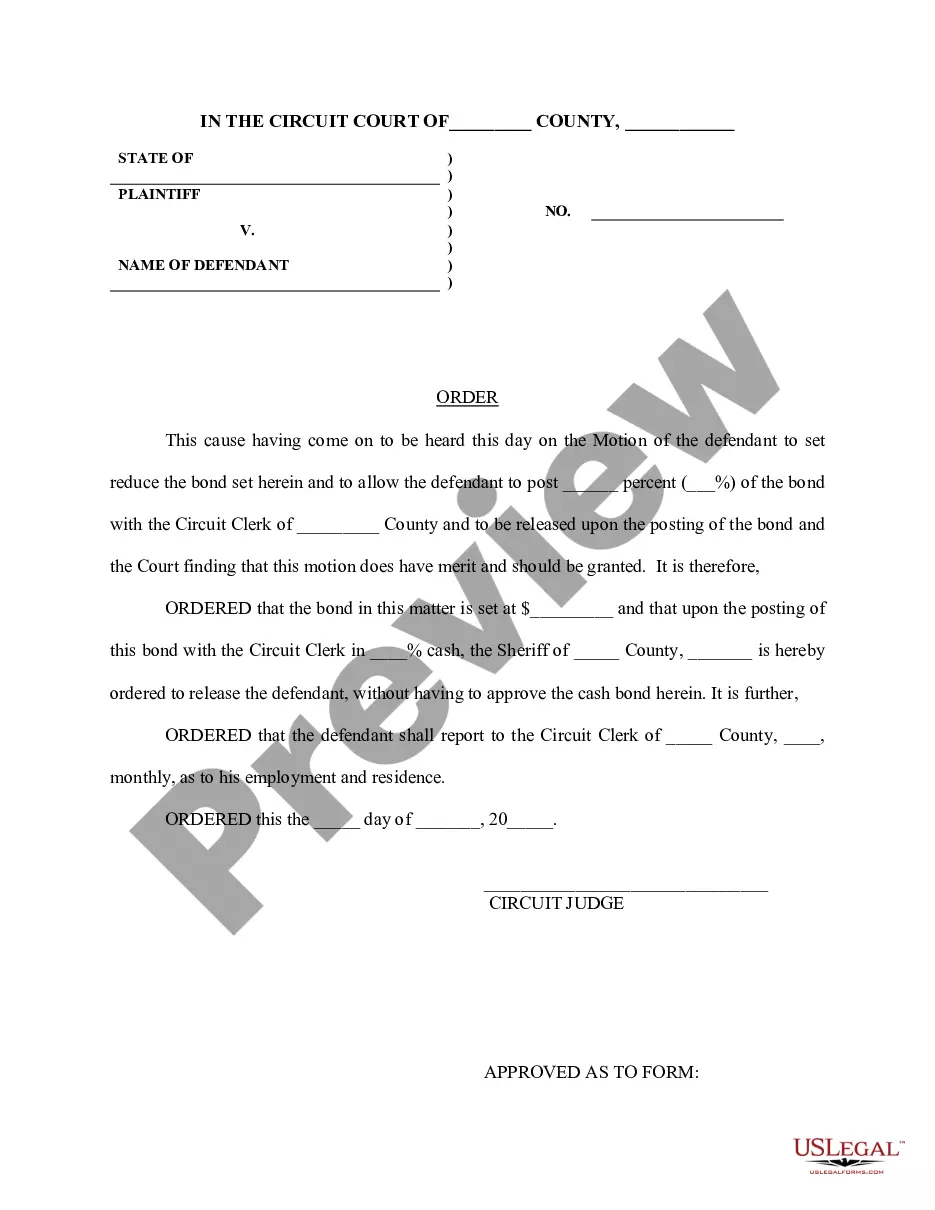

Get your form ready online
Our built-in tools help you complete, sign, share, and store your documents in one place.
Make edits, fill in missing information, and update formatting in US Legal Forms—just like you would in MS Word.
Download a copy, print it, send it by email, or mail it via USPS—whatever works best for your next step.
Sign and collect signatures with our SignNow integration. Send to multiple recipients, set reminders, and more. Go Premium to unlock E-Sign.
If this form requires notarization, complete it online through a secure video call—no need to meet a notary in person or wait for an appointment.
We protect your documents and personal data by following strict security and privacy standards.

Make edits, fill in missing information, and update formatting in US Legal Forms—just like you would in MS Word.

Download a copy, print it, send it by email, or mail it via USPS—whatever works best for your next step.

Sign and collect signatures with our SignNow integration. Send to multiple recipients, set reminders, and more. Go Premium to unlock E-Sign.

If this form requires notarization, complete it online through a secure video call—no need to meet a notary in person or wait for an appointment.

We protect your documents and personal data by following strict security and privacy standards.
Looking for another form?
How to fill out Order Refunding Bond?
Selecting the optimal legal document format can be a challenge. Clearly, there are numerous templates accessible online, but how do you obtain the legal form you require? Use the US Legal Forms website. The service offers thousands of templates, including the Nebraska Order Refunding Bond, which can be utilized for both business and personal purposes. All the forms are reviewed by experts and comply with federal and state regulations.
If you are already registered, Log In to your account and click on the Download button to access the Nebraska Order Refunding Bond. Use your account to browse through the legal forms you have previously purchased. Visit the My documents section of your account and obtain another copy of the document you need.
If you are a new user of US Legal Forms, here are straightforward instructions for you to follow: First, make sure you have selected the correct form for your city/region. You can preview the form using the Preview button and review the form description to ensure it is suitable for you. If the form does not meet your requirements, use the Search field to locate the appropriate form. Once you are confident that the form is correct, click the Get now button to acquire the form. Choose the pricing plan you want and enter the necessary information. Create your account and complete your purchase using your PayPal account or Visa or Mastercard. Select the file format and download the legal document format to your device. Complete, modify, and print and sign the received Nebraska Order Refunding Bond. US Legal Forms is the largest repository of legal forms where you can find various document templates. Use the service to obtain professionally crafted documents that comply with state requirements.
Use the service to obtain professionally crafted documents that comply with state requirements.
- Selecting the optimal legal document format can be a challenge.
- Clearly, there are numerous templates accessible online, but how do you obtain the legal form you require.
- If you are already registered, Log In to your account and click on the Download button to access the Nebraska Order Refunding Bond.
- If you are a new user of US Legal Forms, here are straightforward instructions for you to follow.
- Once you are confident that the form is correct, click the Get now button to acquire the form.
- US Legal Forms is the largest repository of legal forms where you can find various document templates.
Form popularity
FAQ
The judge can revoke your bond if police rearrest you while you are out on bond. If a judge revokes your bond, then there is no amount of money you can pay to secure your release. Instead, you must either remain in custody until your case resolves or convince the court to re-impose the bond.
You will need to bring cash to post bail for someone in Nebraska. Many times bonds are ?percentage bonds,? which means that you must post 10% of the bond amount. So a $10,000 percentage bond would require that you post $1,000 cash for release.
Typically the bond is written in the inmate's name and the refund will be given to the inmate by the Court. The inmate may submit a written request to the court to direct the bond refund to a specific individual.
Full cash bonds are fully refundable. In most cases the courts allow for 10% of the bond to be posted. For example; if the bond amount is $1000, only $100 is needed to post bond. In these cases, 90% of the bond is returned, or $90 in this example.
Typically the bond is written in the inmate's name and the refund will be given to the inmate by the Court. The inmate may submit a written request to the court to direct the bond refund to a specific individual.
Bonds can only be returned by an order from a Judge in the Douglas County District Court. Inquiry about the release of a bond should not be made until two business days after the complete end of a case.
The judge can revoke your bond if police rearrest you while you are out on bond. If a judge revokes your bond, then there is no amount of money you can pay to secure your release. Instead, you must either remain in custody until your case resolves or convince the court to re-impose the bond.
Judges may set either a percentage bond, allowing the defendant to get out if they pay 10 percent of it, or a personal recognizance bond, allowing the defendant to be released on a ?promise to pay? based upon their own signature. Bail bondsmen are not used in the State of Nebraska as they are in other states.
In the event of forfeiture, the indemnitor is responsible to pay the full amount of the bail, or the defendant has been returned to custody, usually with the assistance of the indemnitor, and the court has exonerated the bond, and all incurred expenses are paid. The bond then becomes void.