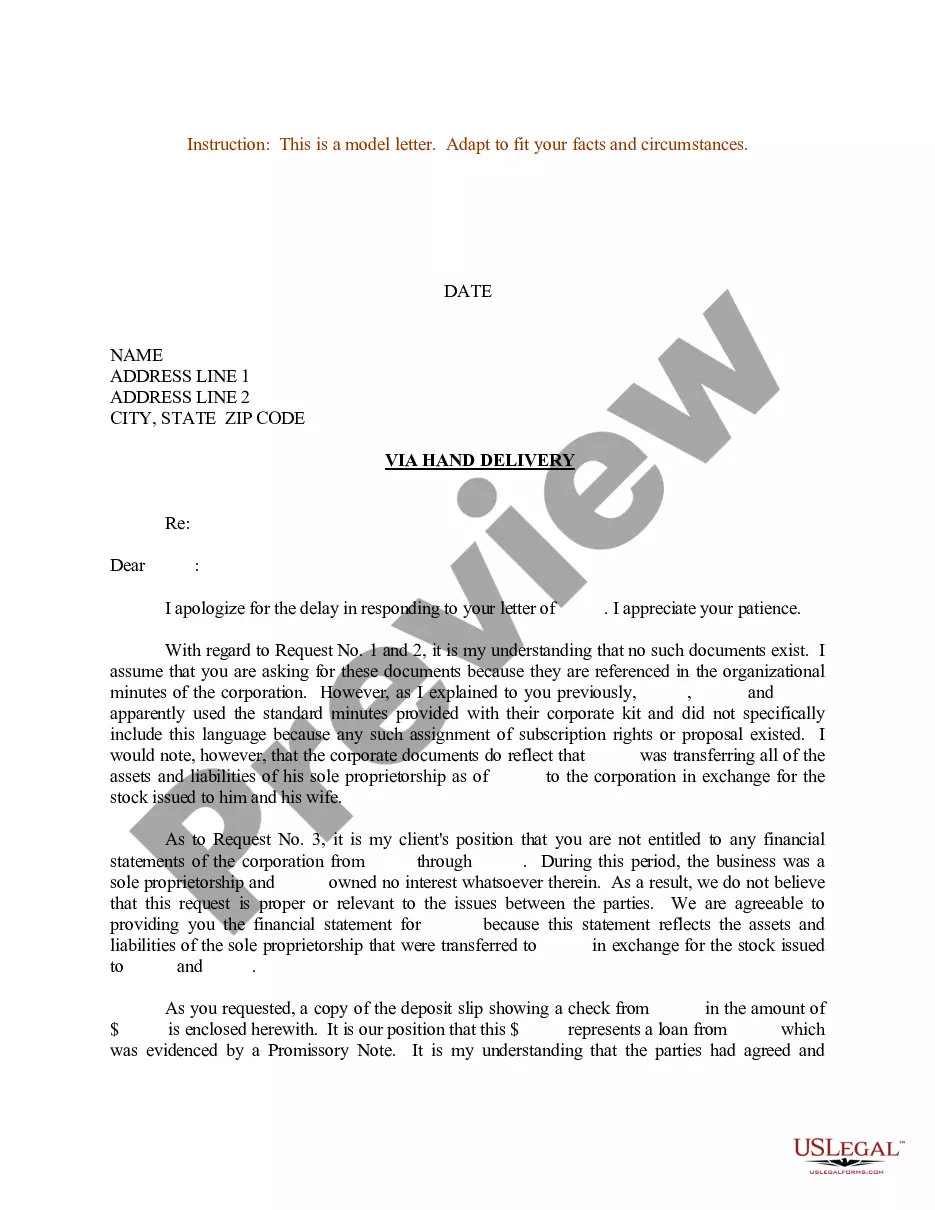
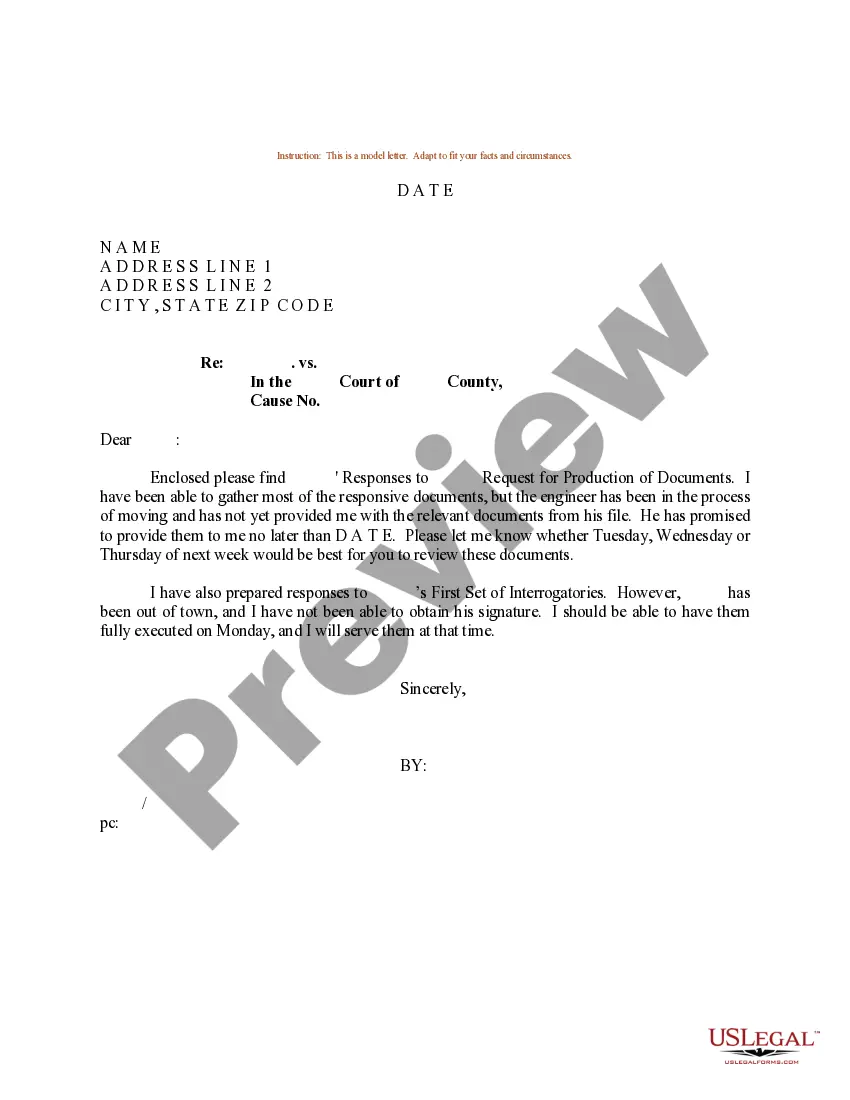
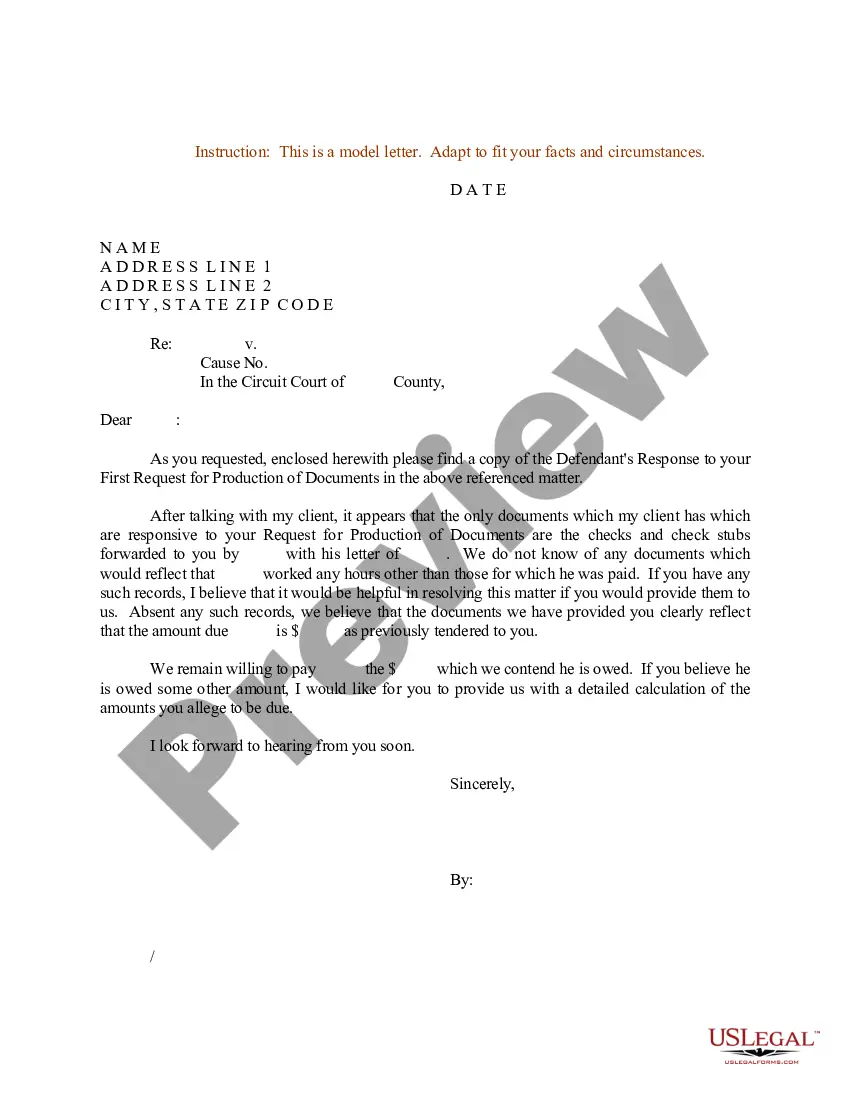
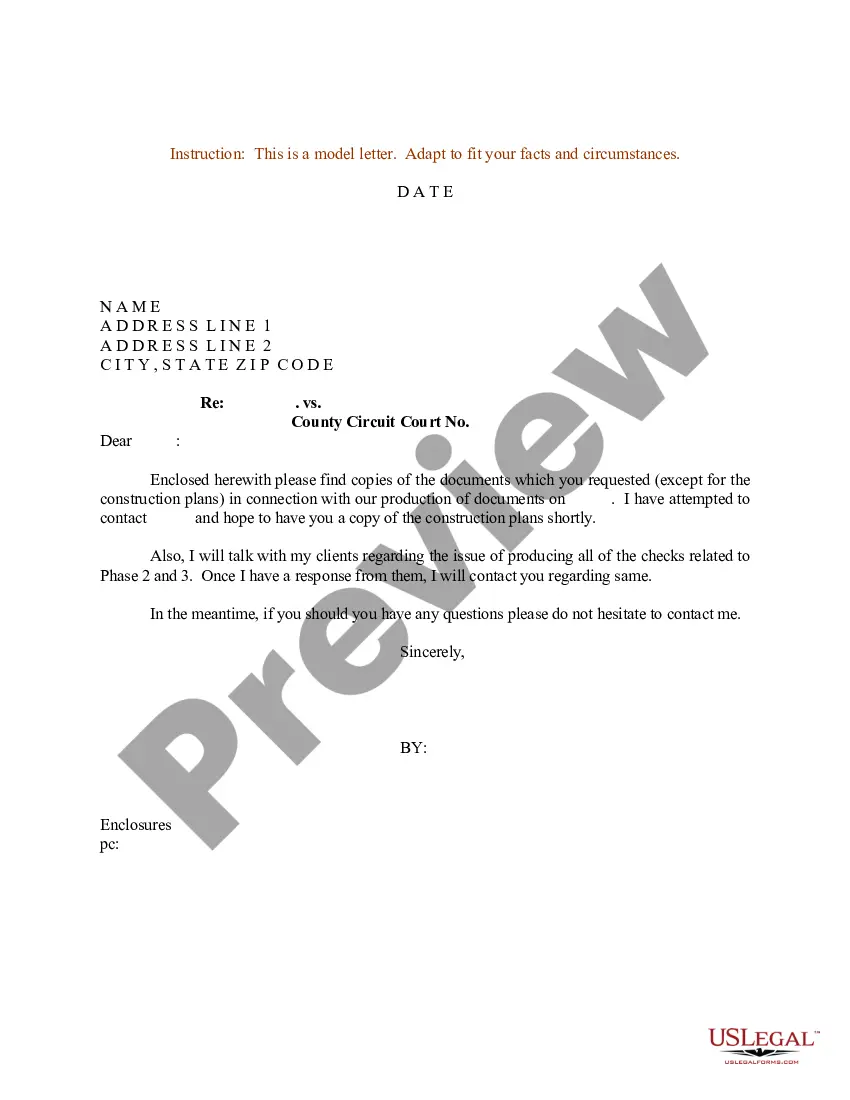
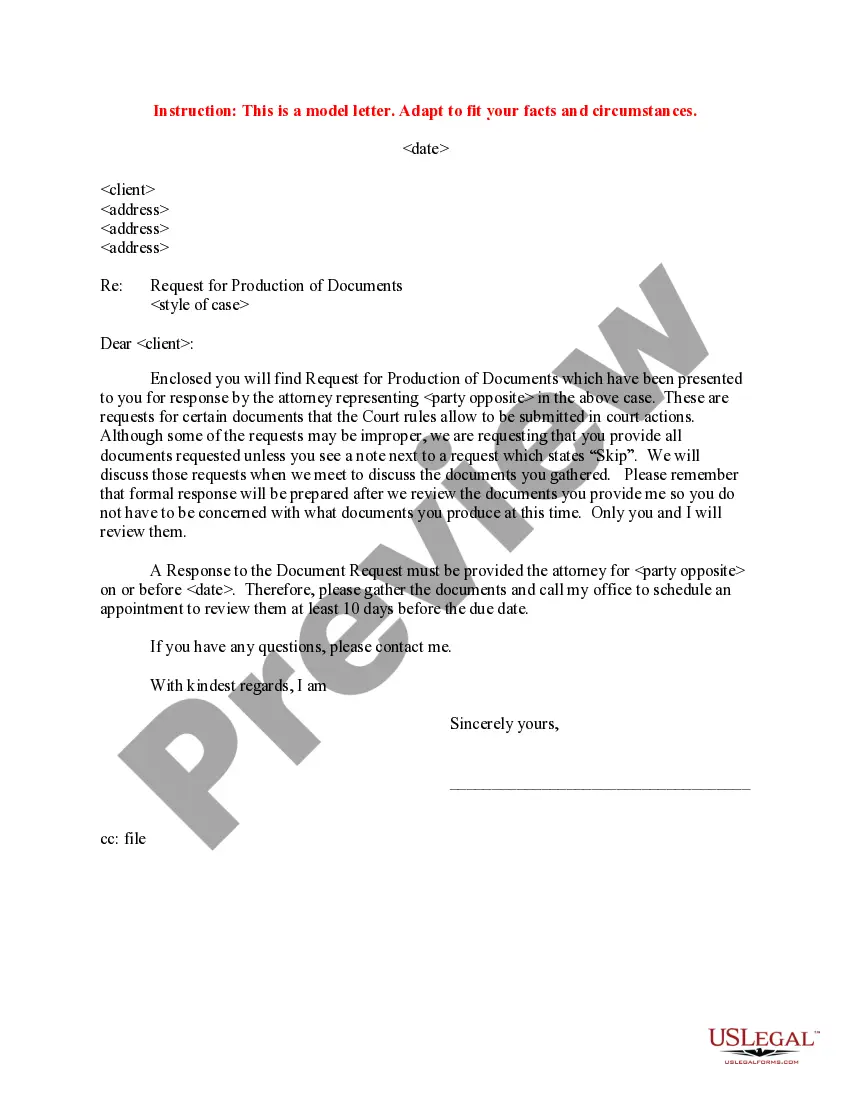
Nebraska Sample Letter for conveying Responses to Request for Production of Documents
Description
Get your form ready online
Our built-in tools help you complete, sign, share, and store your documents in one place.
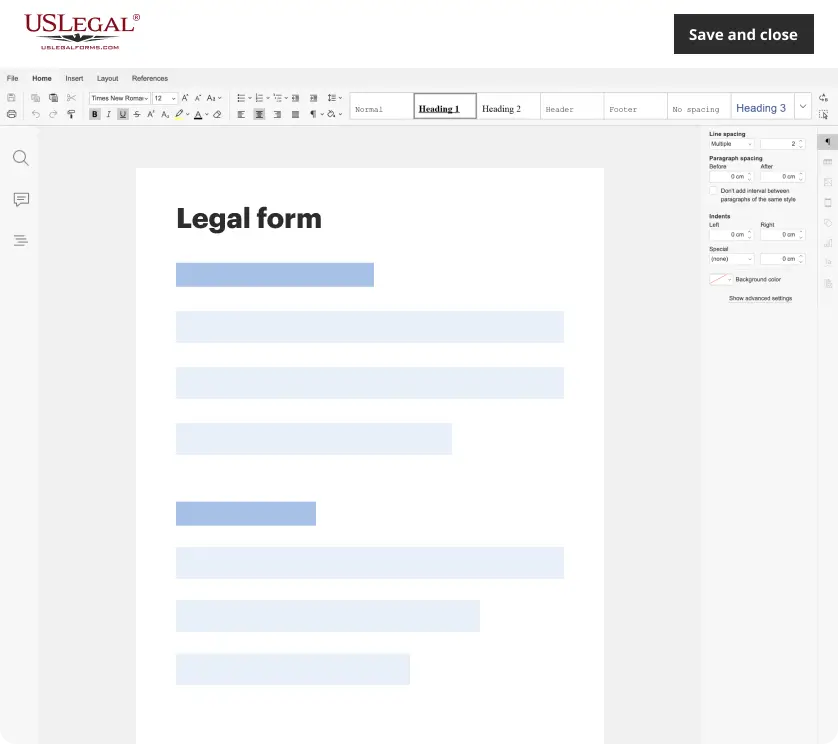
Make edits, fill in missing information, and update formatting in US Legal Forms—just like you would in MS Word.
Download a copy, print it, send it by email, or mail it via USPS—whatever works best for your next step.
Sign and collect signatures with our SignNow integration. Send to multiple recipients, set reminders, and more. Go Premium to unlock E-Sign.
If this form requires notarization, complete it online through a secure video call—no need to meet a notary in person or wait for an appointment.
We protect your documents and personal data by following strict security and privacy standards.
Make edits, fill in missing information, and update formatting in US Legal Forms—just like you would in MS Word.
Download a copy, print it, send it by email, or mail it via USPS—whatever works best for your next step.
Sign and collect signatures with our SignNow integration. Send to multiple recipients, set reminders, and more. Go Premium to unlock E-Sign.

If this form requires notarization, complete it online through a secure video call—no need to meet a notary in person or wait for an appointment.
We protect your documents and personal data by following strict security and privacy standards.
Looking for another form?

How to fill out Sample Letter For Conveying Responses To Request For Production Of Documents?
If you wish to finish, download, or print authorized file templates, utilize US Legal Forms, the largest selection of authorized documents available online. Take advantage of the site's straightforward and user-friendly search feature to find the documents you require. Numerous templates for business and personal uses are organized by categories and claims, or keywords. Use US Legal Forms to locate the Nebraska Sample Letter for conveying Responses to Request for Production of Documents in just a few clicks.
If you are already a US Legal Forms customer, Log In to your account and click on the Download option to obtain the Nebraska Sample Letter for conveying Responses to Request for Production of Documents. You can also access forms you previously downloaded in the My documents tab of your account.
If you are using US Legal Forms for the first time, follow the steps below: Step 1. Ensure you have selected the form for the correct city/state. Step 2. Use the Review feature to examine the form’s content. Do not forget to read through the information. Step 3. If you are dissatisfied with the form, use the Search area at the top of the screen to find other versions of the legal form template. Step 4. Once you have located the form you need, click the Purchase now option. Choose the pricing plan you prefer and enter your credentials to register for an account. Step 5. Complete the transaction. You can use your credit card or PayPal account to finalize the purchase. Step 6. Choose the format of your legal form and download it to your device. Step 7. Complete, modify, and print or sign the Nebraska Sample Letter for conveying Responses to Request for Production of Documents.
Avoid altering or removing any HTML tags. Only synonymize plain text outside of the HTML tags.
- Every legal document template you acquire is yours permanently.
- You have access to every form you downloaded in your account.
- Click on the My documents section and select a form to print or download again.
- Compete and download, and print the Nebraska Sample Letter for conveying Responses to Request for Production of Documents with US Legal Forms.
- There are thousands of professional and state-specific forms you can use for your business or personal needs.
- Utilize the resources available to streamline your document processing.
- Make the most of the extensive library of forms to meet your requirements.
Form popularity
FAQ
(1) A defendant shall serve an answer within 30 days after being served with the summons and complaint or completion of service by publication. (2) A party served with a pleading stating a cross-claim against that party shall serve an answer thereto within 30 days after being served.
Your response to a request for production consists of two parts: One part is a written response to the requests, in which you state under penalty of perjury that you will produce the requested items; that you will not produce and why; or that you object to a request on legal grounds.
Your response for each request must include either an agreement to comply, a representation of your ability to reply, or an objection to all or part of the request. California Code of Civil Procedure (CCP) §§ 2031.210 et. seq require specific statements in your response.
In contrast to interrogatories and requests for admission, which are limited to 35 questions as a "matter of right", there is no limit on demands for production.
This letter is often called a good faith letter. And it is needed under many courts' rules before you can file a motion to compel discovery if the other party ignores your requests or provides evasive responses or move for sanctions if your opponent refuses to comply with the court's discovery order.
The process of delivering, or making available for review, documents produced during litigation or in response to a request for documents from a regulatory or other body. Discoverable documents in litigation may include both paper (hard copy) documents and electronically stored information (ESI).
Requests for the Production of Documents are a discovery device used by a party to enable the individual to learn the facts that are the basis for, or support, a pleading with which he or she has been served by the opposing party.
Unless otherwise permitted by the court for good cause shown, no party shall serve upon any other party more than fifty interrogatories.