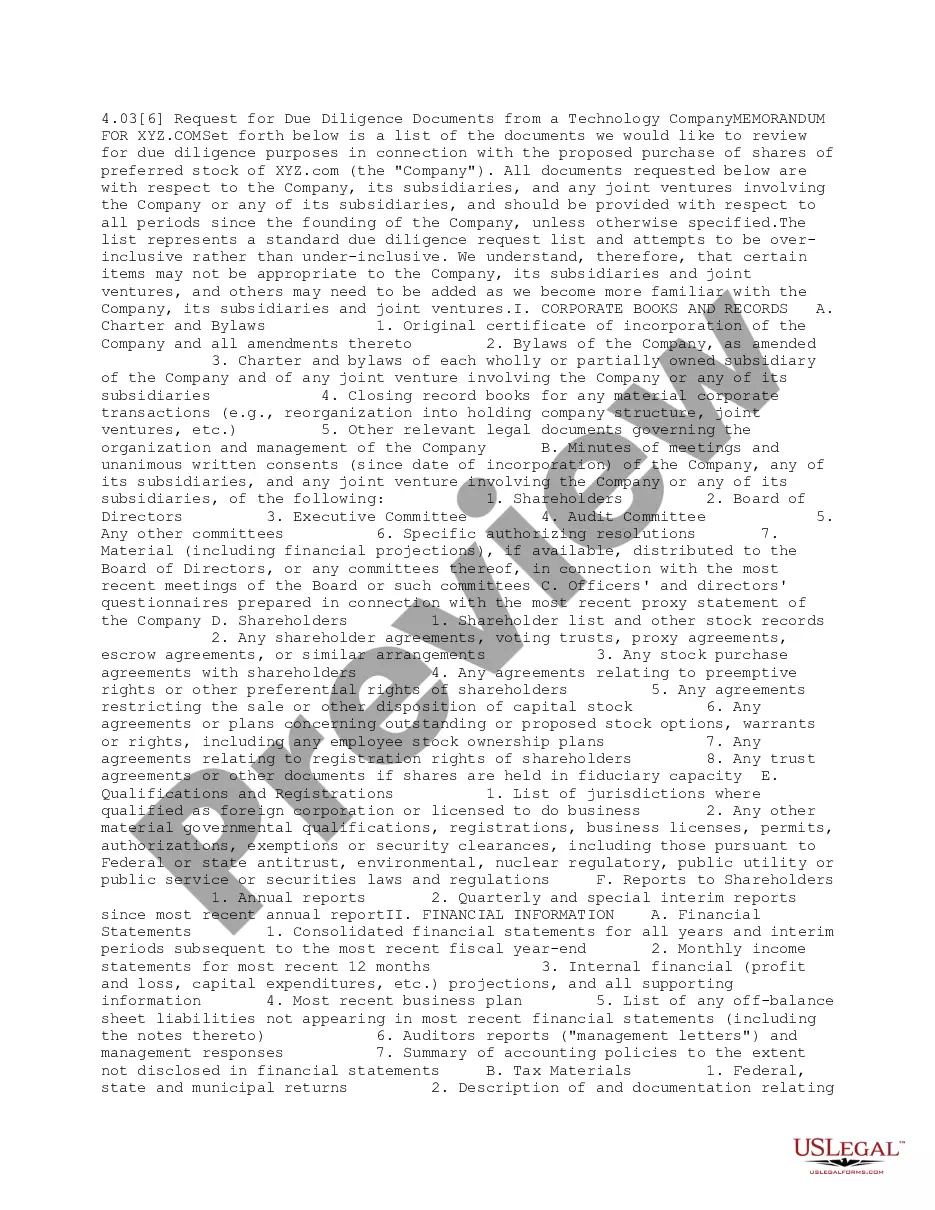
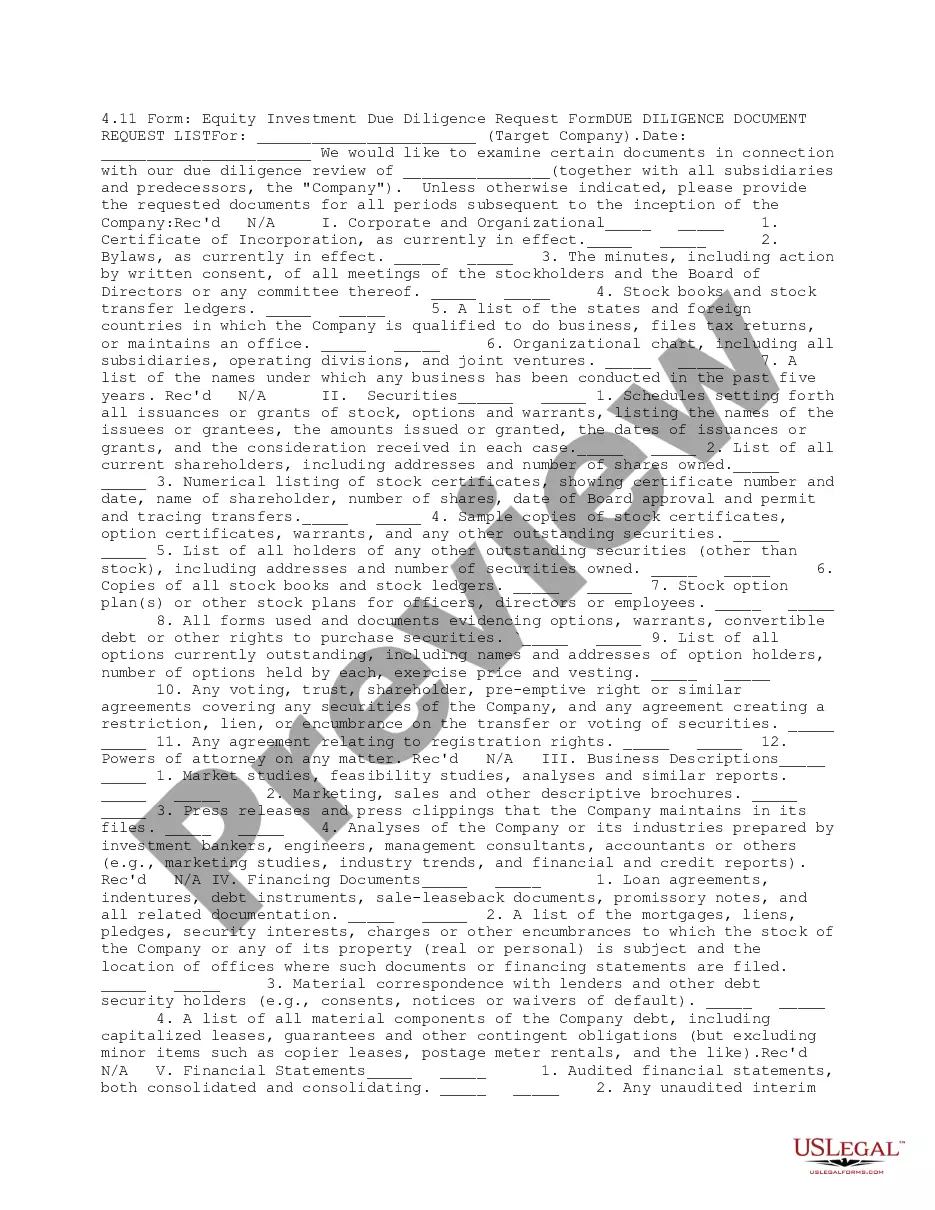
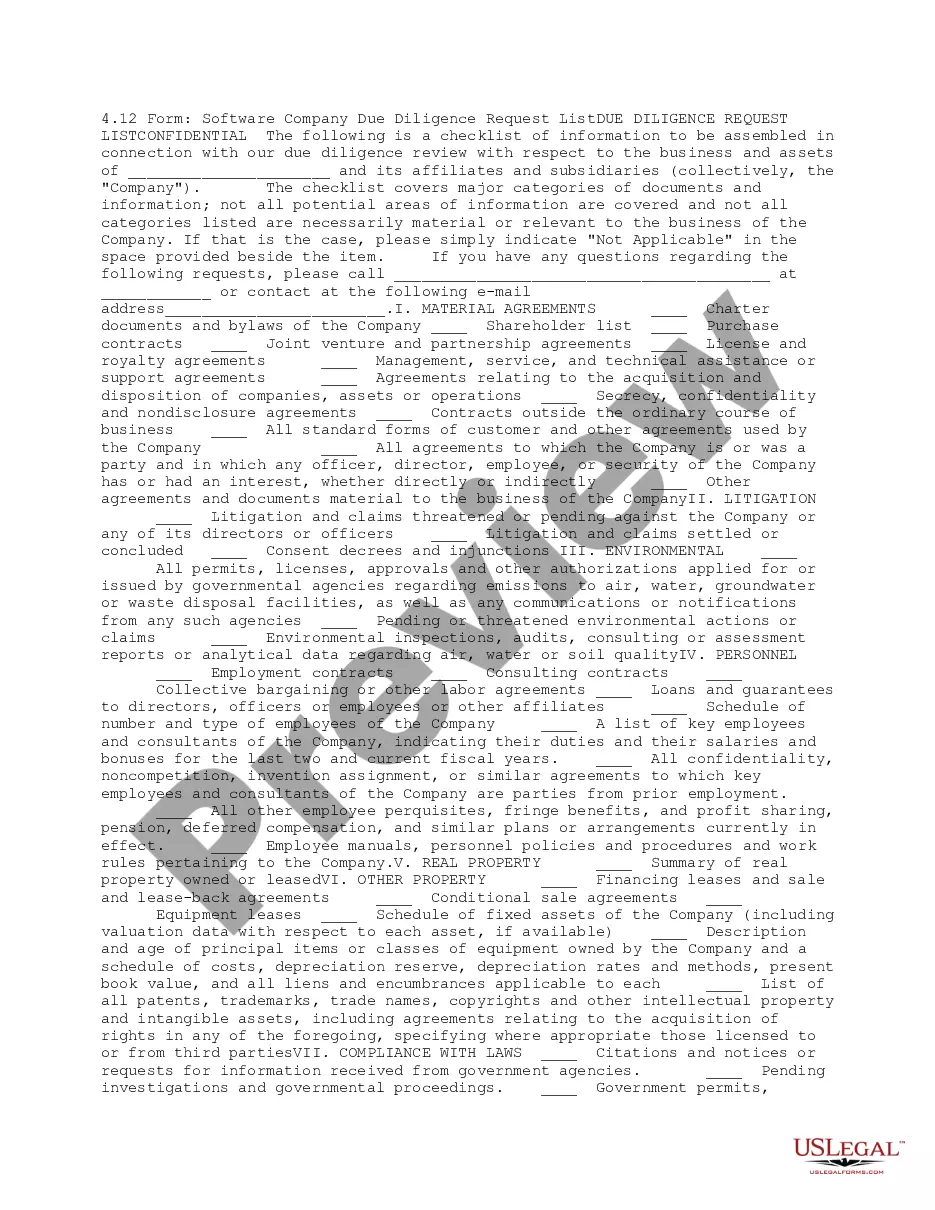
This form consists of due diligence questions regarding information technology personnel, equipment, networks as well as other inquiries in business transactions.
North Dakota Due Diligence Questions Information Technology
Category:
State:
Multi-State
Control #:
US-DD01306
Format:
Word;
PDF;
Rich Text
Instant download
Description
Free preview


Get your form ready online
Our built-in tools help you complete, sign, share, and store your documents in one place.
Built-in online Word editor
Make edits, fill in missing information, and update formatting in US Legal Forms—just like you would in MS Word.
Export easily
Download a copy, print it, send it by email, or mail it via USPS—whatever works best for your next step.
E-sign your document
Sign and collect signatures with our SignNow integration. Send to multiple recipients, set reminders, and more. Go Premium to unlock E-Sign.
Notarize online 24/7
If this form requires notarization, complete it online through a secure video call—no need to meet a notary in person or wait for an appointment.
Store your document securely
We protect your documents and personal data by following strict security and privacy standards.

Make edits, fill in missing information, and update formatting in US Legal Forms—just like you would in MS Word.

Download a copy, print it, send it by email, or mail it via USPS—whatever works best for your next step.

Sign and collect signatures with our SignNow integration. Send to multiple recipients, set reminders, and more. Go Premium to unlock E-Sign.

If this form requires notarization, complete it online through a secure video call—no need to meet a notary in person or wait for an appointment.

We protect your documents and personal data by following strict security and privacy standards.
Looking for another form?








How to fill out Due Diligence Questions Information Technology?
You have the capability to dedicate numerous hours on the web looking for the legal document template that meets both federal and state requirements you require.
US Legal Forms offers a vast array of legal templates that have been assessed by professionals.
You can easily obtain or print the North Dakota Due Diligence Questions Information Technology from the service.
If available, use the Preview button to look through the document template as well.
- If you possess a US Legal Forms account, you can sign in and click the Download button.
- Then, you can complete, edit, print, or sign the North Dakota Due Diligence Questions Information Technology.
- Every legal document template you buy is yours permanently.
- To retrieve another copy of the purchased form, navigate to the My documents tab and click the appropriate button.
- If you are using the US Legal Forms website for the first time, follow the simple instructions below.
- First, make sure you have selected the correct document template for your county/city that you choose.
- Review the form description to confirm you have chosen the right template.
Form popularity
FAQ
50+ Commonly Asked Questions During Due DiligenceCompany information. Who owns the company?Finances. Where are the company's quarterly and annual financial statements from the past several years?Products and services.Customers.Technology assets.IP assets.Physical assets.Legal issues.
Due diligence is a process or effort to collect and analyze information before making a decision or conducting a transaction so a party is not held legally liable for any loss or damage. The term applies to many situations but most notably to business transactions.
13 Critical Things To Do During The Due Diligence PeriodResearch Home Prices.Look up Taxes.Find a Seasoned Real Estate Agent.Find a Lender.Read Disclosures.Home Inspection.Cost of Repairs.Insurance.More items...?
IT due diligence, or technology due diligence, involves auditing a company's IT infrastructure and processes (frequently with a focus on security assessment). This aspect of M&A due diligence allows the acquiring company to evaluate existing IT structures and identify any potential security risks.
A due diligence checklist is an organized way to analyze a company. The checklist will include all the areas to be analyzed, such as ownership and organization, assets and operations, the financial ratios, shareholder value, processes and policies, future growth potential, management, and human resources.
A due diligence questionnaire (often dubbed a DDQ) is a list of frequently asked questions during a M&A transaction or investing. These questions are broken down into categories and work to provide key information to the buyer.
50+ Commonly Asked Questions During Due DiligenceCompany information. Who owns the company?Finances. Where are the company's quarterly and annual financial statements from the past several years?Products and services.Customers.Technology assets.IP assets.Physical assets.Legal issues.
Below, we take a closer look at the three elements that comprise human rights due diligence identify and assess, prevent and mitigate and account , quoting from the Guiding Principles.
Due diligence is supposed to give the investor an answer to whether it is worth taking a risk and concluding a transaction or looking for the more qualified business entity to cooperate with. It is also used to assess the profitability of the project implementation as well as the risks associated with the process.