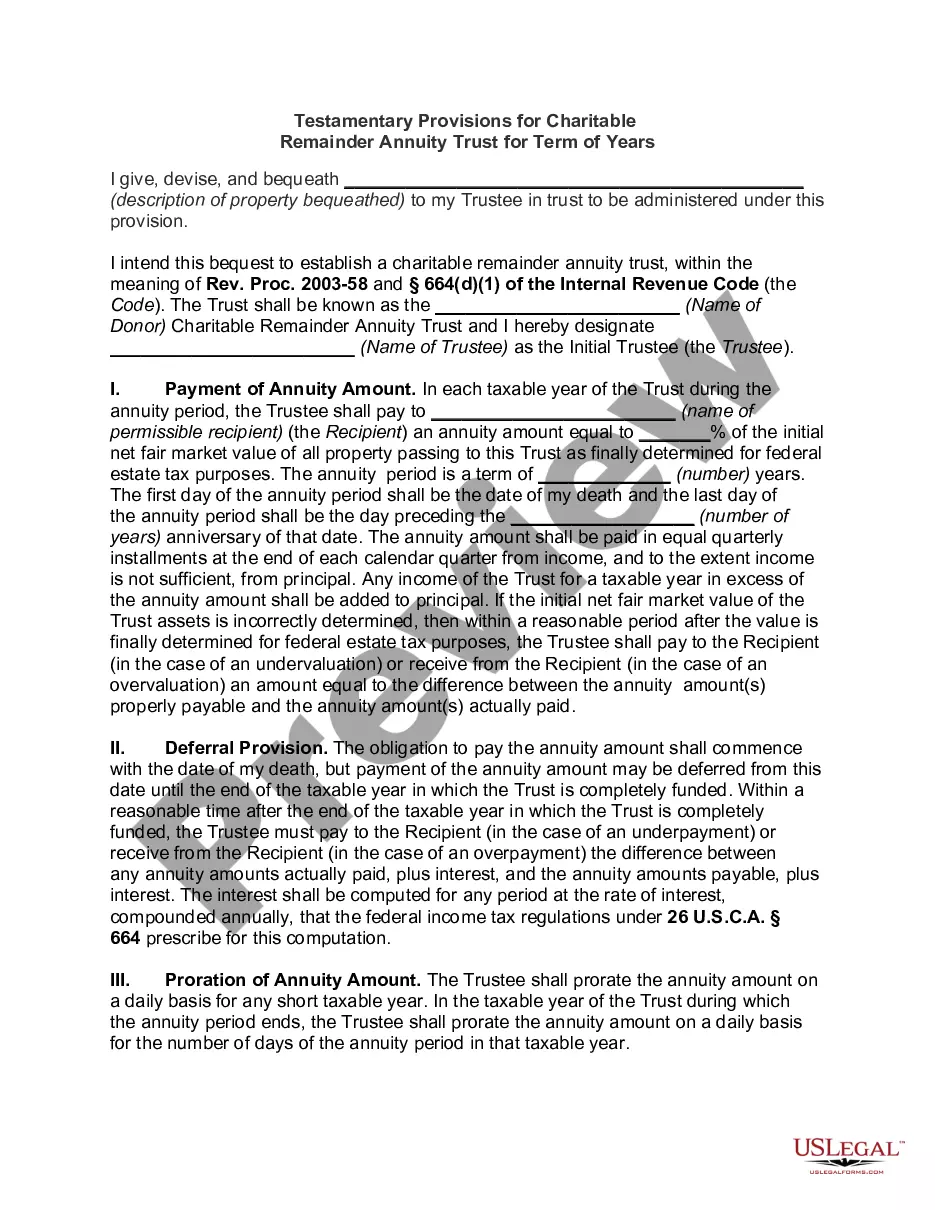
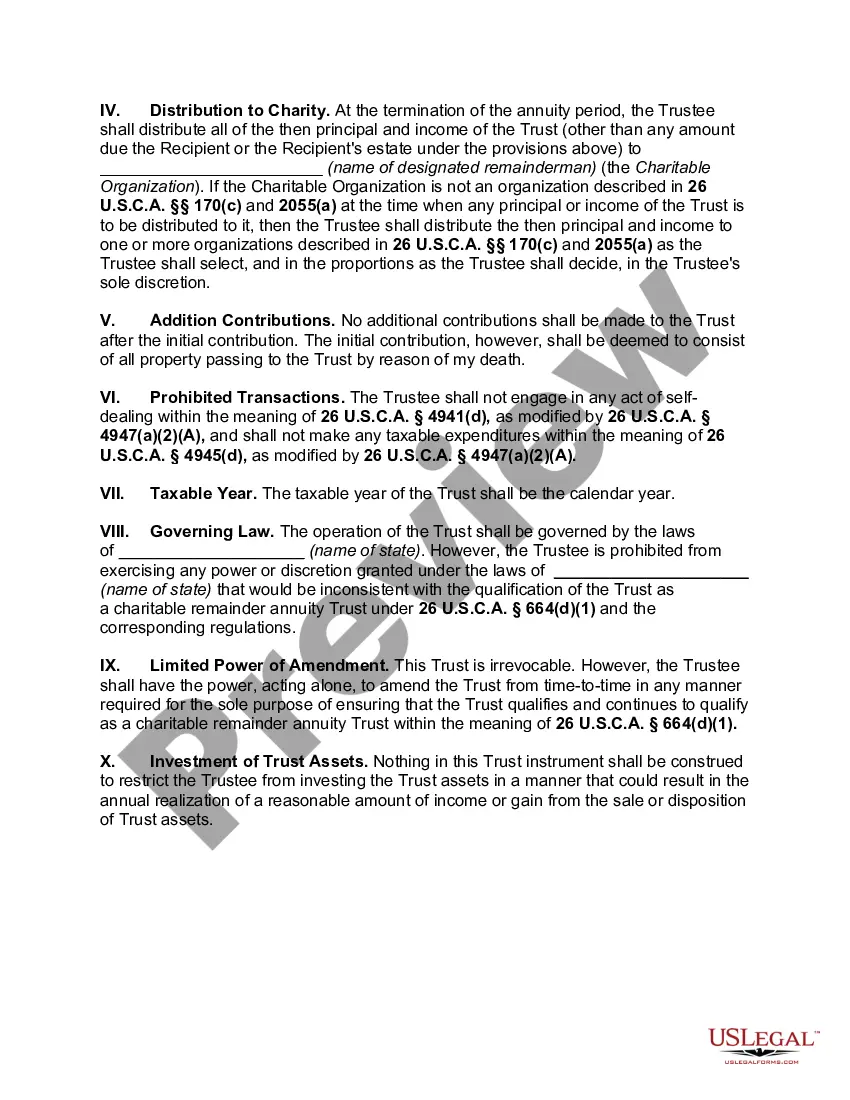
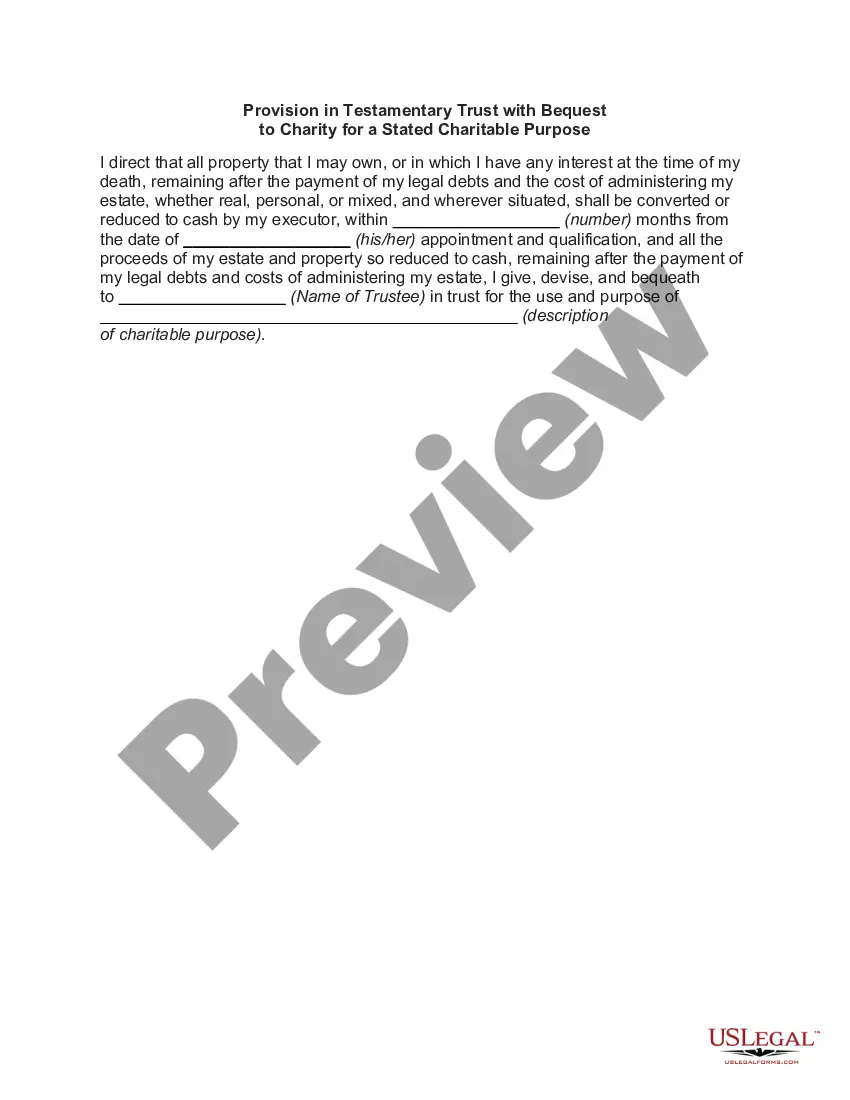
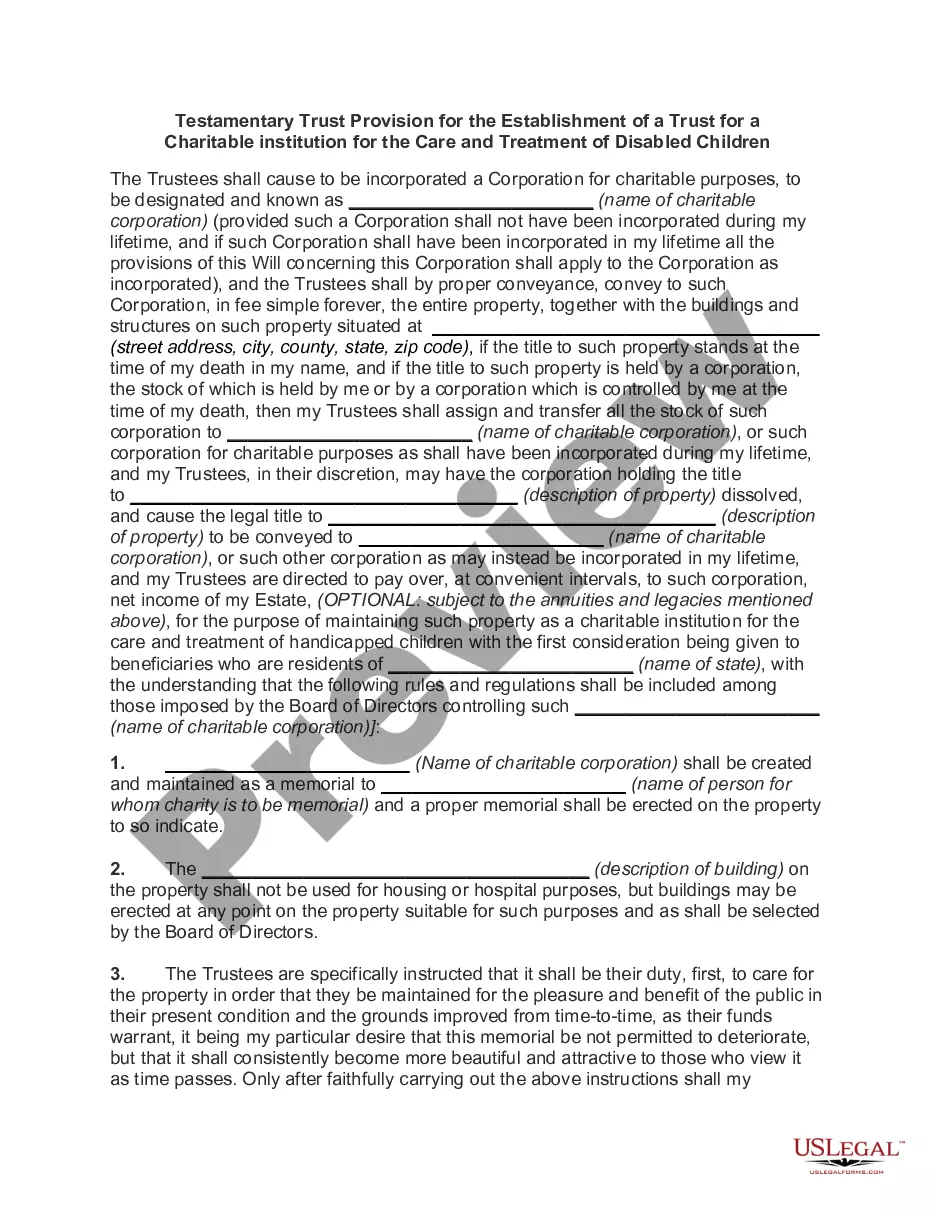
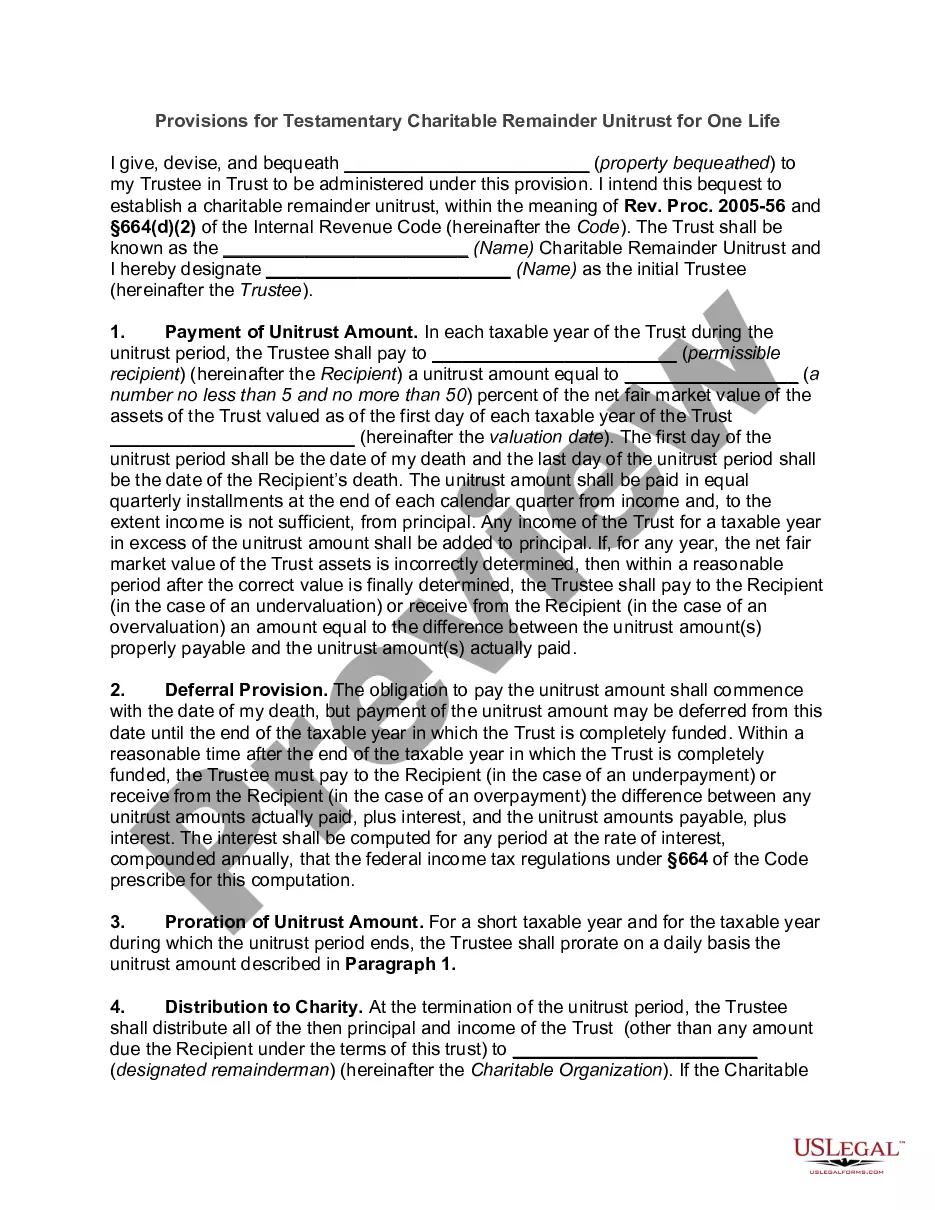
North Dakota Testamentary Provisions for Charitable Remainder Annuity Trust for Term of Years
Description
Get your form ready online
Our built-in tools help you complete, sign, share, and store your documents in one place.
Make edits, fill in missing information, and update formatting in US Legal Forms—just like you would in MS Word.
Download a copy, print it, send it by email, or mail it via USPS—whatever works best for your next step.
Sign and collect signatures with our SignNow integration. Send to multiple recipients, set reminders, and more. Go Premium to unlock E-Sign.
If this form requires notarization, complete it online through a secure video call—no need to meet a notary in person or wait for an appointment.
We protect your documents and personal data by following strict security and privacy standards.

Make edits, fill in missing information, and update formatting in US Legal Forms—just like you would in MS Word.

Download a copy, print it, send it by email, or mail it via USPS—whatever works best for your next step.

Sign and collect signatures with our SignNow integration. Send to multiple recipients, set reminders, and more. Go Premium to unlock E-Sign.

If this form requires notarization, complete it online through a secure video call—no need to meet a notary in person or wait for an appointment.

We protect your documents and personal data by following strict security and privacy standards.
Looking for another form?



How to fill out Testamentary Provisions For Charitable Remainder Annuity Trust For Term Of Years?
Selecting the optimal legal document template can be challenging.
Naturally, there are numerous formats accessible online, but how do you secure the legal document you require.
Utilize the US Legal Forms website.
If you are currently registered, Log In to your account and click the Download button to obtain the North Dakota Testamentary Provisions for Charitable Remainder Annuity Trust for Term of Years.
- The platform offers a vast array of templates, such as the North Dakota Testamentary Provisions for Charitable Remainder Annuity Trust for Term of Years, suitable for both commercial and personal purposes.
- All templates are reviewed by specialists and comply with state and federal regulations.
Form popularity
FAQ
A living trust can also be irrevocable, meaning it cannot be changed once established. However, a testamentary trust cannot be revocable and is typically established as irrevocable since the trustor has passed away.
How does it save tax? A testamentary trust allows the person who controls it to split the income generated by the trust between family members. Importantly, children who receive income from a testamentary trust are taxed at adult tax rates, instead of penalty rates (up to 66%) which apply to other types of trusts.
Any income that you receive from your charitable trust could reduce the total contribution that you end up leaving to your charity. You may risk leaving nothing to your charity if you plan to receive high payments from the trust while you're alive.
A testamentary charitable remainder trust is created with assets upon your death. The trust then makes regular income payments to your named heirs for life or a term of up to 20 years.
To help you get started on understanding the options available, here's an overview the three primary classes of trusts.Revocable Trusts.Irrevocable Trusts.Testamentary Trusts.More items...?
A Charitable Remainder Trust (CRT) can be established during the lifetime of the creator of the trust (the Grantor) or upon the death of the Grantor. Transfers to a CRT established during the lifetime of a Grantor will produce an income tax deduction for the Grantor.
A CRT is an irrevocable trust. An amount of income and/or principal from the CRT is payable to noncharitable beneficiaries, usually the grantor of the CRT and the grantor's spouse. The remainder interest is irrevocably payable to charity.
A testamentary trust (a trust established by will after death) is subject to tax at graduated income tax rates. Conversely, an inter vivos trust (a trust created during a settlor's lifetime) is taxed at the highest marginal tax rate applicable to individuals (currently 43.7% in BC).
The trust can also be used to reduce estate tax liabilities and ensure professional management of the assets. A disadvantage of a testamentary trust is that it does not avoid probatethe legal process of distributing assets through the court.
If an individual establishes a charitable remainder trust for his or her life only, the trust assets will be included in his or her gross estate under IRC section 2036. The amount included, however, will wash out as an estate tax charitable deduction under IRC section 2055.