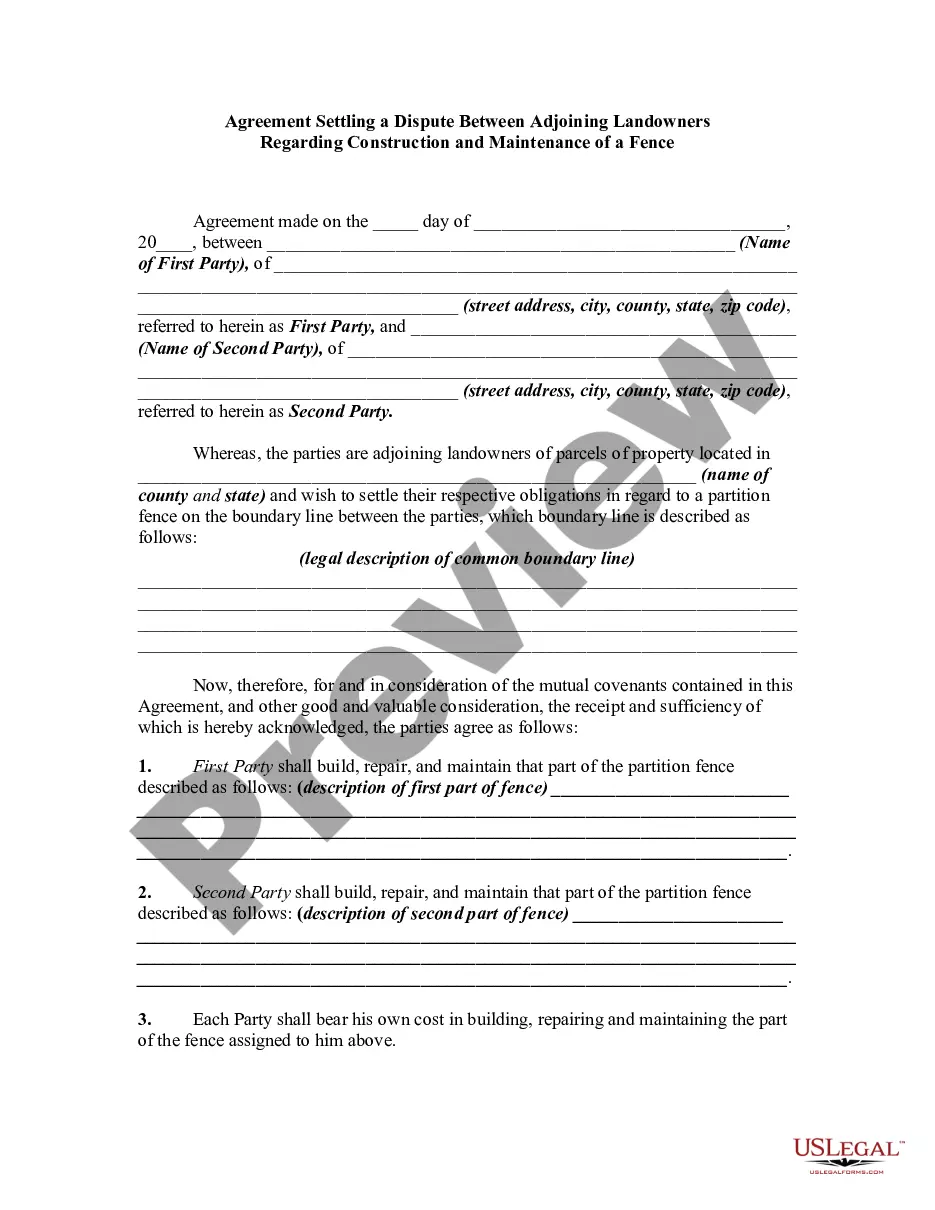
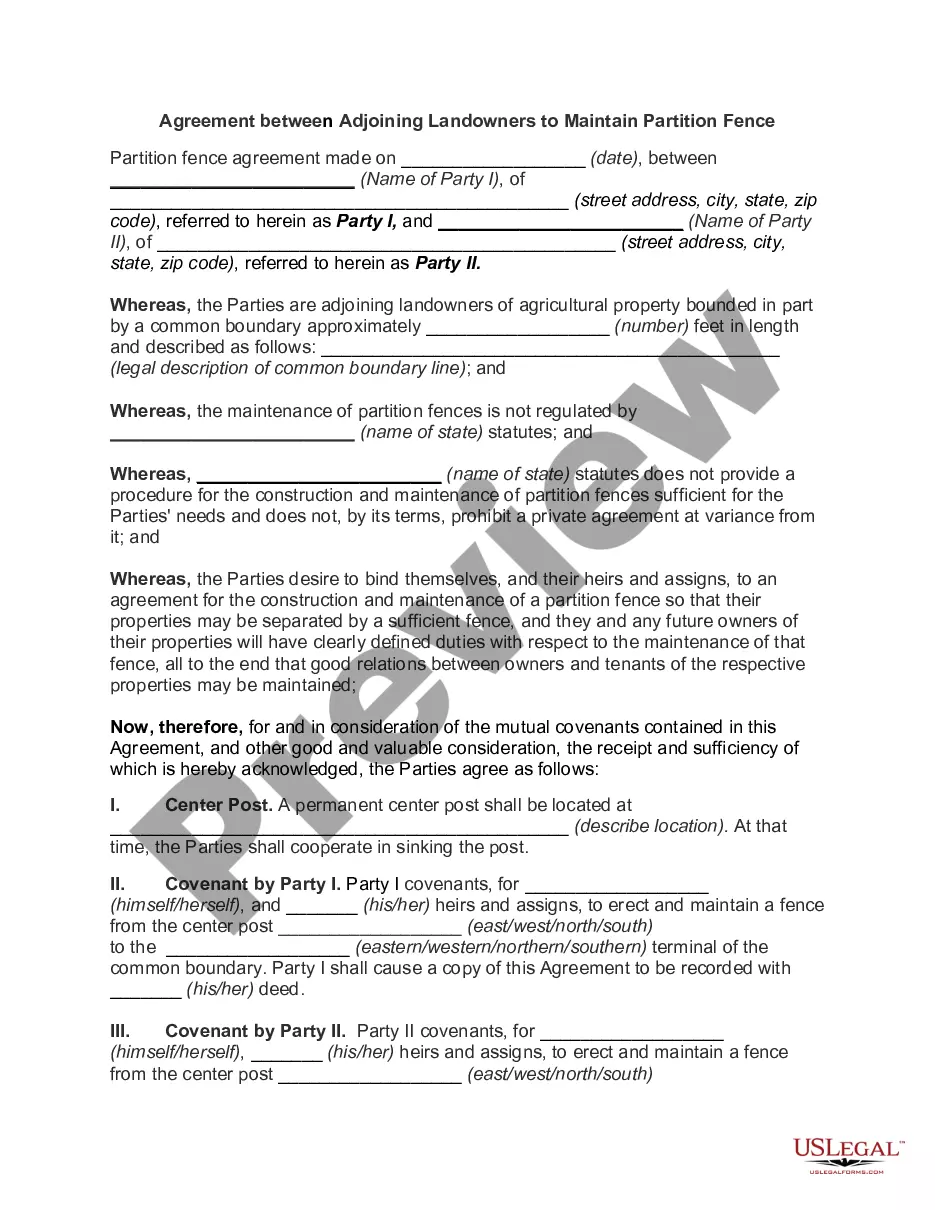
Statutory regulation of partition fences exists in many states. Such statutes may require a particular kind of fence and prohibit other kinds of fences, and may establish certain requirements of cooperation between adjoining landowners as to partition fences. Even where statutory regulation exists, adjoining landowners are usually free to execute agreements with respect to fences that are at variance from the requirements of the statutes. If there is no applicable statute, control over the construction and maintenance of fences is usually regulated by agreement between the adjoining landowners.
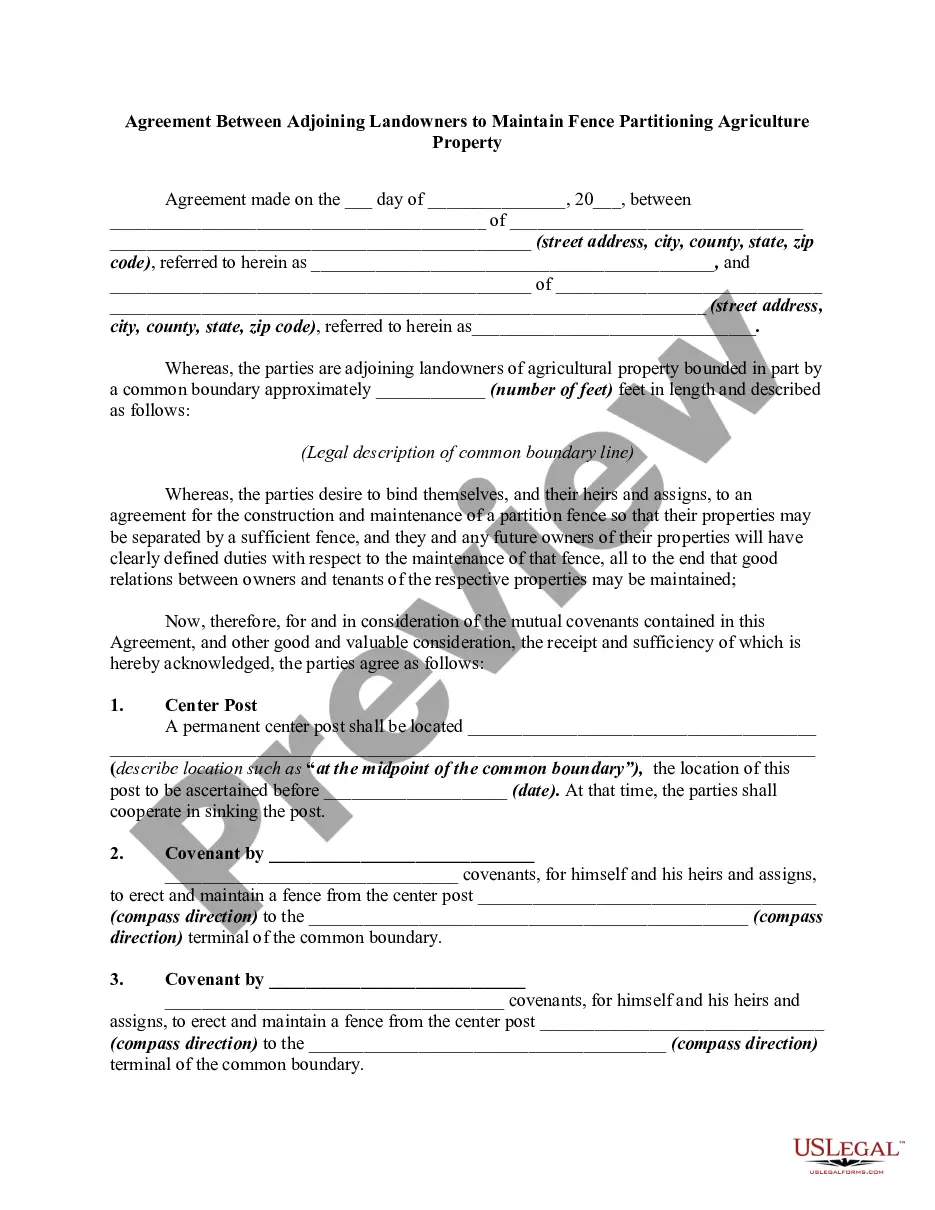
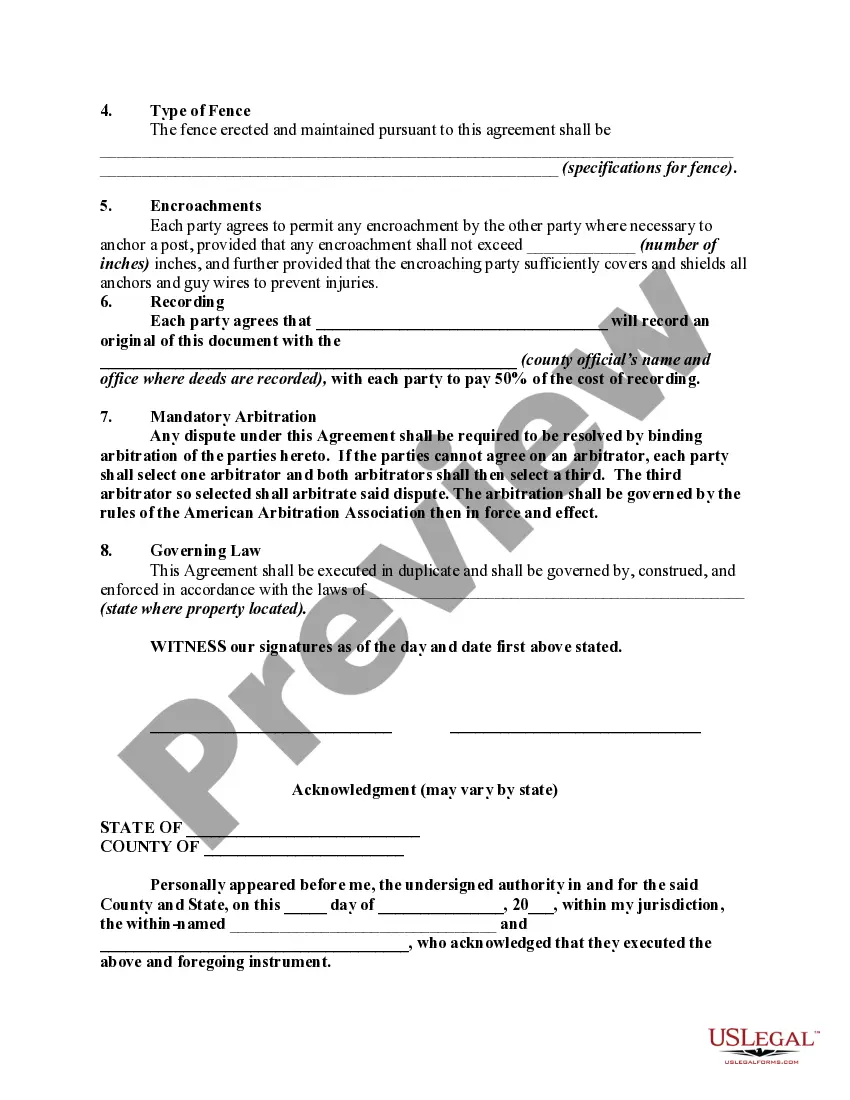
North Carolina Agreement Between Adjoining Landowners to Maintain Fence Partitioning Agriculture Property
Category:
State:
Multi-State
Control #:
US-00944BG
Format:
Word;
Rich Text
Instant download
Description
Free preview

Get your form ready online
Our built-in tools help you complete, sign, share, and store your documents in one place.
Built-in online Word editor
Make edits, fill in missing information, and update formatting in US Legal Forms—just like you would in MS Word.
Export easily
Download a copy, print it, send it by email, or mail it via USPS—whatever works best for your next step.
E-sign your document
Sign and collect signatures with our SignNow integration. Send to multiple recipients, set reminders, and more. Go Premium to unlock E-Sign.
Notarize online 24/7
If this form requires notarization, complete it online through a secure video call—no need to meet a notary in person or wait for an appointment.
Store your document securely
We protect your documents and personal data by following strict security and privacy standards.

Make edits, fill in missing information, and update formatting in US Legal Forms—just like you would in MS Word.

Download a copy, print it, send it by email, or mail it via USPS—whatever works best for your next step.

Sign and collect signatures with our SignNow integration. Send to multiple recipients, set reminders, and more. Go Premium to unlock E-Sign.

If this form requires notarization, complete it online through a secure video call—no need to meet a notary in person or wait for an appointment.

We protect your documents and personal data by following strict security and privacy standards.
Looking for another form?


How to fill out Agreement Between Adjoining Landowners To Maintain Fence Partitioning Agriculture Property?
If you require to obtain, download, or print valid document templates, utilize US Legal Forms, the largest collection of legal forms, available online. Utilize the site's straightforward and user-friendly search to find the documents you need. Various templates for business and personal uses are categorized by types and states, or keywords.
Use US Legal Forms to acquire the North Carolina Agreement Between Adjoining Landowners to Maintain Fence Partitioning Agricultural Property within just a few clicks. If you are already a US Legal Forms user, Log In to your account and click on the Download button to get the North Carolina Agreement Between Adjoining Landowners to Maintain Fence Partitioning Agricultural Property. You can also access forms you previously saved in the My documents section of your account.
If you are using US Legal Forms for the first time, refer to the instructions below: Step 1. Make sure you have selected the form for your correct city/state. Step 2. Utilize the Review feature to examine the form's details. Don’t forget to read the description. Step 3. If you are not satisfied with the form, use the Search field at the top of the screen to find other versions of the legal form template. Step 4. Once you have found the form you need, click the Buy now button. Choose the payment plan you prefer and enter your information to register for an account. Step 5. Process the transaction. You can use your credit card or PayPal account to complete the transaction. Step 6. Select the format of your legal form and download it to your device. Step 7. Complete, modify, and print or sign the North Carolina Agreement Between Adjoining Landowners to Maintain Fence Partitioning Agricultural Property.
Avoid altering or deleting any HTML tags. Only synonymize plain text outside of the HTML tags.
- Every legal document template you acquire is yours permanently.
- You have access to every form you saved in your account.
- Navigate to the My documents section and select a form to print or download again.
- Complete and download, and print the North Carolina Agreement Between Adjoining Landowners to Maintain Fence Partitioning Agricultural Property with US Legal Forms.
- There are numerous professional and state-specific forms available for your business or personal needs.
- Make the most of the extensive collection of templates offered.
Form popularity
FAQ
Fence Height and Permits ing to the California Building Code, Chapter 1, Section 105.2., a permit isn't required if the fence is less than seven feet tall. However, keep in mind that you must still follow any other applicable laws and ordinances. There are still rules about the design or placement of the fence.
When a Permit is Needed. For any accessory building, such as a shed, with any dimension exceeding 12 feet, The North Carolina State Building Code requires that a permit be issued, though a 12'x12' shed doesn't normally need a permit.
If the fence is located in the side or rear yard, the maximum allowed height is 8 feet, unless on a corner lot. When a fence is located in the front yard, the maximum allowed height is 4 feet. A permit is required when the fence/wall is used as a pool barrier on parcels of single family dwellings.
No-fences do not have a setback requirement. You can place a fence anywhere on your property, with the exception of any easements and/or rights of way. You are advised to stay at least six (6) inches off of your property line to avoid any civil disputes with your neighbor(s).
If you are planning to add or move a fence, or replace 50% or more of an existing fence at your residential property, you must first obtain permits from the City before beginning construction. A zoning permit is required when a fence is installed on any property.