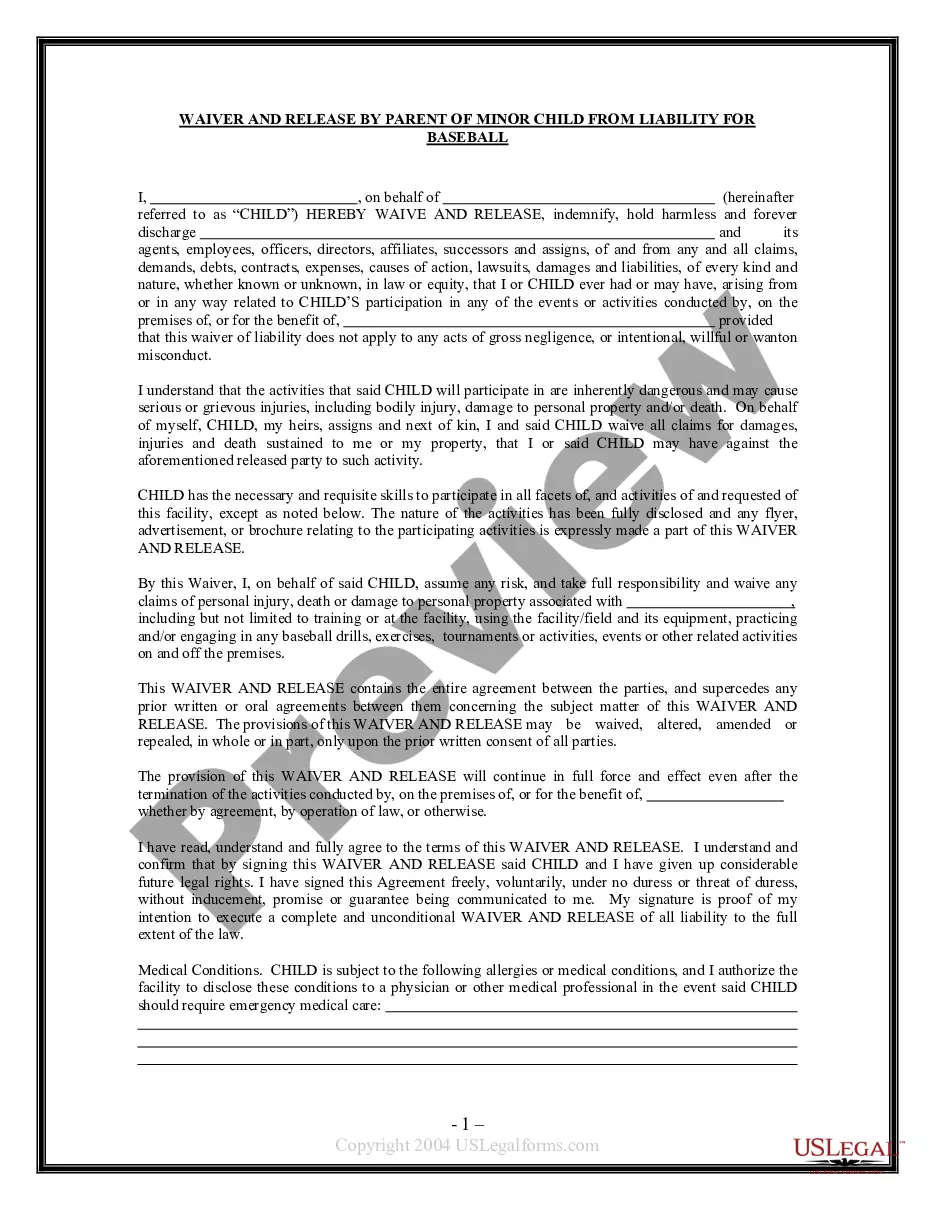
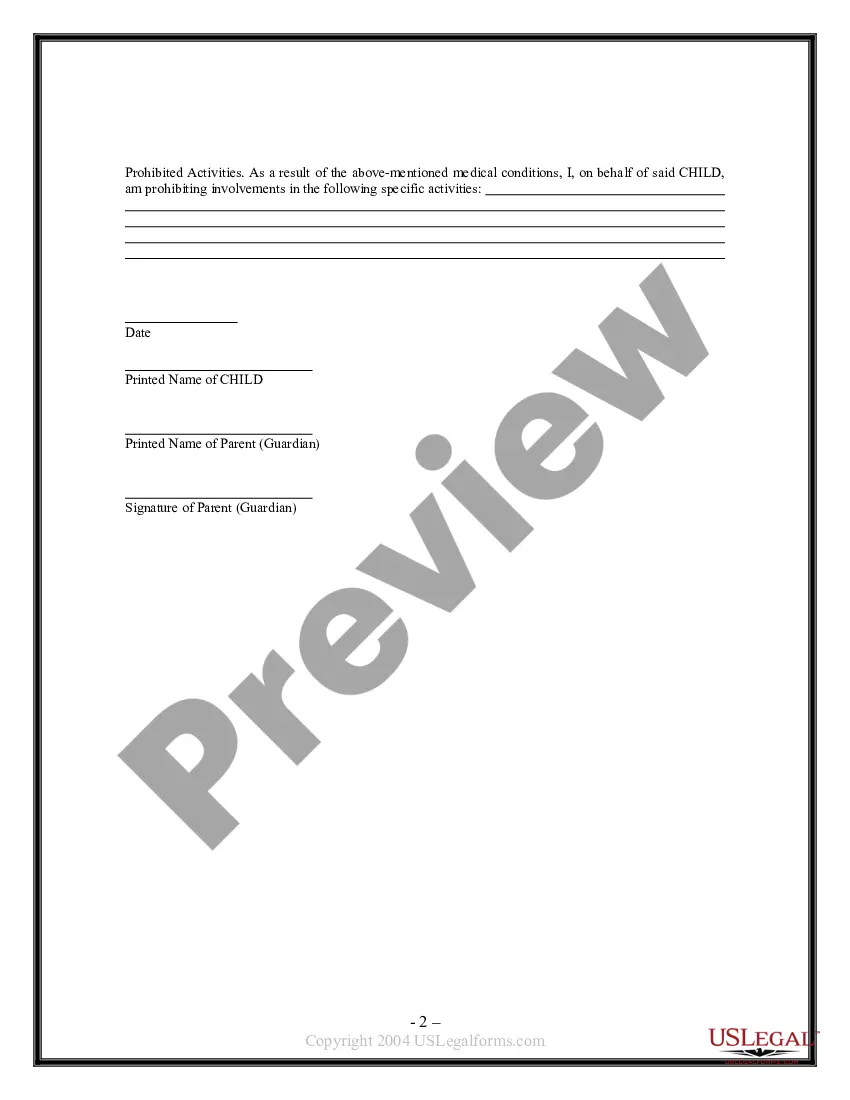
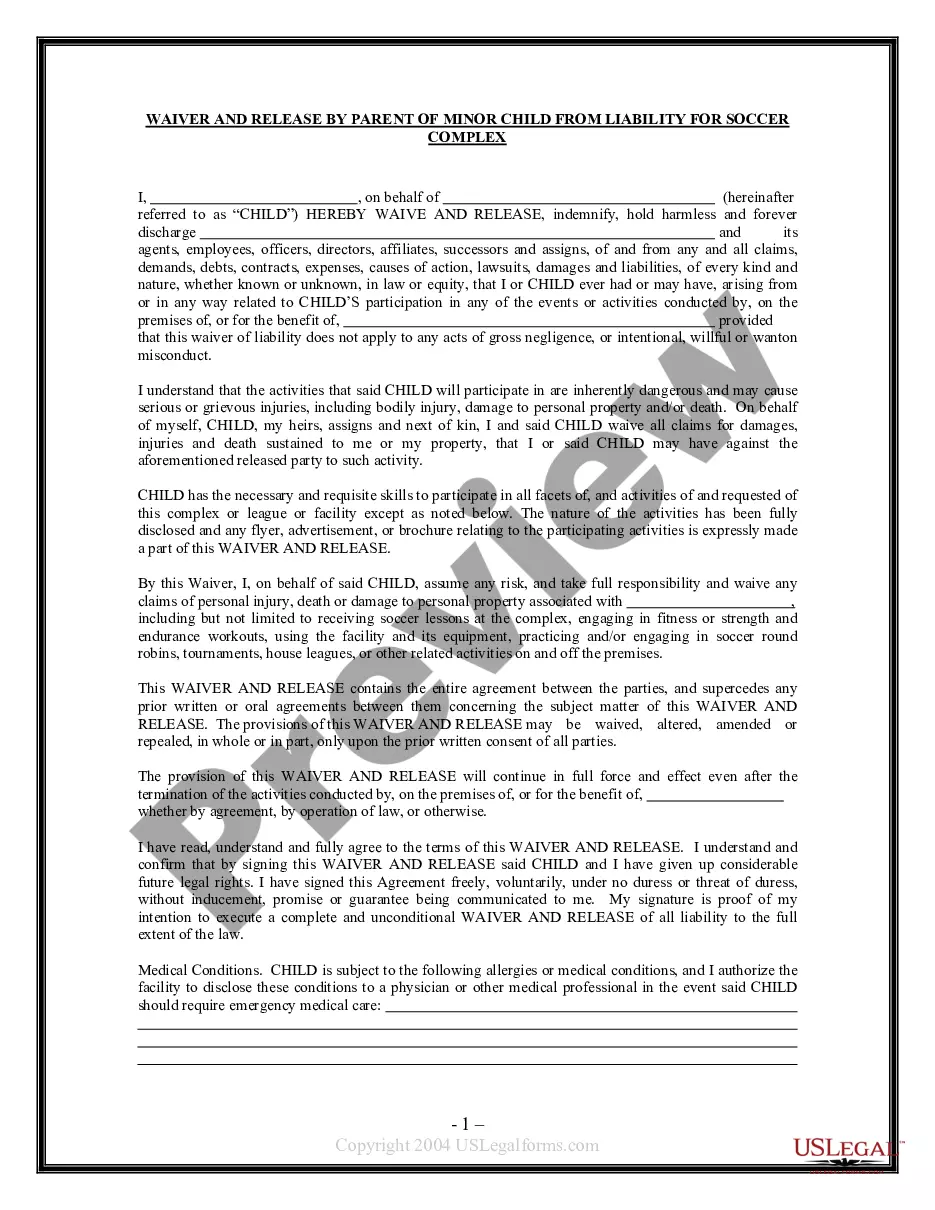
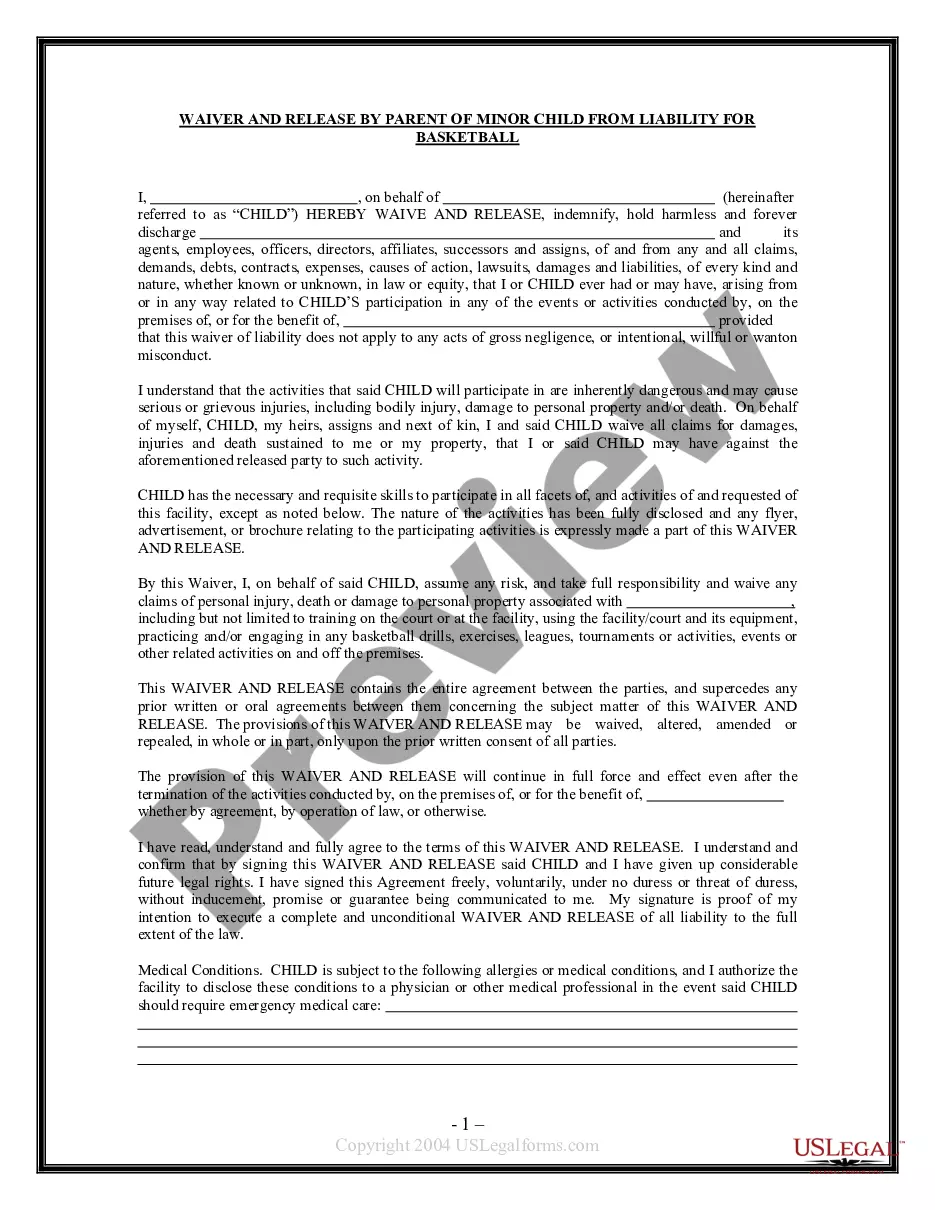
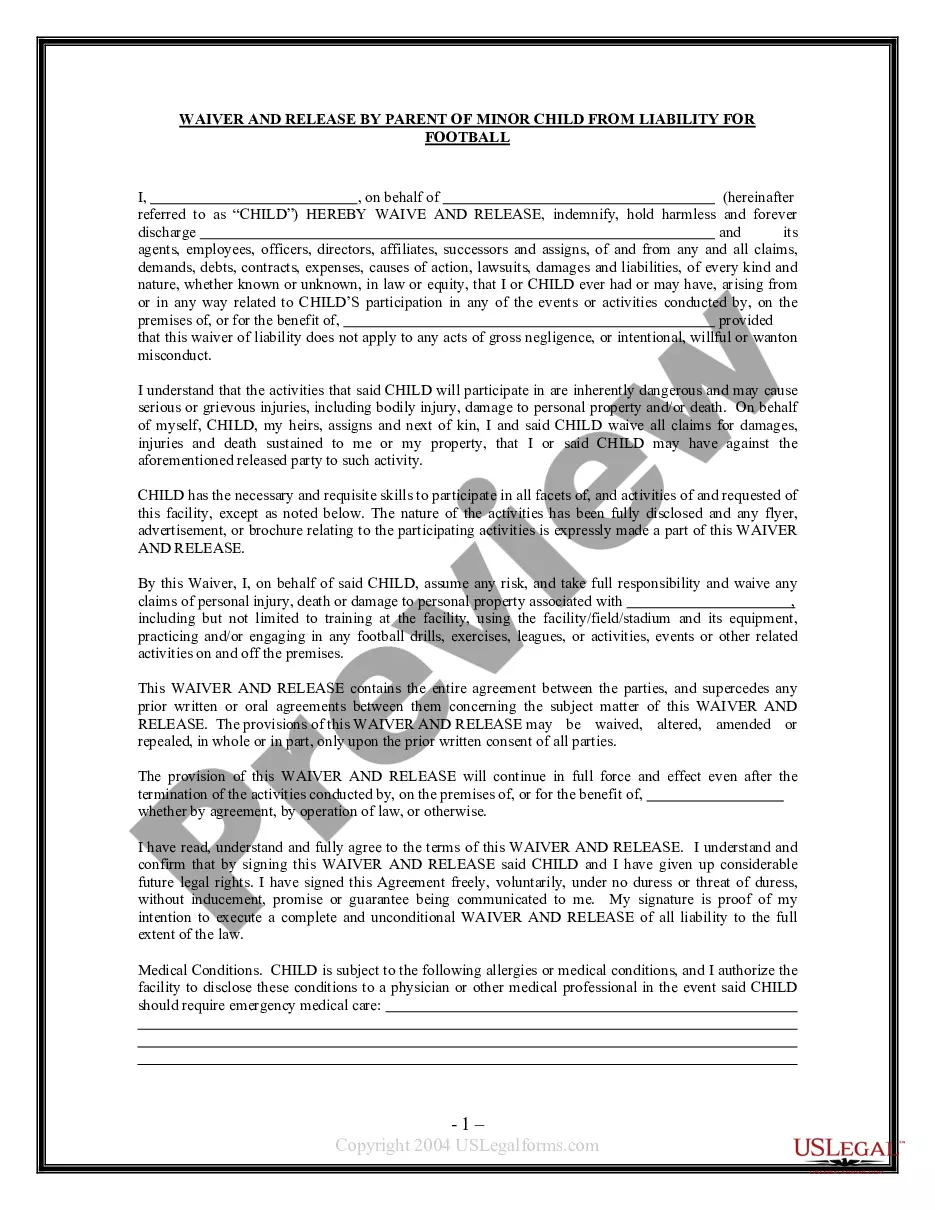
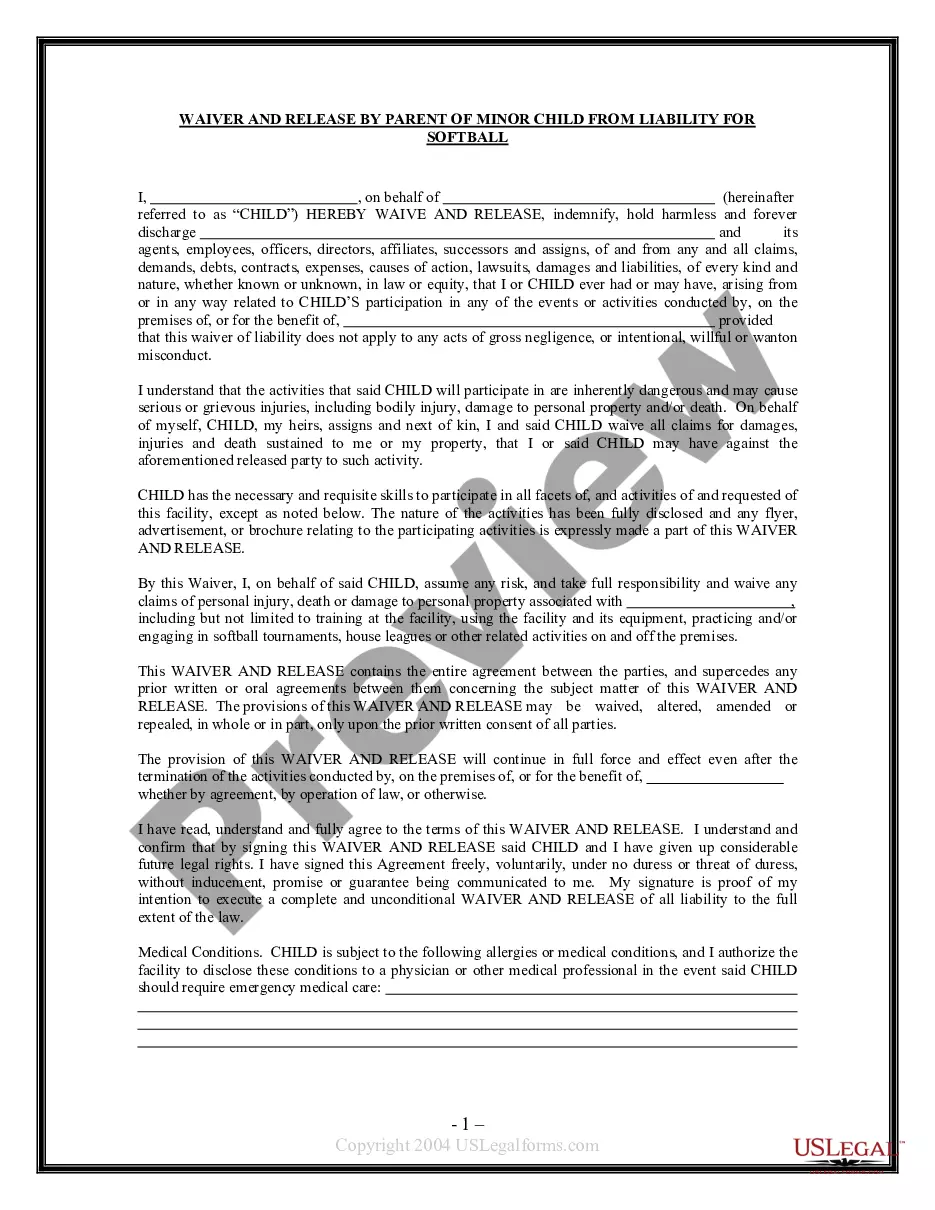
This form allows a parent or guardian to release a baseball stadium from liability for injuries which may be incurred by a minor child while on the premises, taking part in activities, etc.
Montana Waiver and Release From Liability For Minor Child for Baseball Stadium
Category:
State:
Multi-State
Control #:
US-WAV-30M
Format:
Word;
Rich Text
Instant download
Description
Free preview
How to fill out Waiver And Release From Liability For Minor Child For Baseball Stadium?
US Legal Forms - one of the largest collections of legal documents in the United States - offers a broad selection of legal form templates that you can obtain or create. By utilizing the website, you can access thousands of forms for business and personal purposes, organized by categories, states, or keywords.
You can quickly obtain the latest forms like the Montana Waiver and Release From Liability For Minor Child for Baseball Stadium within seconds. If you already have a monthly subscription, Log In to access Montana Waiver and Release From Liability For Minor Child for Baseball Stadium from the US Legal Forms catalog. The Download button will appear on each form you view. You have access to all previously downloaded forms in the My documents section of your account.
If you are using US Legal Forms for the first time, here are simple steps to get started: Ensure you have selected the correct form for your city/county. Click the Review button to examine the form's content. Check the form information to confirm that you have chosen the right form. If the form does not meet your requirements, utilize the Search field at the top of the page to find one that does. If you are satisfied with the form, confirm your choice by clicking the Buy now button. Then, choose the pricing plan you prefer and provide your credentials to register for an account. Complete the transaction. Use your credit card or PayPal account to finalize the transaction. Select the format and download the form to your device. Edit. Fill out, modify, print, and sign the downloaded Montana Waiver and Release From Liability For Minor Child for Baseball Stadium. Each template you add to your account has no expiration date and is yours indefinitely. Therefore, if you wish to obtain or create another version, simply visit the My documents section and click on the form you need.
- Access the Montana Waiver and Release From Liability For Minor Child for Baseball Stadium with US Legal Forms, the most extensive collection of legal document templates.
- Utilize thousands of professional and state-specific templates that cater to your business or personal needs and requirements.
Form popularity
FAQ
Writing a release of liability waiver involves clearly stating the intent to release a party from liability, outlining the activity's risks, and providing space for signatures. For the Montana Waiver and Release From Liability For Minor Child for Baseball Stadium, ensure you include details specific to the event and participant. You can utilize uslegalforms to find templates and guidance, making the process straightforward and ensuring you cover all necessary legal aspects.
A waiver is a document that indicates an individual voluntarily gives up their right to pursue a claim, while a release is a document that formally frees one party from liability for claims. In the context of the Montana Waiver and Release From Liability For Minor Child for Baseball Stadium, a waiver may prevent a parent from suing for injuries, while a release may be used to absolve the stadium from responsibility. Understanding these differences helps you make informed decisions about your child's participation in activities.
A parental release of liability form is a document that parents or guardians sign to acknowledge the risks involved in an activity and to release the organizers from liability. Specifically, the Montana Waiver and Release From Liability For Minor Child for Baseball Stadium is designed to protect baseball stadiums from claims that may arise during events. By signing this form, you ensure that your child can participate while you recognize the inherent risks of the sport.
A liability release form for minors is a document that allows parents or guardians to waive certain legal claims on behalf of their child. This form is essential for activities that involve risks, such as sports events at a baseball stadium, where minors participate. By signing this form, parents acknowledge the risks involved and agree not to hold the organizers liable for any injuries that may occur. For your convenience, USLegalForms offers templates specifically designed for the Montana Waiver and Release From Liability For Minor Child for Baseball Stadium, providing peace of mind for both parents and organizers.
Yes, you can write your own liability waiver, but it is crucial to follow specific guidelines to ensure its legal validity. A well-structured waiver should include essential elements such as the identification of the parties involved, a clear description of the activities, and explicit language that releases liability. While you can draft your own waiver, using a reliable platform like USLegalForms can simplify the process and provide templates tailored for the Montana Waiver and Release From Liability For Minor Child for Baseball Stadium, ensuring compliance with local laws.
To ensure the effectiveness of a waiver of liability, it must be clear, specific, and voluntary. First, the language should be straightforward, avoiding legal jargon to ensure that all parties understand the implications. Second, the waiver must specifically outline the activities and risks involved, making it clear what the participant is agreeing to. Lastly, it should be signed voluntarily, without any pressure or coercion, ensuring that the participant fully comprehends the Montana Waiver and Release From Liability For Minor Child for Baseball Stadium.
A release of liability, also known as a liability waiver or a hold harmless agreement, is a contract in which one party agrees not to hold another party liable for damages or injury. These contracts are common in fields that involve some risk to property, finances, or health.
Here is all that pertains writing an effective liability waiver:Get help. Writing a waiver should not be complicated.Use the correct structure.Proper formatting.Include a subject line.Include a caution!Talk about the activity risks.Do not forget an assumption of risk.Hold harmless.More items...?
A liability waiver is a legal document that a person who participates in an activity may sign to acknowledge the risks involved in their participation. By doing so, the company attempts to remove legal liability from the business or person responsible for the activity.
As tempting as it may be, you should never write your own liability waiver. Unless you're a fully qualified lawyer with experience in this area, it's likely that you'll omit critical language that puts your business at risk for lawsuits.