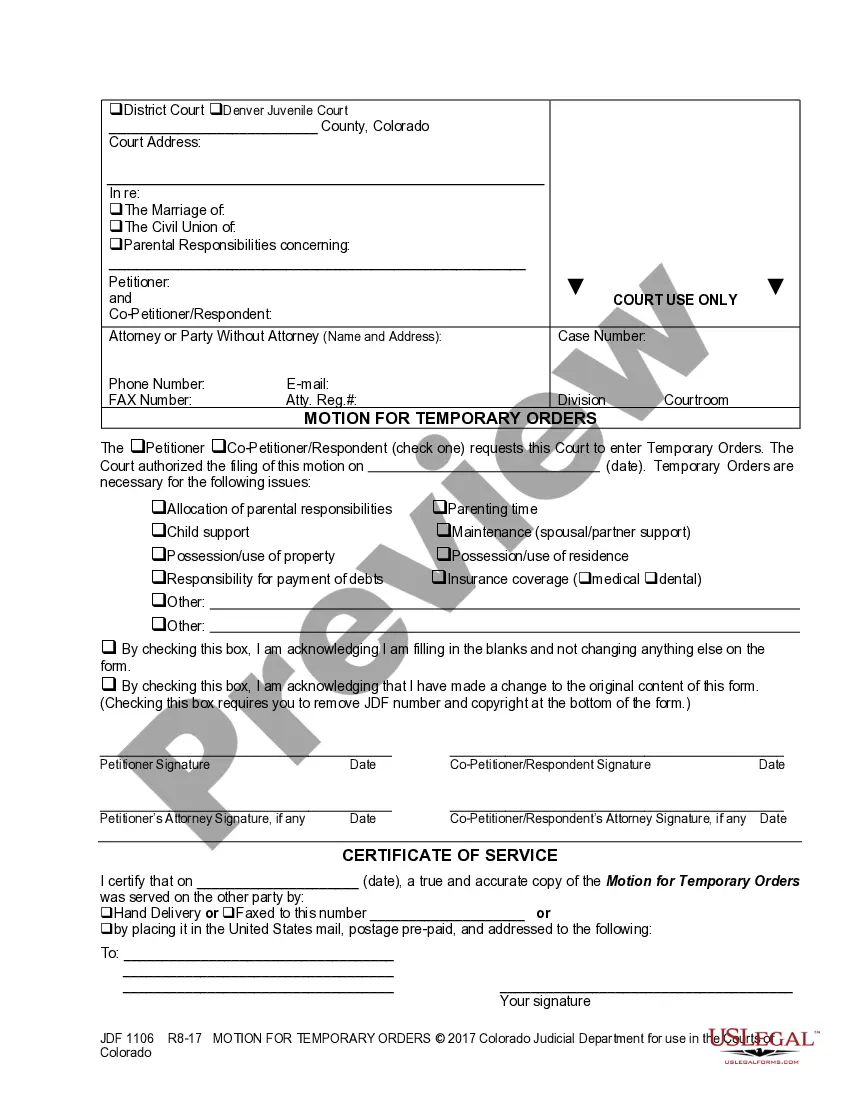
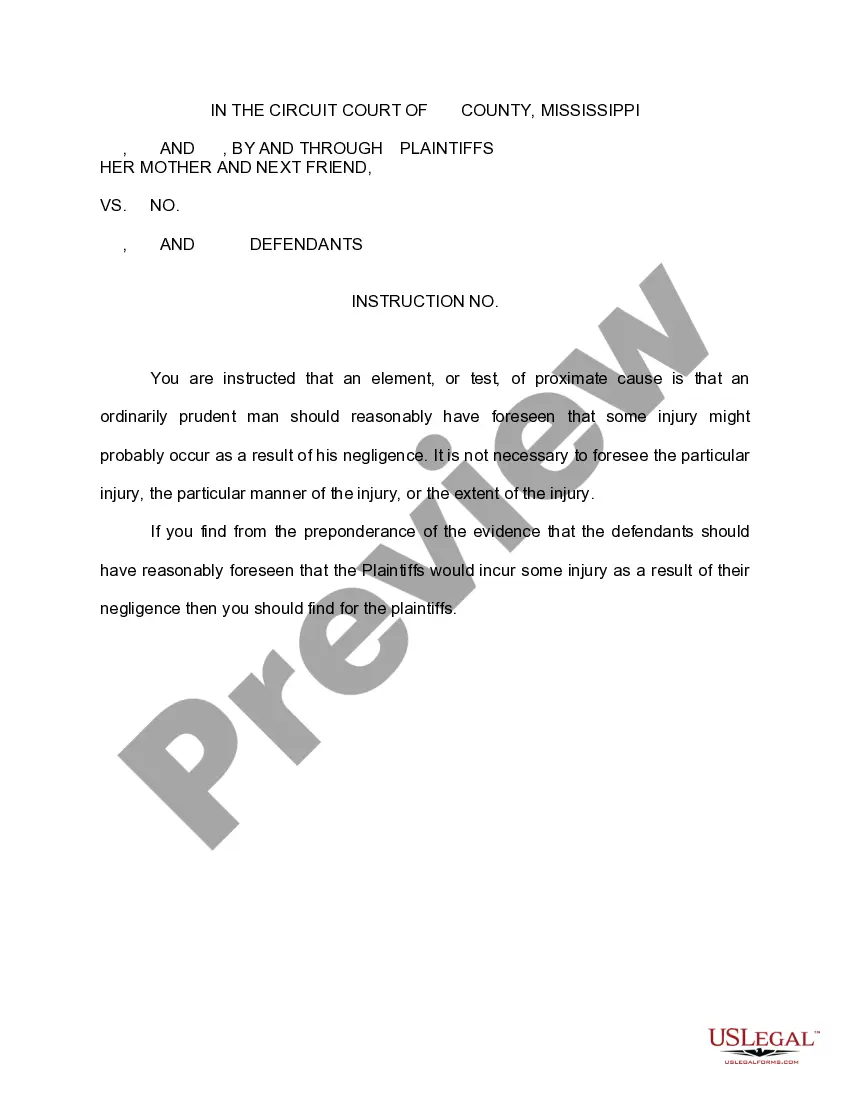
Mississippi Jury Instruction - Approximate Cause - Injury by Power Lines
About this form
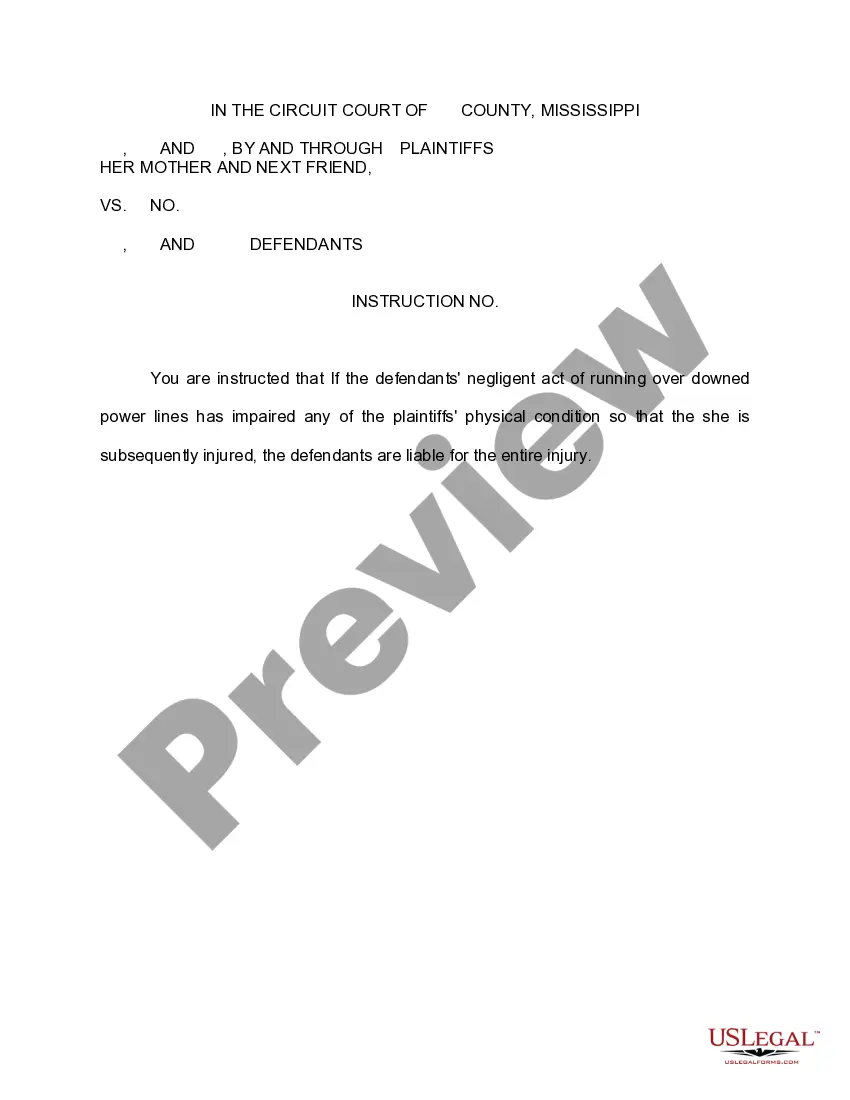
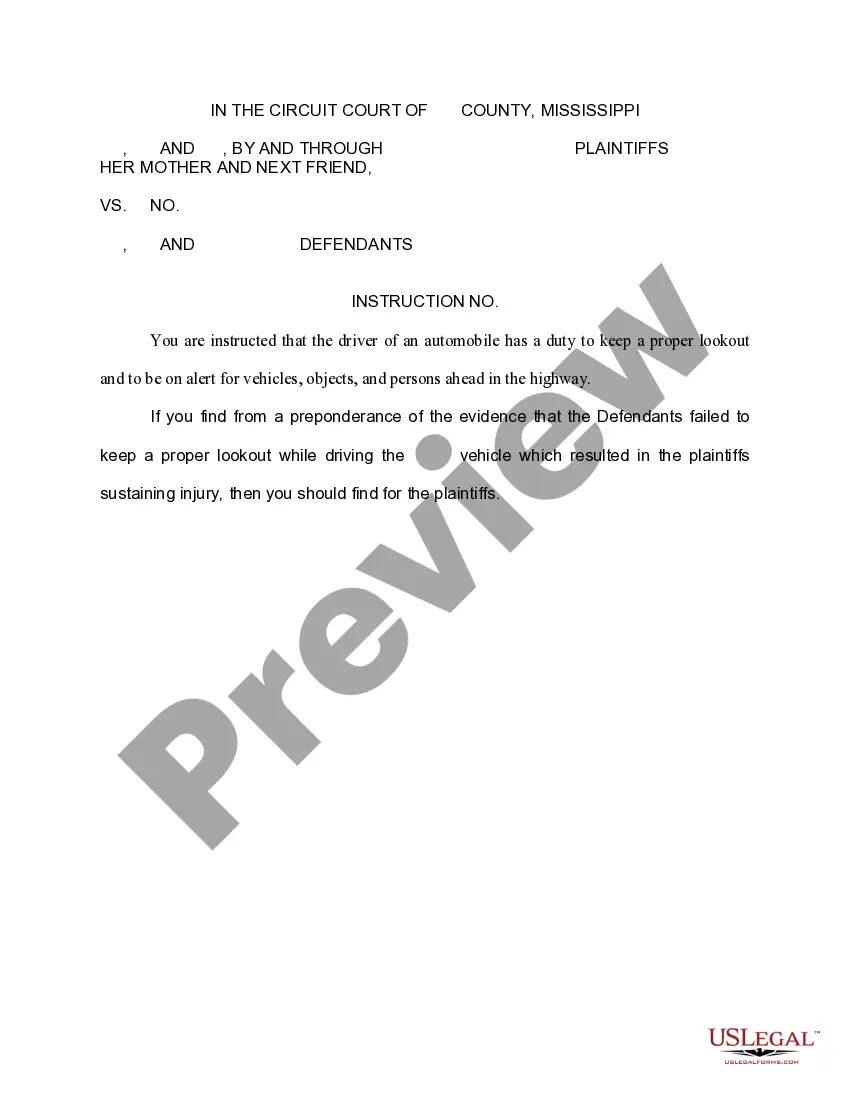
This Jury Instruction - Approximate Cause - Injury by Power Lines provides guidance for jurors in Mississippi on evaluating negligence related to power line injuries. The instruction sets a standard for assessing whether a defendant should have foreseen that their actions could likely cause injury. This form is crucial in personal injury cases involving power lines and differs from other jury instructions by focusing specifically on the concept of proximate cause in these scenarios.
What’s included in this form
- Identification of the plaintiffs and defendants involved in the case.
- Definition of proximate cause and its implications in negligence claims.
- Clarification that specific injuries do not need to be foreseen, only the potential for injury.
- Instructions for jurors on how to evaluate the evidence presented.
When to use this document
This form should be used in cases where jurors need to understand the legal standards for proximate cause in personal injury lawsuits related to power line accidents. It is particularly relevant in litigation involving claims of negligence where the safety of power lines may have been compromised, resulting in injury to plaintiffs.
Intended users of this form
- Judges presiding over personal injury trials involving power lines.
- Attorneys representing plaintiffs or defendants in these types of cases.
- Jurors who are tasked with making determinations based on evidence related to proximate cause.
How to complete this form
- Identify and enter the names of the plaintiffs and defendants involved in the case.
- Review the jury instruction language to ensure it aligns with Mississippi law.
- Ensure the definition of proximate cause is clear and compliant with relevant legal standards.
- Clarify the jury's duty to assess whether injuries could have reasonably been foreseen.
- Finalize and present the instruction for jury consideration during the trial.
Does this document require notarization?
This form usually doesn’t need to be notarized. However, local laws or specific transactions may require it. Our online notarization service, powered by Notarize, lets you complete it remotely through a secure video session, available 24/7.
Get your form ready online
Our built-in tools help you complete, sign, share, and store your documents in one place.
Make edits, fill in missing information, and update formatting in US Legal Forms—just like you would in MS Word.
Download a copy, print it, send it by email, or mail it via USPS—whatever works best for your next step.
Sign and collect signatures with our SignNow integration. Send to multiple recipients, set reminders, and more. Go Premium to unlock E-Sign.
If this form requires notarization, complete it online through a secure video call—no need to meet a notary in person or wait for an appointment.
We protect your documents and personal data by following strict security and privacy standards.

Make edits, fill in missing information, and update formatting in US Legal Forms—just like you would in MS Word.

Download a copy, print it, send it by email, or mail it via USPS—whatever works best for your next step.

Sign and collect signatures with our SignNow integration. Send to multiple recipients, set reminders, and more. Go Premium to unlock E-Sign.

If this form requires notarization, complete it online through a secure video call—no need to meet a notary in person or wait for an appointment.

We protect your documents and personal data by following strict security and privacy standards.
Avoid these common issues
- Failing to update the instruction according to the latest case law.
- Using overly complex language that jurors may not understand.
- Neglecting to clarify who bears the burden of proof regarding foreseeability of injury.
Why complete this form online
- Convenient access to legally vetted instructions tailored for your jurisdiction.
- Easy download and print options for immediate use in court.
- Editable format allows for quick adjustments to ensure compliance with specific case circumstances.
Looking for another form?

Form popularity
FAQ
A proximate cause is an event which is closest to, or immediately responsible for causing, some observed result. This exists in contrast to a higher-level ultimate cause (or distal cause) which is usually thought of as the "real" reason something occurred.
Proximate cause means legal cause, or one that the law recognizes as the primary cause of the injury.In other words, the plaintiff will have to show that the injuries were the natural and direct consequence of the proximate cause, without which the injuries would not have occurred.
Proximate cause is a key principle of insurance and is concerned with how the loss or damage actually occurred and whether it is indeed as a result of an insured peril.The important point to note is that the proximate cause is the nearest cause and not a remote cause.
Proximate Cause (1) The cause having the most significant impact in bringing about the loss under a first-party property insurance policy, when two or more independent perils operate at the same time (i.e., concurrently) to produce a loss.
Example: Driver of Car A runs a red light and hits Car B, which had a green light, causing injury to the driver of Car B.But proximate cause can also be the most difficult issue in a personal injury case. Not every remote cause of an injury will result in a right to recover damage.
Proximate cause is concerned with how the actual loss or damage happened to the insured party and whether it is a result of an insured peril. It looks for what is the reason behind the loss, is that is an insured peril or not. The doctrine of proximate cause is one of the six principles of insurance.
It is a rule of law that in actions on fire policies, full regard must be had to the causa proxima. If the proximate cause of the loss is fire, the loss is recoverable. If the cause is not fire but some other cause remotely connected with fire, it is not recoverable, unless specifically provided for.
Proximate cause is a key principle of insurance and is concerned with how the loss or damage actually occurred and whether it is indeed as a result of an insured peril.The important point to note is that the proximate cause is the nearest cause and not a remote cause.