Mississippi Motion to Sell Marital Domicile at Auction
What this document covers
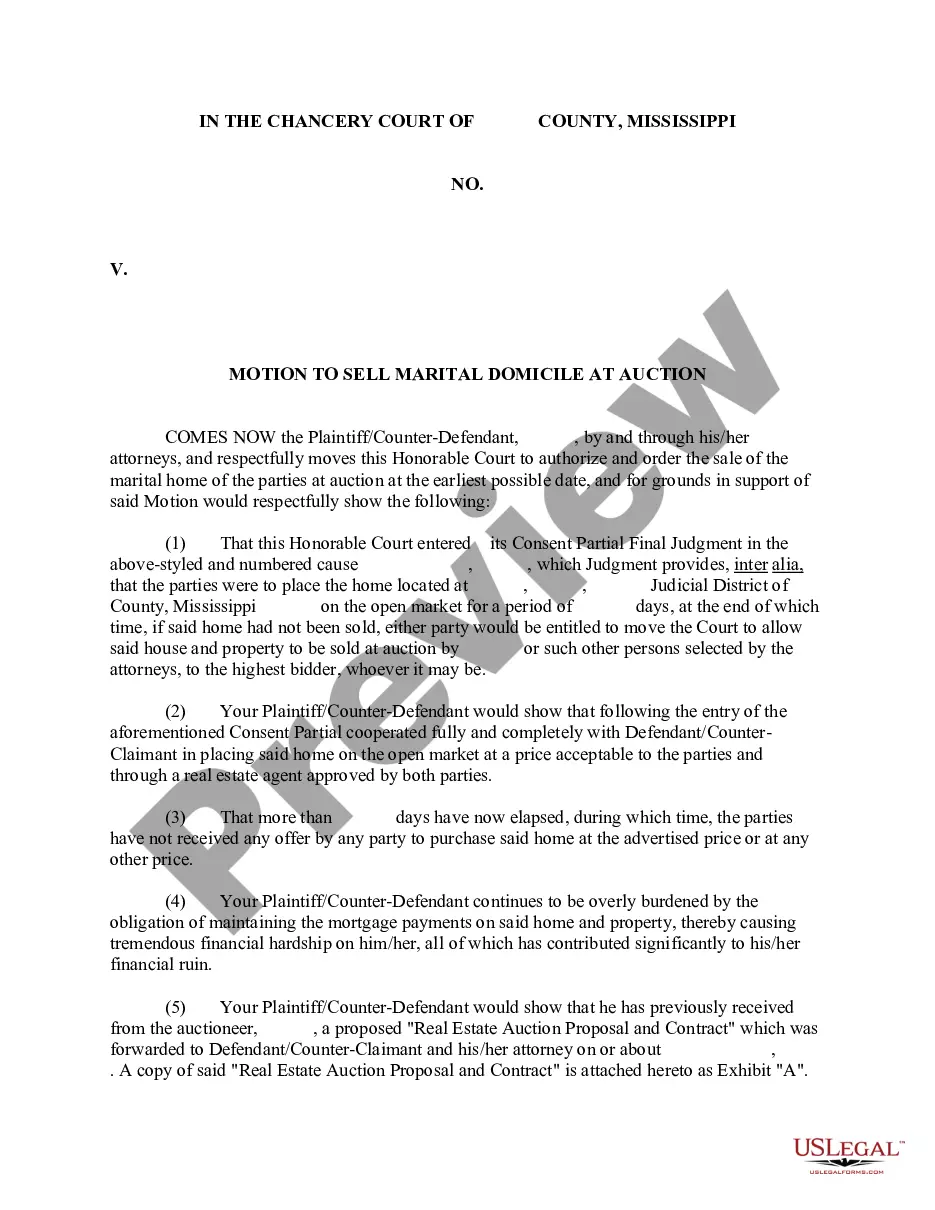
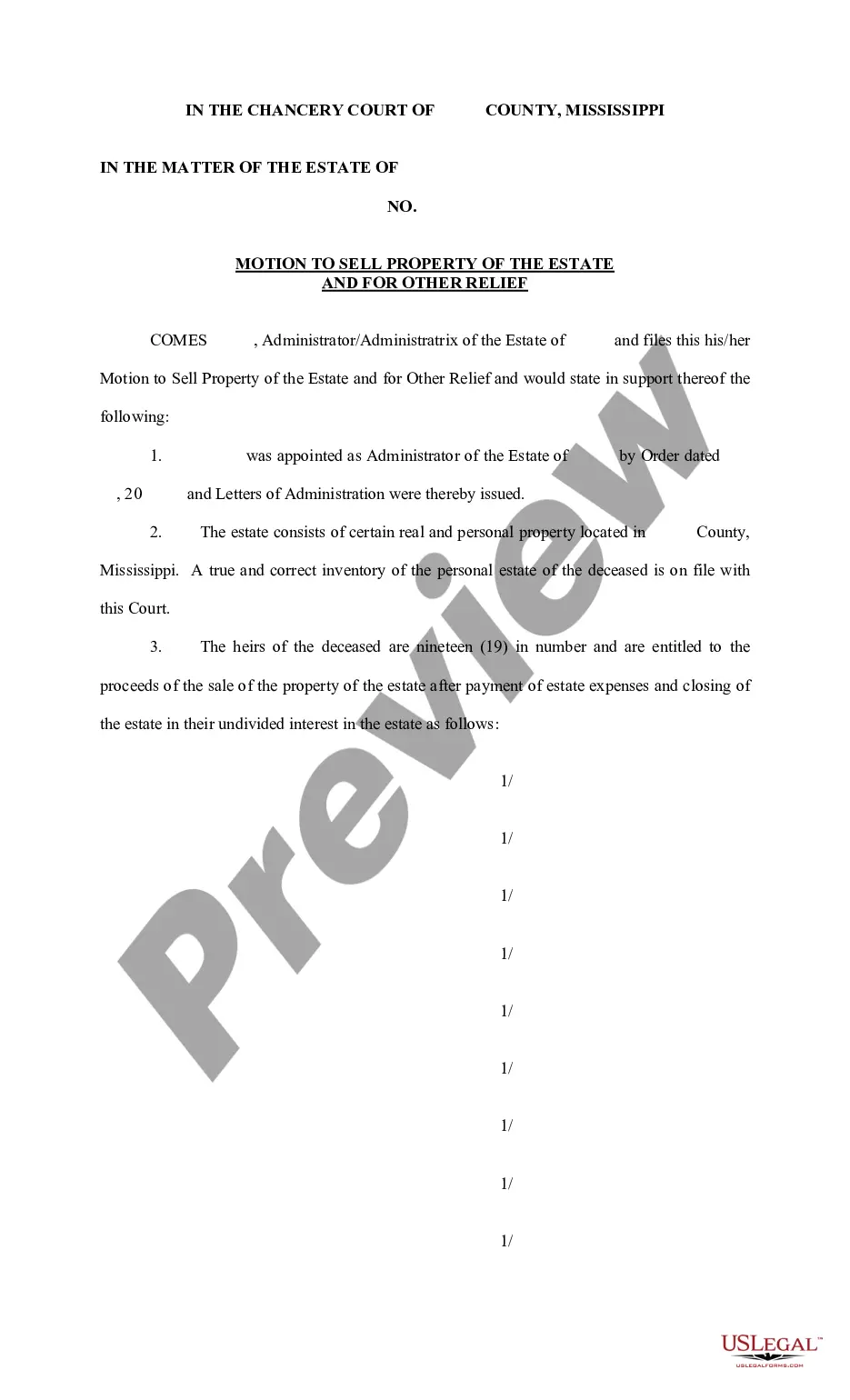
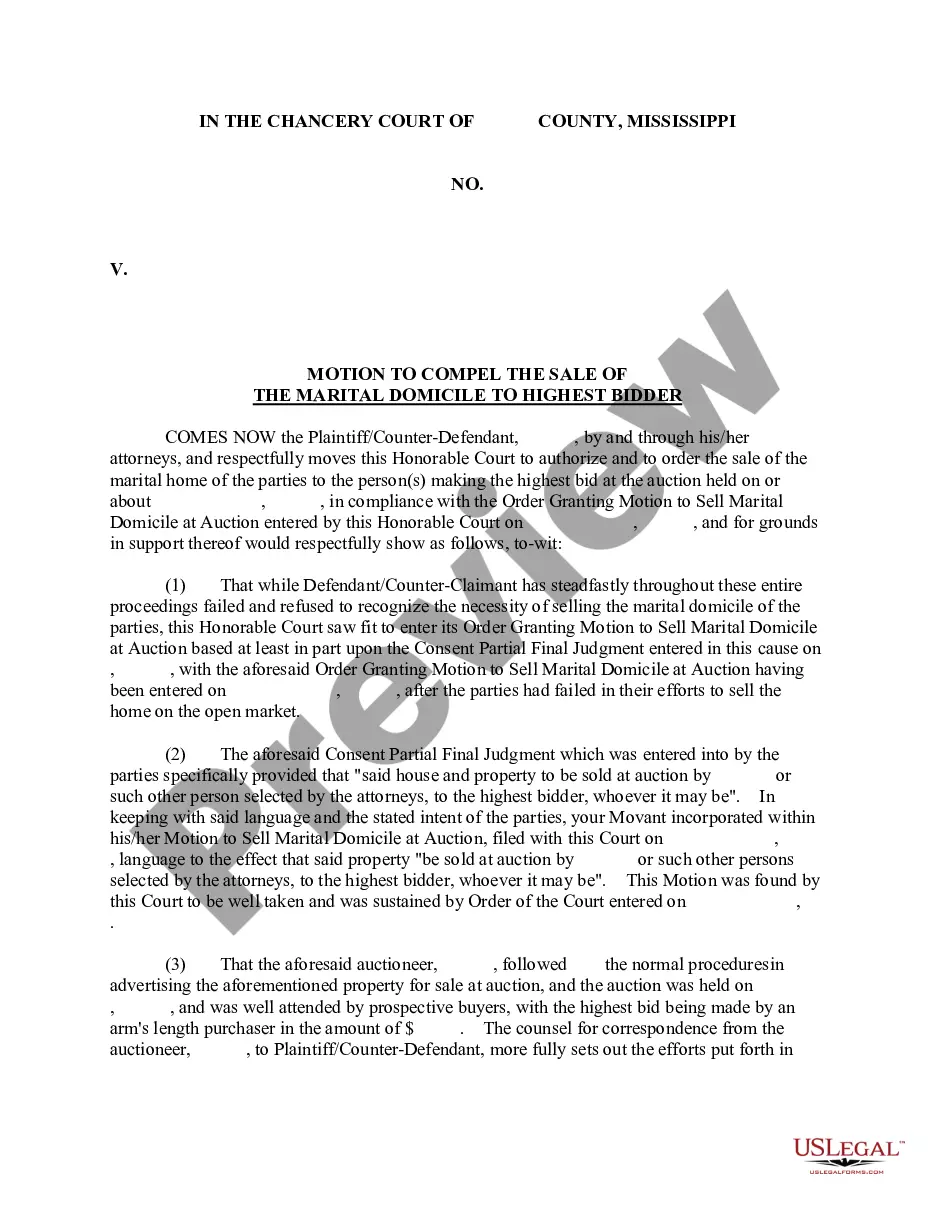
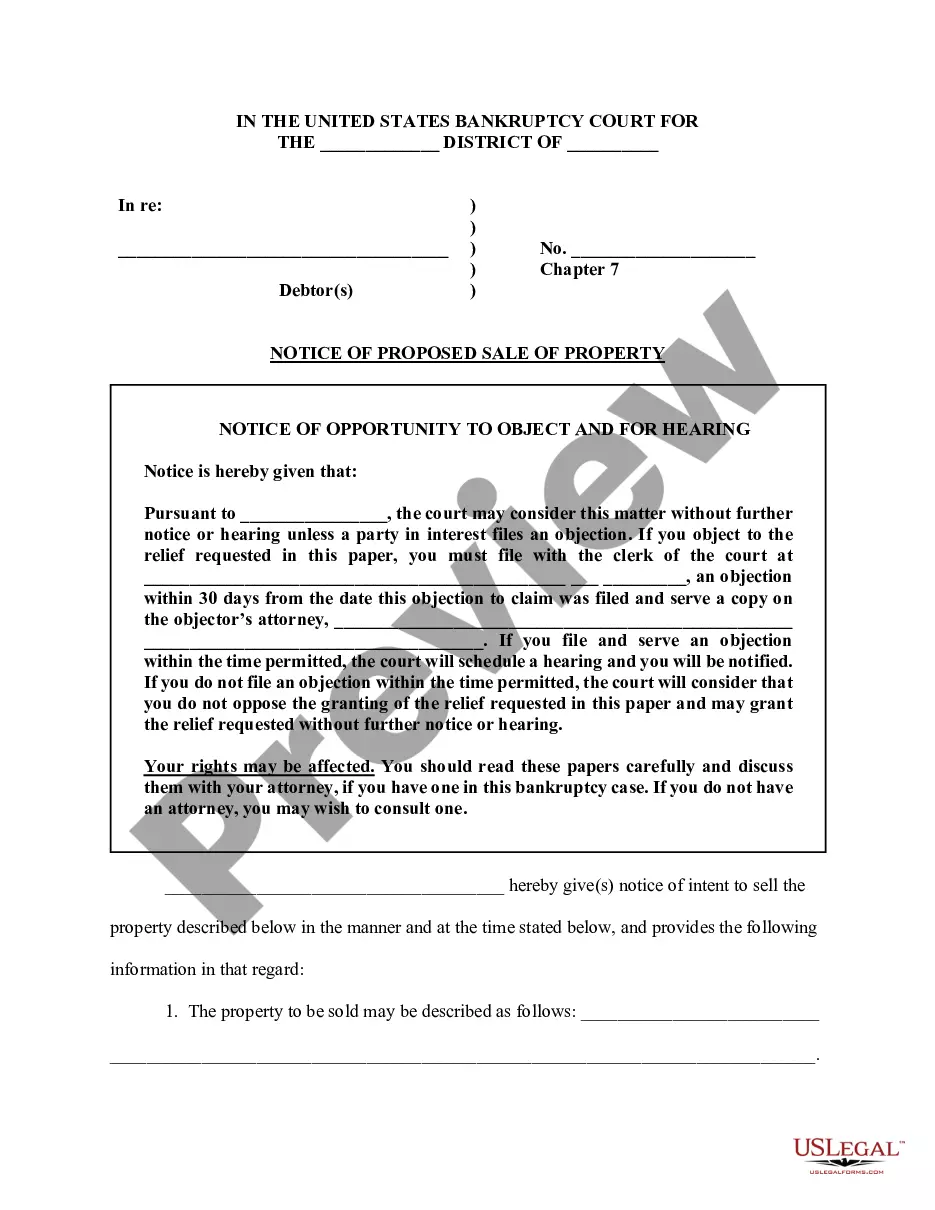
The Motion to Sell Marital Domicile at Auction is a legal request submitted to the court, seeking authorization to sell a marital home at auction. This form is typically used during divorce proceedings or disputes over property, allowing parties to expedite the sale of real estate when market offers have been insufficient. It is distinct from other motions, as it specifically addresses the sale of a shared residence under the terms of a court judgment.
Key components of this form
- Identification of the plaintiff and their attorney.
- Details of the existing court consent judgment related to the marital domicile.
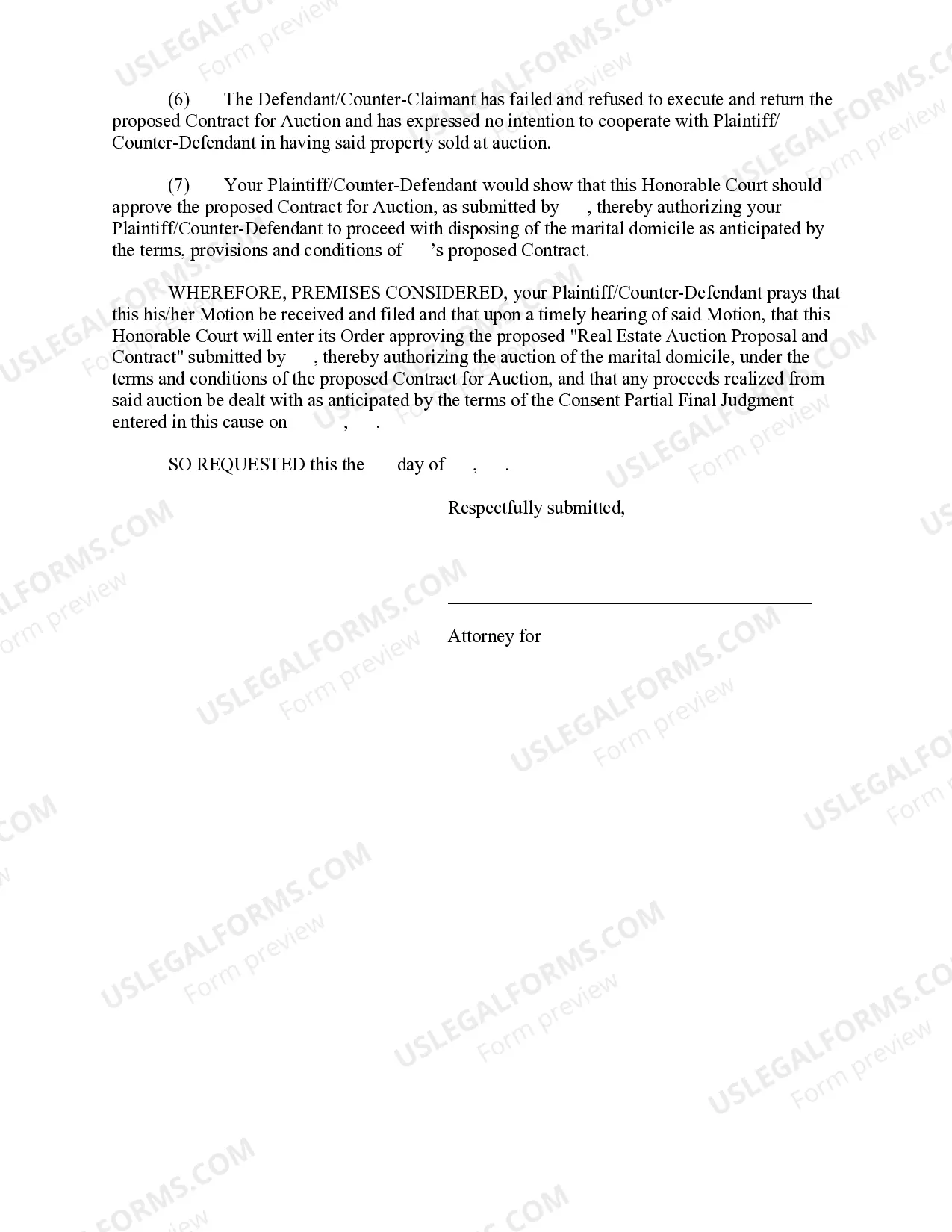
- Specific reasons for the motion, including the lack of offers and financial burden.
- Proposed auctioneer information and relevant documents attached as exhibits.
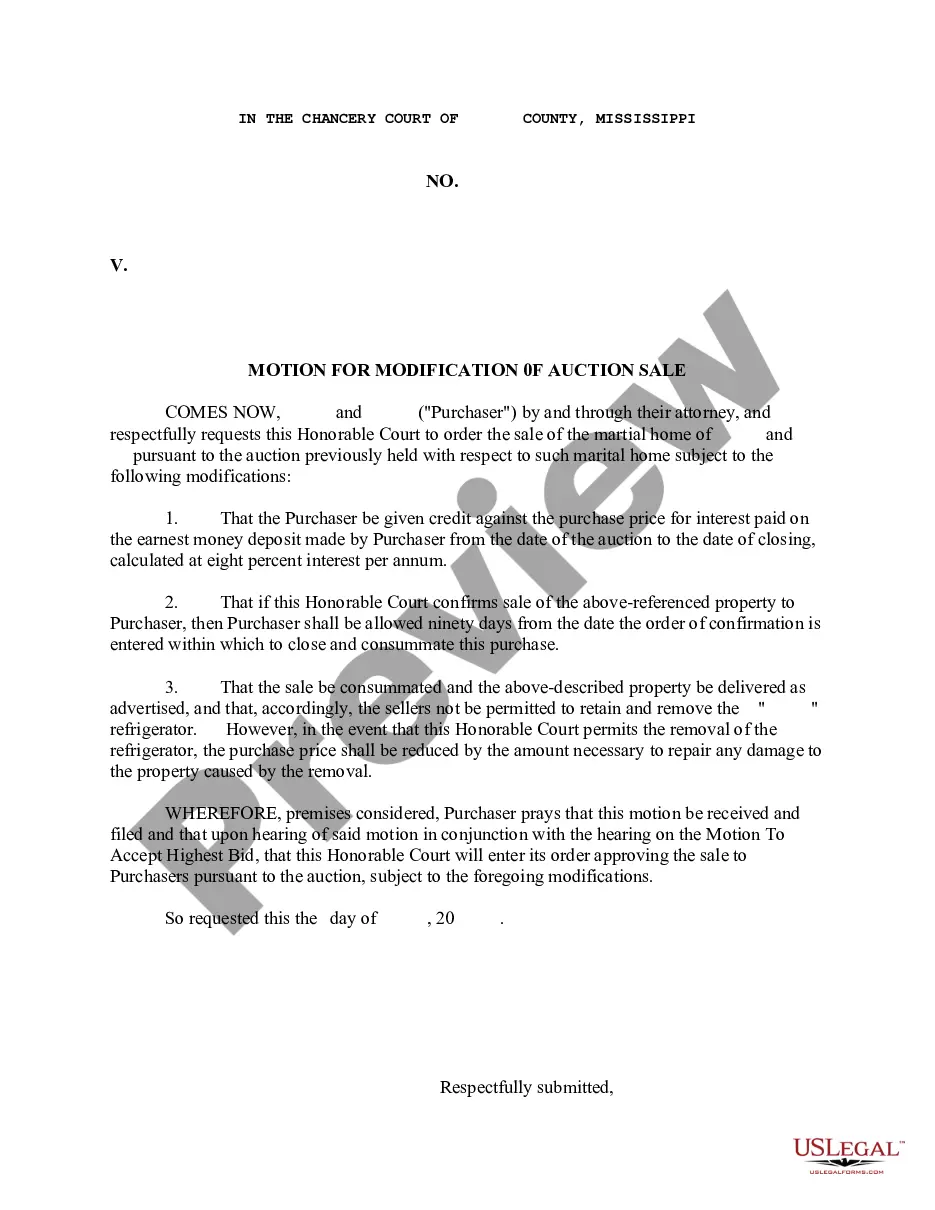
- A plea for the court to approve the auction contract and facilitate the sale.
Situations where this form applies
This form is typically used when the marital home has been placed on the market but has not sold after the designated period. If the parties involved have not received offers capable of meeting their financial obligations, this motion allows one party to seek court permission for an auction, thus expediting the process of property disposition during divorce or separation.
Who can use this document
- Individuals currently going through a divorce or separation and need to sell the marital home.
- Co-owners of property who have reached a standstill in negotiations to sell a home.
- Persons under a court judgment that allows them to request a judicial auction of shared property.
How to prepare this document
- Identify the plaintiff and their attorney in the designated fields.
- Input details of the court's existing Consent Partial Final Judgment.
- Document reasons for seeking auction approval, including attempts to sell and financial hardship.
- Attach any relevant auction proposals and supporting documents.
- Sign and date the motion to finalize the submission.
Does this document require notarization?
Notarization is required for this form to take effect. Our online notarization service, powered by Notarize, lets you verify and sign documents remotely through an encrypted video session, available 24/7.
Get your form ready online
Our built-in tools help you complete, sign, share, and store your documents in one place.
Make edits, fill in missing information, and update formatting in US Legal Forms—just like you would in MS Word.
Download a copy, print it, send it by email, or mail it via USPS—whatever works best for your next step.
Sign and collect signatures with our SignNow integration. Send to multiple recipients, set reminders, and more. Go Premium to unlock E-Sign.
If this form requires notarization, complete it online through a secure video call—no need to meet a notary in person or wait for an appointment.
We protect your documents and personal data by following strict security and privacy standards.

Make edits, fill in missing information, and update formatting in US Legal Forms—just like you would in MS Word.

Download a copy, print it, send it by email, or mail it via USPS—whatever works best for your next step.

Sign and collect signatures with our SignNow integration. Send to multiple recipients, set reminders, and more. Go Premium to unlock E-Sign.

If this form requires notarization, complete it online through a secure video call—no need to meet a notary in person or wait for an appointment.

We protect your documents and personal data by following strict security and privacy standards.
Common mistakes
- Failing to provide complete and accurate property details.
- Neglecting to attach necessary supporting documentation or exhibits.
- Not specifying the reasons clearly for requesting the auction.
Why use this form online
- Convenient access to a professionally drafted legal form tailored for your needs.
- The ability to quickly download and edit the document as needed.
- Reliable content designed to meet legal standards in your jurisdiction.
Legal use & context
- This form is legally recognized in the context of divorce proceedings and asset division.
- The court's approval of this motion is crucial for the sale process to proceed legally.
- Failure to follow proper procedures may lead to delays in the divorce settlement.
Looking for another form?
Form popularity
FAQ
Your domicile is the place where you maintain a permanent home.Thus, domicile is a legal construct used to determine where you vote, file lawsuits, pay taxes, claim benefits, and oblige governmental authority.
Residence is a place you live for a time. It could be a summer hideaway, a college dorm, or just a place you go to get away from the snowy winters up north. Domicile is the place you intend to make your permanent home, the place to which you intend to return if you are temporarily residing in another state.
Matrimonial Domicile refers to a place where husband and wife have established their home. It is also known as matrimonial home. However, a wife need not take a husband's domicile as matrimonial domicile at the time of marriage if the husband intends to acquire a new domicile.
There's no restriction on being married and filing jointly with different state residences. As long as you and your spouse are married on the last day of the year, the IRS counts you as married for all 12 months. If, say, your divorce becomes final December 31, you file as single for the entire year.
Domicile describes the country that a person treats as their permanent home, or lives in and has a substantial connection with. It's somewhere they intend to return to if they currently reside elsewhere. It's important to note that domicile differs to residence.
While states differ somewhat in how they define the place of domicile, the general rule of thumb can be stated as follows: the domicile is the place a person regards as his or her true home, and where they maintain the most economic, social, political, and family ties.
Domicile by origin. Domicile by choice. Domicile by operation of law.
A Domicile/Residence Certificate is generally issued to prove that the person bearing the Certificate is a Domicile/Resident of the State/UT by which the Certificate is being issued.After marriage the wife acquires the domicile of her husband, if the domicile was not same before marriage.
One can have dual nationality but not more than one domicile at a time. A person may have a domicile in one state while maintaining nationality in another country. Unlike nationality, no person can be without a domicile even if stateless.