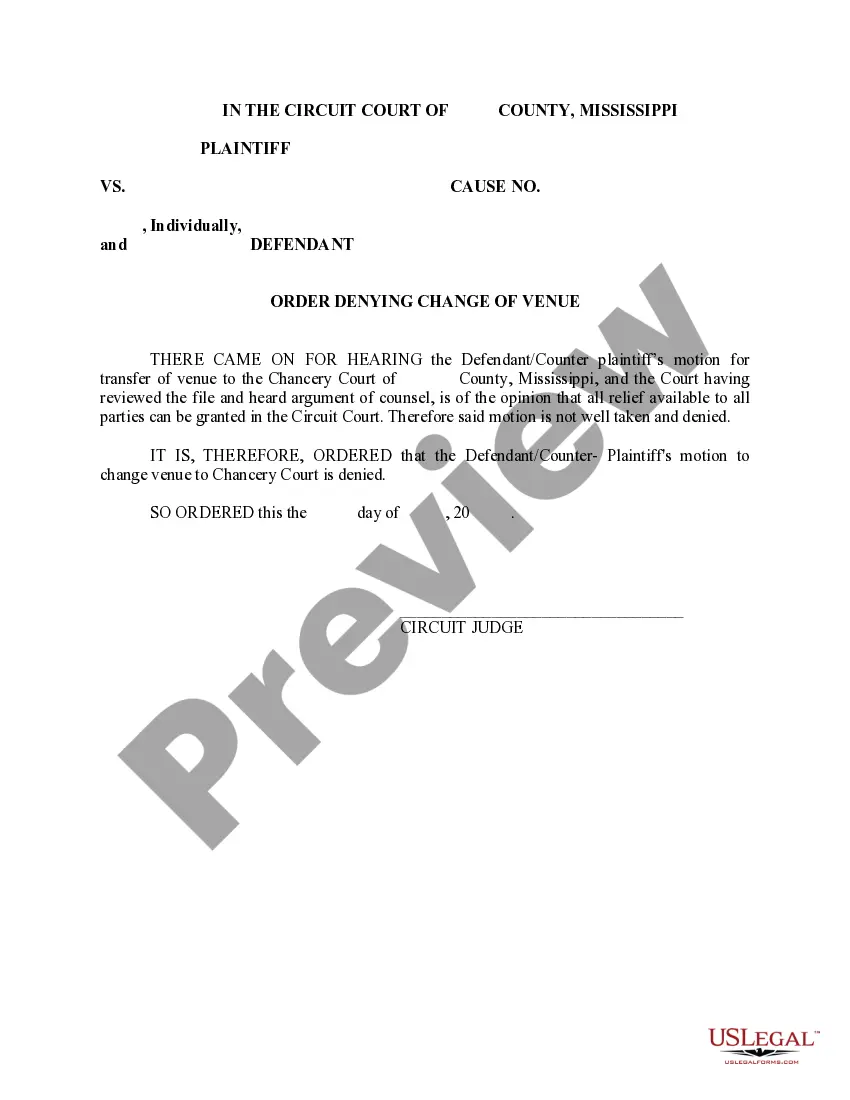
Mississippi Order Denying Change of Venue
What is this form?
The Order Denying Change of Venue is a legal document issued by a court that formally denies a request to transfer a case to a different court. This form serves as an official written statement signed by a judge, detailing the court's decision on the motion for a change of venue. It is essential to use this specific form rather than a generic order to ensure compliance with jurisdictional standards and requirements.
Key components of this form
- Title: Clearly identifies the order as denying a change of venue.
- Case caption: Provides the title of the case being addressed.
- Order statement: Contains the specific language denying the motion, detailing the ruling of the court.
- Signature line: Includes space for the judge's signature, validating the order.
- Date: Indicates when the order was signed.


Common use cases
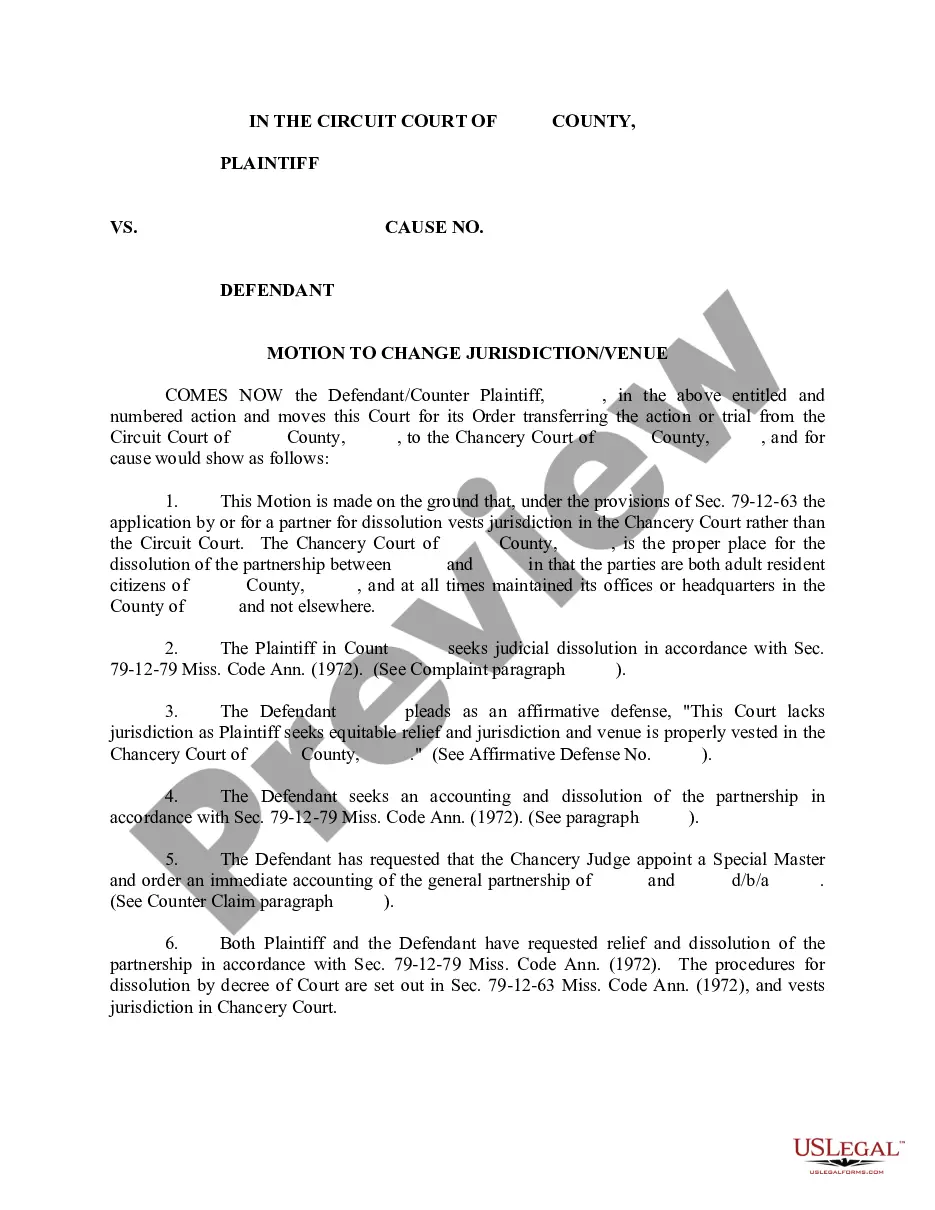
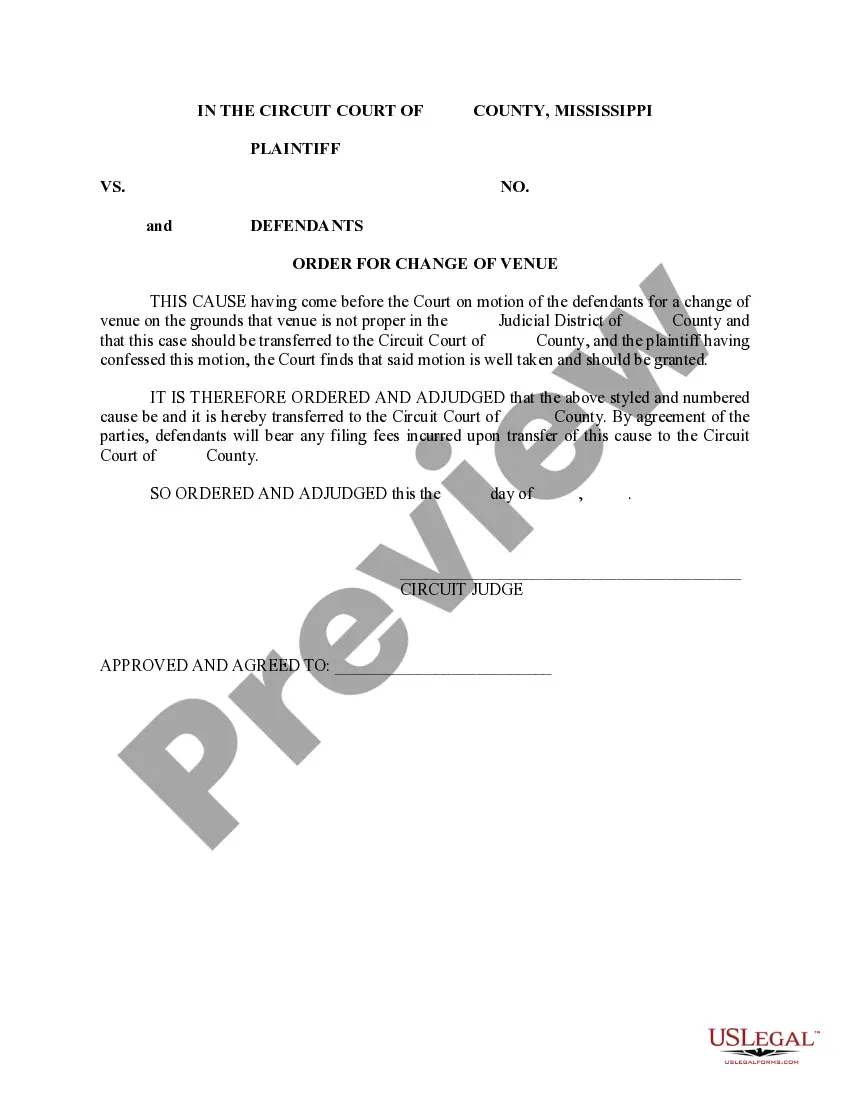
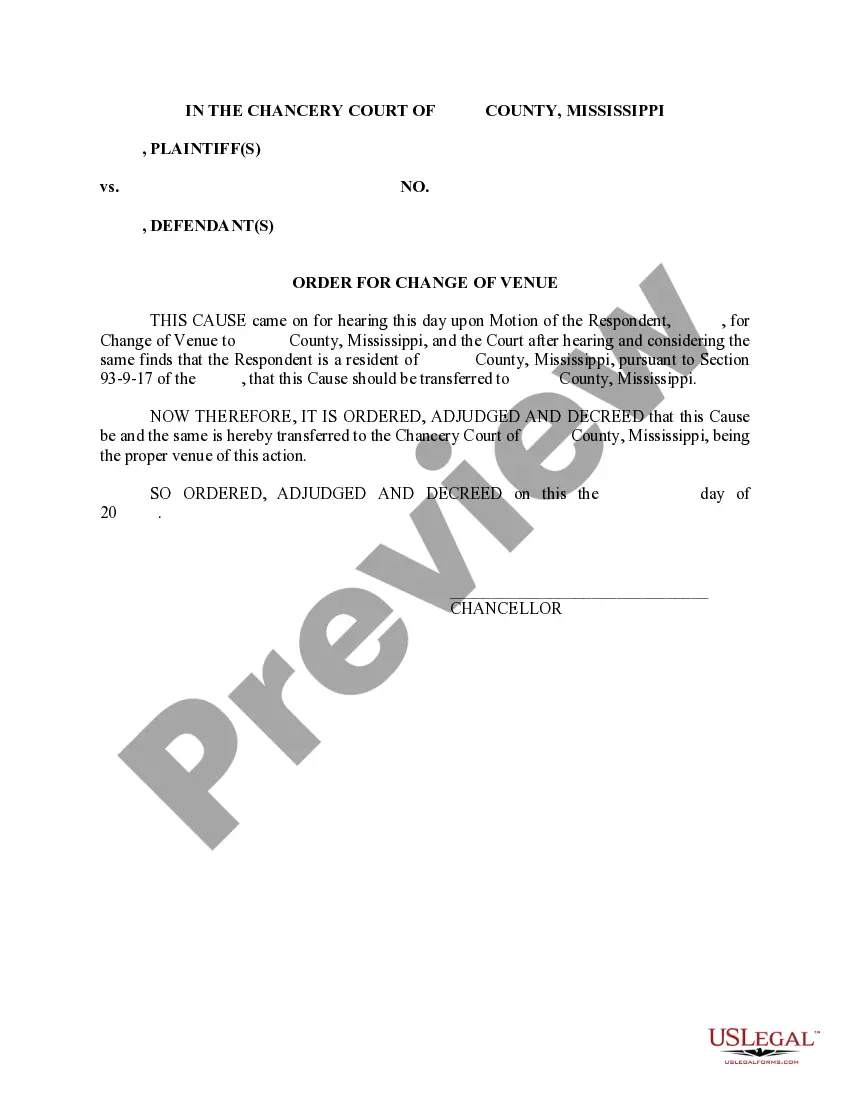
This form is used when a party has filed a motion requesting to change the venue of a case, typically due to claims of bias or inconvenience. If the court reviews the motion and determines that there is no legal basis to grant the request, it will issue an Order Denying Change of Venue. This form helps formalize that decision and serves as a record of the court's ruling.
Who this form is for
- Defendants or counter plaintiffs involved in a legal case requesting a venue change.
- Attorneys representing clients in a case who need to draft an order for the court.
- Individuals seeking to understand the court's decision regarding a motion to change venue.
Completing this form step by step
- Identify the case: Fill in the relevant case caption at the top of the form.
- State the order: Clearly indicate that the motion to change venue is denied.
- Include the judge's signature: Provide space for the judge's signature at the bottom of the form.
- Add the date: Insert the date when the order is signed.
- Review for accuracy: Ensure that all information is correct before submission to the court.
Does this document require notarization?
This form does not typically require notarization to be legally valid. However, some jurisdictions or document types may still require it. US Legal Forms provides secure online notarization powered by Notarize, available 24/7 for added convenience.
Get your form ready online
Our built-in tools help you complete, sign, share, and store your documents in one place.
Make edits, fill in missing information, and update formatting in US Legal Forms—just like you would in MS Word.
Download a copy, print it, send it by email, or mail it via USPS—whatever works best for your next step.
Sign and collect signatures with our SignNow integration. Send to multiple recipients, set reminders, and more. Go Premium to unlock E-Sign.
If this form requires notarization, complete it online through a secure video call—no need to meet a notary in person or wait for an appointment.
We protect your documents and personal data by following strict security and privacy standards.

Make edits, fill in missing information, and update formatting in US Legal Forms—just like you would in MS Word.

Download a copy, print it, send it by email, or mail it via USPS—whatever works best for your next step.

Sign and collect signatures with our SignNow integration. Send to multiple recipients, set reminders, and more. Go Premium to unlock E-Sign.

If this form requires notarization, complete it online through a secure video call—no need to meet a notary in person or wait for an appointment.

We protect your documents and personal data by following strict security and privacy standards.
Common mistakes to avoid
- Failure to include the correct case caption, leading to confusion regarding the order's context.
- Leaving out the date of the order, which is crucial for legal documentation.
- Not providing sufficient detail in the statement of denial, which could result in ambiguity.
Advantages of online completion
- Convenience: Downloadable forms allow you to complete the document at your own pace.
- Editability: Easily adapt the language and details to fit your specific case.
- Reliability: Forms drafted by licensed attorneys ensure compliance with current legal standards.
Looking for another form?
Form popularity
FAQ
A change of venue may be ordered by the Supreme Court where it is shown that the accused might be liquidated by his enemies in the place where the trial was originally scheduled to be held.
Reasons for changes of venue include pretrial publicity, bias, political atmosphere, and any other circumstance that the parties believe would prevent them from obtaining a fair trial in the county in which the case was originally filed.
If you are selected to serve on this Grand jury panel, you will serve approximately one to three days every month for an eighteen (18) month period.
A motion for change of venue ensures that a case is heard in the best location. There are two basic requirements that must be met before a court can hear a case. The first is jurisdiction, which means that the court has the authority to decide the legal issues which affect the rights of the parties in the case.
A change of venue is the legal term for moving a trial to a new location.A change of venue request because venue is improper means that the removing defendant believes that the case may not be in that venue because it is improper under procedural rules.
The criminal statute of limitations requires prosecutors to file criminal charges against a suspect within two years for misdemeanors and within five years for certain felonies, but there is no time limit in Mississippi for charges of murder, kidnapping, rape, burglary, robbery, larceny, and several other serious
Remanded means that whatever was before the court was sent usually to a lower court but here it might be to a file.
To achieve a change of venue, defendants typically have to show a reasonable likelihood that they can't receive a fair trial.Other reasons for a change of venue include: a judge who is prejudiced against the defendant, and. in capital cases, a jury pool that's predisposed for or against the death penalty.