Minnesota Ex Parte Order Waiving the Service and Filing Requirements of Rule 9.03 of Special Rules of Practice for Fourth Judicial District
Understanding this form
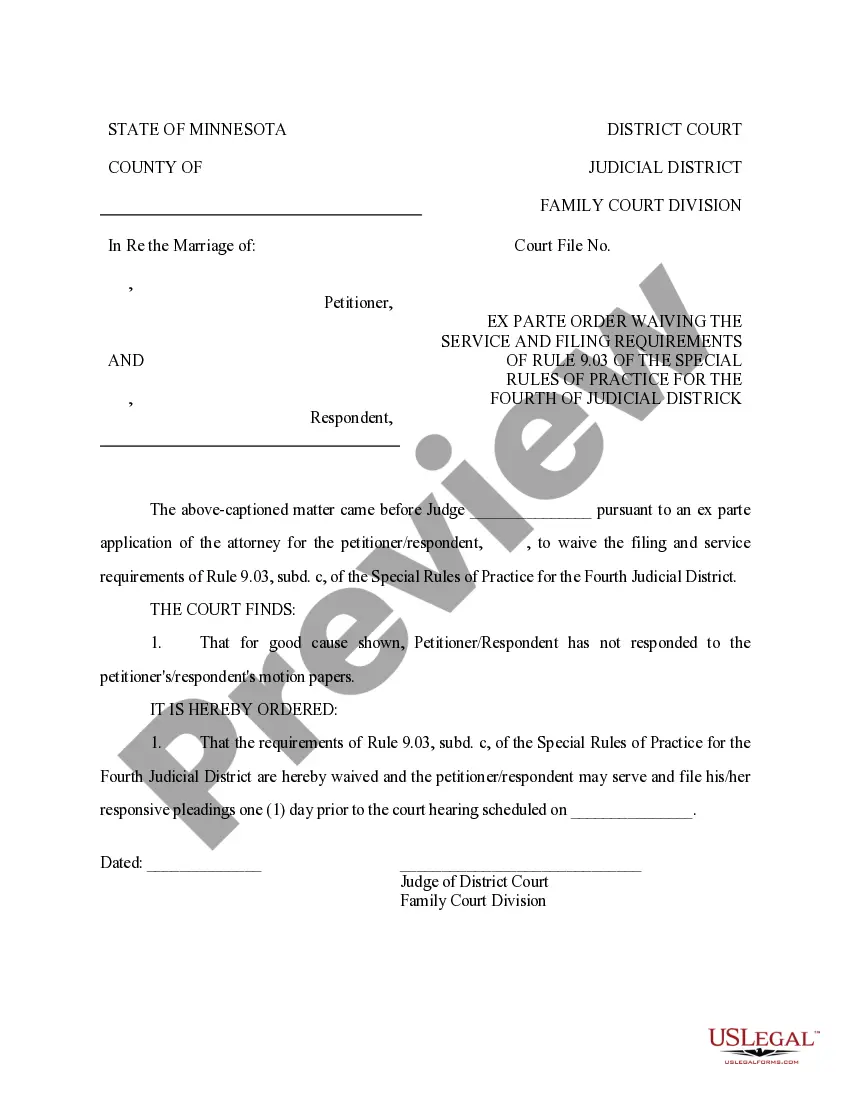
The Ex Parte Order Waiving the Service and Filing Requirements of Rule 9.03 is a legal document issued by a court. This order acknowledges that there was a delay in filing due to good cause and allows the involved parties to submit necessary documents close to the hearing date. This form is different from standard filing documents as it addresses specific procedural exceptions in the Fourth Judicial District.
Key parts of this document
- The name of the judge presiding over the case.
- Identification of the petitioner or respondent applying for the waiver.
- A statement of good cause for the delayed filing.
- Details on waiving the Rule 9.03 requirements.
- The date of the court hearing.
- Signature line for the judge indicating approval.
When to use this form
This form is used when a petitioner or respondent is unable to meet the regular filing and service requirements under Rule 9.03 due to circumstances that justify a delay. It is particularly relevant in urgent situations where time-sensitive legal actions are required, and it allows for a streamlined process as the hearing date approaches.
Who can use this document
This form is typically used by:
- Petitioners or respondents in cases pending in the Fourth Judicial District.
- Attorneys representing clients who need to adjust filing timelines.
- Individuals facing time constraints related to legal hearings.
How to prepare this document
- Identify the presiding judge and write their name in the designated field.
- Fill in the name of the petitioner or respondent seeking the waiver.
- Provide a clear explanation of the good cause for the delayed filing.
- Enter the date of the scheduled court hearing.
- Ensure the judge signs and dates the completed form.
Notarization requirements for this form
This form does not typically require notarization unless specified by local law. However, confirming local requirements is always advisable to ensure compliance.
Get your form ready online
Our built-in tools help you complete, sign, share, and store your documents in one place.
Make edits, fill in missing information, and update formatting in US Legal Forms—just like you would in MS Word.
Download a copy, print it, send it by email, or mail it via USPS—whatever works best for your next step.
Sign and collect signatures with our SignNow integration. Send to multiple recipients, set reminders, and more. Go Premium to unlock E-Sign.
If this form requires notarization, complete it online through a secure video call—no need to meet a notary in person or wait for an appointment.
We protect your documents and personal data by following strict security and privacy standards.

Make edits, fill in missing information, and update formatting in US Legal Forms—just like you would in MS Word.

Download a copy, print it, send it by email, or mail it via USPS—whatever works best for your next step.

Sign and collect signatures with our SignNow integration. Send to multiple recipients, set reminders, and more. Go Premium to unlock E-Sign.

If this form requires notarization, complete it online through a secure video call—no need to meet a notary in person or wait for an appointment.

We protect your documents and personal data by following strict security and privacy standards.
Common mistakes to avoid
- Failing to clearly state the good cause for the delay.
- Neglecting to include the court hearing date.
- Leaving the judge's name blank or incorrectly entered.
- Not having the form signed by the judge post-filing.
Why complete this form online
- Convenient access to legal forms anytime and anywhere.
- Easy editing capabilities to tailor the form to your specific needs.
- Reliable templates drafted by licensed attorneys ensure legal compliance.
Key takeaways
- The Ex Parte Order Waiving the Service and Filing Requirements allows for expedited filings.
- It is crucial to provide credible reasons for any delays in filing.
- This form is compliant with Fourth Judicial District stipulations and must be accurately completed.
Looking for another form?

Form popularity
FAQ
To lift a restraining order in Minnesota, you typically need to file a motion with the court that issued the order. This process may involve demonstrating a change in circumstances or showing that the safety concerns no longer exist. Utilizing a Minnesota Ex Parte Order Waiving the Service and Filing Requirements of Rule 9.03 of Special Rules of Practice for Fourth Judicial District can streamline this process, allowing you to bypass certain procedural steps. Consider using USLegalForms for guidance and resources to help navigate this legal procedure effectively.
The 63.03 rule of civil procedure in Minnesota allows the court to modify certain procedural requirements in specific cases. In the context of a Minnesota Ex Parte Order Waiving the Service and Filing Requirements of Rule 9.03 of Special Rules of Practice for Fourth Judicial District, this rule provides flexibility in how cases proceed. It enables parties to expedite legal processes without adhering to standard service and filing protocols. This can be particularly beneficial in urgent situations where time is critical.
Someone might file an ex parte for several reasons, primarily to seek immediate relief when waiting for a standard hearing could cause harm. This could include situations involving domestic violence, child custody, or financial emergencies. Utilizing a Minnesota Ex Parte Order Waiving the Service and Filing Requirements of Rule 9.03 of Special Rules of Practice for Fourth Judicial District can be crucial for individuals needing urgent legal intervention.
In Minnesota, service by mail is generally allowed, but specific rules apply. For certain cases, including those involving ex parte motions, the court may waive the requirement for personal service altogether. This is particularly relevant when dealing with a Minnesota Ex Parte Order Waiving the Service and Filing Requirements of Rule 9.03 of Special Rules of Practice for Fourth Judicial District, as it expedites the legal process.
An ex parte order in Minnesota is a legal directive issued by a court without the presence of all parties involved. This order is typically sought in urgent situations where immediate intervention is necessary to protect a party’s rights or interests. The Minnesota Ex Parte Order Waiving the Service and Filing Requirements of Rule 9.03 of Special Rules of Practice for Fourth Judicial District allows individuals to bypass standard notification processes to expedite legal action.
While ex parte orders can provide quick relief, they also carry disadvantages. One significant concern is that the absent party may not have the opportunity to present their side, which could lead to unfair outcomes. Additionally, there may be limited legal recourse available once an ex parte order is granted under the Minnesota Ex Parte Order Waiving the Service and Filing Requirements of Rule 9.03 of Special Rules of Practice for Fourth Judicial District.
Rule 63.03 in Minnesota pertains to the ability of a judge to act in the absence of a party when circumstances require immediate action. This rule generally allows the court to prioritize urgent matters, ensuring that justice can be served without undue delay. It is particularly relevant in cases involving a Minnesota Ex Parte Order Waiving the Service and Filing Requirements of Rule 9.03 of Special Rules of Practice for Fourth Judicial District.
After an ex parte order is issued, the court may take immediate action based on the information provided by the requesting party. The other party is usually notified of this decision shortly thereafter, and they often have the opportunity to contest the order in a later hearing. Understanding this process is essential, especially when dealing with a Minnesota Ex Parte Order Waiving the Service and Filing Requirements of Rule 9.03 of Special Rules of Practice for Fourth Judicial District.
When a case is ex parte, it means that one party is presenting their case to the court without the presence of the other party. This typically occurs in situations where immediate action is necessary, and notifying the other party could cause harm or impede justice. In Minnesota, an ex parte order can be obtained under the Minnesota Ex Parte Order Waiving the Service and Filing Requirements of Rule 9.03 of Special Rules of Practice for Fourth Judicial District. This allows for quicker resolutions in urgent matters.