Minnesota Mediation Clause for Uncontested Divorce - for use in Dissolution Agreement
About this form
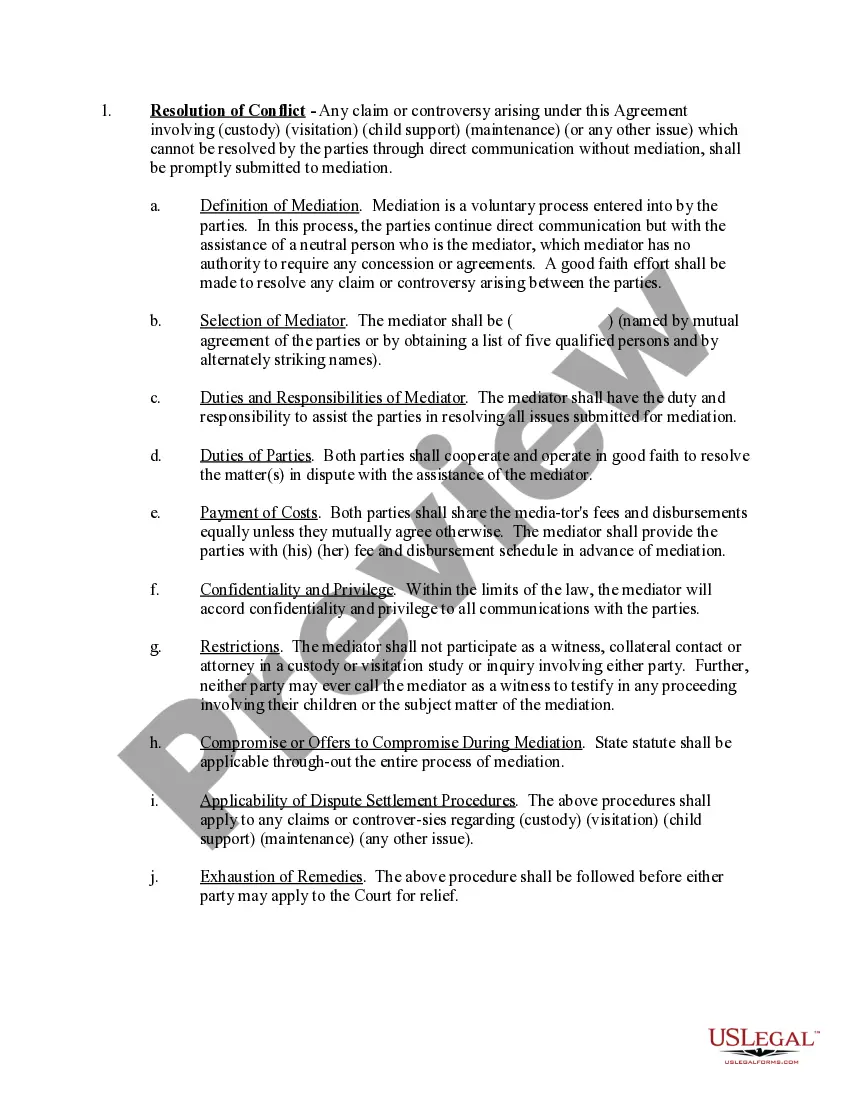
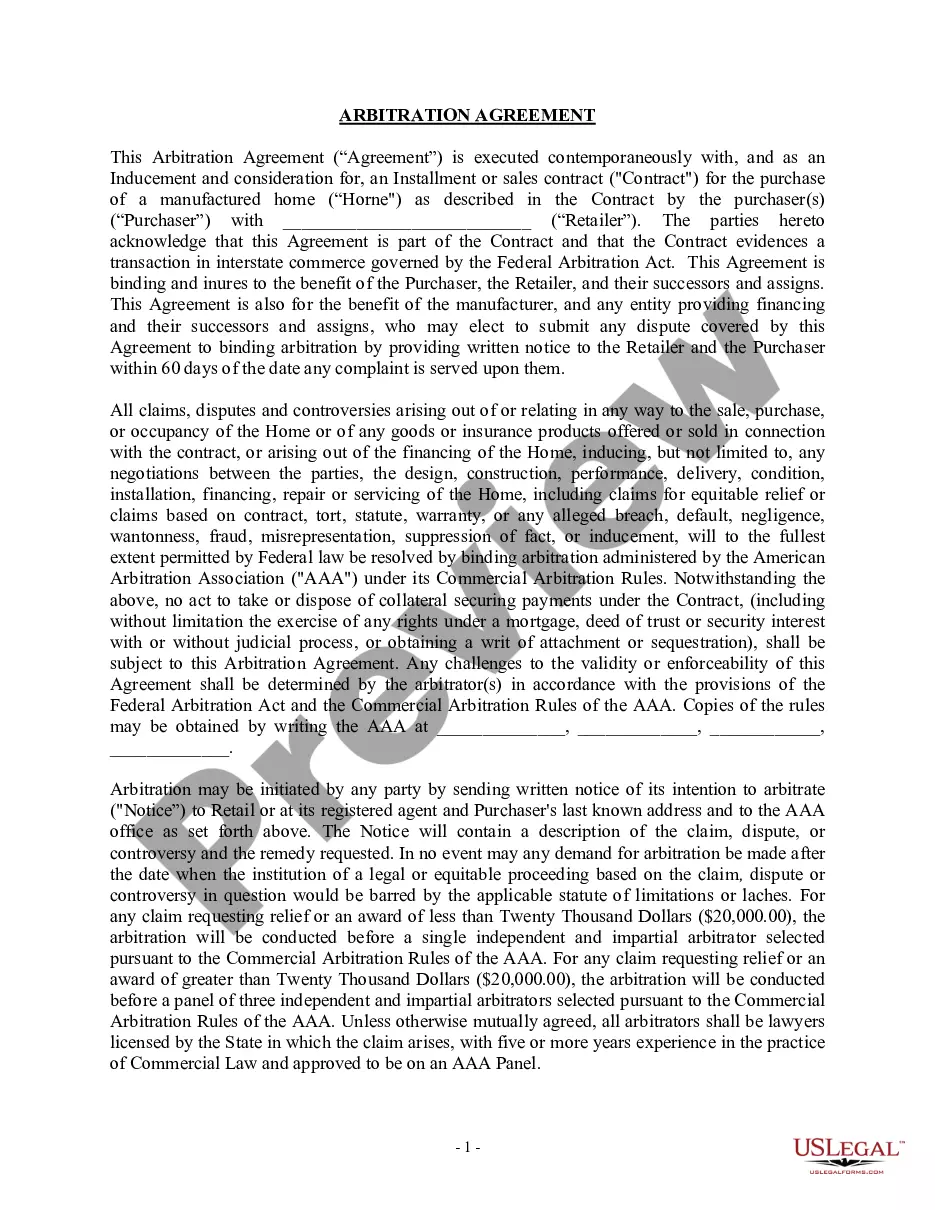
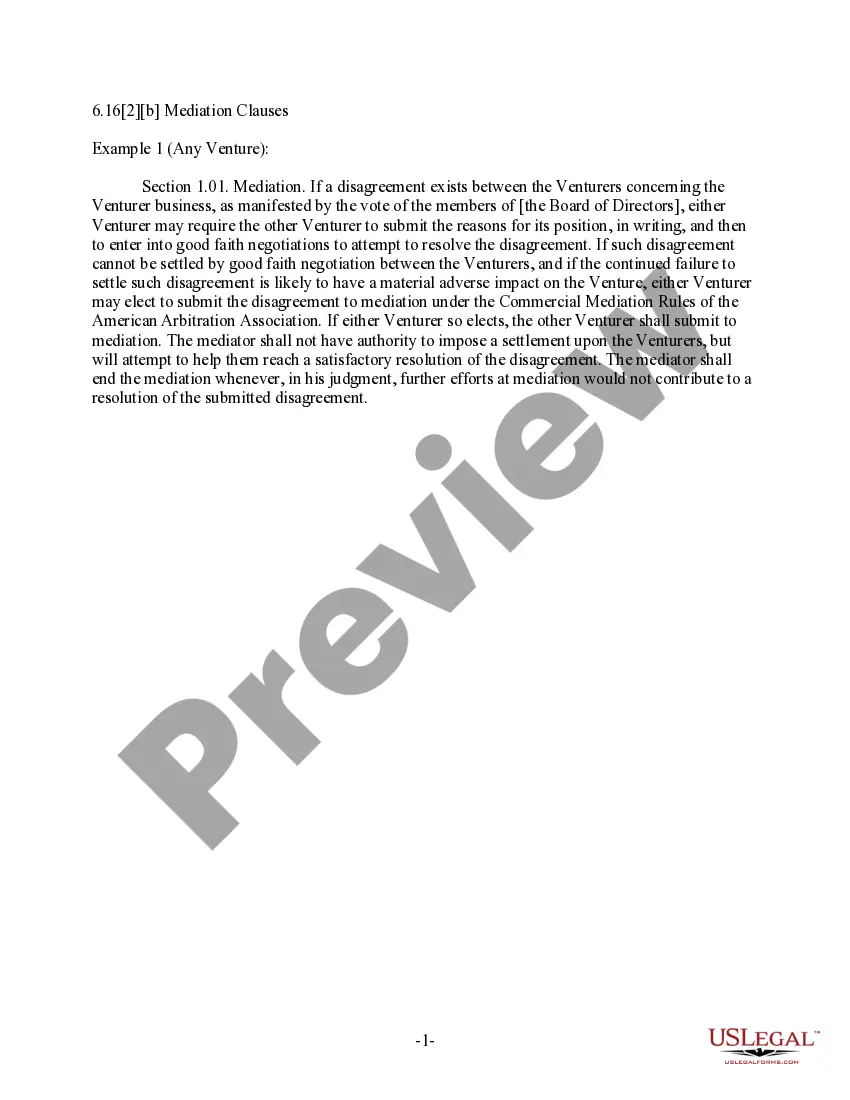
The mediation clause for uncontested divorce is a legal document used within a dissolution agreement to outline the procedures for resolving conflicts that may arise between the parties, such as issues related to child custody, visitation, and support. This form serves to facilitate a amicable negotiation process, whereby both parties can communicate effectively under the guidance of a neutral mediator, unlike other forms that may require court intervention from the outset.
What’s included in this form
- Definition of mediation and its voluntary nature.
- Process for the selection of a mediator by mutual agreement.
- Duties and responsibilities of the mediator, ensuring professional neutrality.
- Expectation for both parties to cooperate in good faith during mediation.
- Clear terms related to payment of mediator costs and potential confidentiality agreements.
- Restrictions on the mediator's involvement in future legal proceedings.

Situations where this form applies
This form is particularly useful during an uncontested divorce when both parties agree on the need for mediation to resolve any disputes that may arise regarding child custody, visitation rights, support obligations, and maintenance. It should be utilized when both parties prefer to reach an agreement outside of court, maintaining control over the process and prioritizing the well-being of any children involved.
Intended users of this form
- Couples undergoing an uncontested divorce.
- Parties wanting to resolve child-related issues amicably.
- Individuals seeking to maintain a collaborative approach in their divorce process.
- Those wishing to establish clear guidelines for mediation proceedings.
How to complete this form
- Identify the names of both parties involved in the mediation.
- Designate the mediator either by mutual agreement or through a provided selection process.
- Outline the responsibilities and duties of the mediator within the document.
- Insert any specific terms regarding the sharing of mediation costs.
- Ensure that both parties agree to maintain confidentiality throughout the mediation process.
Does this document require notarization?
This form does not typically require notarization to be legally valid. However, some jurisdictions or document types may still require it. US Legal Forms provides secure online notarization powered by Notarize, available 24/7 for added convenience.
Get your form ready online
Our built-in tools help you complete, sign, share, and store your documents in one place.
Make edits, fill in missing information, and update formatting in US Legal Forms—just like you would in MS Word.
Download a copy, print it, send it by email, or mail it via USPS—whatever works best for your next step.
Sign and collect signatures with our SignNow integration. Send to multiple recipients, set reminders, and more. Go Premium to unlock E-Sign.
If this form requires notarization, complete it online through a secure video call—no need to meet a notary in person or wait for an appointment.
We protect your documents and personal data by following strict security and privacy standards.

Make edits, fill in missing information, and update formatting in US Legal Forms—just like you would in MS Word.

Download a copy, print it, send it by email, or mail it via USPS—whatever works best for your next step.

Sign and collect signatures with our SignNow integration. Send to multiple recipients, set reminders, and more. Go Premium to unlock E-Sign.

If this form requires notarization, complete it online through a secure video call—no need to meet a notary in person or wait for an appointment.

We protect your documents and personal data by following strict security and privacy standards.
Avoid these common issues
- Failing to clearly name the mediator or skipping the selection process.
- Not specifying payment responsibilities, leading to disputes later.
- Ignoring confidentiality clauses, potentially jeopardizing the mediation process.
- Assuming all issues can be mediated without prior discussion of major concerns.
Why use this form online
- Convenience of downloading and completing the form at your own pace.
- Reduced time and cost compared to drafting a form from scratch.
- Access to templates created by licensed attorneys, ensuring legal reliability.
- Opportunity to edit and customize the form to fit specific needs.
Legal use & context
- Mediation clauses, when included in a dissolution agreement, are typically enforceable in court.
- Such clauses are often recognized for providing a structured approach to conflict resolution.
- Limitations may apply, such as jurisdictions requiring specific language or formats in mediation agreements.
What to keep in mind
- The mediation clause for uncontested divorce outlines the resolution methods for disputes.
- Using this form ensures a structured mediation process focused on cooperation.
- Parties must engage in good faith and maintain confidentiality throughout mediation.
- Consult local laws to ensure the clause adheres to specific state requirements.
Looking for another form?

Form popularity
FAQ
Yes, you can refuse mediation in a divorce if you feel it is not suitable for your situation. While mediation can be a helpful tool, it is ultimately your choice whether to participate. If you decide against mediation, remember that having a Minnesota Mediation Clause for Uncontested Divorce - for use in Dissolution Agreement can still give you the option to mediate in the future, should you change your mind.
As mentioned earlier, mediation is not a legal requirement for divorce in Minnesota. However, it often proves beneficial for couples seeking to minimize conflict and expedite their divorce process. Including a Minnesota Mediation Clause for Uncontested Divorce - for use in Dissolution Agreement can provide a structured framework for resolving disagreements should they arise.
A Rule 114 neutral is a trained mediator who helps couples navigate divorce issues under Minnesota law. Their role is to facilitate discussions and assist in resolving conflicts, helping both parties reach a mutually agreeable outcome. Utilizing a Minnesota Mediation Clause for Uncontested Divorce - for use in Dissolution Agreement can enhance the effectiveness of a Rule 114 neutral, ensuring that your divorce process is as smooth as possible.
Mediation is not required for divorce in Minnesota, but it is highly encouraged. Many couples find that mediation helps them resolve disputes more amicably and efficiently. By incorporating a Minnesota Mediation Clause for Uncontested Divorce - for use in Dissolution Agreement, you can prioritize a peaceful resolution, making the process less stressful for both parties.
Yes, you can apply for a divorce without mediation in Minnesota. Mediation is not mandatory, but it can be a beneficial step in reaching an amicable resolution. If you decide to forego mediation, you may want to consider including a Minnesota Mediation Clause for Uncontested Divorce - for use in Dissolution Agreement later on, as it might still aid in reaching agreements on contentious issues.
Yes, you can use a mediator to help create a separation agreement. A mediator facilitates communication between both parties, ensuring that the terms are fair and mutually acceptable. This process can lead to a Minnesota Mediation Clause for Uncontested Divorce - for use in Dissolution Agreement, which can simplify the divorce proceedings and reduce conflict.
The settlement agreement in an uncontested divorce is ratified through court approval. Once both parties reach an agreement, they file the necessary paperwork with the court. By including the Minnesota Mediation Clause for Uncontested Divorce - for use in Dissolution Agreement, you ensure that your terms are clearly outlined, making it easier for the court to approve your settlement.
Moving out during a divorce can create misunderstandings and impact your legal rights. By leaving, you may unintentionally give up claims to assets or custody arrangements. Staying put can demonstrate your commitment to equitable solutions, and referencing the Minnesota Mediation Clause for Uncontested Divorce - for use in Dissolution Agreement can help establish clear terms while you navigate this challenging transition.
Yes, your ex can take you to court without mediation, but this can complicate matters. Mediation provides a structured environment for resolving disputes, which can lead to better outcomes. Utilizing the Minnesota Mediation Clause for Uncontested Divorce - for use in Dissolution Agreement may help you avoid court altogether and save time and resources.
Uncontested divorce and mediation are related but not identical. An uncontested divorce occurs when both spouses agree on all terms, allowing for a smoother process. Mediation, on the other hand, involves a neutral third party helping couples reach an agreement. You can use the Minnesota Mediation Clause for Uncontested Divorce - for use in Dissolution Agreement to facilitate discussions and ensure a fair resolution.