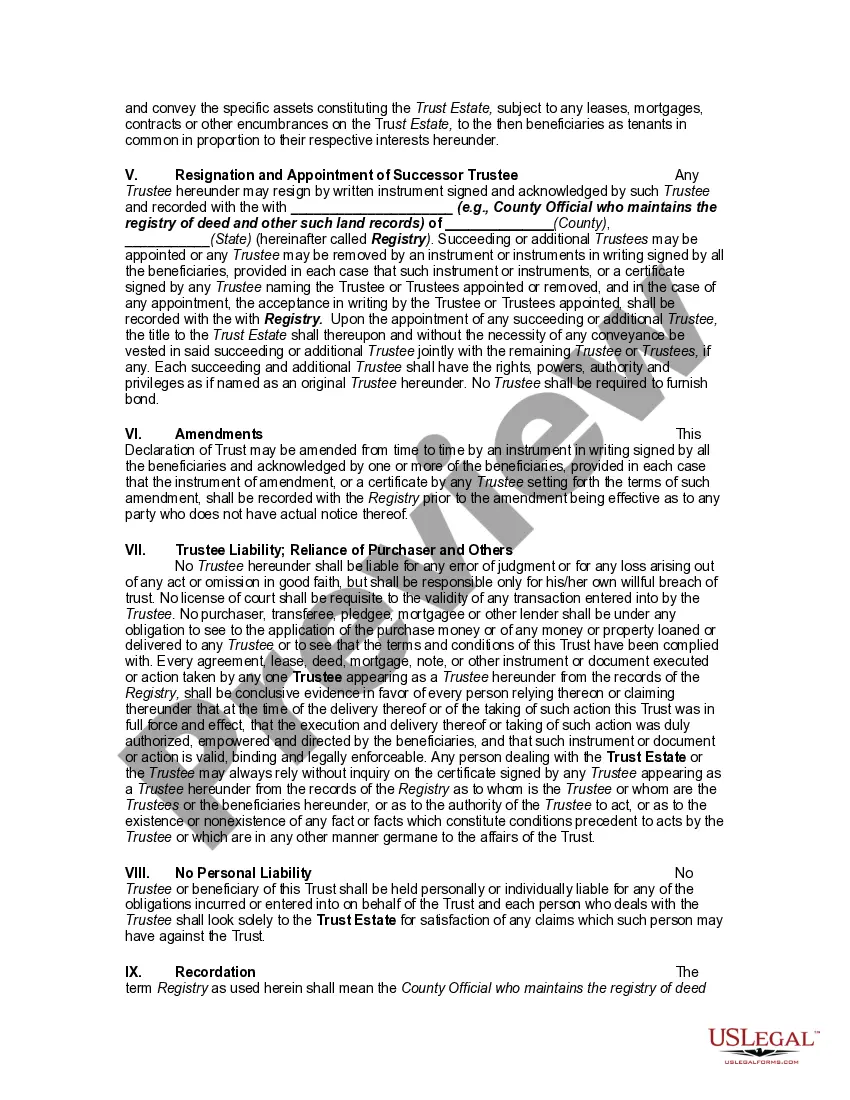
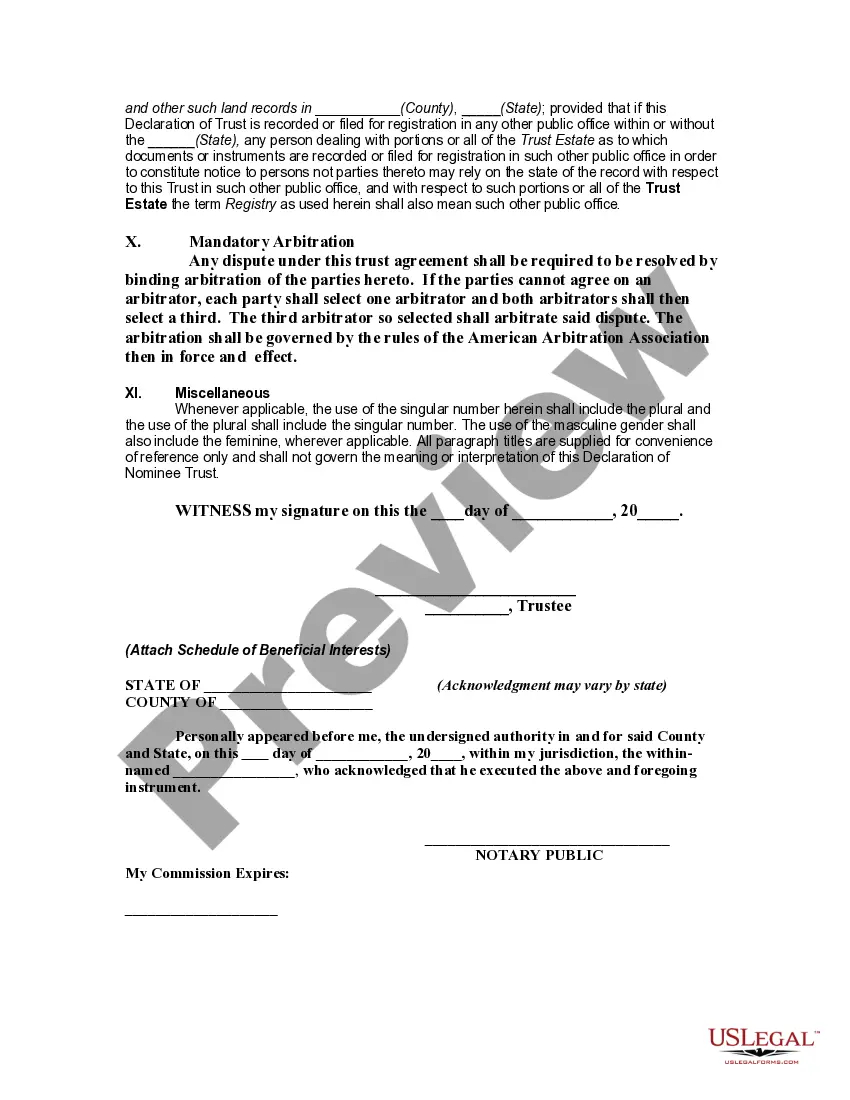
A nominee trust is a trust in which the trustee holds legal title to the trust property for the trust's beneficiaries, but the beneficiaries exercise the controlling powers, and the actions that the trustees may take on their own are very limited. Such trusts are a common device for holding title to real estate, and afford certain tax advantages. A nominee trust is not a trust in the strict classical sense, because of the trustee-beneficiary relationship. Despite a nominee trust's nontraditional relationship between trustee and beneficiary, such a trust must still adhere to the rule that no trust exists when the same individual is the sole settlor, sole trustee, and sole beneficiary. The trustees of a nominee trust act at the direction of the beneficiaries.
Michigan Nominee Trust
Description
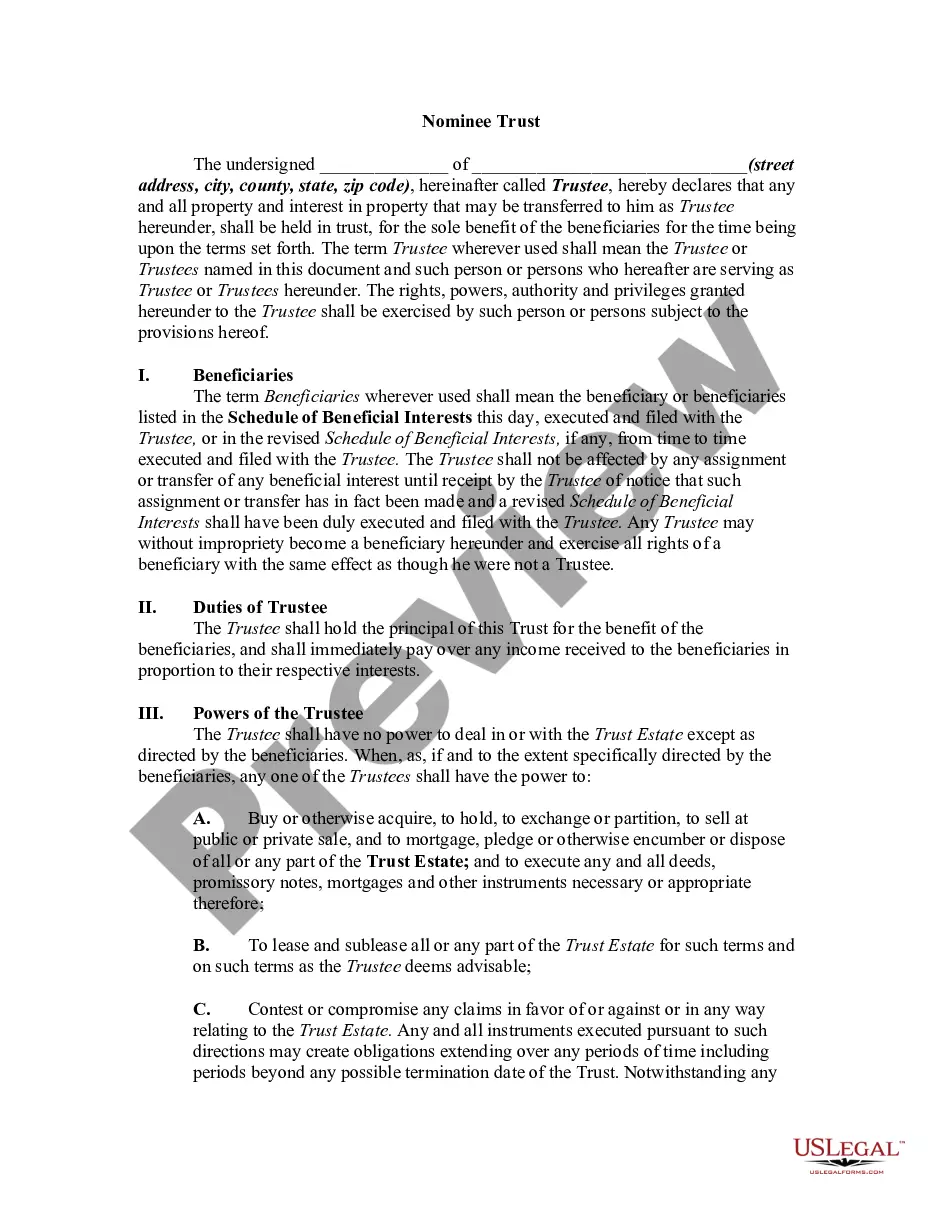

Get your form ready online
Our built-in tools help you complete, sign, share, and store your documents in one place.
Make edits, fill in missing information, and update formatting in US Legal Forms—just like you would in MS Word.
Download a copy, print it, send it by email, or mail it via USPS—whatever works best for your next step.
Sign and collect signatures with our SignNow integration. Send to multiple recipients, set reminders, and more. Go Premium to unlock E-Sign.
If this form requires notarization, complete it online through a secure video call—no need to meet a notary in person or wait for an appointment.
We protect your documents and personal data by following strict security and privacy standards.

Make edits, fill in missing information, and update formatting in US Legal Forms—just like you would in MS Word.

Download a copy, print it, send it by email, or mail it via USPS—whatever works best for your next step.

Sign and collect signatures with our SignNow integration. Send to multiple recipients, set reminders, and more. Go Premium to unlock E-Sign.

If this form requires notarization, complete it online through a secure video call—no need to meet a notary in person or wait for an appointment.

We protect your documents and personal data by following strict security and privacy standards.
Looking for another form?
How to fill out Nominee Trust?
Are you in the position where you require documents for potentially business or personal purposes almost every time.
There are numerous legal form templates available online, but finding reliable ones isn't straightforward. US Legal Forms provides a vast array of form templates, such as the Michigan Nominee Trust, designed to meet state and federal requirements.
If you are already familiar with the US Legal Forms website and possess an account, simply Log In. After that, you can download the Michigan Nominee Trust template.
Access all the form templates you have purchased in the My documents section. You can obtain an additional copy of the Michigan Nominee Trust at any time if needed. Just select the required form to download or print the document template.
Utilize US Legal Forms, the most extensive collection of legal forms, to save time and avoid mistakes. The service offers well-crafted legal document templates that can be used for various purposes. Create an account on US Legal Forms and start simplifying your life.
- Obtain the form you need and ensure it is for your correct city/state.
- Utilize the Preview feature to review the form.
- Check the summary to confirm you have selected the accurate form.
- If the form isn't what you are looking for, use the Search field to find the form that fits your needs and requirements.
- Once you find the correct form, click Get now.
- Choose the pricing plan you prefer, fill in the necessary details to create your account, and pay for your order using your PayPal or Visa or Mastercard.
- Select a convenient file format and download your copy.
Form popularity
FAQ
TRUST REGISTRATION If an individual has created a Trust, he or she may want to register it with the Probate Court. To do so, the individual must complete the Trust Registration form, PC 610 and submit it to the Probate Court along with a $25 filing fee.
You are entitled to a copy of the Trust if you are a direct beneficiary. A direct beneficiary is a person who receives an immediate benefit from the trust. For example, if the trust is created and you have been given an immediate right to some portion of the income of the trust, then you are a direct beneficiary.
This generally means you must be a beneficiary or have a financial interest that would be directly impacted by the trust. Timely Filing: Trust contests must be filed within the specified time limits. In Michigan, you generally have one year from the date the trust was made known to file a contest.
The cost of setting up a trust in Michigan varies depending on the complexity of the trust and the attorney's fees. A basic Revocable Living Trust generally ranges from $1,000 to $3,000. More complex trusts can cost several thousand dollars more.
Anyone listed as a trust beneficiary will be entitled to receive a copy of the Trust. Additionally, an heir of the settlor is entitled to a copy of the Trust.
(l) "Trust beneficiary" means a person to whom 1 or both of the following apply: (i) The person has a present or future beneficial interest in a trust, vested or contingent. (ii) The person holds a power of appointment over trust property in a capacity other than that of trustee or trust director.
The grantor can opt to have the beneficiaries receive trust property directly without any restrictions. The trustee can write the beneficiary a check, give them cash, and transfer real estate by drawing up a new deed or selling the house and giving them the proceeds.