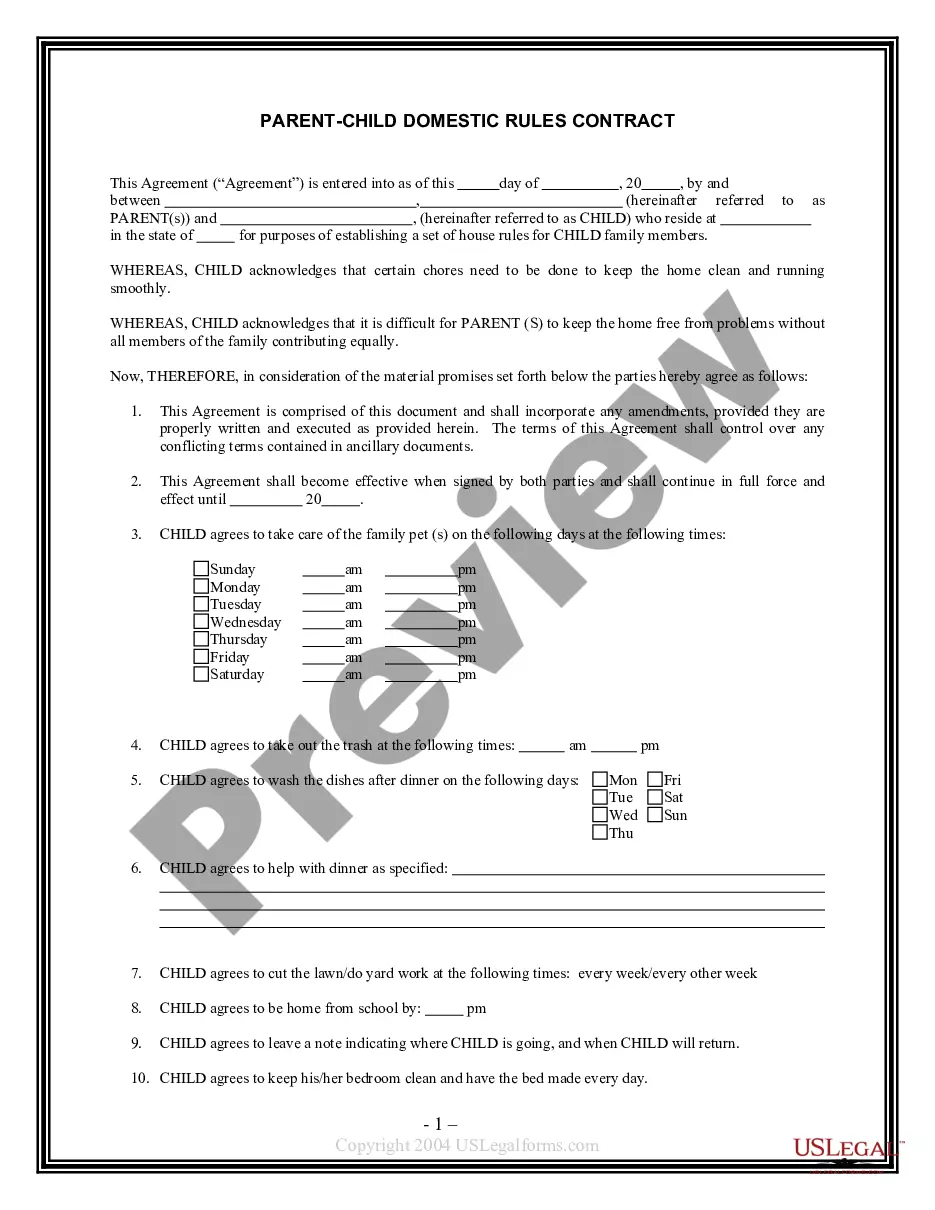
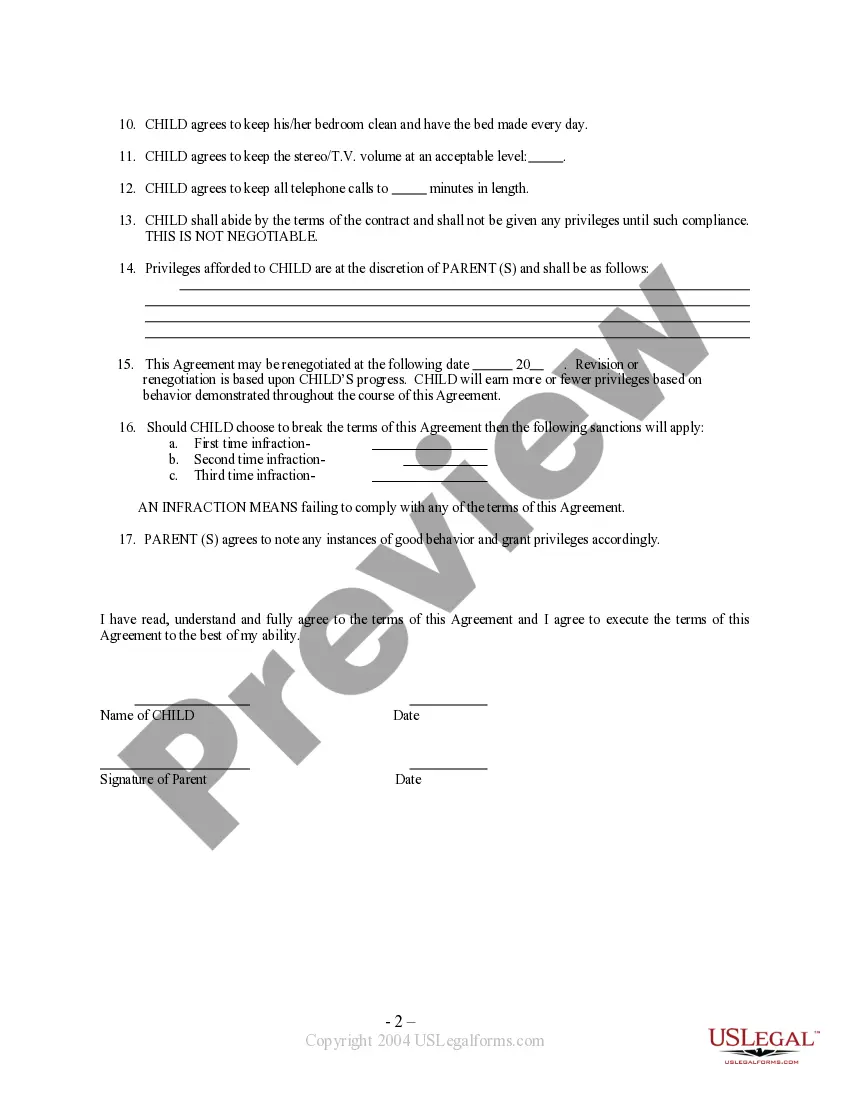
This is a contract between parent(s) and child indicating what chores are expected of child, and on what days and times child is expected to complete the chores. This contract also lists what privileges will be extended for abiding by the contract and what repercussions will follow for breaking the contract.
Maine Parent - Child Domestic Rules Contract
Category:
State:
Multi-State
Control #:
US-PC08
Format:
Word;
Rich Text
Instant download
Description
Free preview
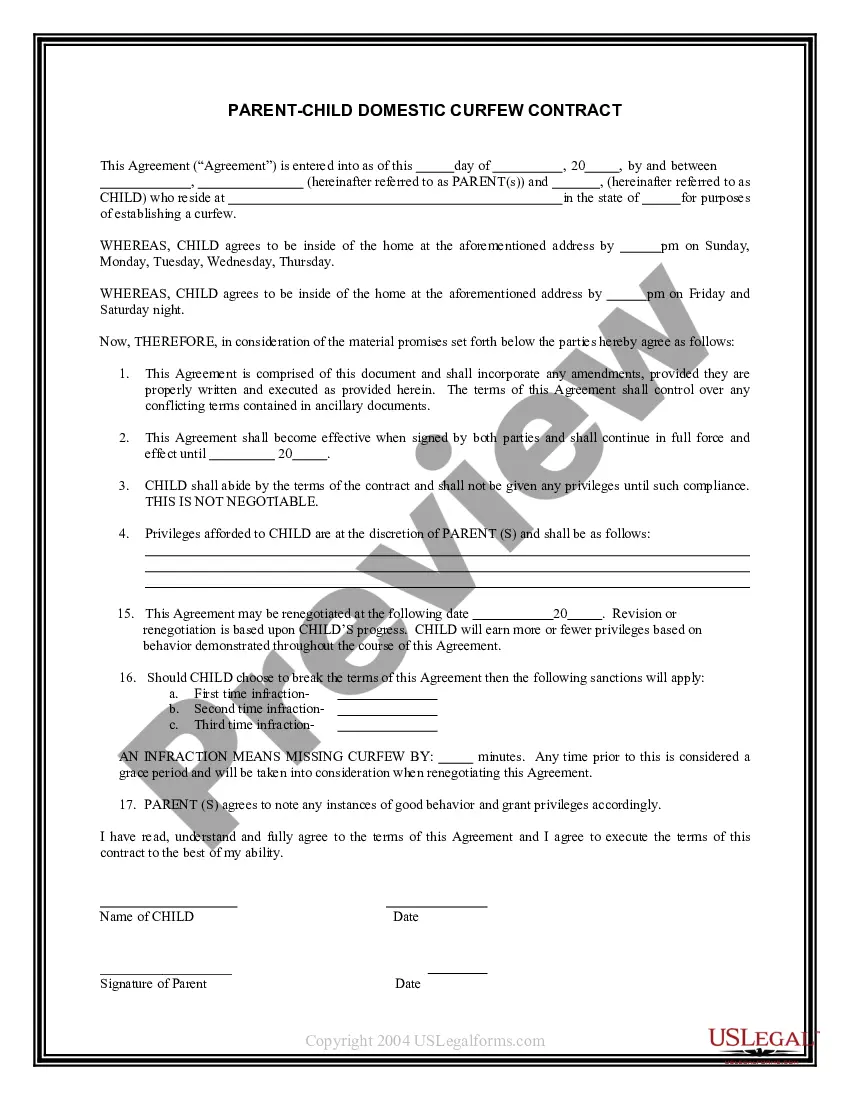
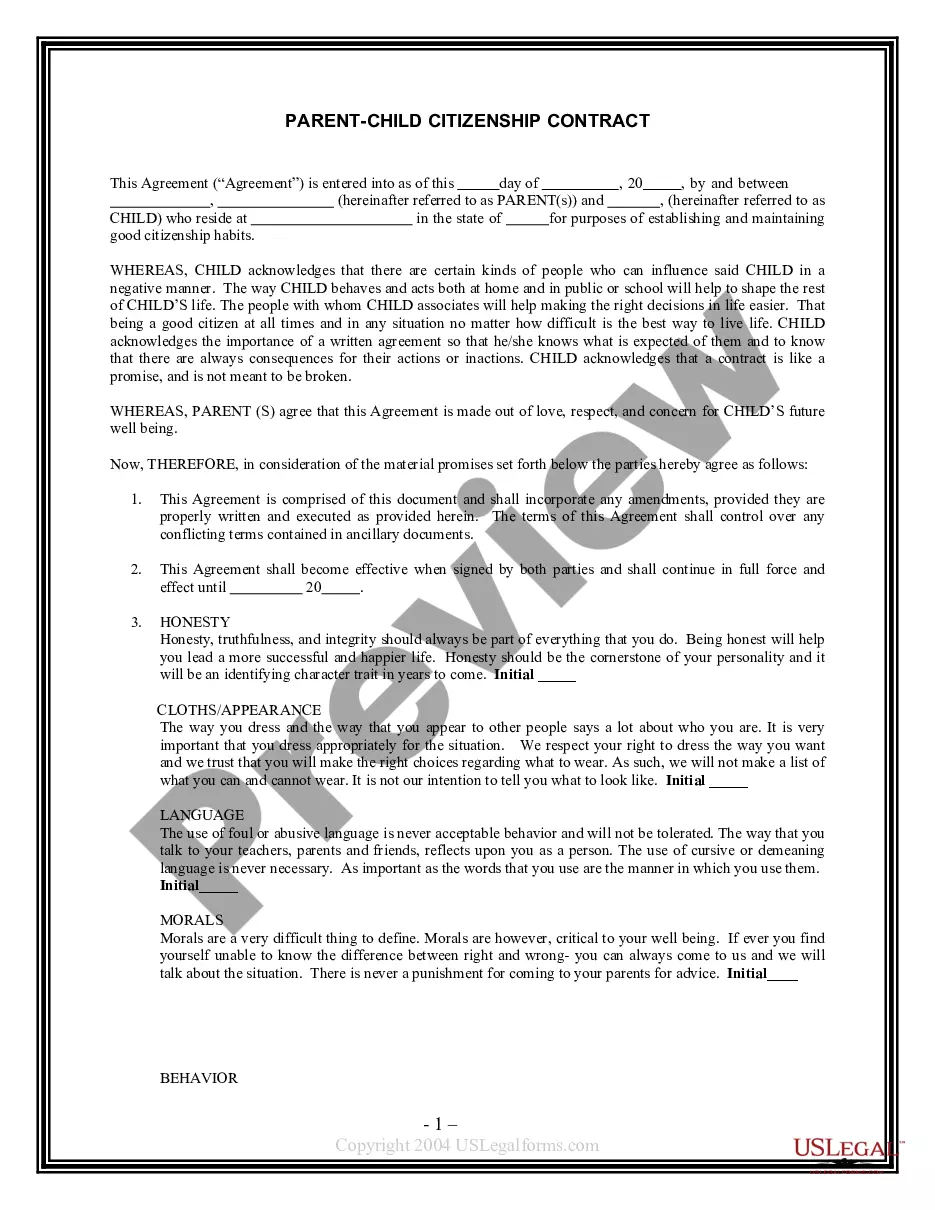
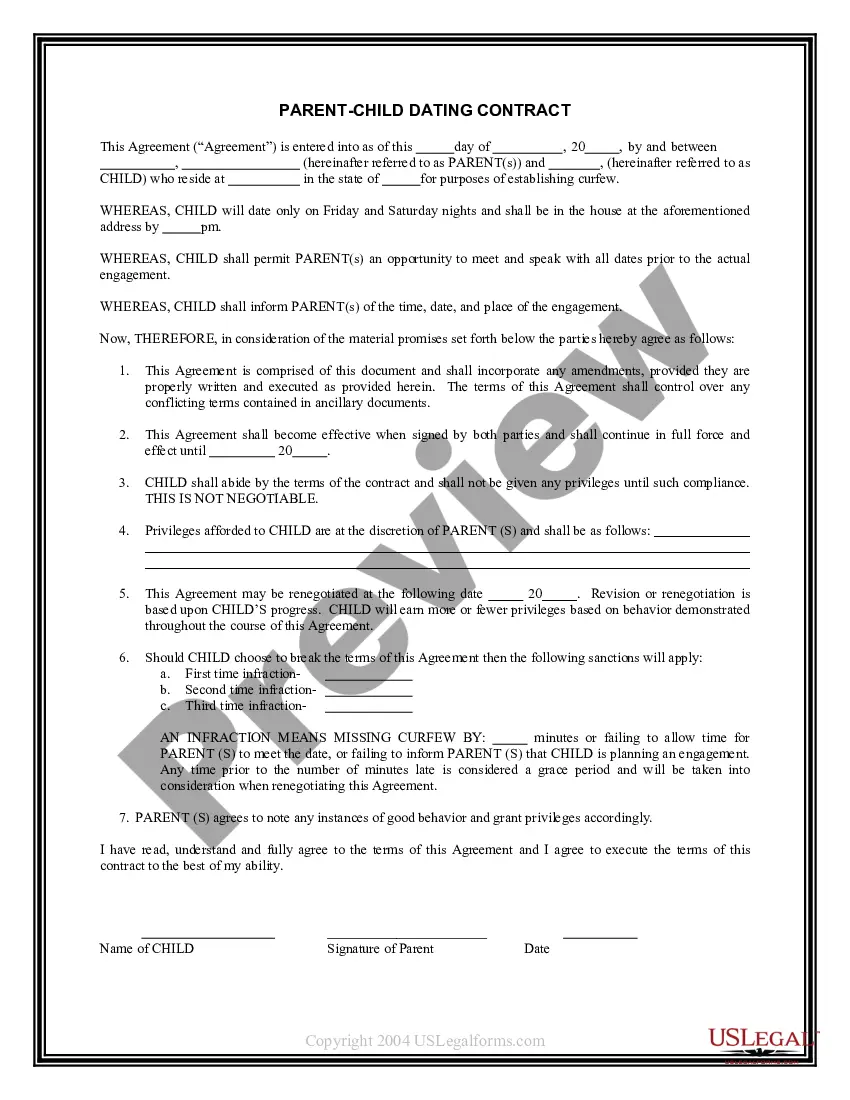
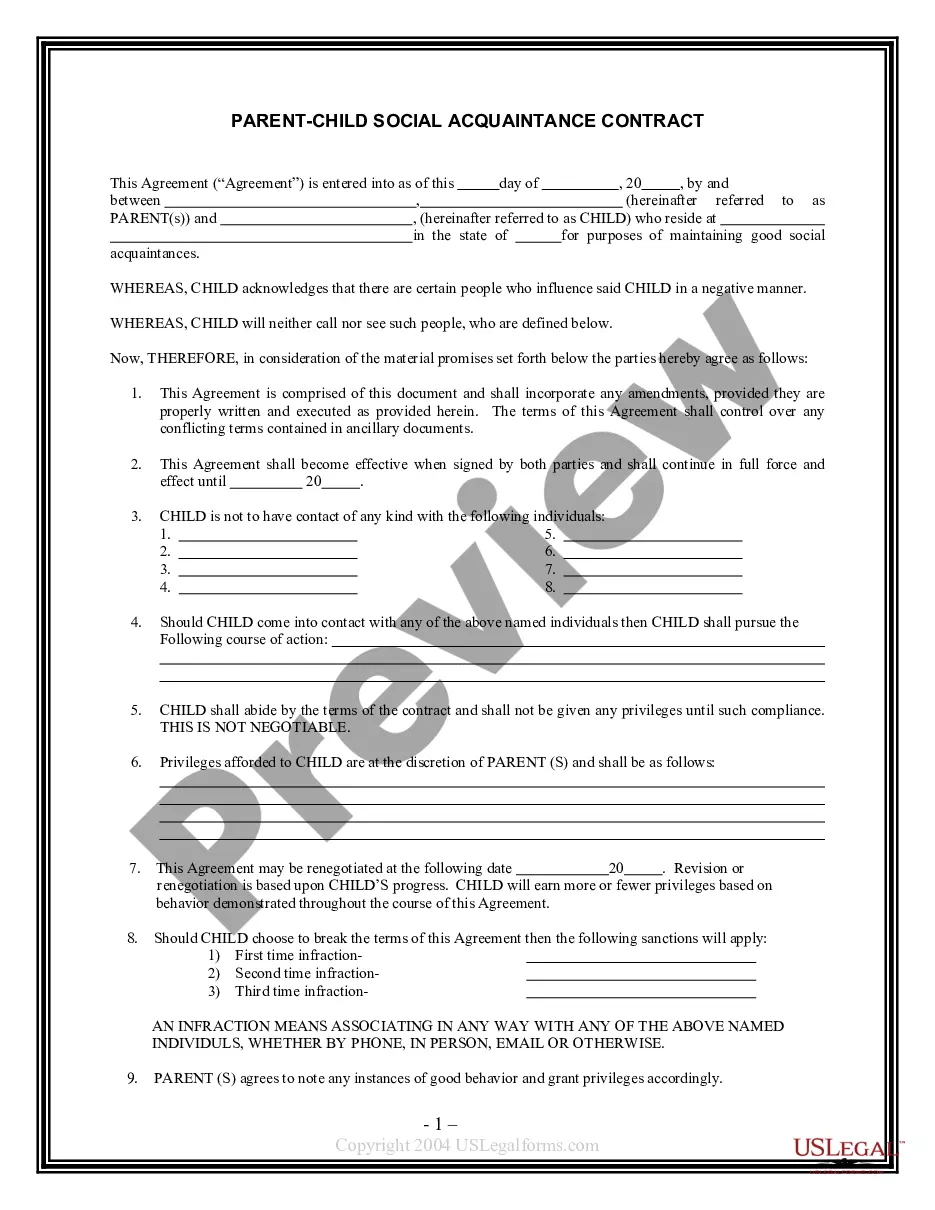
Get your form ready online
Our built-in tools help you complete, sign, share, and store your documents in one place.
Built-in online Word editor
Make edits, fill in missing information, and update formatting in US Legal Forms—just like you would in MS Word.
Export easily
Download a copy, print it, send it by email, or mail it via USPS—whatever works best for your next step.
E-sign your document
Sign and collect signatures with our SignNow integration. Send to multiple recipients, set reminders, and more. Go Premium to unlock E-Sign.
Notarize online 24/7
If this form requires notarization, complete it online through a secure video call—no need to meet a notary in person or wait for an appointment.
Store your document securely
We protect your documents and personal data by following strict security and privacy standards.

Make edits, fill in missing information, and update formatting in US Legal Forms—just like you would in MS Word.

Download a copy, print it, send it by email, or mail it via USPS—whatever works best for your next step.

Sign and collect signatures with our SignNow integration. Send to multiple recipients, set reminders, and more. Go Premium to unlock E-Sign.

If this form requires notarization, complete it online through a secure video call—no need to meet a notary in person or wait for an appointment.

We protect your documents and personal data by following strict security and privacy standards.
Looking for another form?


How to fill out Parent - Child Domestic Rules Contract?
It is feasible to spend hours on the web searching for the legal document template that meets the state and federal criteria you require.
US Legal Forms offers a vast array of legal documents that are reviewed by professionals.
You can conveniently download or print the Maine Parent - Child Domestic Rules Contract from the platform.
If available, use the Review button to examine the document template as well. If you wish to find another version of the form, use the Search field to locate the template that best fits your needs and requirements. Once you have located the template you want, click on Get now to proceed. Choose the pricing plan you prefer, enter your information, and register for an account on US Legal Forms. Complete the transaction. You can use your credit card or PayPal account to pay for the legal document. Select the format of the document and download it to your device. Make changes to the document if necessary. You can complete, modify, and sign and print the Maine Parent - Child Domestic Rules Contract. Download and print a vast number of document templates using the US Legal Forms website, which provides the largest selection of legal forms. Utilize professional and state-specific templates to address your business or personal needs.
- If you already possess a US Legal Forms account, you may Log In and click on the Download button.
- After that, you can complete, modify, print, or sign the Maine Parent - Child Domestic Rules Contract.
- Each legal document template you acquire is yours permanently.
- To obtain another copy of a purchased form, go to the My documents tab and click on the relevant button.
- If you are using the US Legal Forms website for the first time, follow the straightforward instructions below.
- First, ensure you have selected the correct document template for the county/city of your choice.
- Review the form description to confirm you have chosen the right form.
Form popularity
FAQ
Yes, Maine recognizes domestic partnerships, allowing couples to enjoy many of the same legal benefits as married couples. This recognition is significant for those who wish to formalize their relationship without traditional marriage. Under the Maine Parent - Child Domestic Rules Contract, domestic partners can also seek legal arrangements related to parental responsibilities. For guidance on navigating these legalities, consider exploring the resources available at US Legal Forms.
To apply for a court order regarding parental responsibility under the Maine Parent - Child Domestic Rules Contract, start by gathering necessary documents, including proof of your relationship to the child. Next, you should complete the appropriate forms and file them with your local court. It's advisable to consult with a legal expert to ensure your submission meets all legal standards. Using resources from US Legal Forms can help streamline this process and provide you with the correct forms.
Several factors can negatively impact a custody case, including evidence of neglect, substance abuse, or failure to provide a stable environment for the child. Additionally, any attempts to alienate the child from the other parent can be viewed unfavorably by the court. To protect your interests, ensure your parenting plan aligns with the Maine Parent - Child Domestic Rules Contract. Utilizing resources from US Legal Forms can guide you in presenting a strong case.
In Maine, a child can express their preference regarding custody at any age, but the court typically gives more weight to the child's opinion around the age of 14. The court will consider the child's maturity and the reasons for their preference. It's essential to document any discussions about this preference, as it can relate to the Maine Parent - Child Domestic Rules Contract. Consulting with a legal expert can help navigate this complex issue.
To create a written agreement for child visitation, start by clearly outlining the visitation schedule, including dates, times, and locations. Specify any conditions, such as transportation responsibilities and communication methods. Consider using a template, like those provided by US Legal Forms, which adheres to the Maine Parent - Child Domestic Rules Contract. This ensures your agreement is legally sound and tailored to your needs.
The older and more mature a child is the more weight that a child's preference will have on custody. One Maine court has specifically stated that the opinion of a child aged 12 or older should carry a lot of weight. Another court has also stated that the opinion of a 4-year-old won't factor into the custody decision.
Maine law does not deem the unmarried biological father of a baby to be a legal parent. This means that the baby can lose important rights, like the right to inherit property or benefits. It also means that if the mother dies an untimely death, there could be a major legal dispute about where the child should live.
The home the children live in a majority of the time is referred to as their primary residence. If the children spend an equal amount of time with each parent throughout the course of a year, parents may have shared primary residence.
The State of Maine does not favor one gender of parent over the other in family law matters. Both parents are considered to be fit and able guardians of their child and both parents are equally entitled to have custody of their child (19-A M.R.S. §1651).
The standard that most states use to determine child custody is the best interests of the child. In Maine, family court judges also use this standard to determine residence and parent-child contact, looking at factors such as: The age and preference of the child.