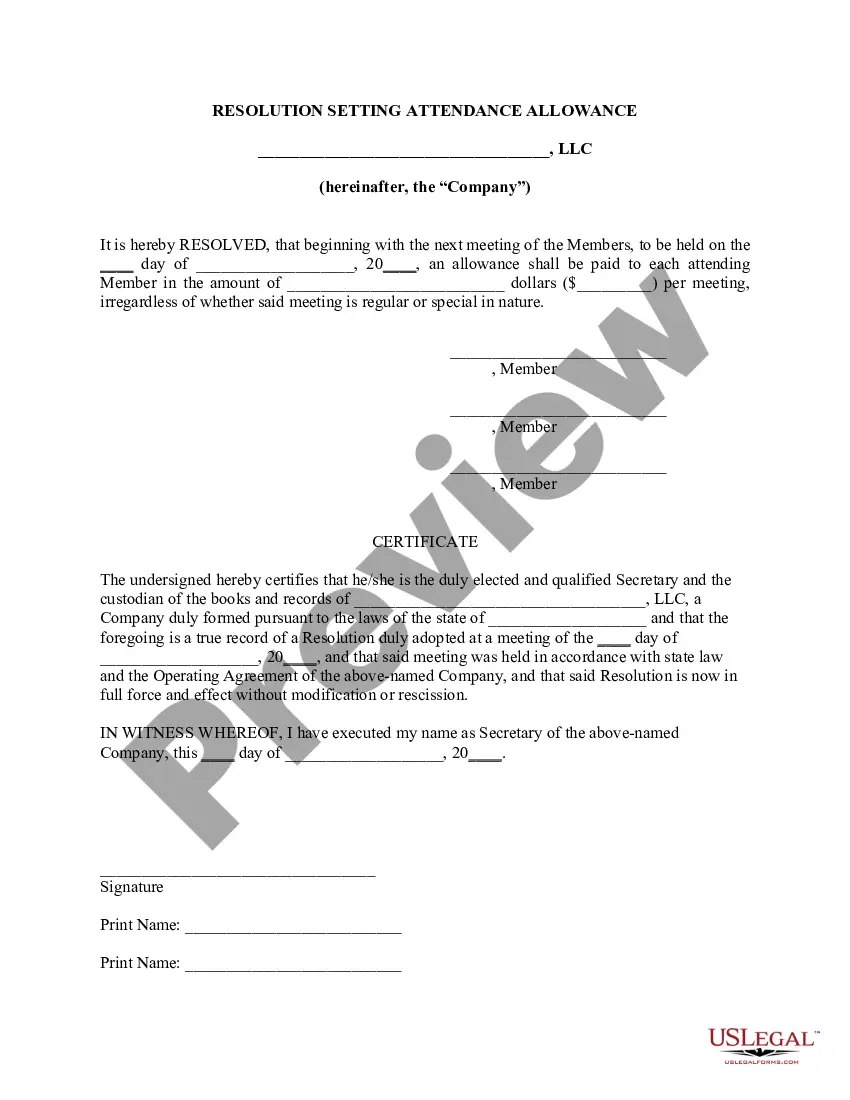
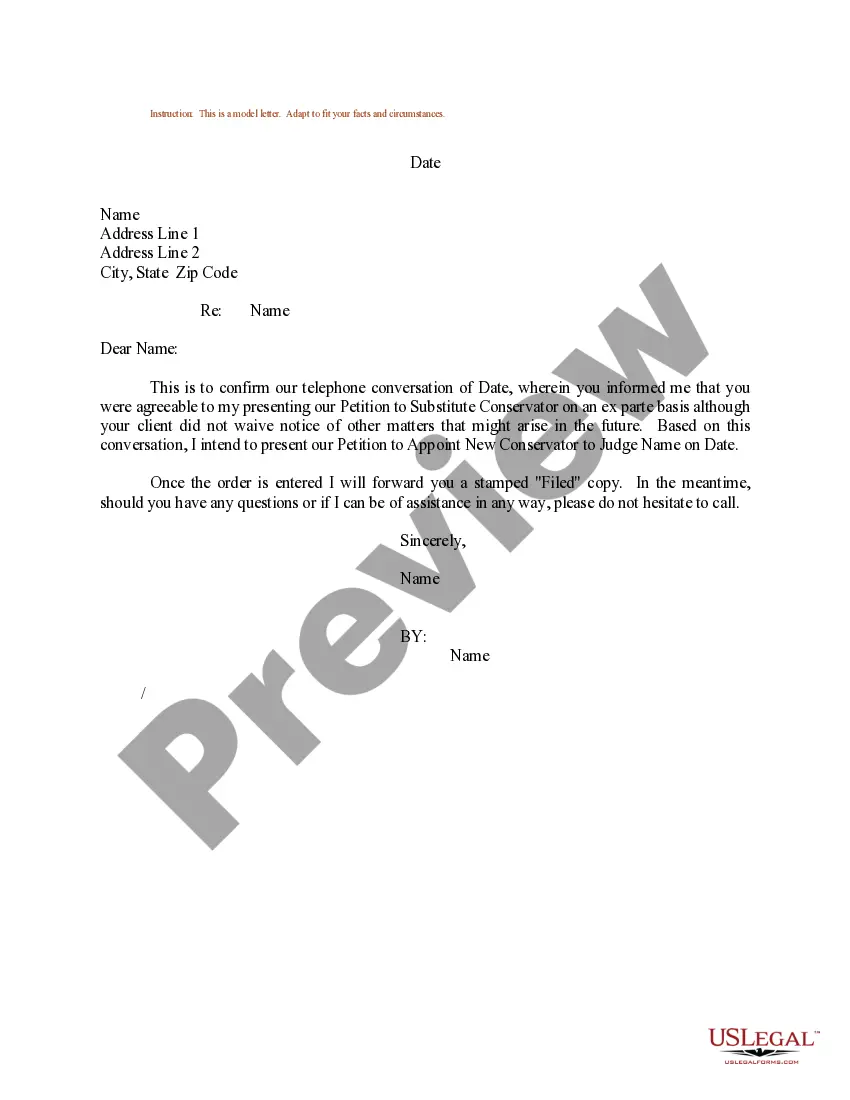
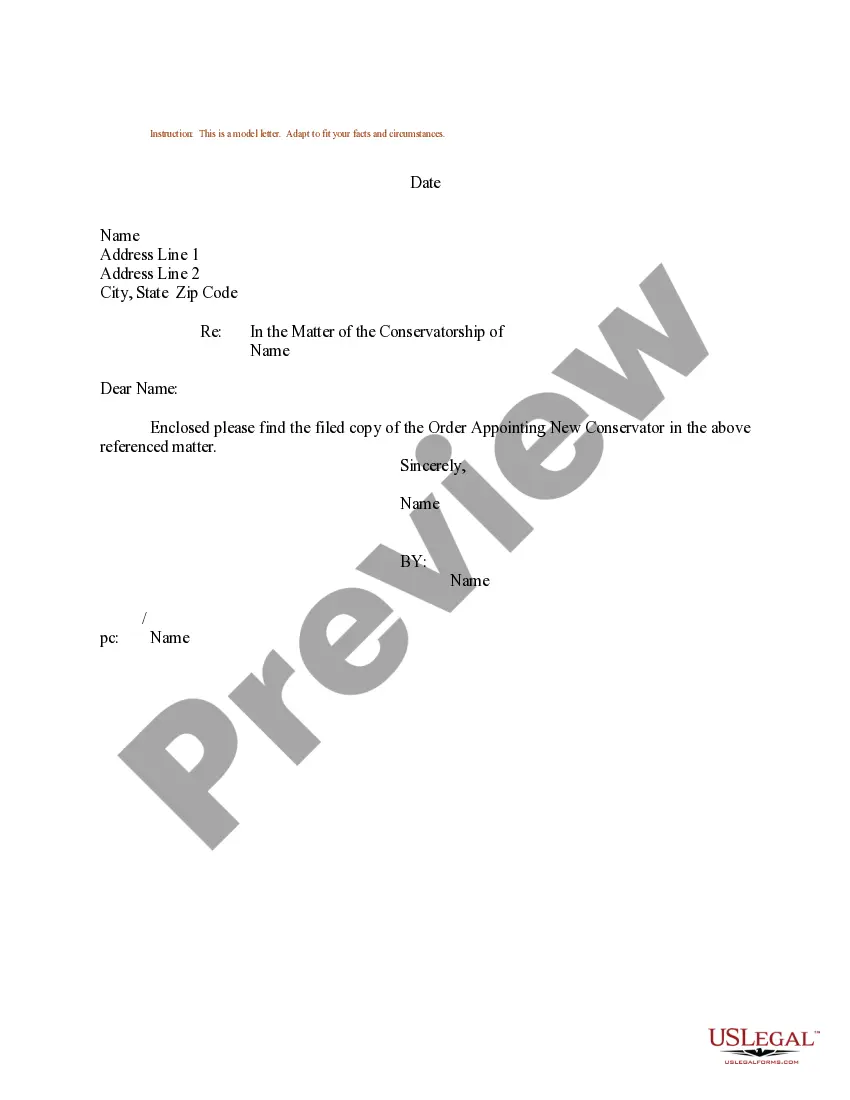
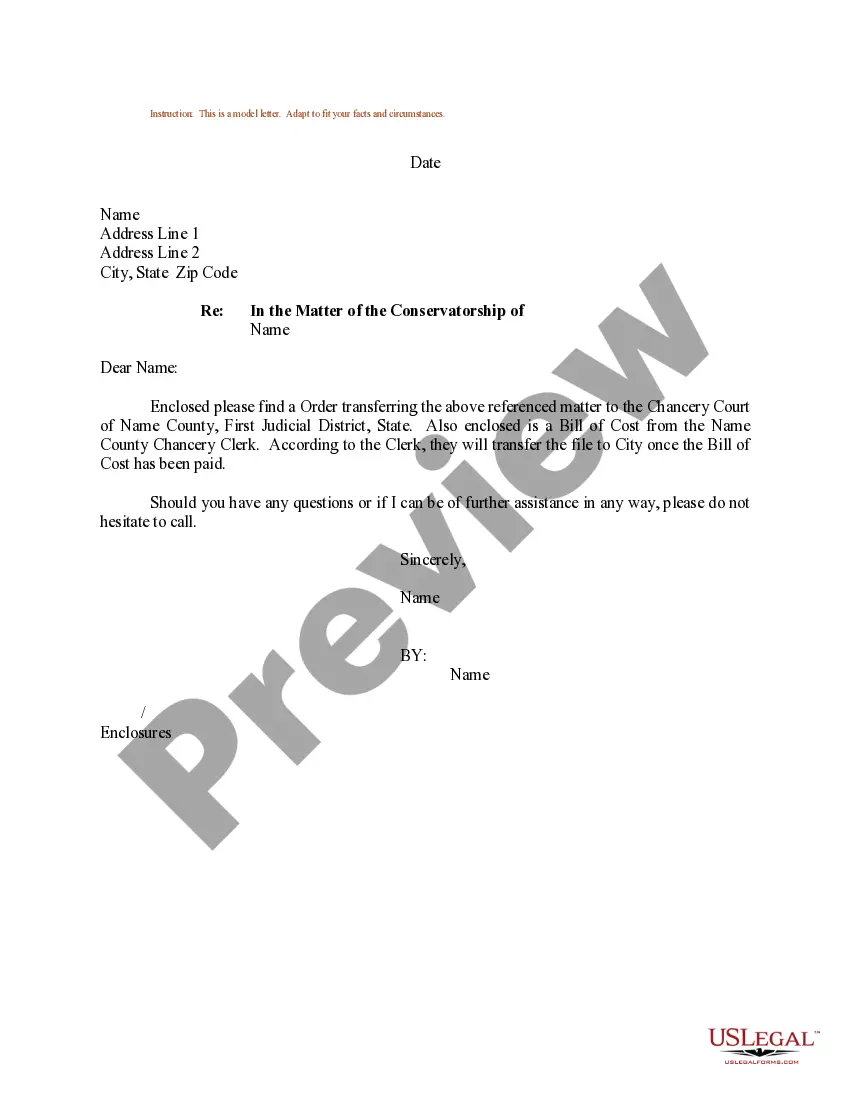
Maine Sample Letter regarding Conservatorship - Agreed Order Substituting Counsel
Description


Get your form ready online
Our built-in tools help you complete, sign, share, and store your documents in one place.
Make edits, fill in missing information, and update formatting in US Legal Forms—just like you would in MS Word.
Download a copy, print it, send it by email, or mail it via USPS—whatever works best for your next step.
Sign and collect signatures with our SignNow integration. Send to multiple recipients, set reminders, and more. Go Premium to unlock E-Sign.
If this form requires notarization, complete it online through a secure video call—no need to meet a notary in person or wait for an appointment.
We protect your documents and personal data by following strict security and privacy standards.

Make edits, fill in missing information, and update formatting in US Legal Forms—just like you would in MS Word.

Download a copy, print it, send it by email, or mail it via USPS—whatever works best for your next step.

Sign and collect signatures with our SignNow integration. Send to multiple recipients, set reminders, and more. Go Premium to unlock E-Sign.

If this form requires notarization, complete it online through a secure video call—no need to meet a notary in person or wait for an appointment.

We protect your documents and personal data by following strict security and privacy standards.
Looking for another form?







How to fill out Sample Letter Regarding Conservatorship - Agreed Order Substituting Counsel?
If you want to comprehensive, download, or print authorized record web templates, use US Legal Forms, the largest assortment of authorized forms, which can be found on the web. Take advantage of the site`s basic and hassle-free research to find the files you want. Different web templates for enterprise and individual reasons are categorized by classes and states, or search phrases. Use US Legal Forms to find the Maine Sample Letter regarding Conservatorship - Agreed Order Substituting Counsel with a few mouse clicks.
If you are previously a US Legal Forms consumer, log in in your account and click on the Download option to get the Maine Sample Letter regarding Conservatorship - Agreed Order Substituting Counsel. You can also gain access to forms you earlier downloaded in the My Forms tab of your account.
If you work with US Legal Forms for the first time, follow the instructions beneath:
- Step 1. Be sure you have selected the shape for your correct metropolis/region.
- Step 2. Use the Review option to look through the form`s articles. Don`t forget to see the explanation.
- Step 3. If you are not happy with all the kind, make use of the Search area towards the top of the display screen to find other variations in the authorized kind web template.
- Step 4. When you have located the shape you want, select the Get now option. Select the pricing program you favor and add your credentials to register for the account.
- Step 5. Method the purchase. You may use your Мisa or Ьastercard or PayPal account to perform the purchase.
- Step 6. Pick the file format in the authorized kind and download it on the system.
- Step 7. Comprehensive, revise and print or signal the Maine Sample Letter regarding Conservatorship - Agreed Order Substituting Counsel.
Each authorized record web template you buy is your own forever. You might have acces to every single kind you downloaded with your acccount. Click the My Forms portion and decide on a kind to print or download once again.
Remain competitive and download, and print the Maine Sample Letter regarding Conservatorship - Agreed Order Substituting Counsel with US Legal Forms. There are millions of skilled and status-certain forms you can utilize to your enterprise or individual needs.
Form popularity
FAQ
7 powers in a limited conservatorship Consent or withhold consent to the conservatee to marry. Exercise the conservatee's right to enter into a contract. Give or withhold medical consent on behalf of the conservatee. Exercise or limit the conservatee's right to control social and sexual contacts and relationships.
Conservators are court-appointed individuals who are given the ability to manage another person's finances and personal affairs. They're able to limit the conservatee's spending and, depending on the extent of the conservatorship, any other financial and personal decisions.
CONS: Loss of autonomy: A conservatorship involves the loss of autonomy for the conservatee, who may be subjected to decisions that they would not have made if they were capable of making decisions for themselves.
There are two types of conservatorships: general and limited. A general conservatorship is established for an adult who needs the assistance of another party to handle their finances and other affairs. General conservatorships are granted to those who are elderly or have been impaired by an illness or accident.
Unlike a Guardian, a Conservator only has authority over your money and finances, not your personal life. Your Conservator is required to use your money to provide for your needs. They may not use your money for their benefit, and must keep your money separate from their own.
Under U.S. law, a conservatorship results from the appointment of a guardian or a protector by a judge to manage the personal or financial affairs of another person who is incapable of fully managing their own affairs due to age or physical or mental limitations.