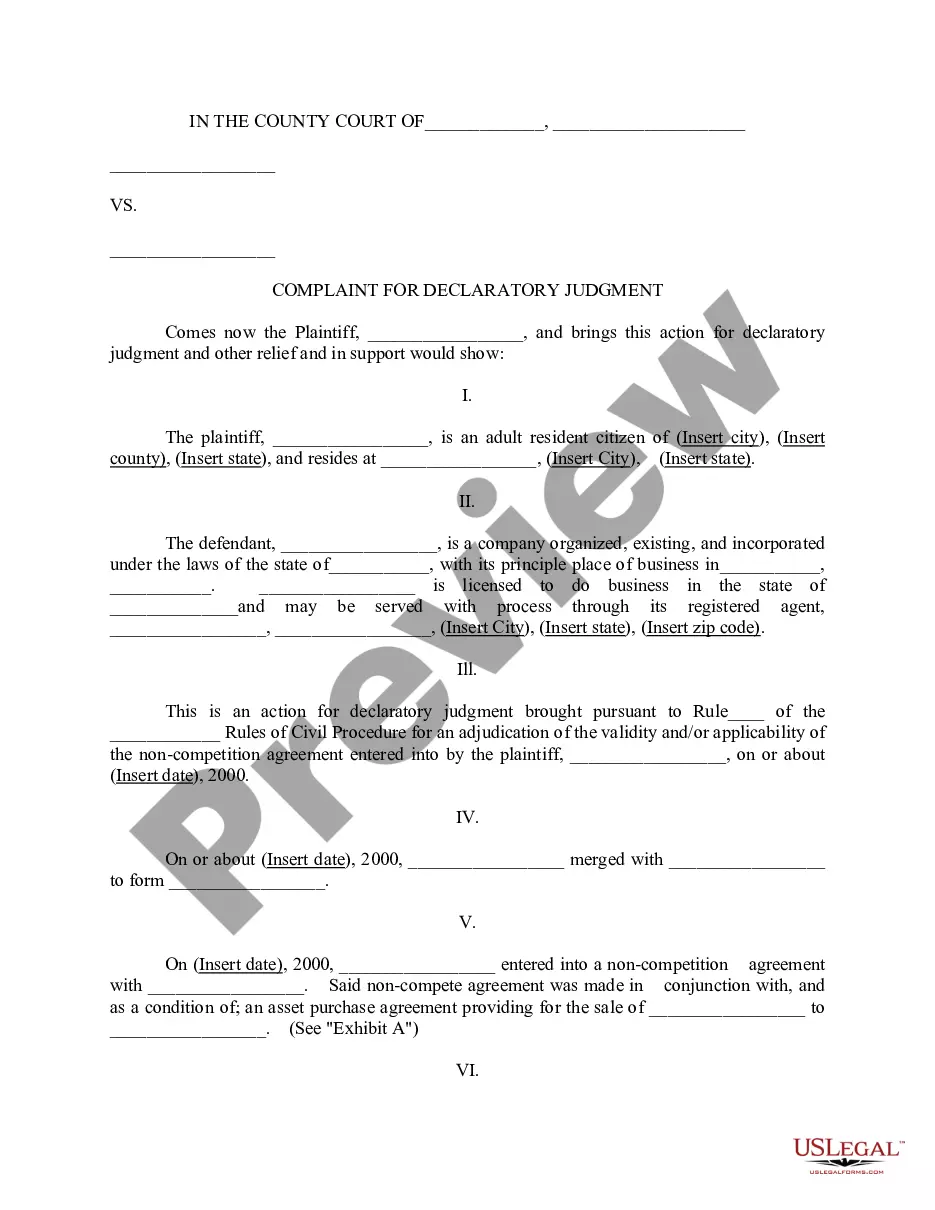
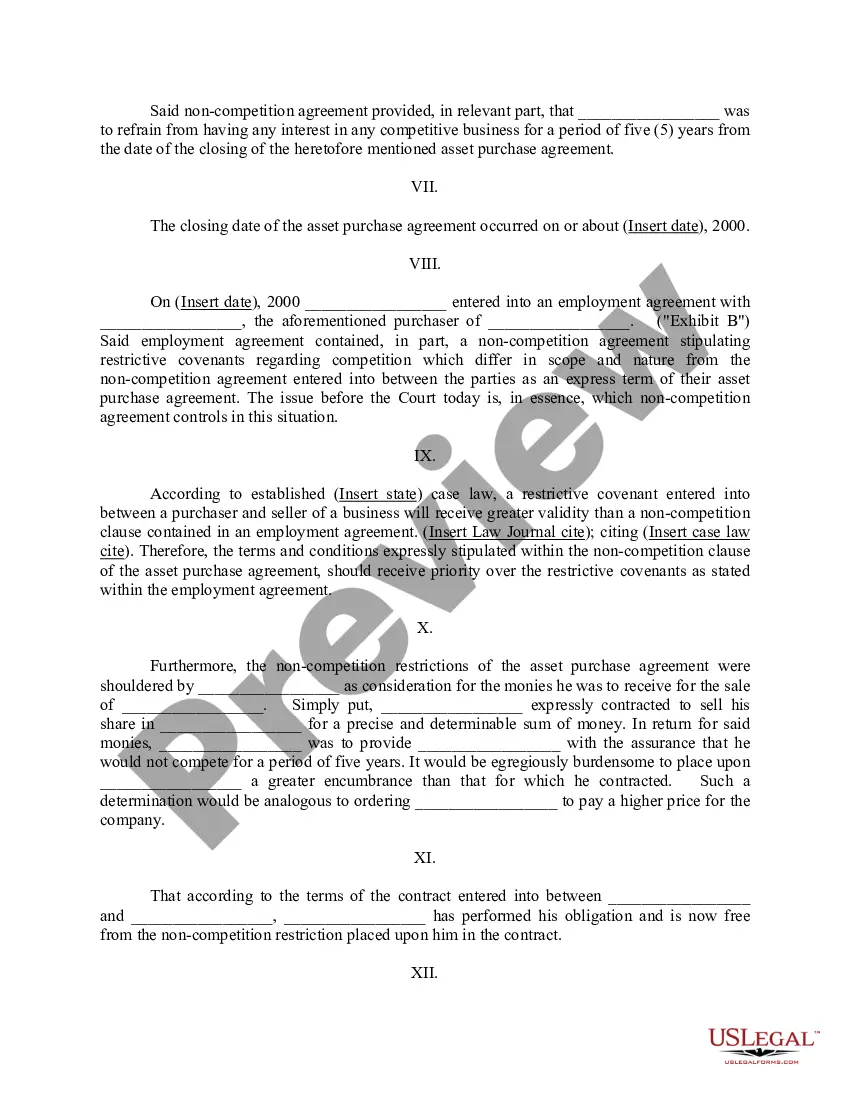
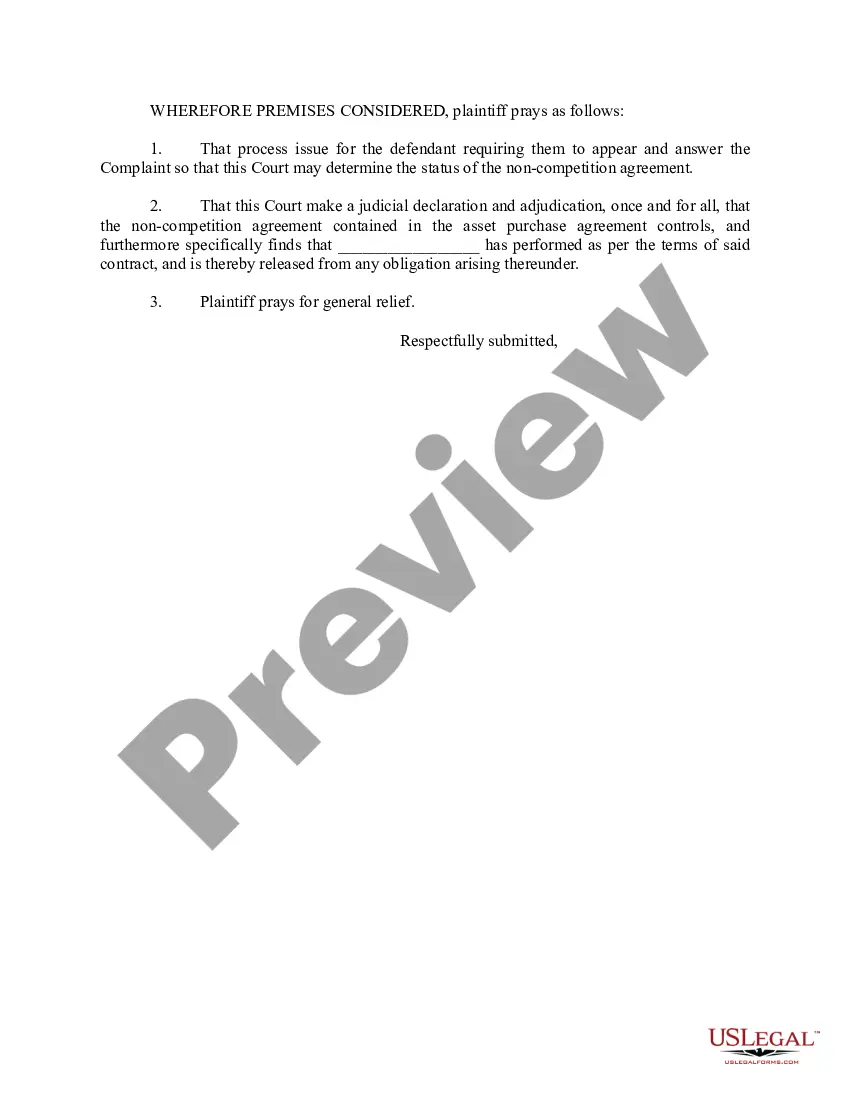
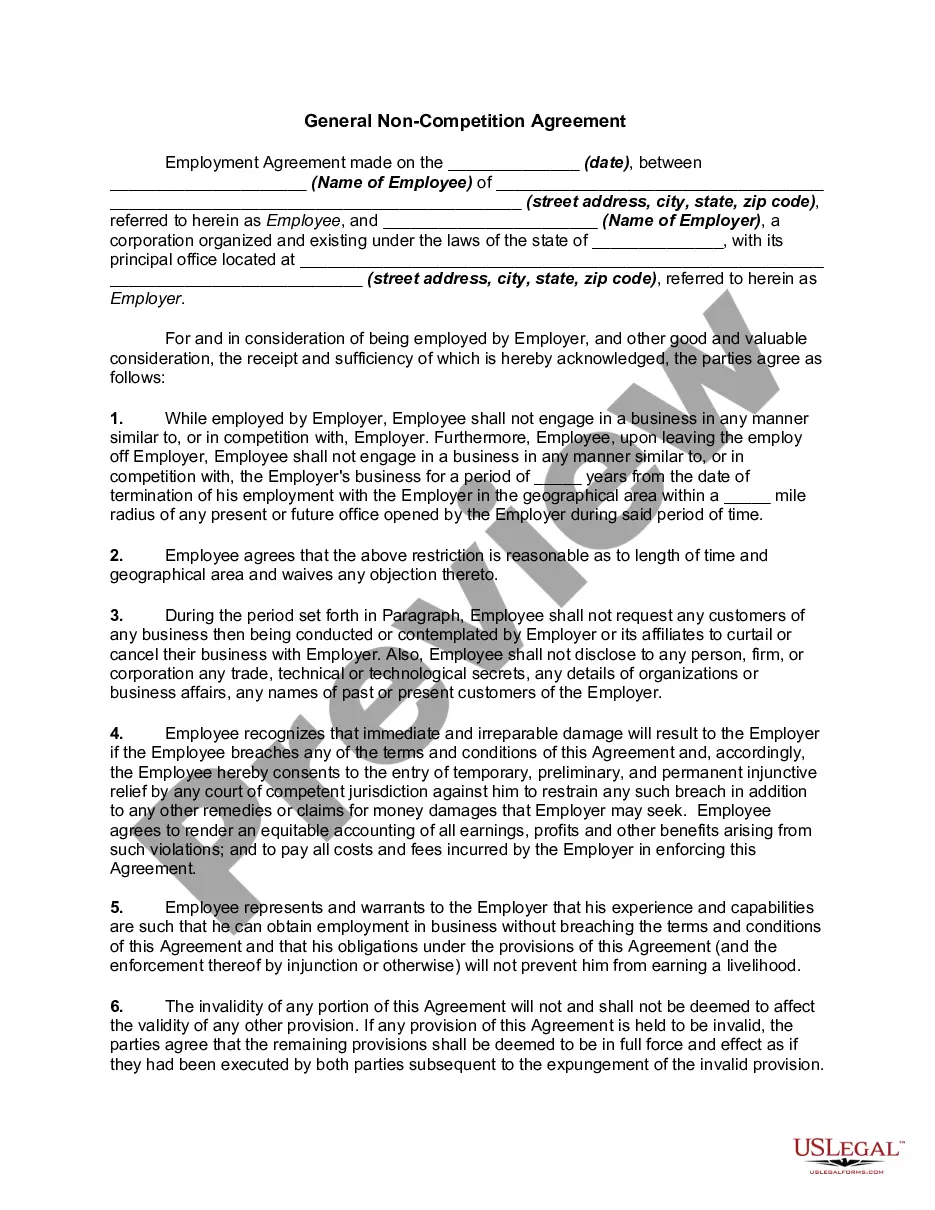
Plaintiff brings an action for a declaratory judgment arguing that he/she has fulfilled certain contractual duties and is now free from a non-competition restriction placed upon him/her in the contract.
Maine Complaint For Declaratory Judgment Of Validity of Separate Noncompetition Agreements
State:
Multi-State
Category:
Control #:
US-000288
Format:
Word;
Rich Text
47 downloads
Description
Free preview



Get your form ready online
Our built-in tools help you complete, sign, share, and store your documents in one place.
Built-in online Word editor
Make edits, fill in missing information, and update formatting in US Legal Forms—just like you would in MS Word.
Export easily
Download a copy, print it, send it by email, or mail it via USPS—whatever works best for your next step.
E-sign your document
Sign and collect signatures with our SignNow integration. Send to multiple recipients, set reminders, and more. Go Premium to unlock E-Sign.
Notarize online 24/7
If this form requires notarization, complete it online through a secure video call—no need to meet a notary in person or wait for an appointment.
Store your document securely
We protect your documents and personal data by following strict security and privacy standards.

Make edits, fill in missing information, and update formatting in US Legal Forms—just like you would in MS Word.

Download a copy, print it, send it by email, or mail it via USPS—whatever works best for your next step.

Sign and collect signatures with our SignNow integration. Send to multiple recipients, set reminders, and more. Go Premium to unlock E-Sign.

If this form requires notarization, complete it online through a secure video call—no need to meet a notary in person or wait for an appointment.

We protect your documents and personal data by following strict security and privacy standards.
Looking for another form?




How to fill out Complaint For Declaratory Judgment Of Validity Of Separate Noncompetition Agreements?
US Legal Forms - one of the largest collections of legal documents in the United States - offers a broad selection of legal form templates that you can download or print. By using the site, you can access thousands of forms for business and personal purposes, categorized by types, states, or keywords. You can find the latest versions of forms such as the Maine Complaint For Declaratory Judgment Of Validity of Separate Noncompetition Agreements in moments.
If you possess a membership, Log In and download the Maine Complaint For Declaratory Judgment Of Validity of Separate Noncompetition Agreements from your US Legal Forms library. The Download button will appear on each form you view. You can access all previously downloaded forms in the My documents section of your account.
If you are using US Legal Forms for the first time, here are simple steps to get started: Ensure you have selected the correct form for your locality/state. Click on the Preview button to check the content of the form. Review the form description to confirm you have chosen the right form. If the form does not meet your needs, use the Search box at the top of the screen to find the one that does. If you are satisfied with the form, confirm your choice by clicking the Purchase now button. Then, select the pricing option you prefer and provide your information to register for an account.
Gain access to the Maine Complaint For Declaratory Judgment Of Validity of Separate Noncompetition Agreements with US Legal Forms, one of the most extensive collections of legal document templates. Utilize thousands of professional and state-specific templates that meet your business or personal needs and requirements.
- Process the transaction. Use your credit card or PayPal account to complete the transaction.
- Select the format and download the form to your device.
- Make modifications. Complete, edit, print, and sign the downloaded Maine Complaint For Declaratory Judgment Of Validity of Separate Noncompetition Agreements.
- Each template you add to your account has no expiration date and belongs to you indefinitely.
- So, if you wish to download or print another copy, simply navigate to the My documents section and click on the form you need.
Form popularity
FAQ
Yes, non-compete agreements can be enforceable in Maine, but they are subject to specific legal standards. To establish validity, these agreements must be reasonable in scope, duration, and geographic area. If you are facing issues related to a non-compete agreement, you might consider filing a Maine Complaint For Declaratory Judgment Of Validity of Separate Noncompetition Agreements. Utilizing platforms like US Legal Forms can provide you with the necessary resources and templates to navigate this process effectively.
In Maine, a violation of condition of release occurs when an individual fails to adhere to the terms set by the court upon their release. This can include not complying with specific restrictions or orders, such as maintaining contact with certain individuals or staying within designated areas. Understanding these conditions is crucial, especially if you are involved in legal matters that may lead to a Maine Complaint For Declaratory Judgment Of Validity of Separate Noncompetition Agreements. Ensuring compliance not only affects your current legal situation but also prevents further complications.
You might consider a declaratory judgment action when you face uncertainty about the validity of agreements, such as noncompetition agreements. For instance, if you believe that your separate noncompetition agreements may be unenforceable, a Maine Complaint For Declaratory Judgment Of Validity of Separate Noncompetition Agreements can clarify your legal standing. This process helps in resolving disputes before they escalate and provides a clear legal framework for moving forward. Utilizing the right legal resources can help you navigate this complex area effectively.
An example of this in a case involving contracts would be a party seeking an interpretation of the contract to determine their rights. Another example would be an insured individual seeking a specific determination of their rights and surrounding circumstances regarding insurance coverage under a specific policy.
Prohibits or restricts one employer from soliciting or hiring another employer's employees or former employees.
A person is guilty of violation of privacy if, except in the execution of a public duty or as authorized by law, that person intentionally: A. Commits a civil trespass on property with the intent to overhear or observe any person in a private place; [PL 1997, c. 467, §1 (AMD).]
A court will only allow an employer to enforce a non-compete if the agreement is specifically tailored to protect the employer's legitimate business interests. The validity of non-compete agreements in New Hampshire is evaluated on a case-by-case basis.
Noncompete agreements are contrary to public policy and are enforceable only to the extent that they are reasonable and are no broader than necessary to protect one or more of the following legitimate business interests of the employer: A.