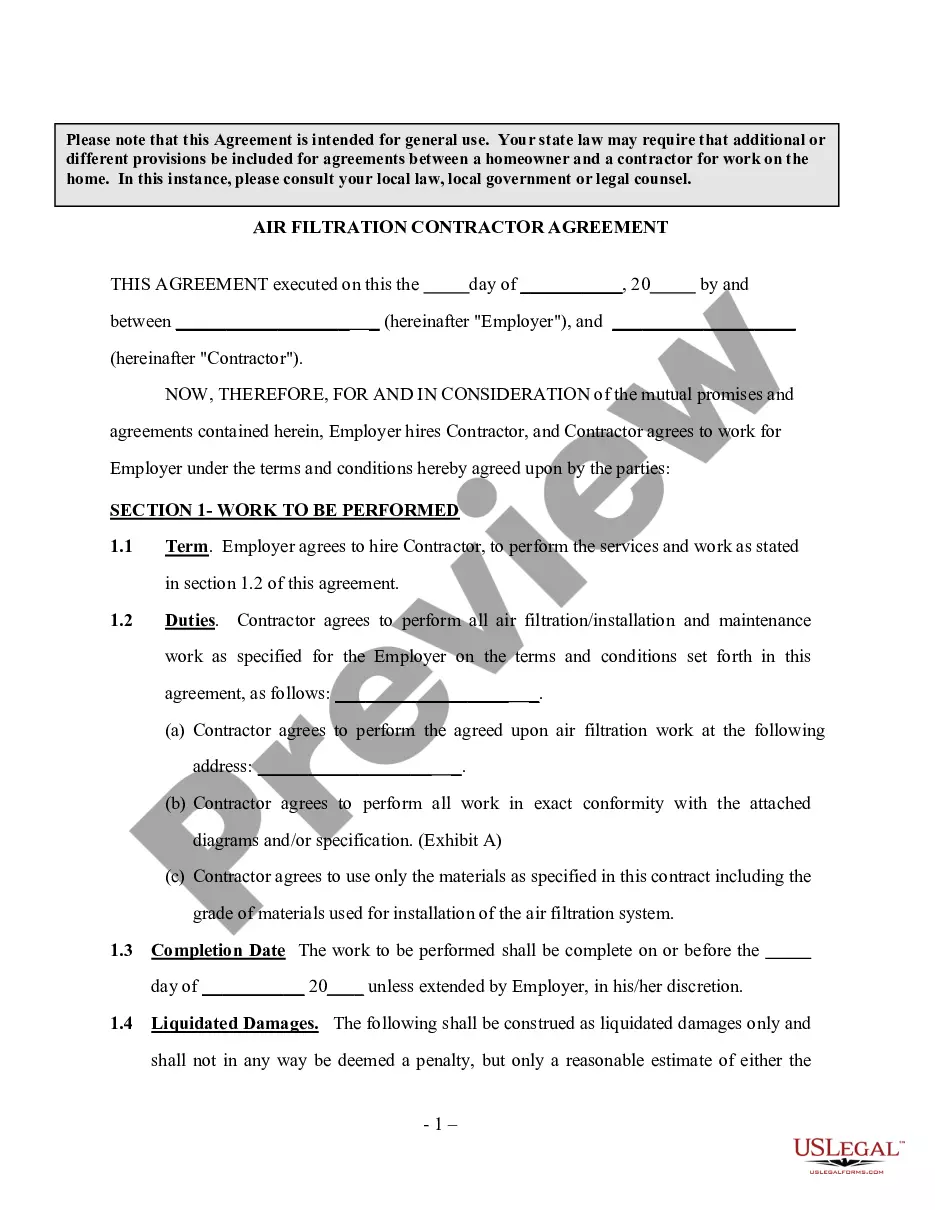
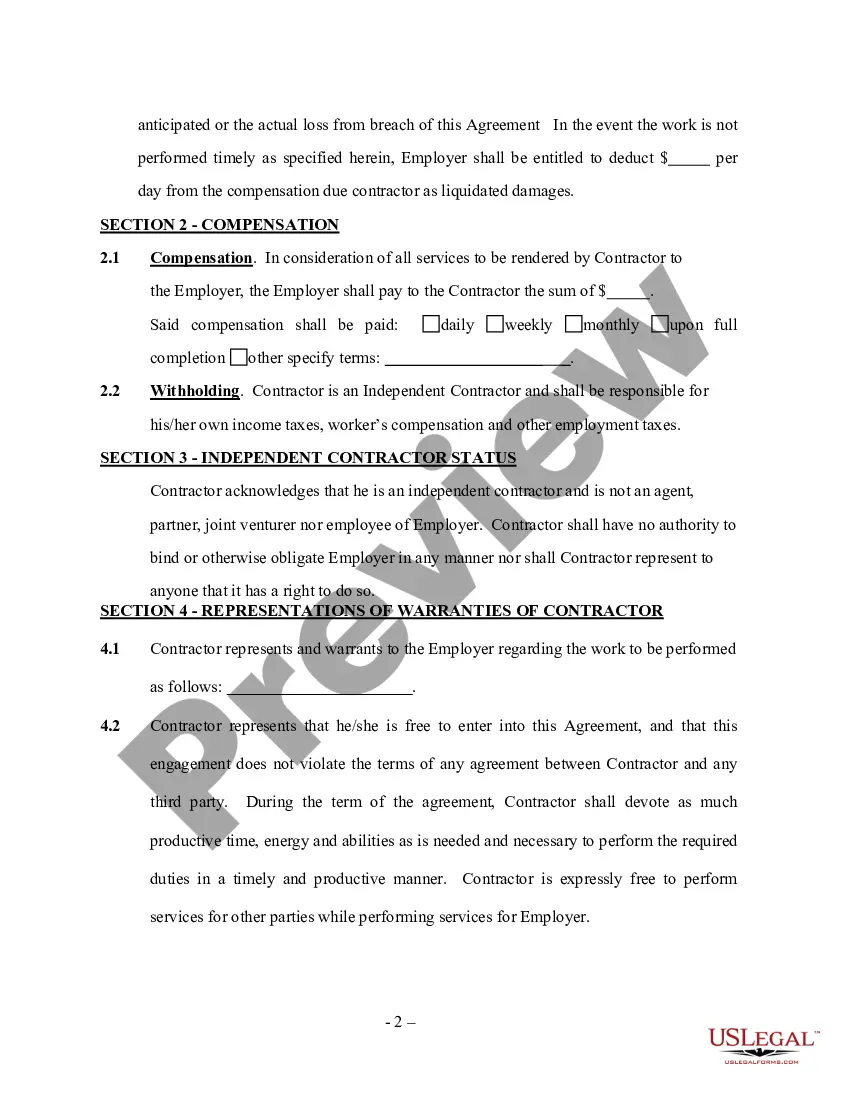
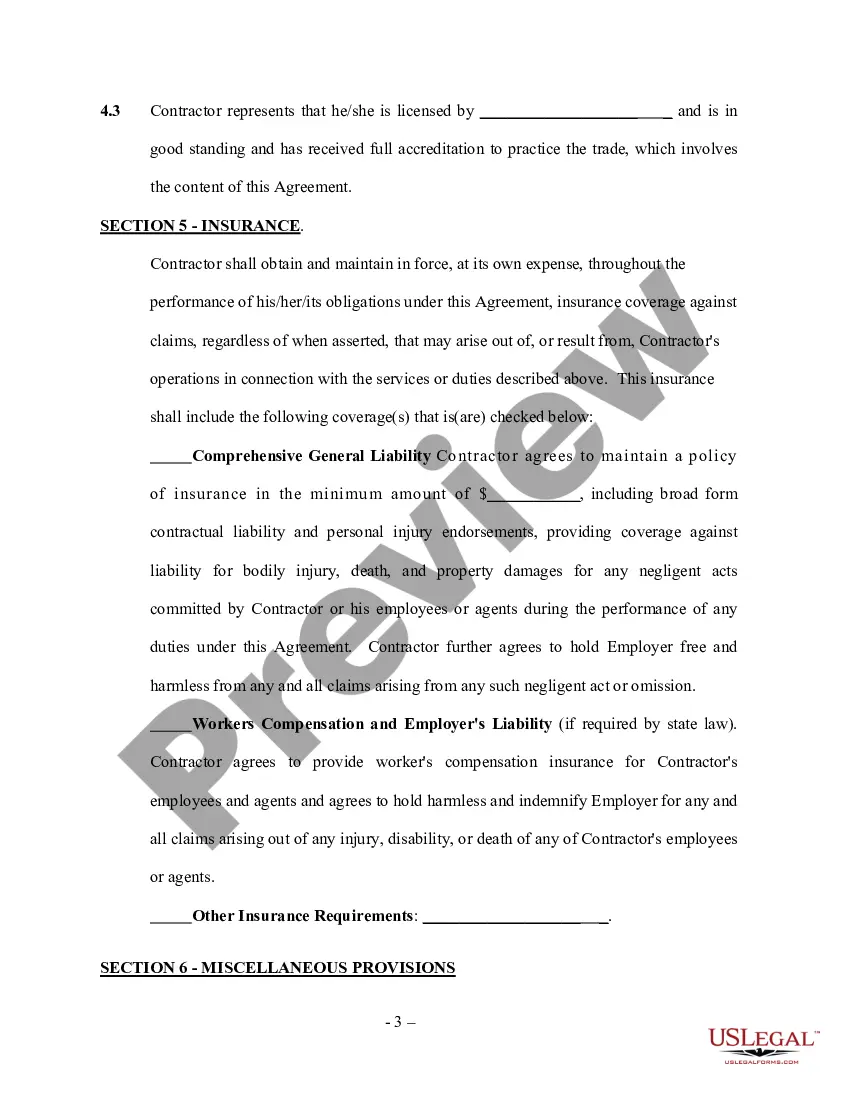
Employer contracts with an independent contractor to provide and service an air filtration system as specified and agreed upon in the contract. Please note that this Agreement is intended for general use. Your state law may require that additional or different provisions be included for agreements between a homeowner and a contractor for work on the home. In this instance, please consult your local law, local government or legal counsel.
Maryland Air Filtration Contractor Agreement - Self-Employed
State:
Multi-State
Control #:
US-INDC-116
Format:
Word;
Rich Text
Instant download
Description
Free preview
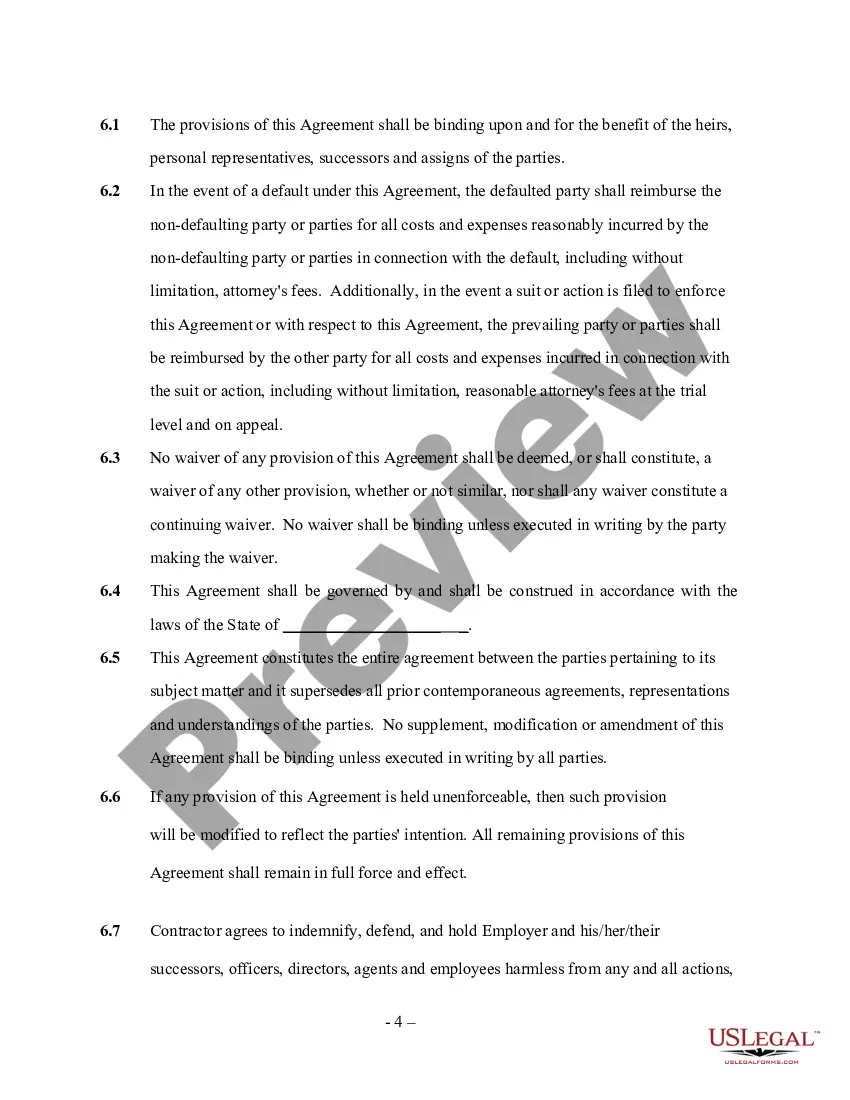
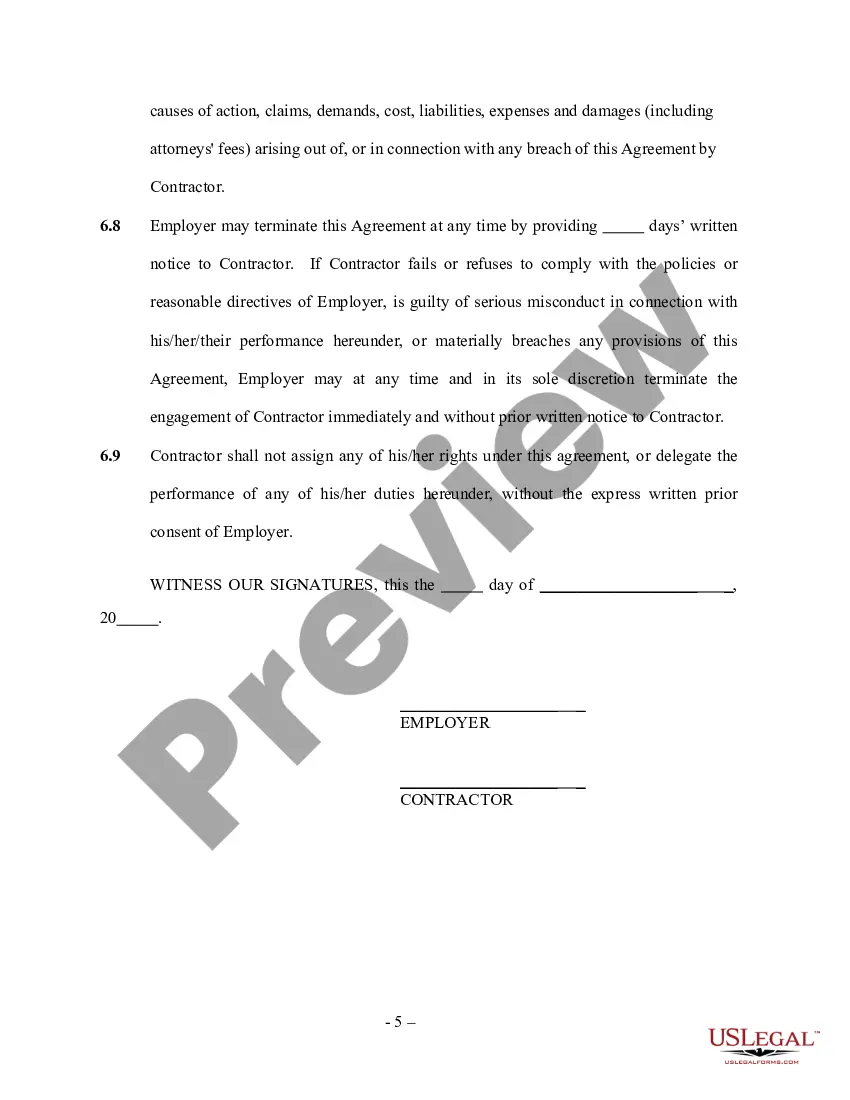
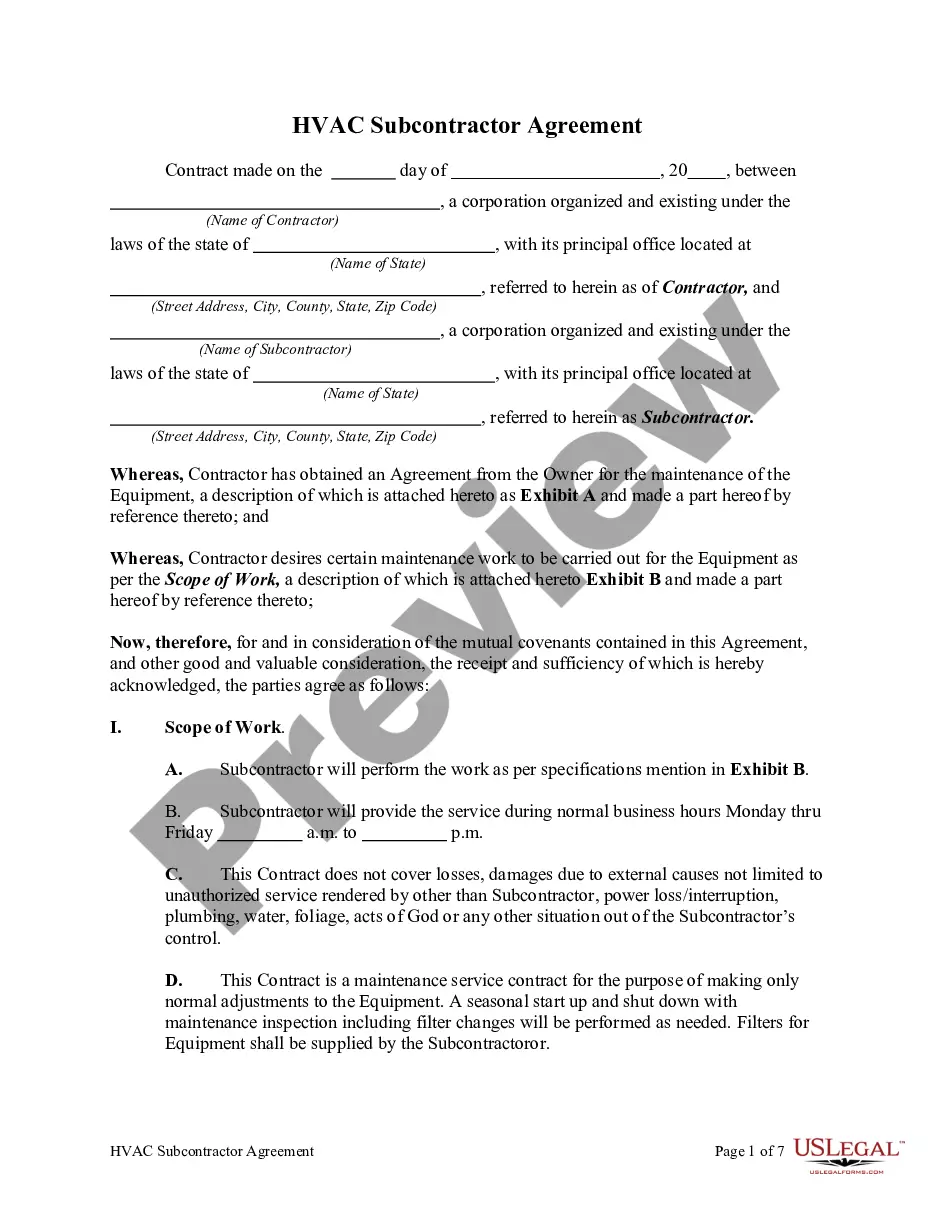
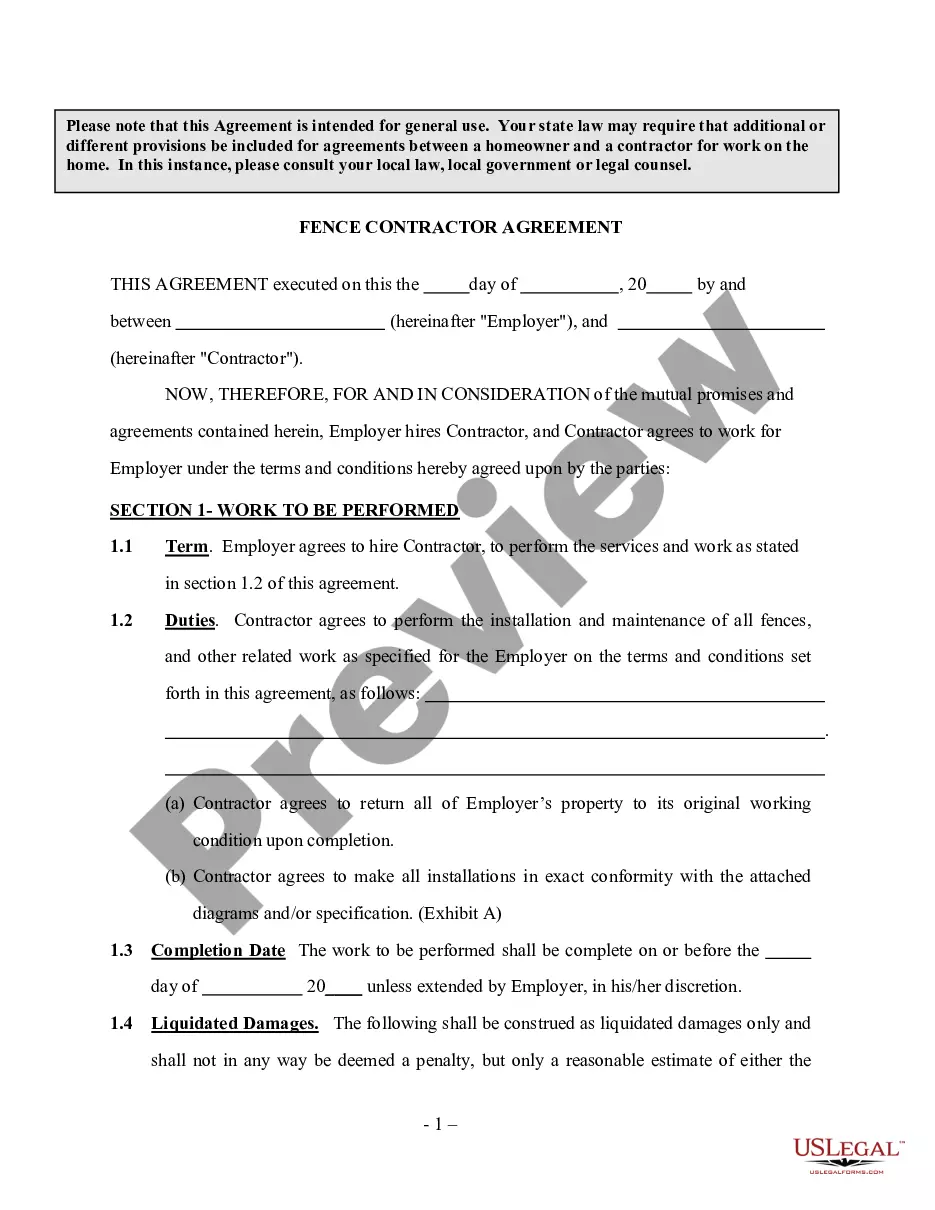
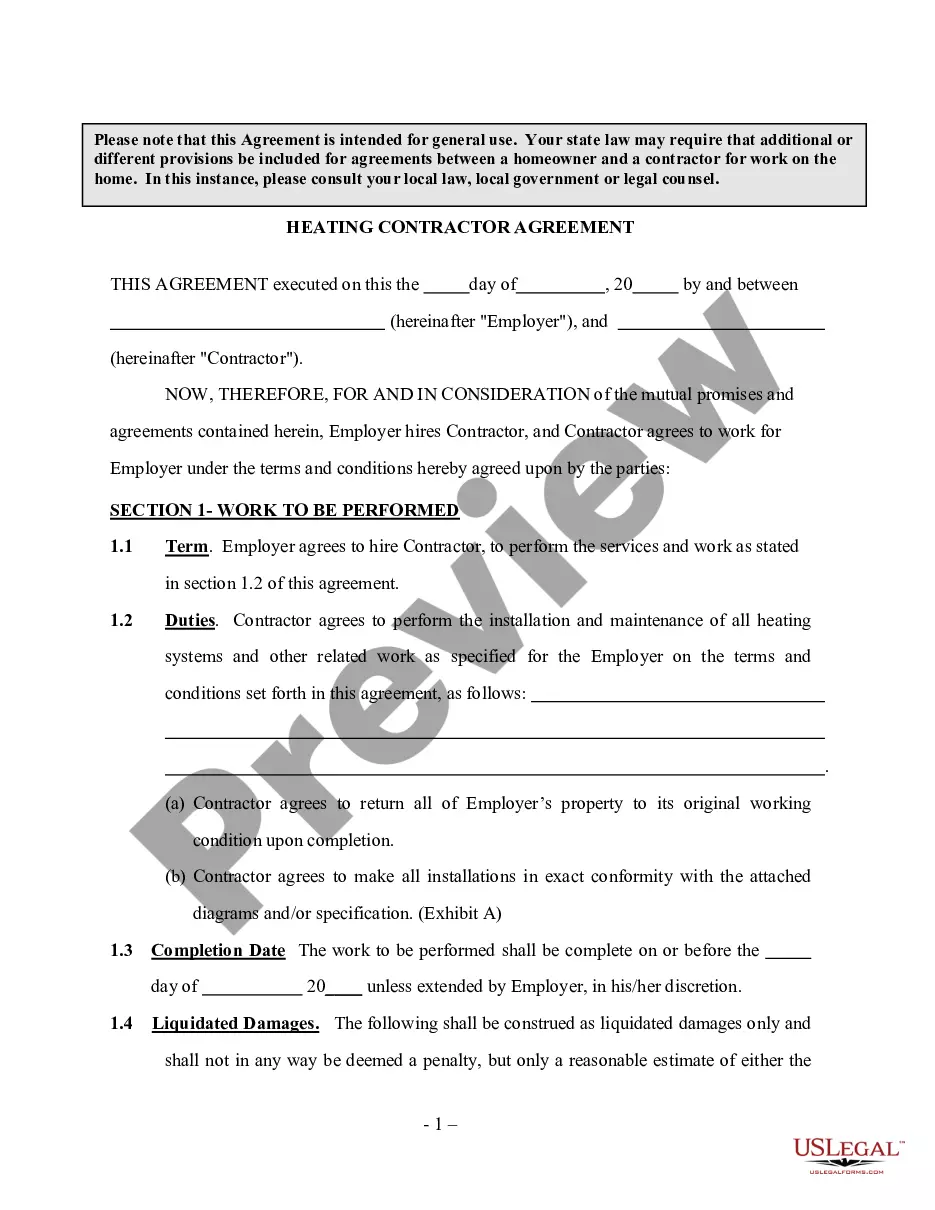
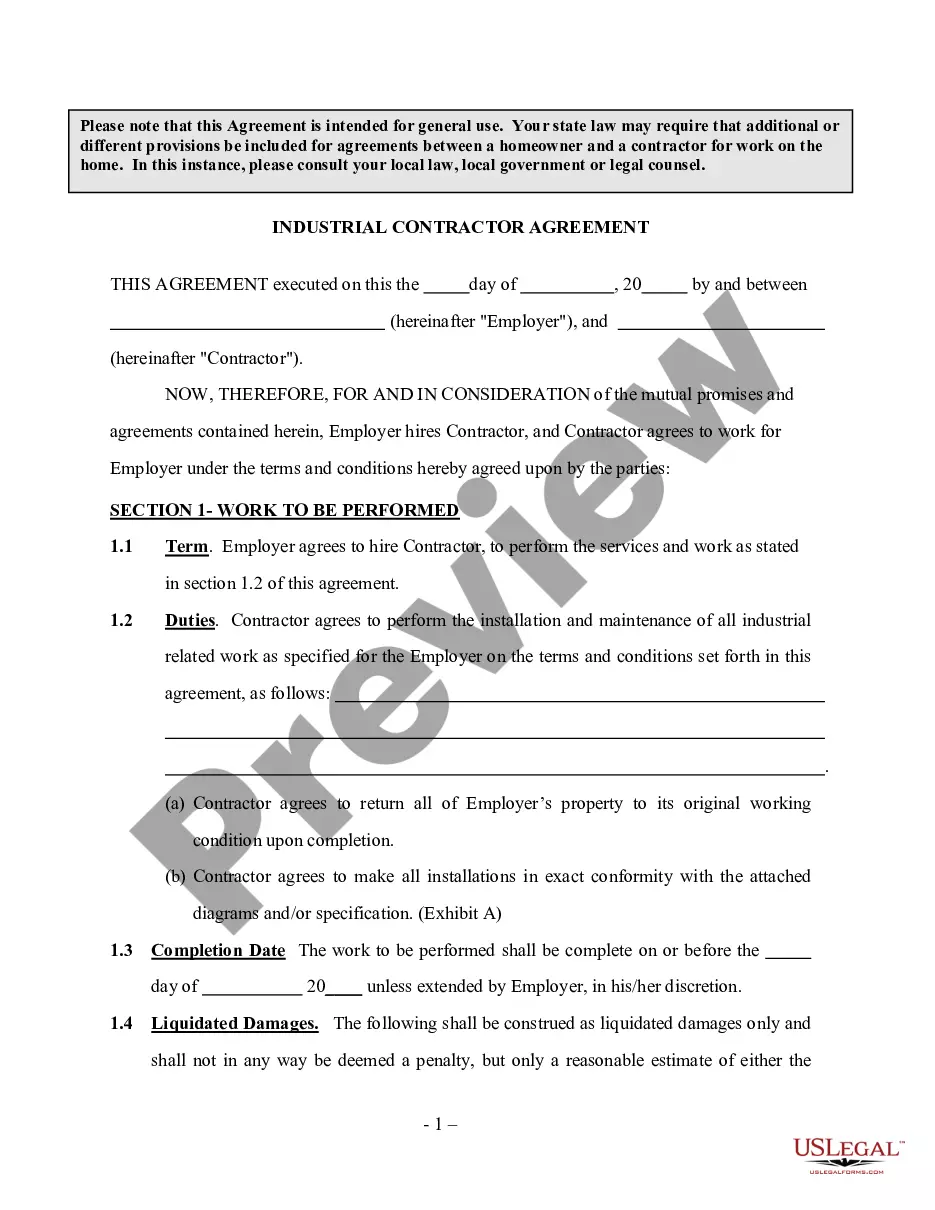
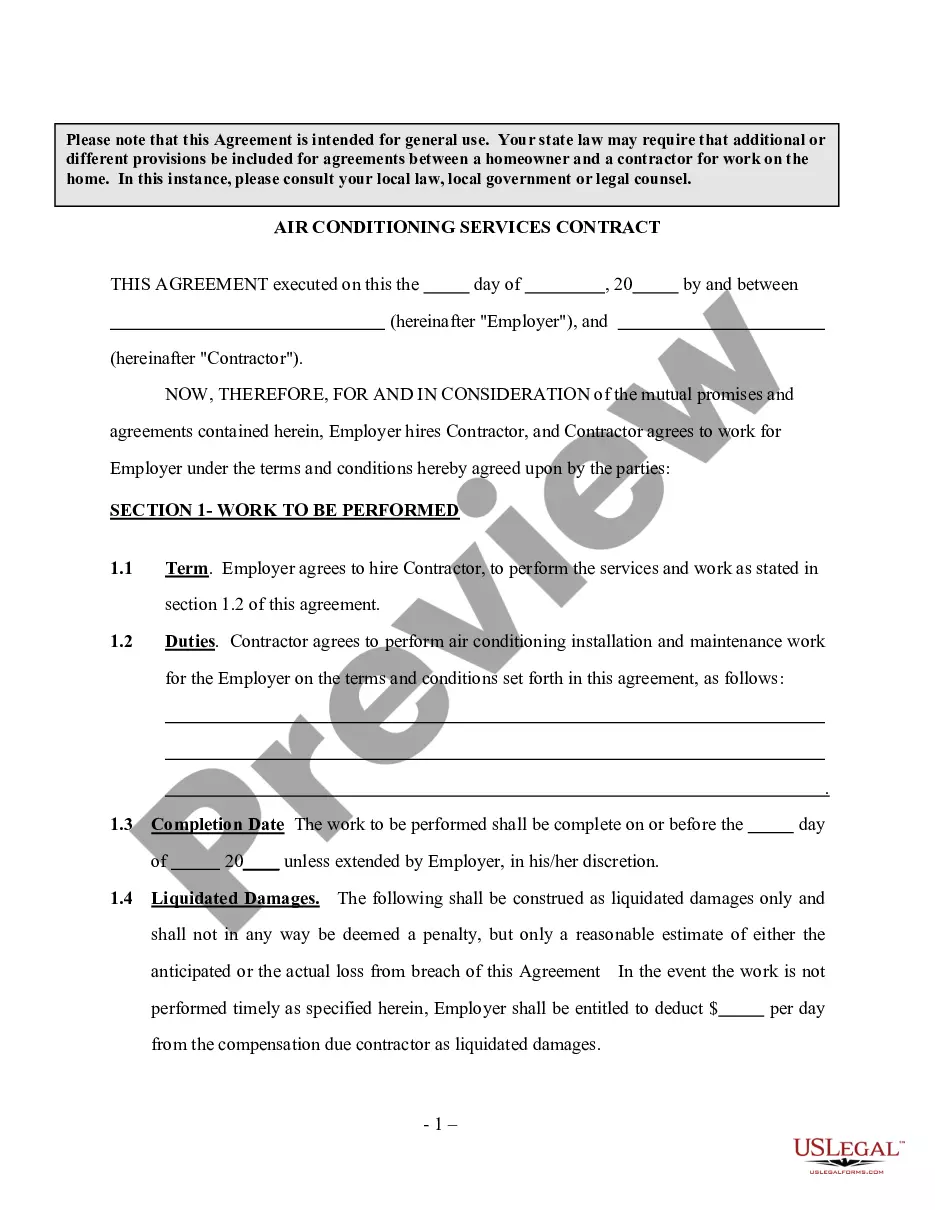
Get your form ready online
Our built-in tools help you complete, sign, share, and store your documents in one place.
Built-in online Word editor
Make edits, fill in missing information, and update formatting in US Legal Forms—just like you would in MS Word.
Export easily
Download a copy, print it, send it by email, or mail it via USPS—whatever works best for your next step.
E-sign your document
Sign and collect signatures with our SignNow integration. Send to multiple recipients, set reminders, and more. Go Premium to unlock E-Sign.
Notarize online 24/7
If this form requires notarization, complete it online through a secure video call—no need to meet a notary in person or wait for an appointment.
Store your document securely
We protect your documents and personal data by following strict security and privacy standards.

Make edits, fill in missing information, and update formatting in US Legal Forms—just like you would in MS Word.

Download a copy, print it, send it by email, or mail it via USPS—whatever works best for your next step.

Sign and collect signatures with our SignNow integration. Send to multiple recipients, set reminders, and more. Go Premium to unlock E-Sign.

If this form requires notarization, complete it online through a secure video call—no need to meet a notary in person or wait for an appointment.

We protect your documents and personal data by following strict security and privacy standards.
Looking for another form?
How to fill out Air Filtration Contractor Agreement - Self-Employed?
If you need to comprehensive, acquire, or print sanctioned document templates, utilize US Legal Forms, the largest collection of legal forms available on the web.
Make use of the site's straightforward and user-friendly search to find the documents you require.
Various templates for business and personal purposes are organized by categories and states, or keywords.
Step 4. Once you have found the form you need, click the Purchase now button. Choose the pricing plan that suits you and enter your information to register for an account.
Step 5. Process the payment. You can use your credit card or PayPal account to complete the transaction.
- Use US Legal Forms to obtain the Maryland Air Filtration Contractor Agreement - Self-Employed with just a few clicks.
- If you are already a US Legal Forms customer, Log In to your account and click the Download button to access the Maryland Air Filtration Contractor Agreement - Self-Employed.
- You can also retrieve forms you have previously downloaded within the My documents section of your account.
- If this is your first time using US Legal Forms, follow the instructions below.
- Step 1. Ensure you have selected the form for the correct city/state.
- Step 2. Utilize the Review option to examine the form's details. Don't forget to check the summary.
- Step 3. If you are dissatisfied with the form, use the Search field at the top of the screen to find alternative versions of the legal form template.
Form popularity
FAQ
As an independent contractor in Maryland, you have several rights that protect your interests. These rights include the ability to negotiate terms of your contracts, the right to receive payment for completed work, and the right to operate your business as you see fit. Understanding these rights, particularly through a Maryland Air Filtration Contractor Agreement - Self-Employed, ensures that you safeguard your position and uphold your professional integrity.
Independent contractors must adhere to specific rules to maintain compliance and ensure protection. These rules include generating invoices for services rendered, paying self-employment taxes, and maintaining professional licenses when required. When working with a Maryland Air Filtration Contractor Agreement - Self-Employed, familiarize yourself with these rules to avoid pitfalls and manage your business effectively.
The recent federal rule regarding independent contractors aims to clarify the criteria for determining their classification. Under this rule, the focus is shifting toward the nature of the work relationship rather than the labels used. Therefore, understanding the implications of the Maryland Air Filtration Contractor Agreement - Self-Employed becomes increasingly important, as it should reflect your status accurately to align with federal standards.
One key requirement to be classified as an independent contractor in Maryland is the degree of independence in your work approach. This means you should control how, when, and where you fulfill your work commitments. Having a clear Maryland Air Filtration Contractor Agreement - Self-Employed can help establish your status as an independent contractor by outlining your autonomy in the contract. This classification is vital for tax and liability purposes.
Independent contractors in Maryland must fulfill specific legal requirements to ensure compliance with state laws. These include registering a business if necessary, adhering to tax obligations, and maintaining proper insurance. It is essential to have a well-drafted Maryland Air Filtration Contractor Agreement - Self-Employed that outlines your work terms. This can ultimately protect your rights and clarify your responsibilities under Maryland law.
In Maryland, the main difference between an independent contractor and an employee lies in the level of control over work. Employees work under the guidance of employers and typically receive benefits associated with employment. On the other hand, independent contractors, such as those working under a Maryland Air Filtration Contractor Agreement - Self-Employed, maintain greater control over how they complete their tasks. Understanding these distinctions can help you navigate your professional relationships effectively.
Filling out a Maryland Air Filtration Contractor Agreement - Self-Employed form requires entering essential details such as your personal information, business name, and contact details. Specify the nature of the work and payment structure clearly. Additionally, check for any state-specific requirements that may apply. Using resources from USLegalForms can help guide you through this process smoothly.
Writing a Maryland Air Filtration Contractor Agreement - Self-Employed involves several key elements. Start with the names of both parties, then detail the services to be provided, including timelines and payment rates. Include clauses for confidentiality, liability, and termination to protect both parties. Using templates from platforms like USLegalForms can simplify the drafting process and ensure you cover all necessary areas.
The independent contractor rule defines the working relationship between a contractor and a client. This rule states that an independent contractor, like a Maryland Air Filtration Contractor Agreement - Self-Employed, retains control over how they complete their work. They operate as a separate business entity, allowing for more flexibility and autonomy. This arrangement differs from employee relationships, where the employer has more control.
To fill out a Maryland Air Filtration Contractor Agreement - Self-Employed, start by entering your name and business details. Clearly outline the scope of work, payment terms, and deadlines. Make sure to include any specific provisions related to confidentiality and termination. Finally, both parties should sign and date the agreement for it to become legally binding.