Massachusetts Monthly Cash Flow Plan
Description


Get your form ready online
Our built-in tools help you complete, sign, share, and store your documents in one place.
Make edits, fill in missing information, and update formatting in US Legal Forms—just like you would in MS Word.
Download a copy, print it, send it by email, or mail it via USPS—whatever works best for your next step.
Sign and collect signatures with our SignNow integration. Send to multiple recipients, set reminders, and more. Go Premium to unlock E-Sign.
If this form requires notarization, complete it online through a secure video call—no need to meet a notary in person or wait for an appointment.
We protect your documents and personal data by following strict security and privacy standards.

Make edits, fill in missing information, and update formatting in US Legal Forms—just like you would in MS Word.

Download a copy, print it, send it by email, or mail it via USPS—whatever works best for your next step.

Sign and collect signatures with our SignNow integration. Send to multiple recipients, set reminders, and more. Go Premium to unlock E-Sign.

If this form requires notarization, complete it online through a secure video call—no need to meet a notary in person or wait for an appointment.

We protect your documents and personal data by following strict security and privacy standards.
Looking for another form?


How to fill out Monthly Cash Flow Plan?
If you desire to extensive, obtain, or print legal document templates, utilize US Legal Forms, the largest assortment of legal forms, which are accessible on the web.
Take advantage of the site’s straightforward and convenient search to locate the documents you need.
A range of templates for business and personal purposes are organized by categories and states, or keywords. Use US Legal Forms to locate the Massachusetts Monthly Cash Flow Plan in just a few clicks.
Every legal document template you download is yours indefinitely. You have access to each document you downloaded in your account. Click the My documents section and select a document to print or download again.
Stay competitive and acquire, and print the Massachusetts Monthly Cash Flow Plan with US Legal Forms. There are thousands of professional and state-specific forms available for your business or personal needs.
- If you are already a US Legal Forms customer, Log Into your account and click the Download button to access the Massachusetts Monthly Cash Flow Plan.
- You can also retrieve forms you previously downloaded in the My documents tab of your account.
- If this is your first time using US Legal Forms, follow the steps below.
- Step 1. Make sure you have selected the form for your appropriate city/state.
- Step 2. Use the Review feature to examine the form’s content. Always remember to read the information.
- Step 3. If you are dissatisfied with the form, use the Search field at the top of the screen to find other versions of the legal form template.
- Step 4. Once you have found the form you need, click the Get now button. Choose the payment plan you prefer and provide your details to register for an account.
- Step 5. Process the transaction. You can use your credit card or PayPal account to complete the transaction.
- Step 6. Select the format of your legal document and download it to your device.
- Step 7. Complete, modify, and print or sign the Massachusetts Monthly Cash Flow Plan.
Form popularity
FAQ
Six tips for creating a cash flow planSet ambitious, but realistic goals. The first step to building better cash flow is to visualise where you want to be financially.Pay yourself first.Review the flow of your money.Consider your costs versus income.Start budgeting.Get advice.
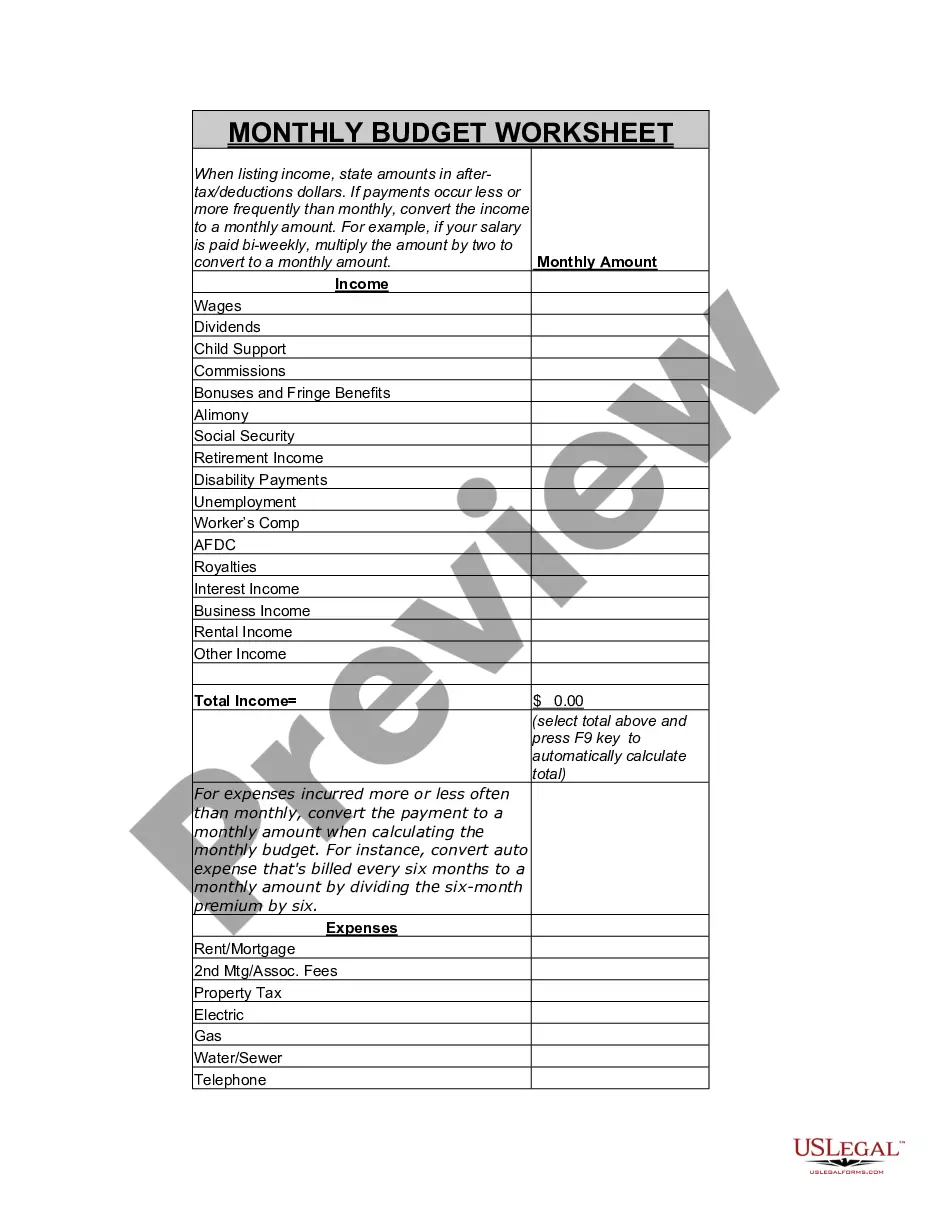
Do one month at a time.Enter Your Beginning Balance. For the first month, start your projection with the actual amount of cash your business will have in your bank account.Estimate Cash Coming In. Fill in all amounts you expect to take in during the month.Estimate Cash Going Out.Subtract Outlays From Income.
Your Monthly Cash Flow Plan. (BUDGET) A monthly cash flow plan or budget gives you more control over your money and sets you up to achieve short-term and long-term financial goals and dreams. It is important to have a zero based cash flow plan which means your monthly income minus your expenses should equal ZERO.
Preparing a cash flow budget involves four steps:Preparing a sales forecast.Projecting your anticipated cash inflows.Projecting your anticipated cash outflows.Putting the projections together to come up with your cash flow bottom line.
Monthly Cash Flow reports are considered essential month-end financial statements and are often used by CFOs and Analysts to review the cash inflows and outflows of the business. Key functionality in this type of report is parameter driven so the figures are presented automatically when the user runs the report.
A cash flow statement is a financial statement that provides aggregate data regarding all cash inflows a company receives from its ongoing operations and external investment sources. It also includes all cash outflows that pay for business activities and investments during a given period.
Do one month at a time.Enter Your Beginning Balance. For the first month, start your projection with the actual amount of cash your business will have in your bank account.Estimate Cash Coming In. Fill in all amounts you expect to take in during the month.Estimate Cash Going Out.Subtract Outlays From Income.
A cash flow statement shows how money flows in and out of a business....How to Write a Cash Flow StatementStart with the Opening Balance.Calculate the Cash Coming in (Sources of Cash)Determine the Cash Going Out (Uses of Cash)Subtract Uses of Cash (Step 3) from your Cash Balance (sum of Steps 1 and 2)
In a general sense, a cash flow plan allows a company to plan its incoming and outgoing cash to ensure it can meet expenses. Cash flow activities include operating activities, investing activities, and financing activities.
How to Create a Personal Cash Flow StatementNote your income. Find out when you are paid. This is about more than just recognizing your monthly income.Track your expenses. Next, you should know where your money is going, and when it needs to get there.