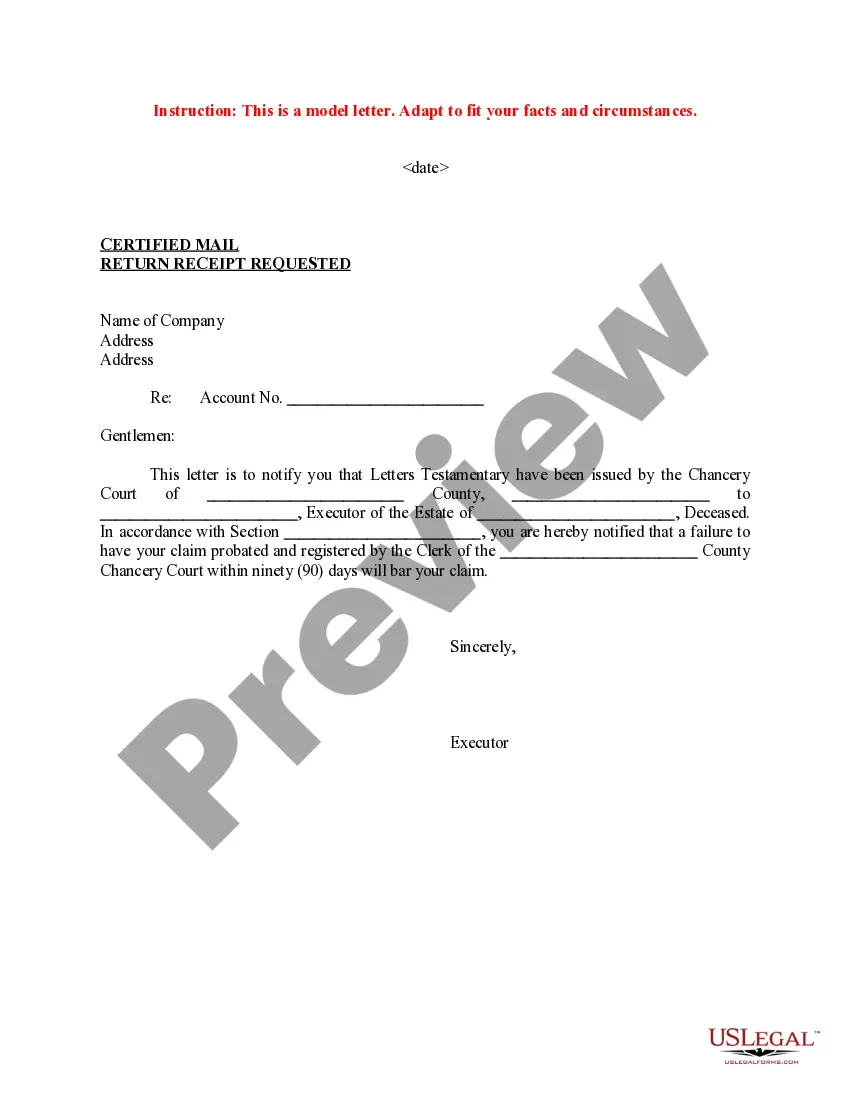
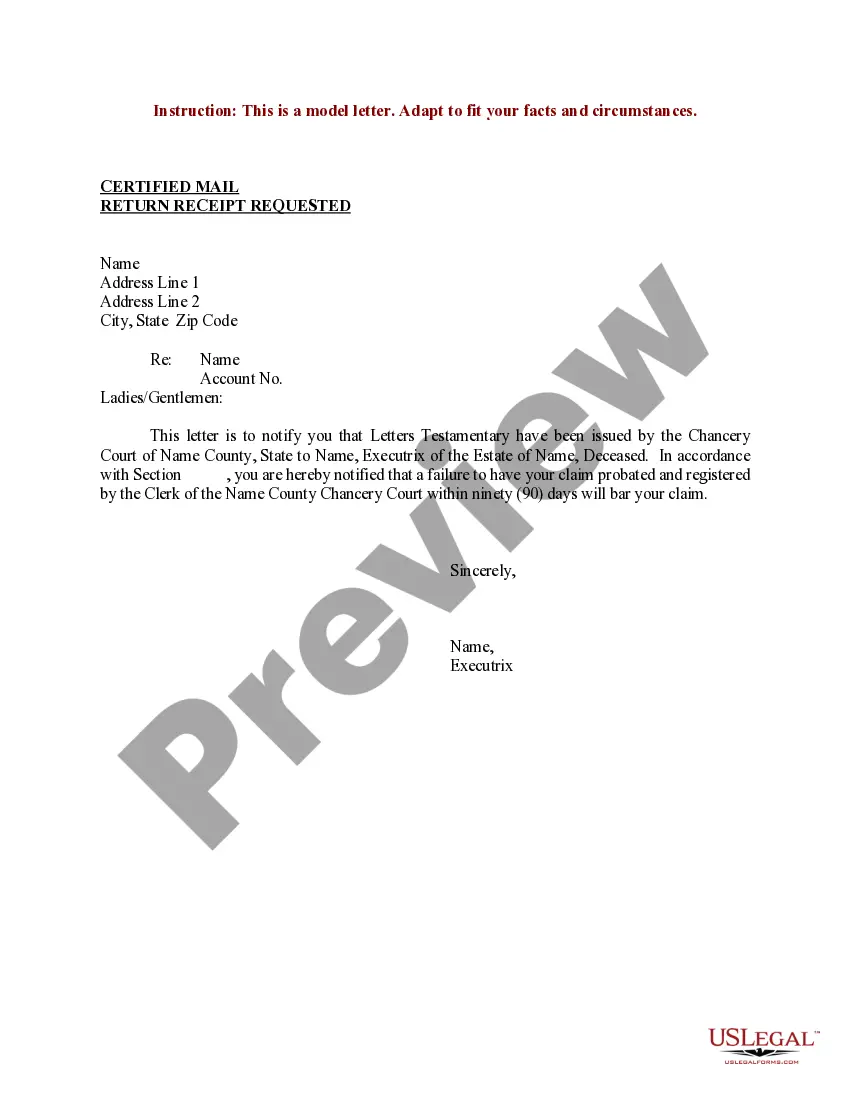
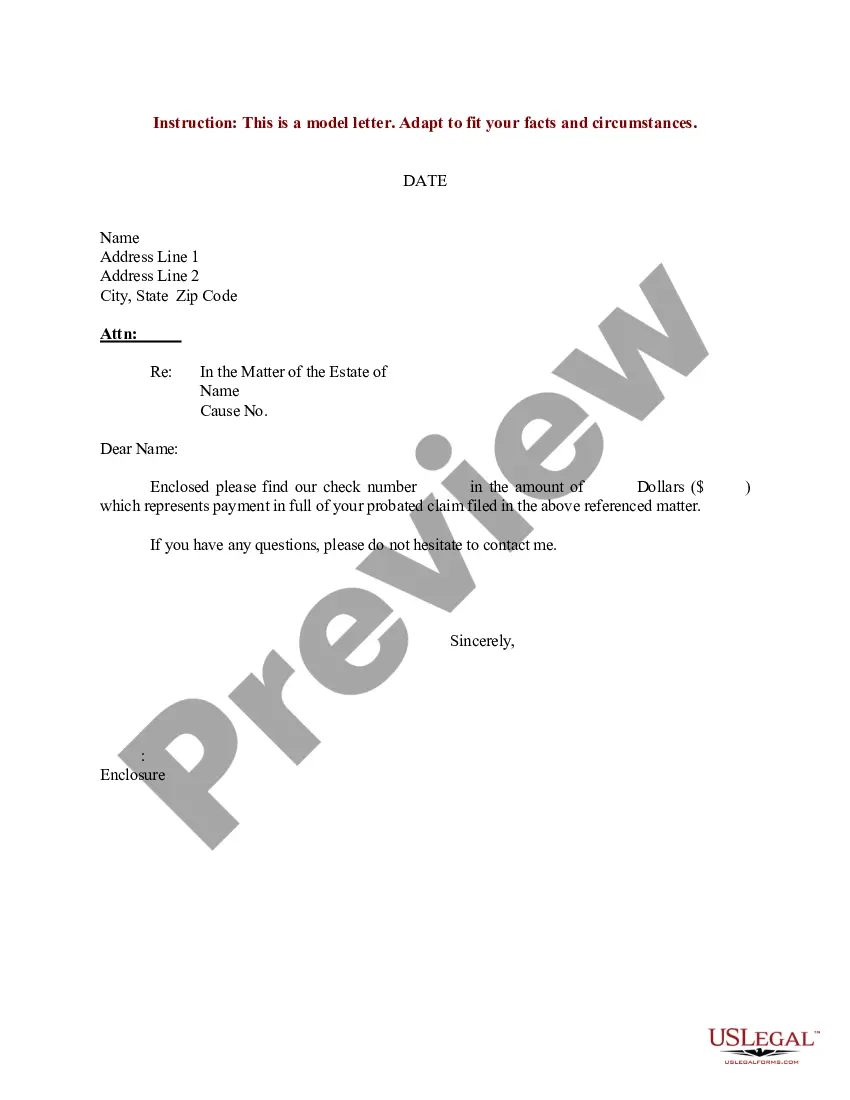
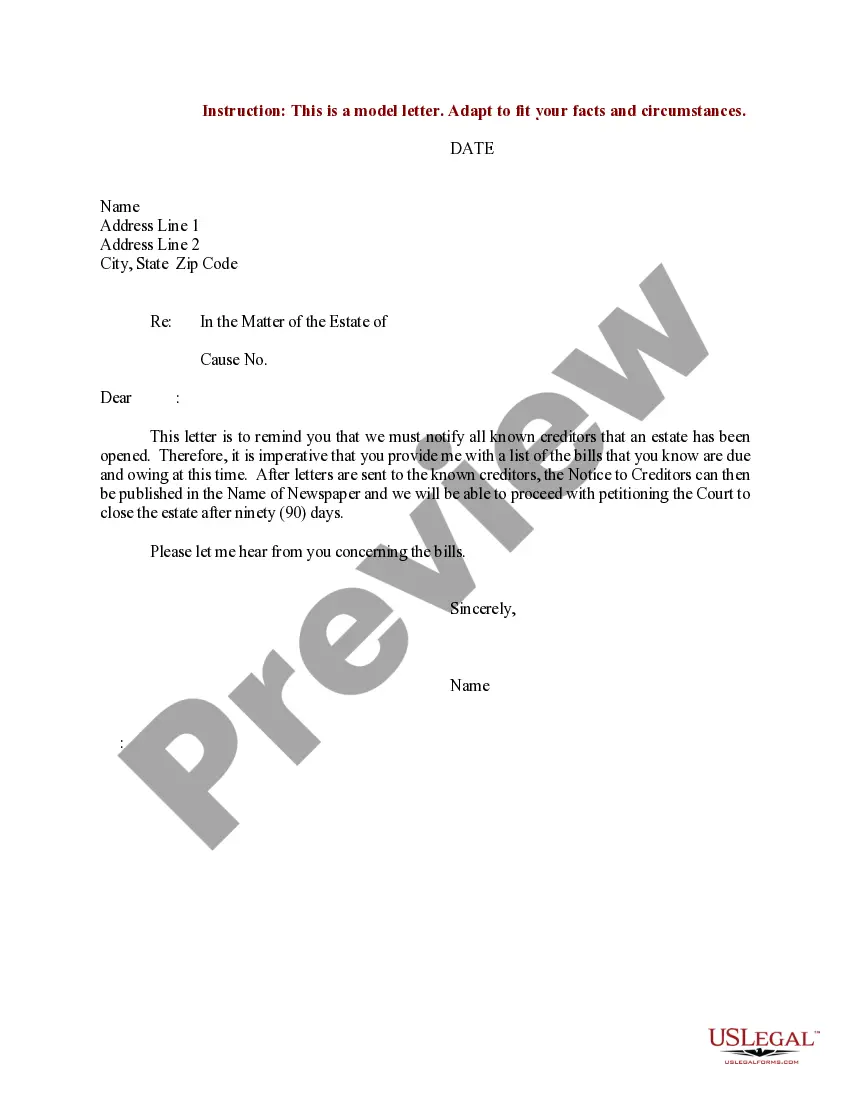
Massachusetts Sample Letter for Notification to Creditor to Probate and Register Claim
Description

Get your form ready online
Our built-in tools help you complete, sign, share, and store your documents in one place.
Make edits, fill in missing information, and update formatting in US Legal Forms—just like you would in MS Word.
Download a copy, print it, send it by email, or mail it via USPS—whatever works best for your next step.
Sign and collect signatures with our SignNow integration. Send to multiple recipients, set reminders, and more. Go Premium to unlock E-Sign.
If this form requires notarization, complete it online through a secure video call—no need to meet a notary in person or wait for an appointment.
We protect your documents and personal data by following strict security and privacy standards.

Make edits, fill in missing information, and update formatting in US Legal Forms—just like you would in MS Word.

Download a copy, print it, send it by email, or mail it via USPS—whatever works best for your next step.

Sign and collect signatures with our SignNow integration. Send to multiple recipients, set reminders, and more. Go Premium to unlock E-Sign.

If this form requires notarization, complete it online through a secure video call—no need to meet a notary in person or wait for an appointment.

We protect your documents and personal data by following strict security and privacy standards.
Looking for another form?
How to fill out Sample Letter For Notification To Creditor To Probate And Register Claim?
Finding the right legal document format could be a struggle. Obviously, there are plenty of templates available online, but how can you obtain the legal kind you require? Use the US Legal Forms website. The service provides 1000s of templates, for example the Massachusetts Sample Letter for Notification to Creditor to Probate and Register Claim, which can be used for business and personal requires. All the varieties are checked by specialists and meet up with federal and state requirements.
In case you are presently registered, log in to the accounts and click on the Acquire button to find the Massachusetts Sample Letter for Notification to Creditor to Probate and Register Claim. Utilize your accounts to check with the legal varieties you possess ordered earlier. Visit the My Forms tab of your accounts and acquire one more duplicate in the document you require.
In case you are a fresh consumer of US Legal Forms, allow me to share easy guidelines for you to follow:
- Initially, ensure you have selected the correct kind for your city/area. It is possible to check out the form while using Review button and look at the form description to ensure it is the right one for you.
- If the kind does not meet up with your requirements, take advantage of the Seach field to discover the right kind.
- Once you are certain the form would work, click the Purchase now button to find the kind.
- Choose the rates strategy you would like and enter in the necessary information and facts. Design your accounts and pay for your order utilizing your PayPal accounts or bank card.
- Opt for the data file structure and down load the legal document format to the product.
- Total, change and produce and signal the obtained Massachusetts Sample Letter for Notification to Creditor to Probate and Register Claim.
US Legal Forms is definitely the biggest local library of legal varieties where you can find different document templates. Use the company to down load professionally-created paperwork that follow condition requirements.
Form popularity
FAQ
The general rule is that an estate has to be probated within 3 years of when the decedent died. However, this deadline doesn't apply to: A voluntary administration. Determining heirs.
You'll need to file: Petition for Formal Probate of Will and/or Appointment of Personal Representative (MPC 160) Surviving Spouse, Children, Heirs at Law (MPC 162) A certified copy of the death certificate if it's available, or an affidavit if it's not. Citation-Return of Service (MPC 560), which the court will give you.
Since creditors have a year (after the death) to come forward with claims, probate in Massachusetts usually takes a year or so. If there is a court battle over the will (which is uncommon), or if there are unusual assets or debts, it can take much longer.
The creditor has one year from the date of death to make a filing against the estate. If probate hasn't been started before the one-year date of death anniversary, a creditor under Massachusetts law can file a probate and preserve its claim prior to this deadline.
The following assets are exempt from probate in Massachusetts: Property jointly owned with right of survivorship. Property held in tenancy by the entirety. Accounts with transfer-on-death (TOD) or payable-on-death (POD) designations. Small estates (under $20,000) Certain life insurance policies. Certain retirement accounts.
You'll need to file: Petition for Informal Probate of Will and/or Appointment of Personal Representative (MPC 150) Surviving Spouse, Children, Heirs at Law (MPC 162) Devisees (MPC 163) The original will. A certified copy of the death certificate. Notice of Informal Probate and Return of Service (MPC 550)
Is there a deadline to probate an estate? The general rule is that an estate has to be probated within 3 years of when the decedent died.
Formal probate matters are typically heard by a judge and may involve 1 or more court hearings. You might need to file a formal probate for several reasons, including: To object to an informal probate. If the will is a copy or has handwritten words added (interlineations) or crossed out (deletions)