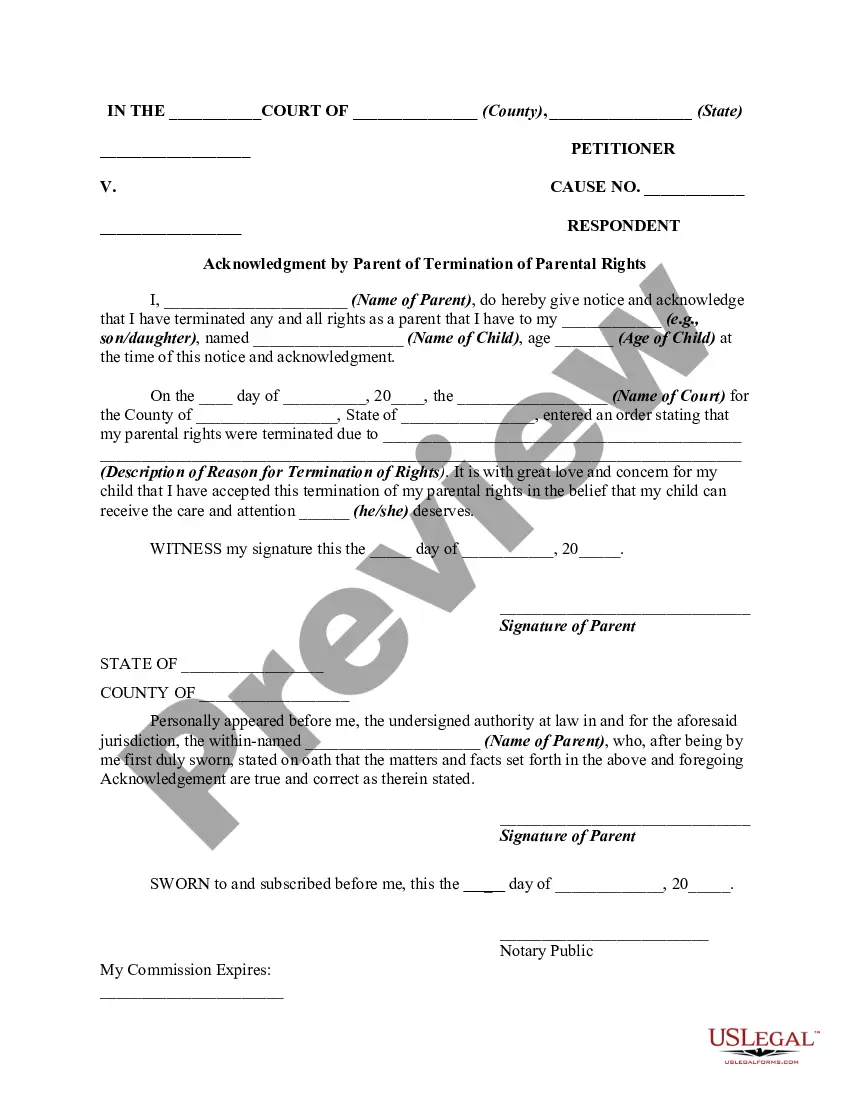
This form is an acknowledgment of a parent of a minor child stating that the parent's parental rights have been duly terminated by a court with proper jurisdiction.
Massachusetts Acknowledgment and Agreement by Parent of Termination or Relinquish of Parental Rights - Release of Parental Rights
Instant download
Description
Free preview
Get your form ready online
Our built-in tools help you complete, sign, share, and store your documents in one place.
Built-in online Word editor
Make edits, fill in missing information, and update formatting in US Legal Forms—just like you would in MS Word.
Export easily
Download a copy, print it, send it by email, or mail it via USPS—whatever works best for your next step.
E-sign your document
Sign and collect signatures with our SignNow integration. Send to multiple recipients, set reminders, and more. Go Premium to unlock E-Sign.
Notarize online 24/7
If this form requires notarization, complete it online through a secure video call—no need to meet a notary in person or wait for an appointment.
Store your document securely
We protect your documents and personal data by following strict security and privacy standards.

Make edits, fill in missing information, and update formatting in US Legal Forms—just like you would in MS Word.

Download a copy, print it, send it by email, or mail it via USPS—whatever works best for your next step.

Sign and collect signatures with our SignNow integration. Send to multiple recipients, set reminders, and more. Go Premium to unlock E-Sign.

If this form requires notarization, complete it online through a secure video call—no need to meet a notary in person or wait for an appointment.

We protect your documents and personal data by following strict security and privacy standards.
Looking for another form?

How to fill out Acknowledgment And Agreement By Parent Of Termination Or Relinquish Of Parental Rights - Release Of Parental Rights?
If you desire to finalize, obtain, or create legal document templates, utilize US Legal Forms, the largest collection of legal forms available online.
Employ the site’s straightforward and user-friendly search to discover the documents you need.
Various templates for business and personal purposes are categorized by type and state, or keywords.
Step 4. Once you have found the form you need, click the Get now button. Choose the pricing plan you prefer and enter your credentials to register for the account.
Step 5. Complete the transaction. You can use your Visa or MasterCard or PayPal account to process the payment.
- Utilize US Legal Forms to acquire the Massachusetts Acknowledgment and Agreement by Parent of Termination or Relinquish of Parental Rights - Release of Parental Rights in just a few clicks.
- If you are already a US Legal Forms customer, Log In to your account and select the Download option to retrieve the Massachusetts Acknowledgment and Agreement by Parent of Termination or Relinquish of Parental Rights - Release of Parental Rights.
- You can also access forms you previously saved from the My documents section of your account.
- If you are using US Legal Forms for the first time, adhere to the instructions below.
- Step 1. Ensure you have selected the form for the correct city/state.
- Step 2. Use the Review option to examine the form’s content. Remember to check the details.
- Step 3. If you are not satisfied with the form, utilize the Search field at the top of the screen to find alternative versions of the legal form template.
Form popularity
FAQ
When it comes to child custody in Massachusetts, there is no exact standard used to determine the best interests of the child; however, family court judges will weigh several factors as guidelines. The health, safety, and well being of the child are always the primary considerations.
However, removal of a parent's rights can occur in a number of different circumstances, including: When the state determines that a child is in an unsafe situation or is subject to neglect or abandonment in the family home, after reasonable efforts to work with the parents.
A parent who is declared ?unfit? by a Court stands to lose not just parenting time, but their parental rights altogether. Indeed, a parent who is declared unfit by a court can see their parental rights suspended completely in a guardianship case, or terminated altogether in an adoption without consent proceeding.
While there is no specific age when judges will consider a child's preference, judges tend to give the opinions of older teenagers more weight. A child below the age of 10 would need to be very mature for a Massachusetts judge to factor the child's preference into a custody decision.
In Massachusetts, a parent can be deemed unfit if they have a history of abuse or neglect towards their child. This can result from physical, emotional, or sexual abuse and neglectful behaviors such as failing to provide for the child's basic needs.
Moreover, proving parental alienation can be challenging, as it often involves subtle behaviors and emotional manipulation. Courts rely on expert testimony, psychological evaluations, and documented evidence to make informed decisions.
If the law applies to you, you must get permission either from the other parent or the court before you can leave the state with your child. If you can get permission from the other parent to leave the state with your child, you do not need the court's permission also.
History of crime, violence or substance abuse In extreme cases, a parent who has continually put their child in danger could lose all custodial rights. Parents who make false allegations could lose custody themselves or face other legal repercussions.