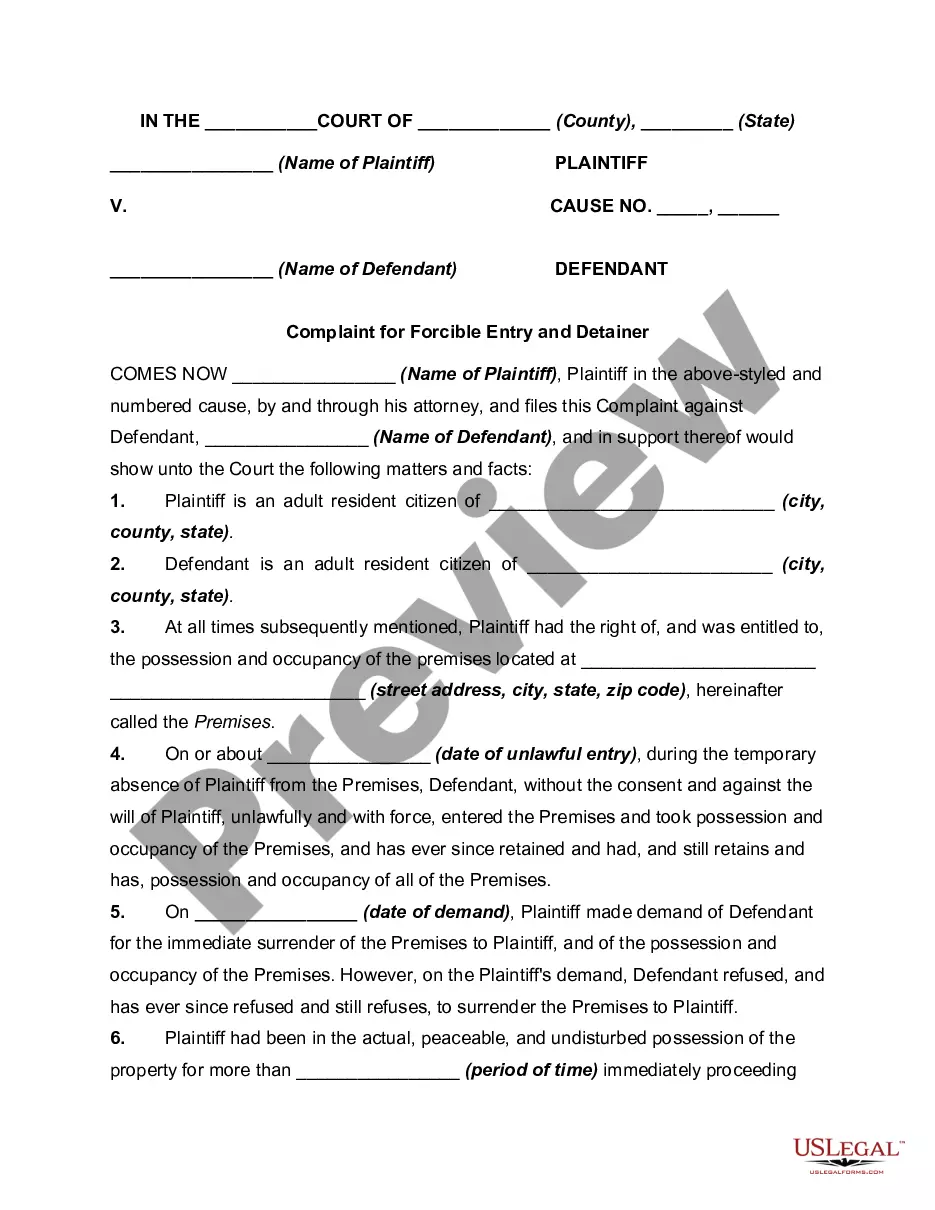
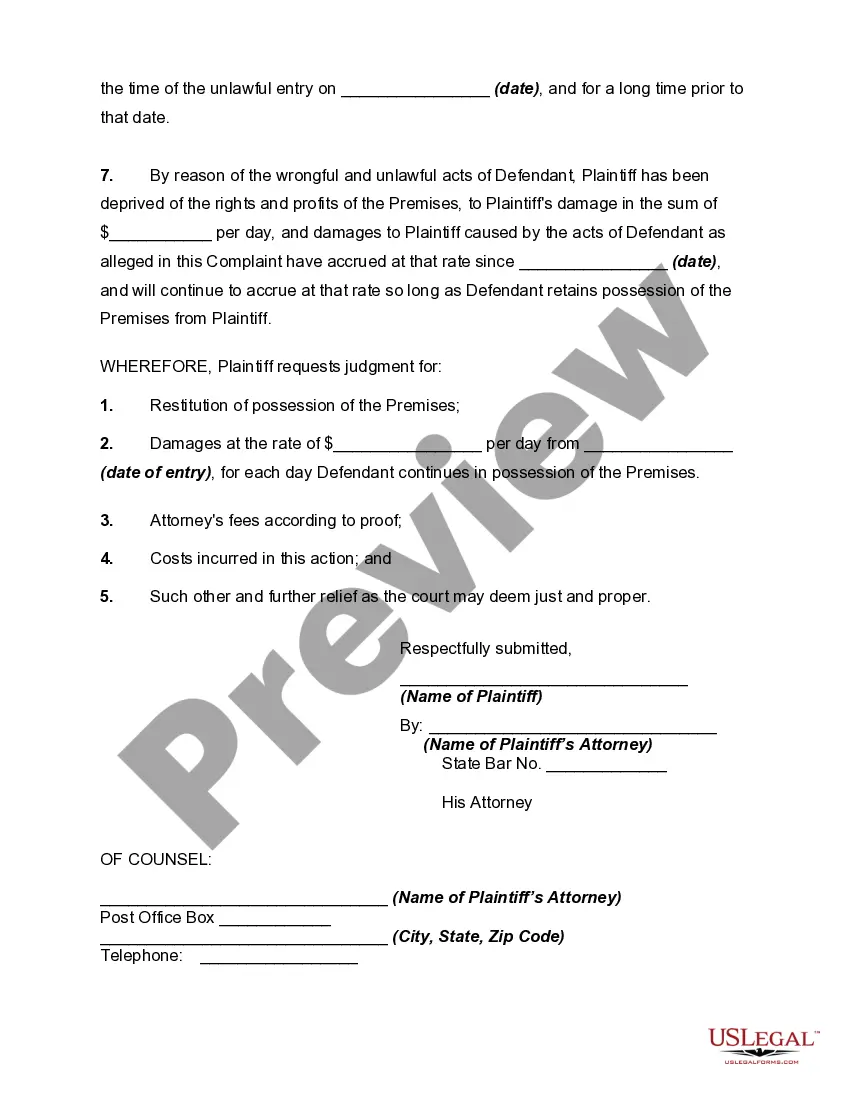
Louisiana Complaint for Forcible Entry and Detainer - Defendant Refuses to Surrender Premises on Demand

State:
Multi-State
Control #:
US-03314BG
Format:
Word; 
Rich Text
Instant download

Description

Unlawful entry is illegal entry upon lands or structures without force but by means of fraud or other willful wrong. It is closely related to housebreaking. But unlike housebreaking, the intent to commit an offense within the place entered is not needed for this offense. The basis of proof for this offense is that the entry was unlawful and that the conduct of the accused was contrary to good order and discipline.


Unlawful detention means keeping in custody unlawfully. Under criminal law it means keeping or confining a person in custody without any lawful reason. In civil law it is keeping in custody real property to which one is not entitled. A person is guilty of unlawful detention of real property when entry is made wrongfully without any right or title into any vacant or unoccupied lands tenements or other possessions.
Free preview
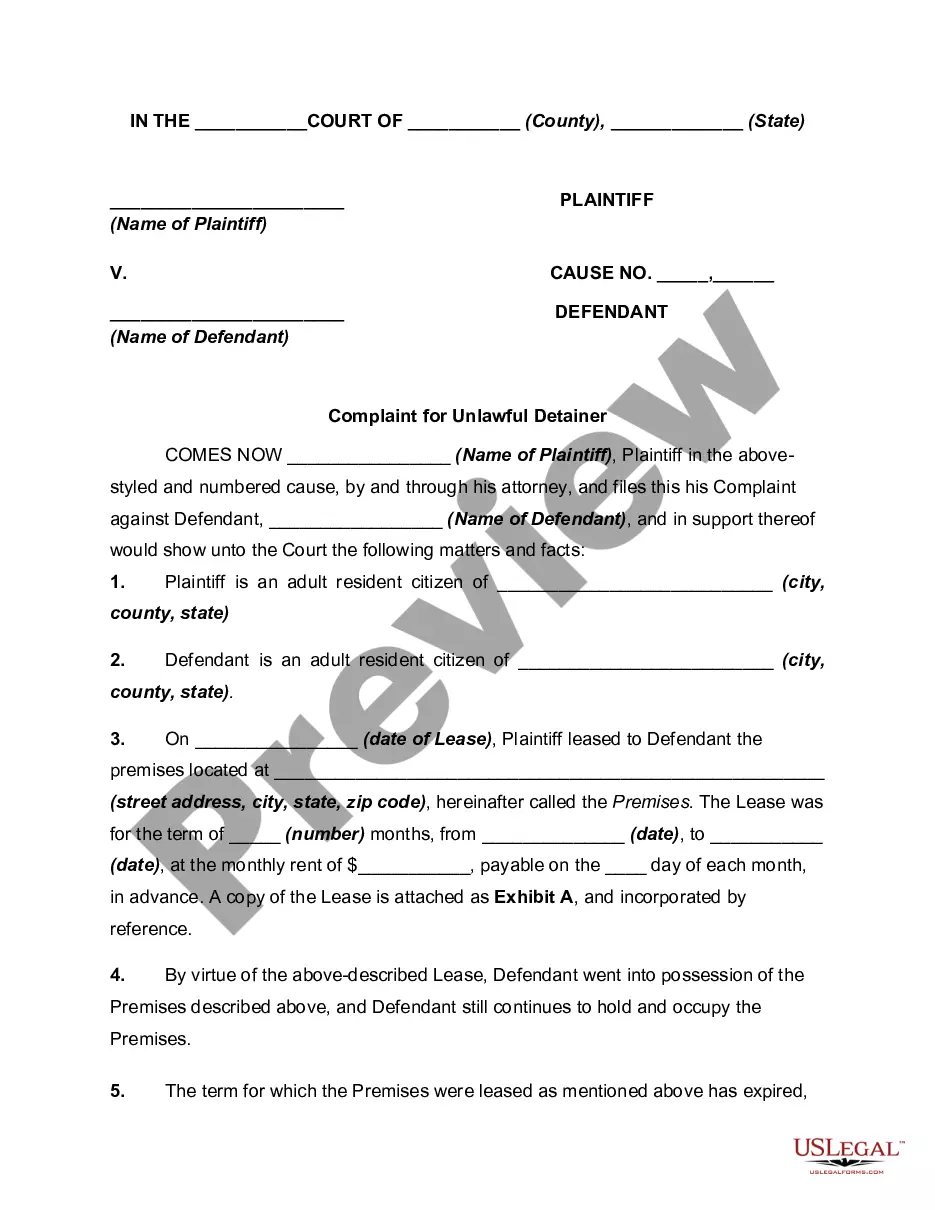
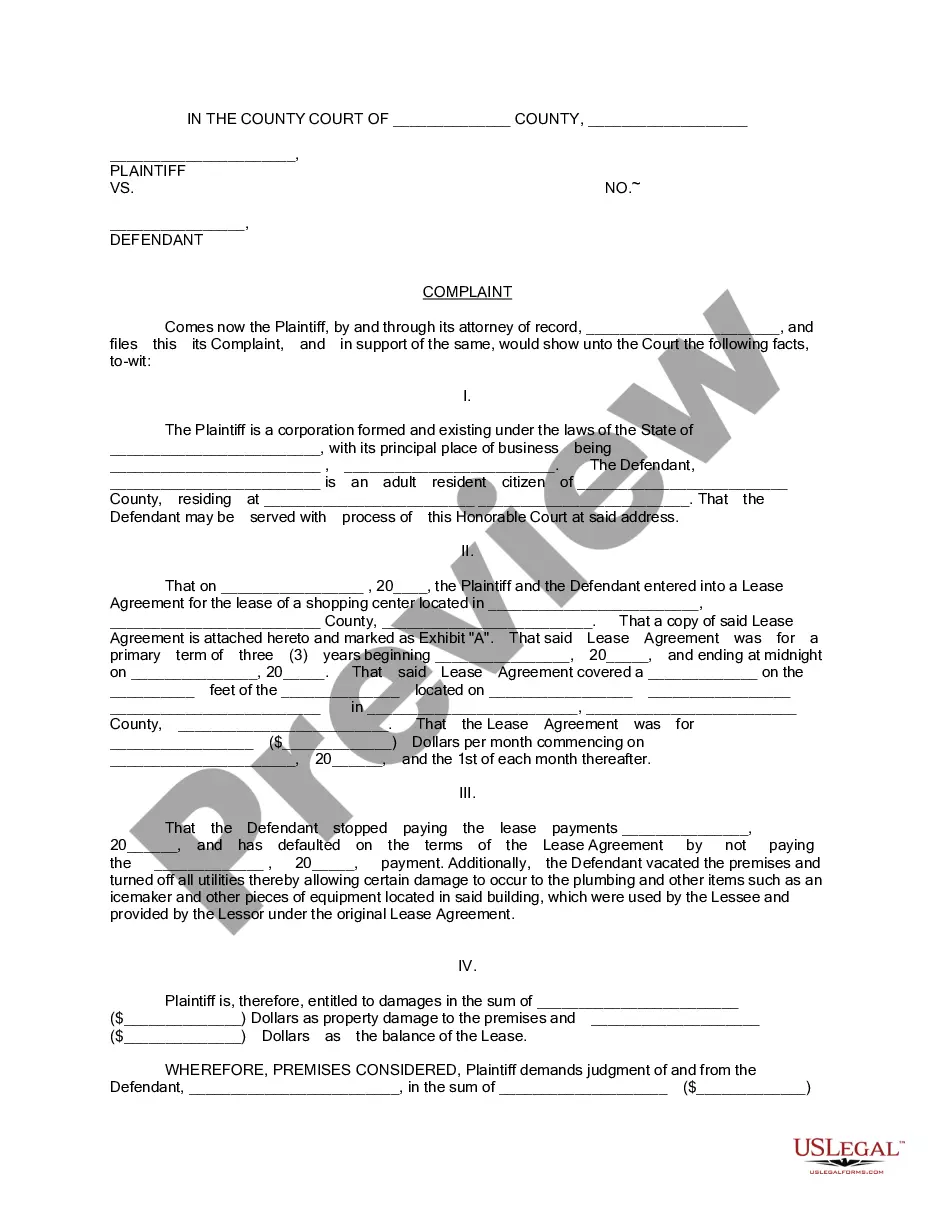
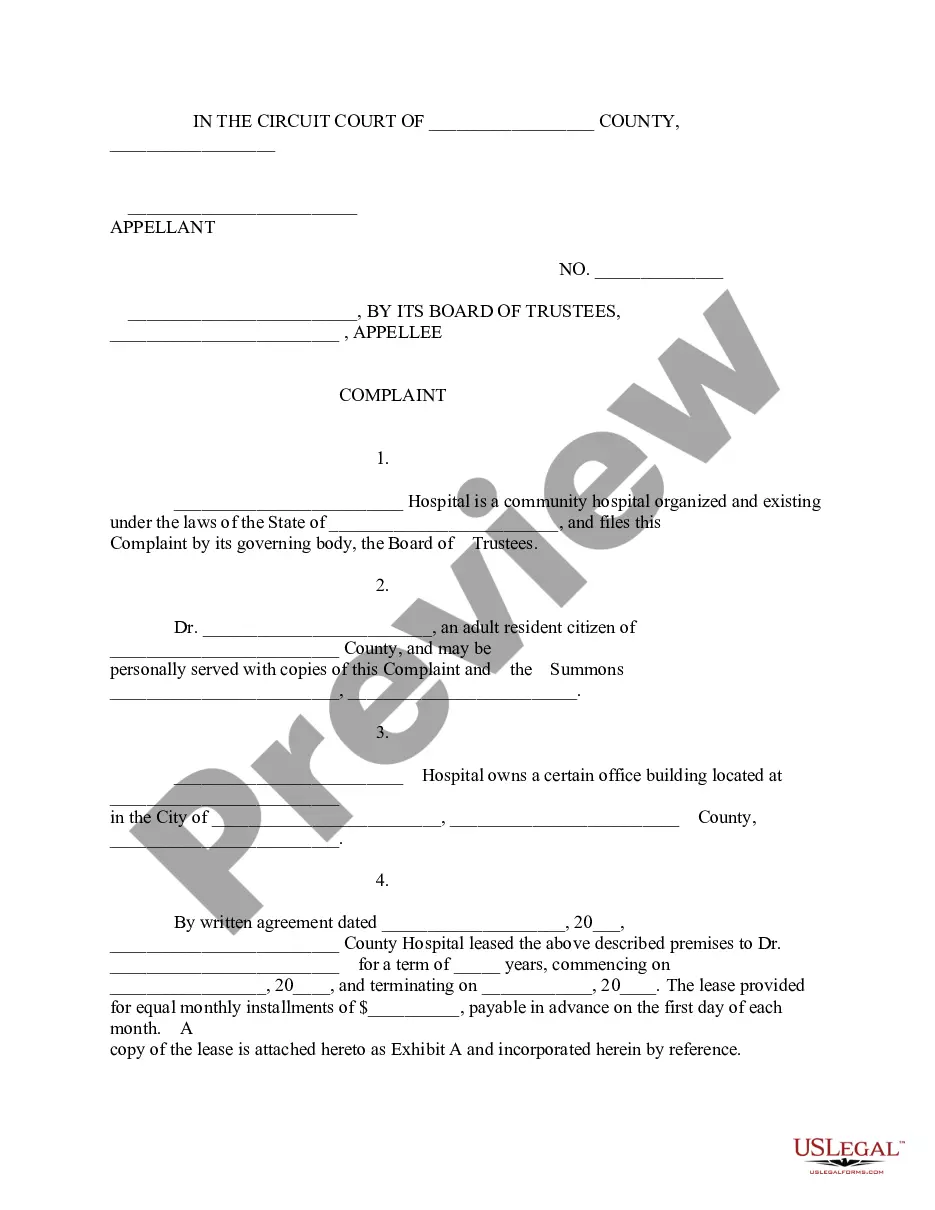
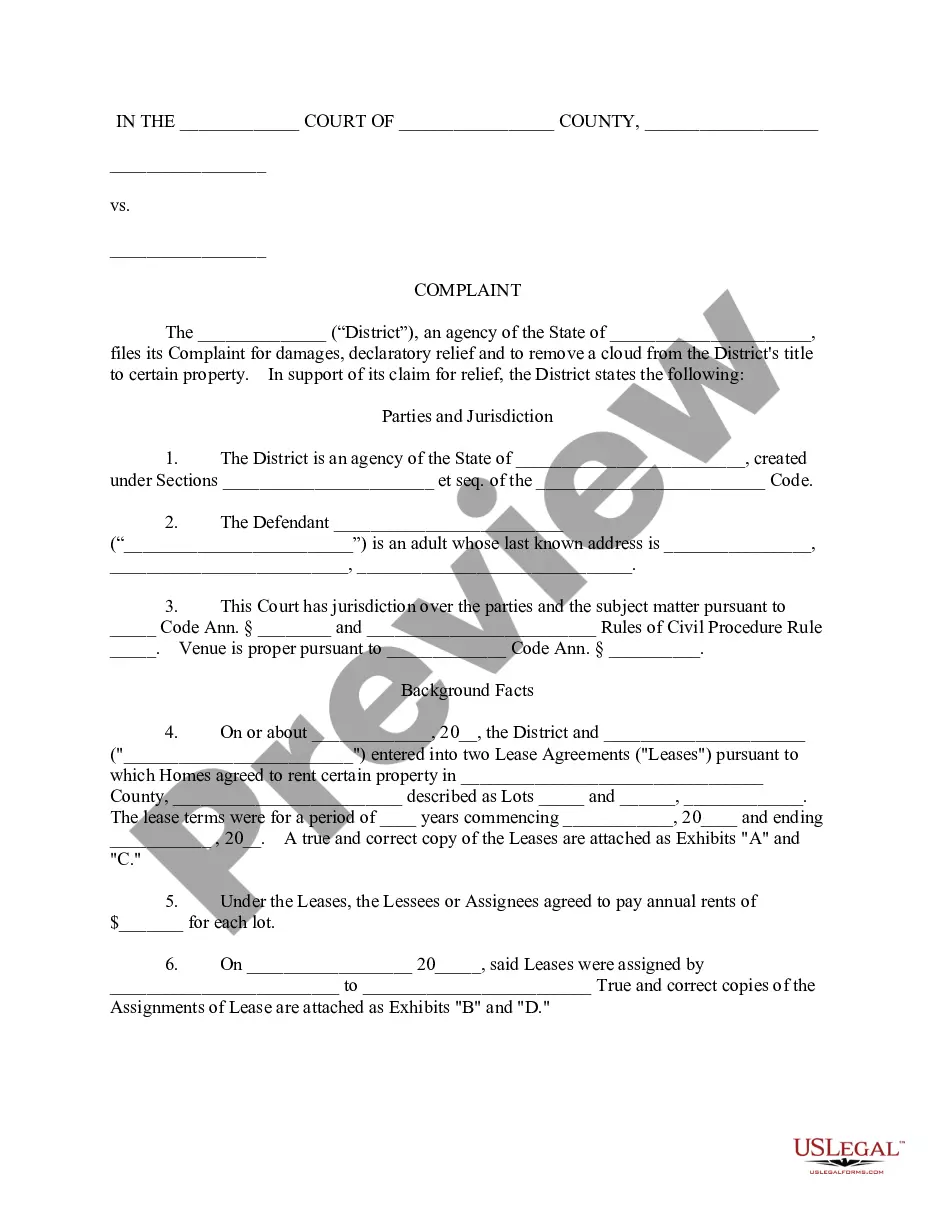
  • Preview Complaint for Forcible Entry and Detainer - Defendant Refuses to Surrender Premises on Demand
  • Preview Complaint for Forcible Entry and Detainer - Defendant Refuses to Surrender Premises on Demand

How to fill out Complaint For Forcible Entry And Detainer - Defendant Refuses To Surrender Premises On Demand?

If you want to full, obtain, or print out lawful file templates, use US Legal Forms, the greatest collection of lawful kinds, that can be found on the Internet. Take advantage of the site`s easy and hassle-free lookup to get the files you will need. Different templates for enterprise and individual purposes are categorized by classes and suggests, or search phrases. Use US Legal Forms to get the Louisiana Complaint for Forcible Entry and Detainer - Defendant Refuses to Surrender Premises on Demand in a couple of mouse clicks.

When you are presently a US Legal Forms consumer, log in for your account and then click the Acquire switch to obtain the Louisiana Complaint for Forcible Entry and Detainer - Defendant Refuses to Surrender Premises on Demand. You can also access kinds you earlier saved within the My Forms tab of your respective account.

Should you use US Legal Forms the first time, follow the instructions listed below:

  • Step 1. Make sure you have chosen the form for your right metropolis/land.
  • Step 2. Utilize the Review method to examine the form`s content material. Do not overlook to read through the description.
  • Step 3. When you are unsatisfied with all the develop, take advantage of the Search field towards the top of the monitor to get other variations of the lawful develop template.
  • Step 4. Once you have located the form you will need, click the Purchase now switch. Opt for the prices strategy you choose and include your accreditations to sign up for an account.
  • Step 5. Process the purchase. You can use your bank card or PayPal account to complete the purchase.
  • Step 6. Find the structure of the lawful develop and obtain it on the device.
  • Step 7. Comprehensive, modify and print out or indication the Louisiana Complaint for Forcible Entry and Detainer - Defendant Refuses to Surrender Premises on Demand.

Each lawful file template you get is your own for a long time. You have acces to every develop you saved with your acccount. Go through the My Forms area and pick a develop to print out or obtain again.

Be competitive and obtain, and print out the Louisiana Complaint for Forcible Entry and Detainer - Defendant Refuses to Surrender Premises on Demand with US Legal Forms. There are thousands of specialist and express-particular kinds you may use for the enterprise or individual requirements.

Form popularity

FAQ

Section 92.109 - Liability of Landlord (a) A landlord who in bad faith retains a security deposit in violation of this subchapter is liable for an amount equal to the sum of $100, three times the portion of the deposit wrongfully withheld, and the tenant's reasonable attorney's fees in a suit to recover the deposit.

(a) A landlord may not remove a door, window, or attic hatchway cover or a lock, latch, hinge pin, doorknob, or other mechanism connected to a door, window, or attic hatchway cover from the premises leased to tenant or remove furniture, fixtures, or appliances furnished by the landlord from premises leased to a tenant ...

For example, if a landlord successfully proves their case in court and obtains a judgment for possession, they can legally regain control of the property. The court may also award the landlord compensation for any unpaid rent or other damages incurred during the eviction process.

Section 4024 of the CARES Act prohibits landlords from requiring tenants to vacate ?before the date that is 30 days after the date ? that the landlord provides the tenant with a notice to vacate.? This prohibition applies only when a tenant fails to pay rent or other fees or charges due under their tenancy agreement.

116-136) (CARES Act) into law. Section 4024 of the CARES Act imposes a temporary moratorium on evictions.

The CARES Act, Section 4023 covers multi-family rental real estate properties with 5 or more units, and are backed by a federal loan (HUD, Fannie Mae, or Freddie Mac). This section covers an apartment building with 6 units and an apartment complex with 150 units, but not a quadplex with 4 units.

The CARES Act states that a landlord may not Page 7 -7- ?require the tenant to vacate? the property until 30 days after giving the tenant a notice to vacate. In New Jersey, a landlord may not require a tenant to leave his or her home except through a court proceeding.

A ?Federally backed multifamily mortgage loan? has the same definition as ?Federally backed mortgage loan,? except that (i) this loan is secured by a property designed principally for the occupancy of five or more families, and (ii) this loan cannot be a temporary financing loan such as a construction loan.

Trusted and secure by over 3 million people of the world’s leading companies

Louisiana Complaint for Forcible Entry and Detainer - Defendant Refuses to Surrender Premises on Demand