Louisiana Judgment of Divorce with community property, with children, restraining orders
What this document covers
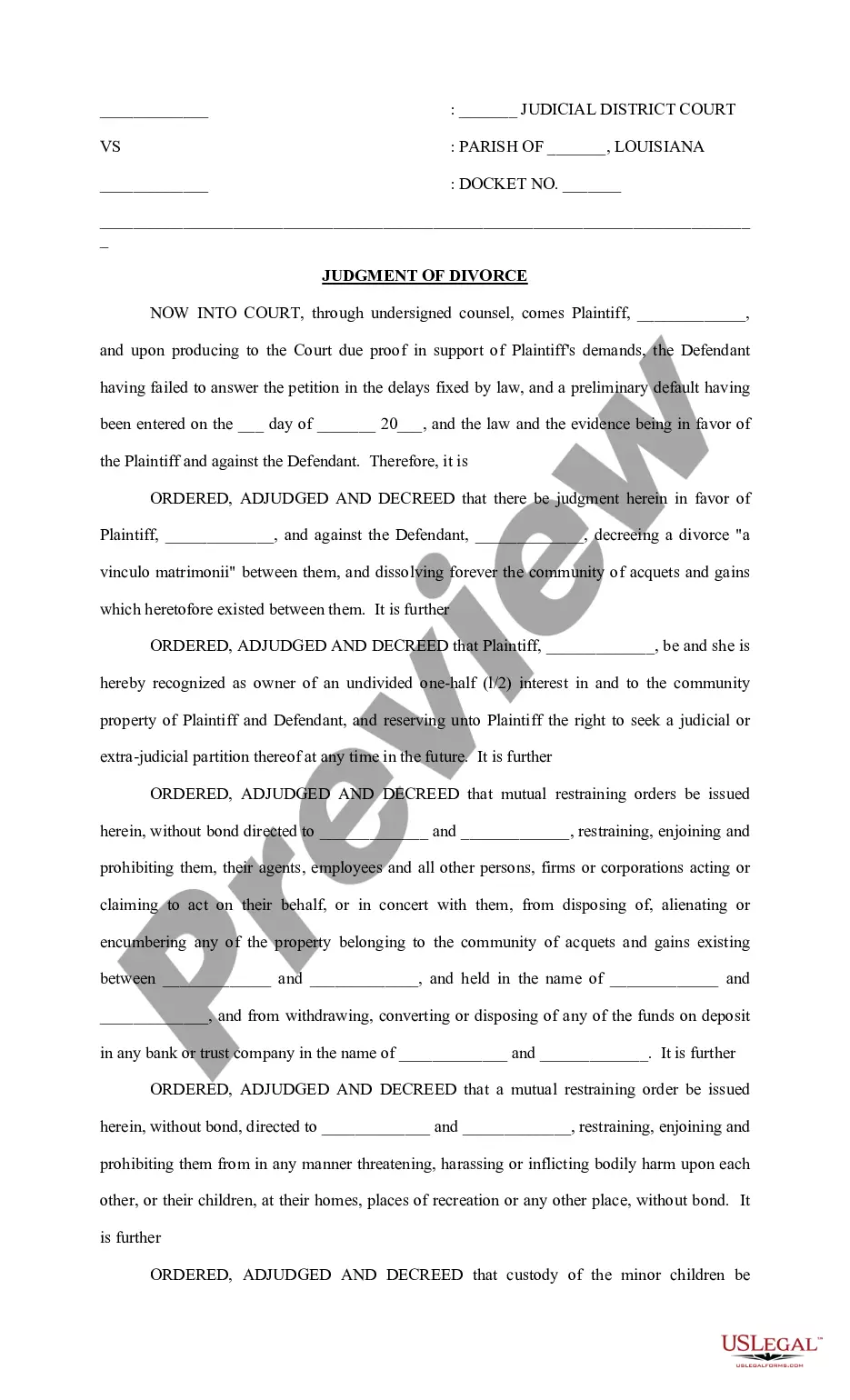
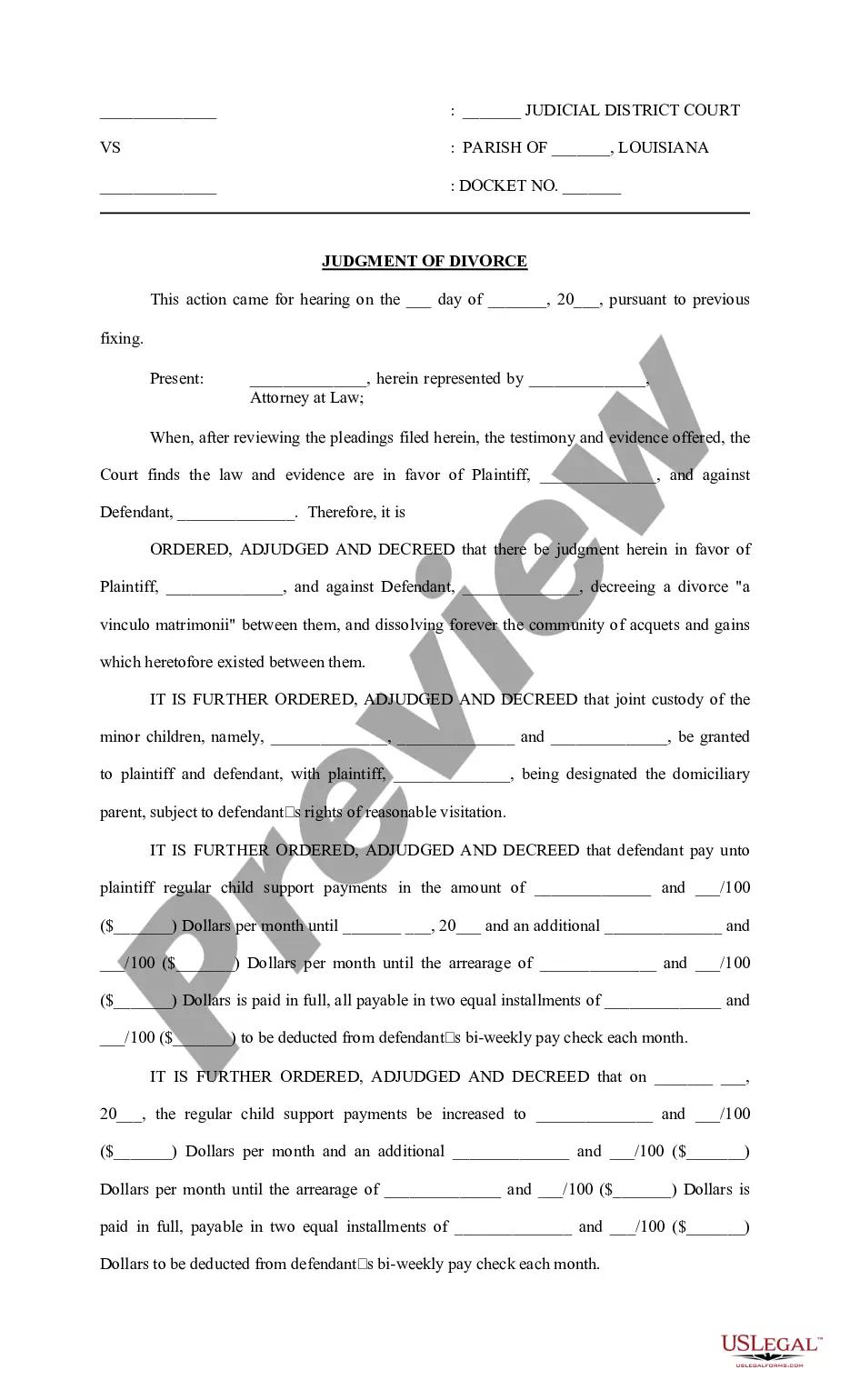
The Judgment of Divorce form is a legal document that officially concludes a marriage and addresses critical matters such as community property ownership, child custody, and restraining orders. This form is specifically designed for situations where one spouse does not respond to divorce proceedings, allowing for a default judgment in favor of the plaintiff. It differs from other divorce forms by encompassing community property considerations, custody arrangements, and mutual restraining orders, ensuring comprehensive legal protection for both parties and their children.
Key parts of this document
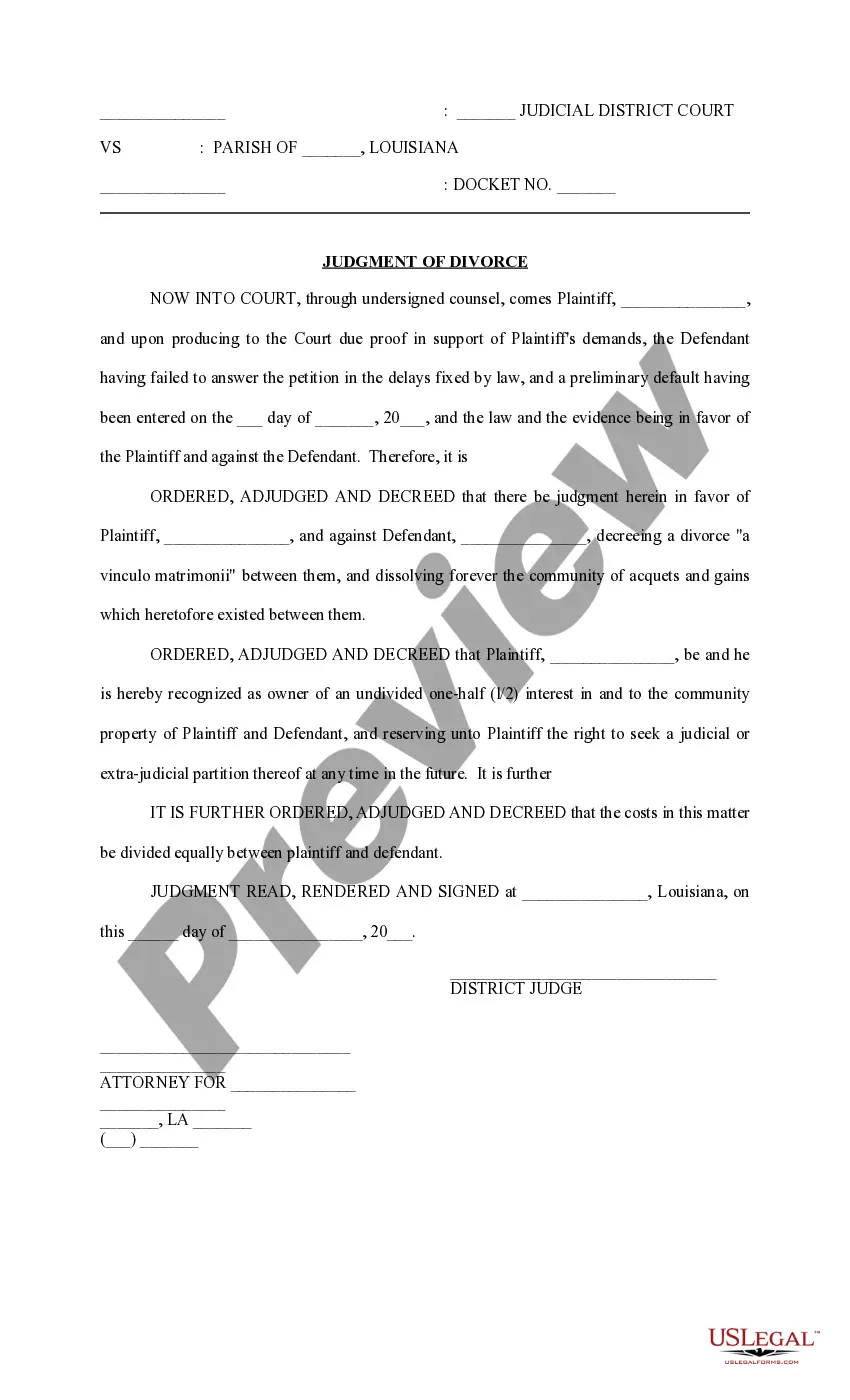
- Judgment of divorce: Officially ends the marriage, decreeing a divorce "a vinculo matrimonii."
- Community property recognition: Affirms the plaintiff's ownership of half of the community property.
- Mutual restraining orders: Prohibits both parties from disposing of community property and from threatening or harassing each other or their children.
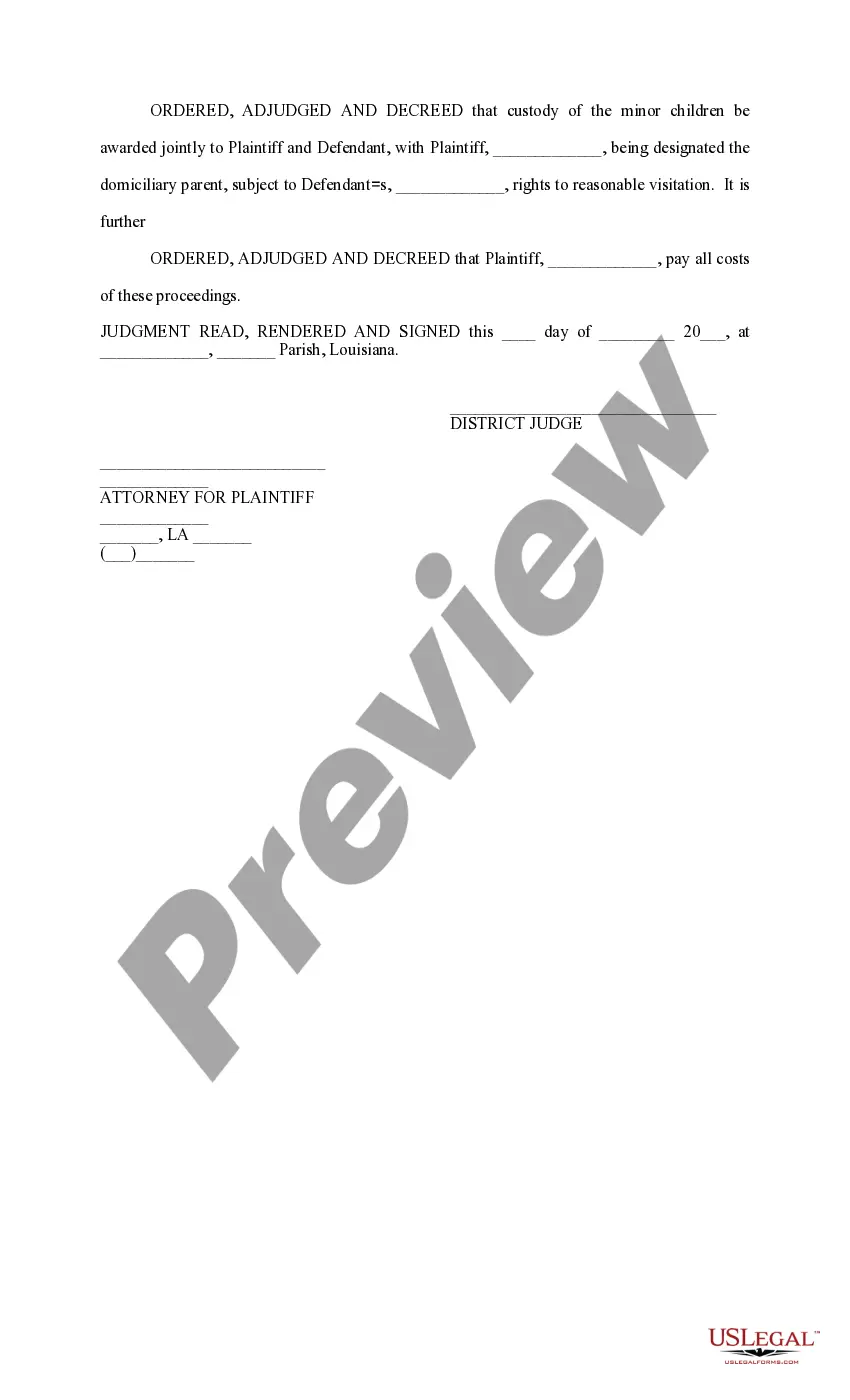
- Child custody arrangement: Grants joint custody, designating the plaintiff as the domiciliary parent with specific visitation rights for the defendant.
- Costs of proceedings: Specifies that the plaintiff is responsible for all court-related costs.
Situations where this form applies
This form is necessary in scenarios where one spouse wishes to dissolve the marriage and the other fails to respond or appear in court. It is particularly useful when there are children involved, as it also addresses custody issues and property rights. The Judgment of Divorce is suitable for individuals who need a legally binding document to finalize their divorce in accordance with state laws, ensuring that community property and custody matters are resolved before the court.
Who needs this form
- Individuals initiating a divorce where the other spouse does not respond.
- Parents seeking legal clarification regarding custody and visitation rights.
- Spouses looking to assert ownership over community property in a divorce.
- Parties needing to establish mutual restraining orders for safety concerns.
Instructions for completing this form
- Enter the name of the plaintiff and defendant in the designated fields.
- Provide the court docket number for identification.
- Specify the date when the defendant failed to respond to the petition.
- Indicate the custody arrangement for any minor children.
- Sign the form as required and ensure it is filed with the appropriate court.
Does this form need to be notarized?
In most cases, this form does not require notarization. However, some jurisdictions or signing circumstances might. US Legal Forms offers online notarization powered by Notarize, accessible 24/7 for a quick, remote process.
Get your form ready online
Our built-in tools help you complete, sign, share, and store your documents in one place.
Make edits, fill in missing information, and update formatting in US Legal Forms—just like you would in MS Word.
Download a copy, print it, send it by email, or mail it via USPS—whatever works best for your next step.
Sign and collect signatures with our SignNow integration. Send to multiple recipients, set reminders, and more. Go Premium to unlock E-Sign.
If this form requires notarization, complete it online through a secure video call—no need to meet a notary in person or wait for an appointment.
We protect your documents and personal data by following strict security and privacy standards.

Make edits, fill in missing information, and update formatting in US Legal Forms—just like you would in MS Word.

Download a copy, print it, send it by email, or mail it via USPS—whatever works best for your next step.

Sign and collect signatures with our SignNow integration. Send to multiple recipients, set reminders, and more. Go Premium to unlock E-Sign.

If this form requires notarization, complete it online through a secure video call—no need to meet a notary in person or wait for an appointment.

We protect your documents and personal data by following strict security and privacy standards.
Avoid these common issues
- Failing to provide complete and accurate names of the parties involved.
- Omitting pertinent details regarding minor children and custody agreements.
- Not signing or dating the judgment, which may render it invalid.
- Neglecting to double-check state-specific filing requirements or local rules.
Why complete this form online
- Instant access to professionally drafted legal documents, saving time and effort.
- Ability to edit and customize the form as needed for your specific situation.
- Secure storage and retrieval of documents anytime, ensuring convenience.
- Guidance through the completion process to minimize errors.
Looking for another form?
Form popularity
FAQ
There is no specific age at which children can fully handle their parents' divorce, as every child is different. Typically, children aged 12 and older may express their preferences regarding custody and visitation. However, younger children may also display emotional responses that need support. Therefore, ensuring open communication and professional guidance can help families navigate these conversations effectively.
Under Louisiana law, marital property, or property acquired during the marriage, is distributed equally (50-50) to each party unless the court finds such a division to be inequitable or parties agree to a different formula under which to divide property.
Infidelity or other bad behaviors do not affect the amount of community property one is entitled to. Also, one is not entitled to more spousal support, child support, or custody rights even if they can prove their spouse had an affair. Today in Louisiana, adultery actually plays a very minor role in a divorce.
Yes, Louisiana is in the minority of states that follows community property laws. Most states adhere to equitable distribution principles, but Louisiana isn't one of them. Louisiana community property laws seek to divide a couple's property equally in a Louisiana divorce.
Louisiana provides for fault and no-fault divorce options.Under a 102 divorce, a spouse can file a petition for divorce, allege jurisdiction and venue, and request a judgment of divorce after the parties have lived separate and apart from service of the petition or written waiver of service for a period of 180 days.
Louisiana is a community property state. This means that spouses generally share equally in the assets, income and debt acquired by either spouse during the marriage. However, some income and some property may be separate income or separate property.
Separate property is property belongs exclusively to one of two spouses. Under Louisiana law, assets acquired by a deceased person while unmarried, or acquired during the marriage by gift, is considered to be separate property.
A judge will typically only deny an uncontested divorce if there are procedural matters that haven't been done properly, something is unclear or confusing, or something is not in the best interests of the child.