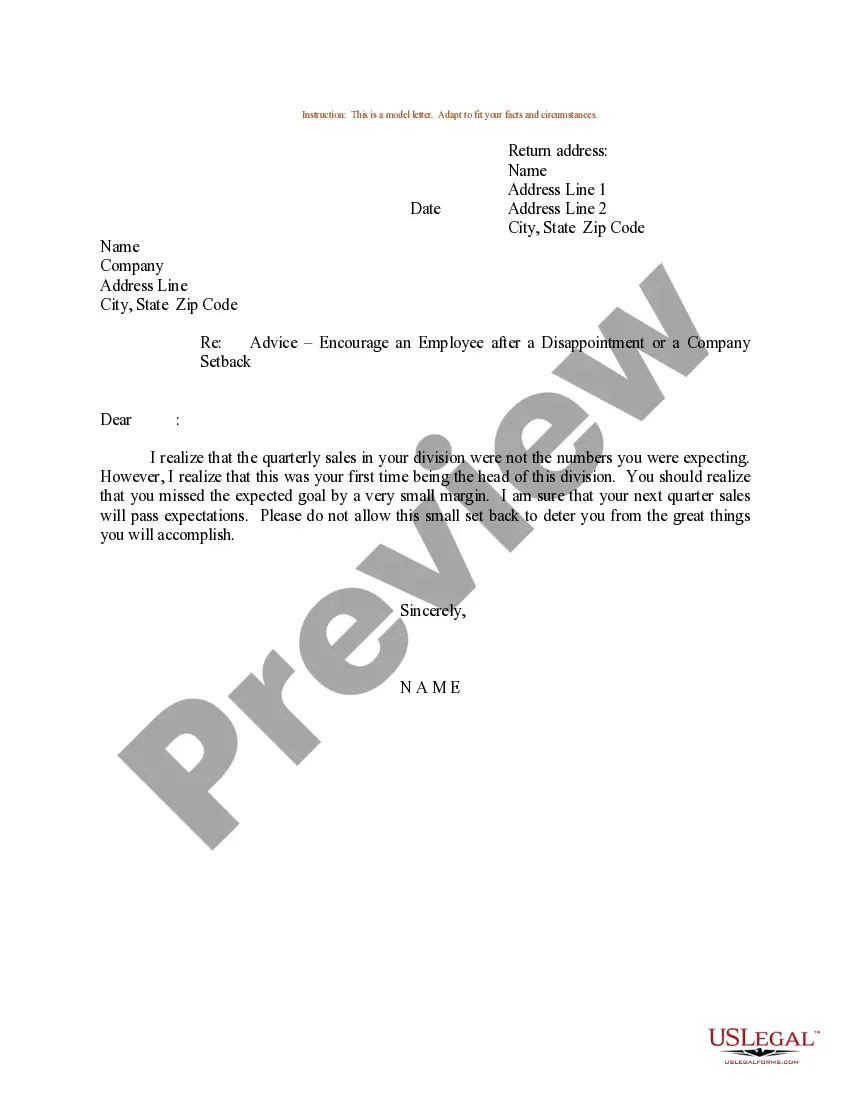
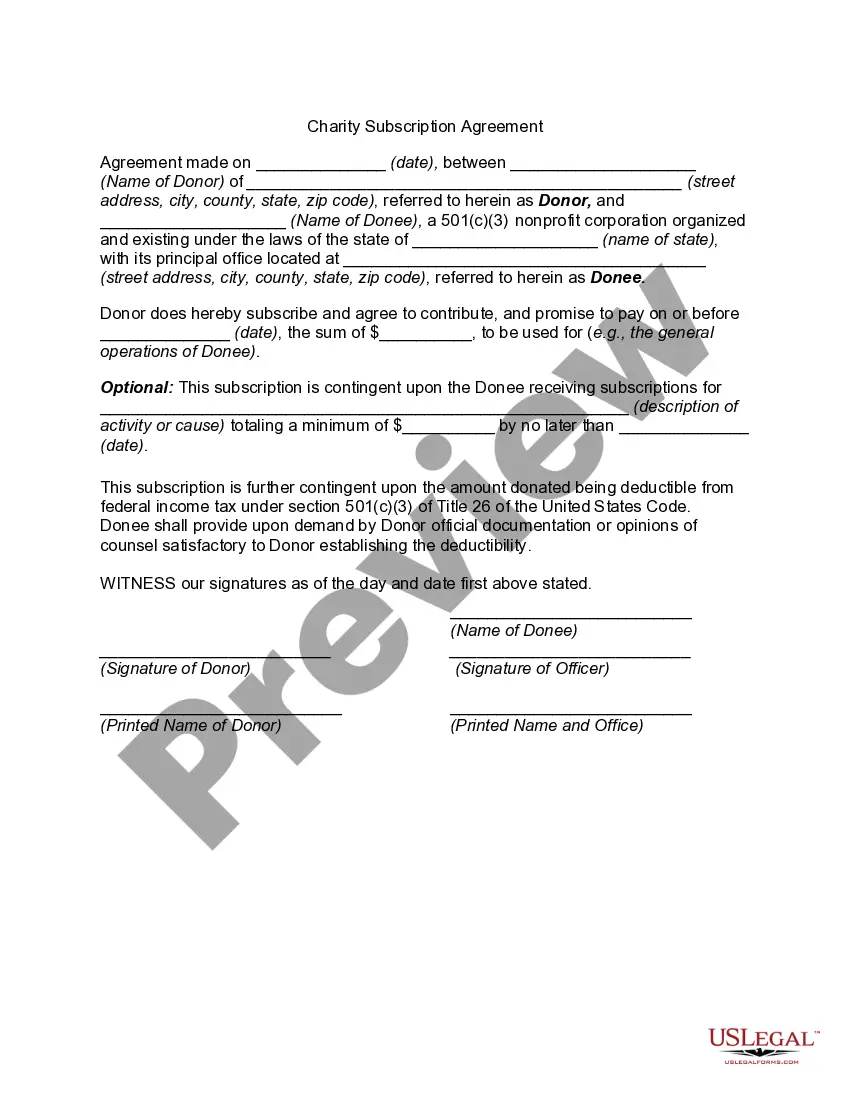
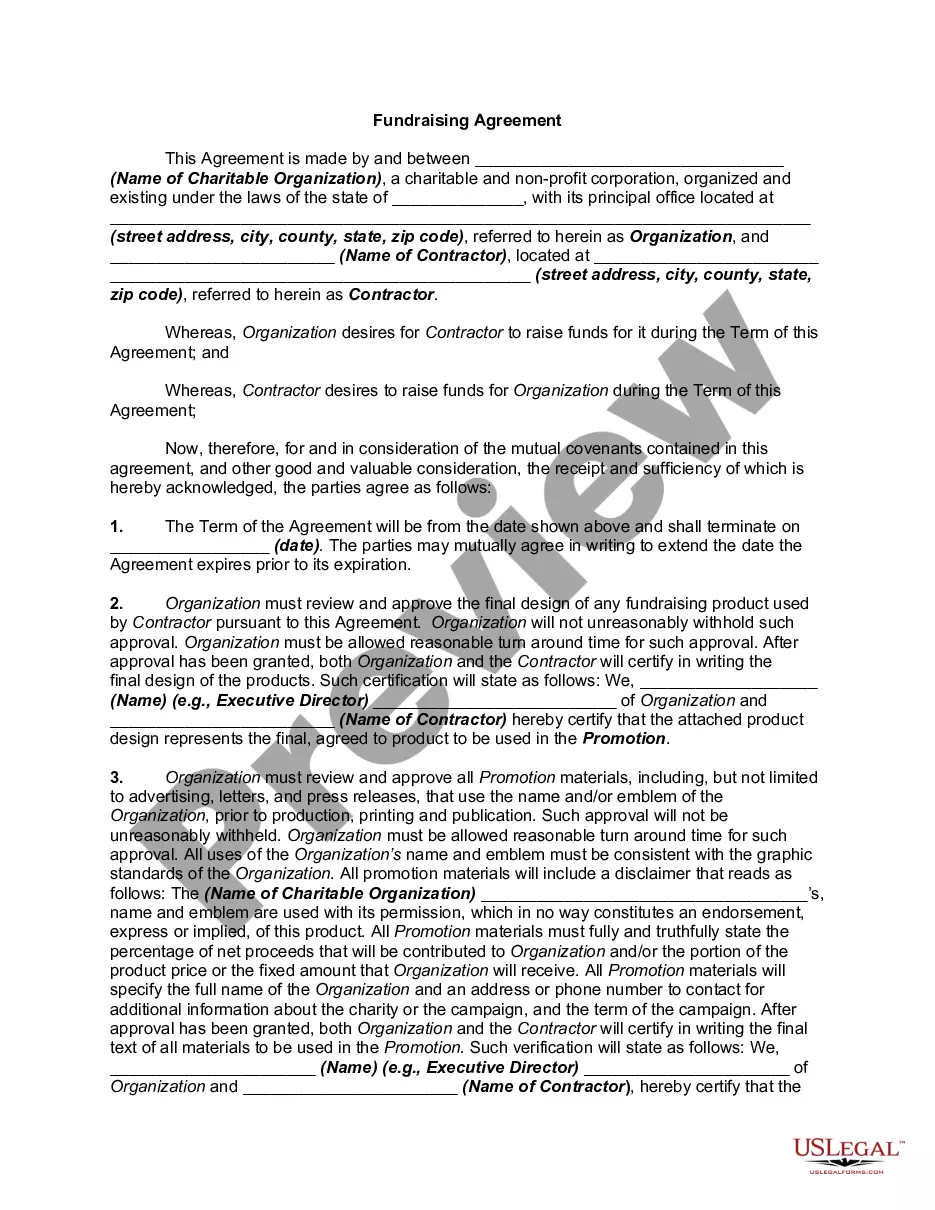
Kentucky Charity Subscription Agreement
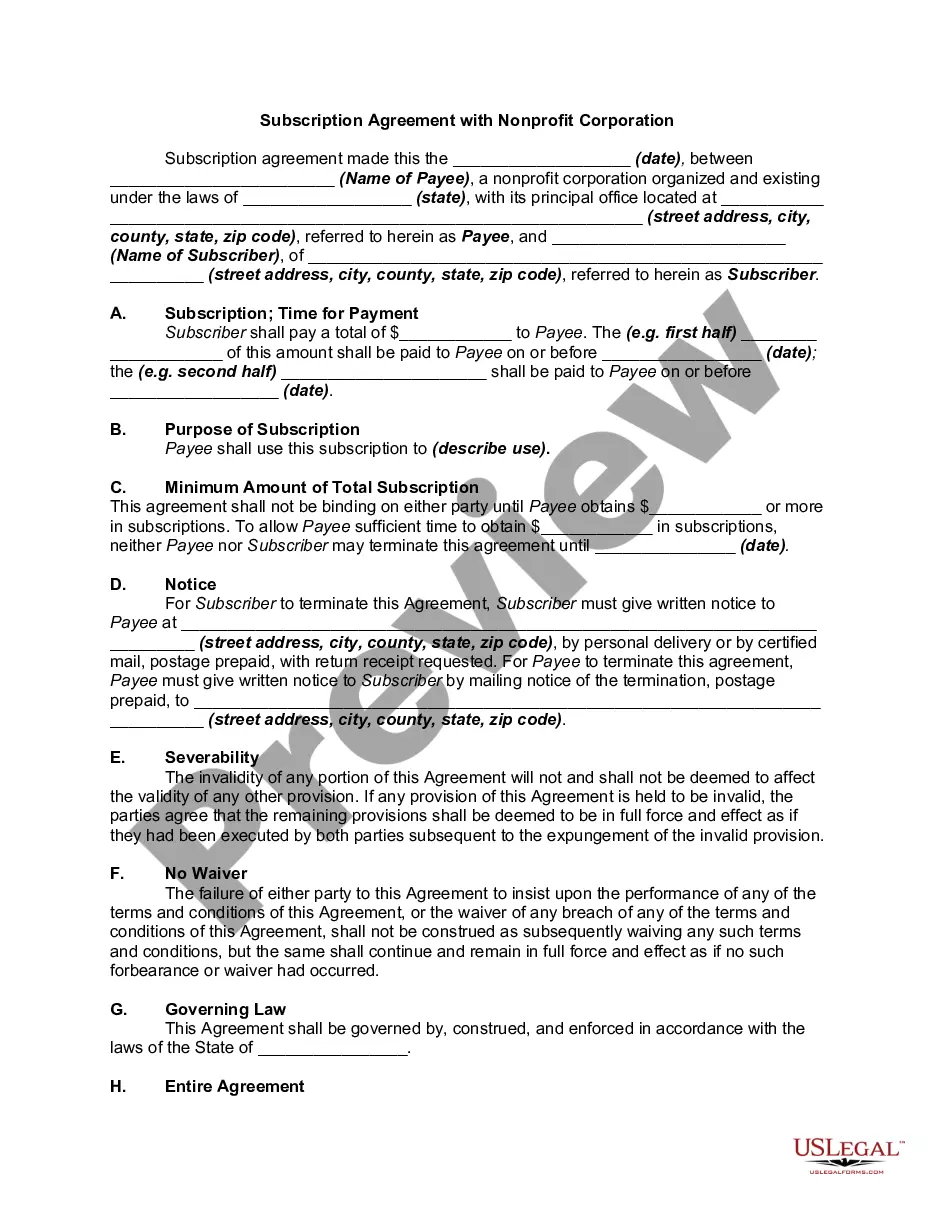
Description
Get your form ready online
Our built-in tools help you complete, sign, share, and store your documents in one place.
Make edits, fill in missing information, and update formatting in US Legal Forms—just like you would in MS Word.
Download a copy, print it, send it by email, or mail it via USPS—whatever works best for your next step.
Sign and collect signatures with our SignNow integration. Send to multiple recipients, set reminders, and more. Go Premium to unlock E-Sign.
If this form requires notarization, complete it online through a secure video call—no need to meet a notary in person or wait for an appointment.
We protect your documents and personal data by following strict security and privacy standards.

Make edits, fill in missing information, and update formatting in US Legal Forms—just like you would in MS Word.

Download a copy, print it, send it by email, or mail it via USPS—whatever works best for your next step.

Sign and collect signatures with our SignNow integration. Send to multiple recipients, set reminders, and more. Go Premium to unlock E-Sign.

If this form requires notarization, complete it online through a secure video call—no need to meet a notary in person or wait for an appointment.

We protect your documents and personal data by following strict security and privacy standards.
Looking for another form?

How to fill out Charity Subscription Agreement?
US Legal Forms - one of the largest repositories of legal documents in the United States - offers a variety of legal form templates that you can download or print.
By utilizing the website, you can access thousands of forms for business and personal purposes, organized by categories, states, or keywords.
You can obtain the most recent versions of documents like the Kentucky Charity Subscription Agreement within moments.
Check the form summary to confirm that you've chosen the right document.
If the form doesn't meet your needs, use the Search box at the top of the screen to find one that does.
- If you already have an account, Log In and download the Kentucky Charity Subscription Agreement from the US Legal Forms library.
- The Download button will appear on every form you view.
- You can access all previously downloaded forms from the My documents section of your account.
- If you're using US Legal Forms for the first time, here are simple steps to get started.
- Ensure you have selected the correct form for your locality.
- Click the Preview button to review the form's content.
Form popularity
FAQ
A charitable pledge is enforceable if it is a legally binding contract. A legally binding contract exists when there is agreement between the parties and there has been consideration given in exchange for the pledge. These are known as the three essential elements of a contract.
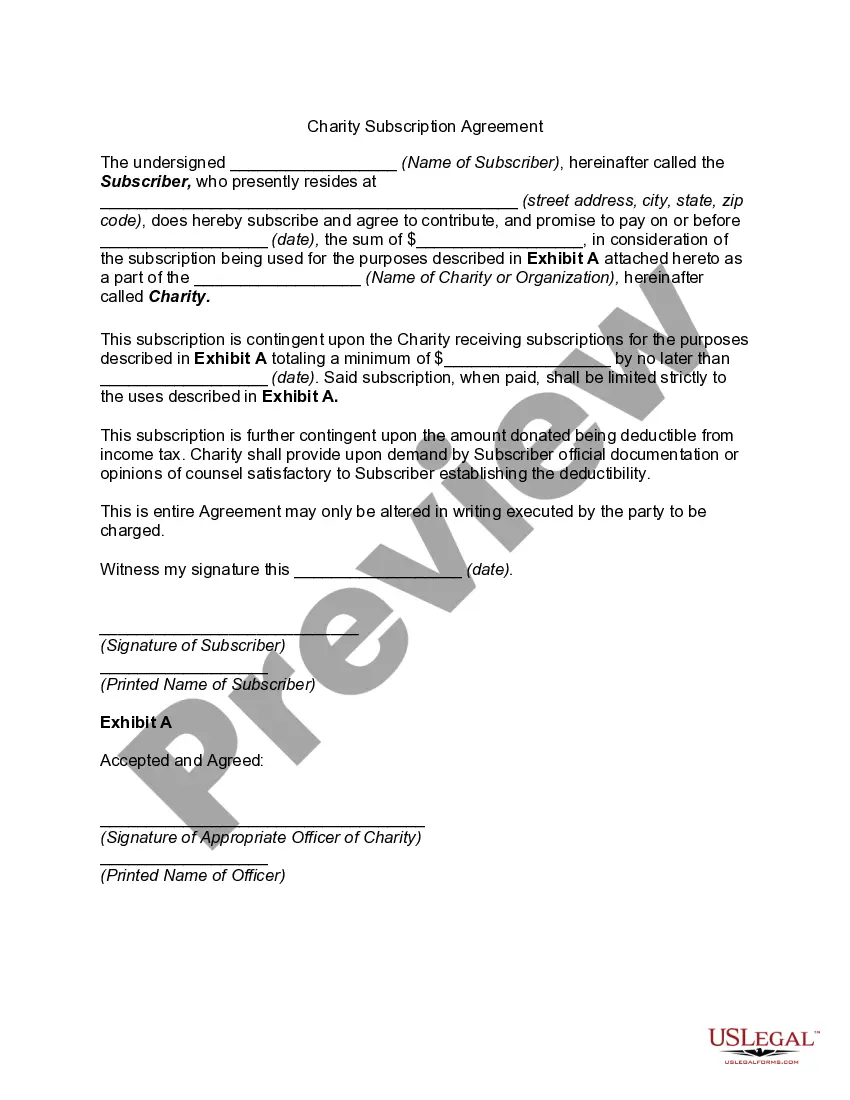
A charitable subscription, also called a charitable pledge, is a donor's written or oral promise or statement of intent to contribute money or property to a charity.
A gift agreement documents a gift has been made by the donor to a charitable organization and is legally enforceable. A pledge agreement records a commitment by a donor to make a gift at a future time.
Contracts Law. A charitable subscription, also called a charitable pledge, is a donor's written or oral promise or statement of intent to contribute money or property to a charity.
Under traditional contract law principles, a charitable pledge is enforceable if it meets the requirements for a legally binding contract. There must be an agreement between the donor and the charity -- in effect, the donor must promise to make a gift and the charity must promise to accept it.
The most common types of contracts that must be in writing are: Contracts for the sale or transfer of an interest in land, and. A contract that cannot be performed within one year of the making (in other words, a long-term contract like a mortgage).
In California, like most other states, charitable pledges are analyzed as a matter of contract law. This means that pledges are not enforceable unless: (1) the pledgor receives consideration for making the pledge; or (2) the charity has detrimentally relied on the pledge.
Within contract law, promissory estoppel refers to the doctrine that a party may recover on the basis of a promise made when the party's reliance on that promise was reasonable, and the party attempting to recover detrimentally relied on the promise.
A promise that is unenforceable due to indefiniteness or lack of mutuality, where only one side is bound to perform. An example of this would be an agreement between a seller and buyer which states that the seller "agrees to sell all of the ice cream he wants to" to the buyer.
Under what situations is consideration not binding? Consideration is not binding if the promise does not create a duty or impose an obligation such as with illusory promises. Illusory promises include termination clauses in contracts and output and requirements contracts.