A written agreement regarding child custody and support entered into by unmarried parents at time of their breakup is generally enforceable unless the parties abandon the agreement, or the agreement is unconscionable.
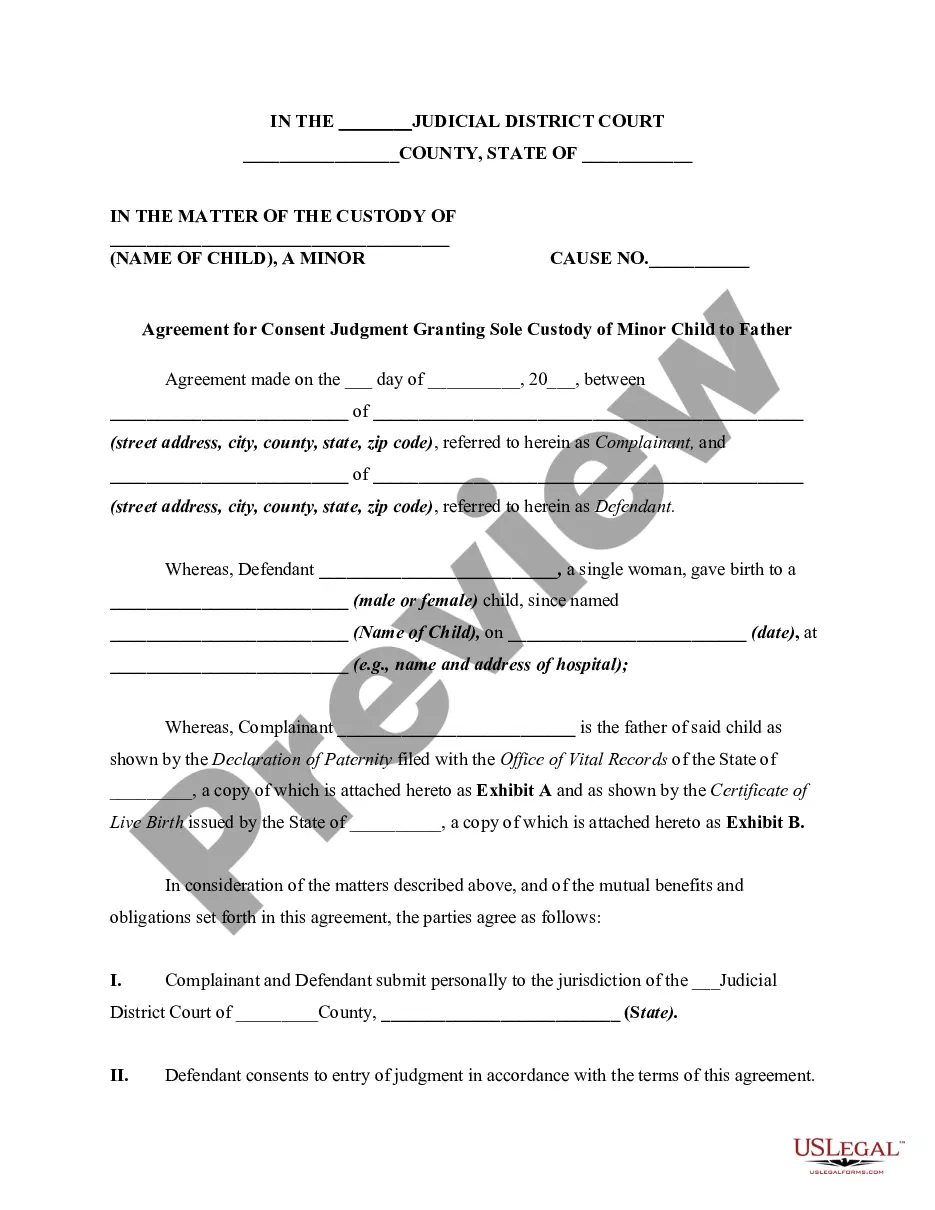
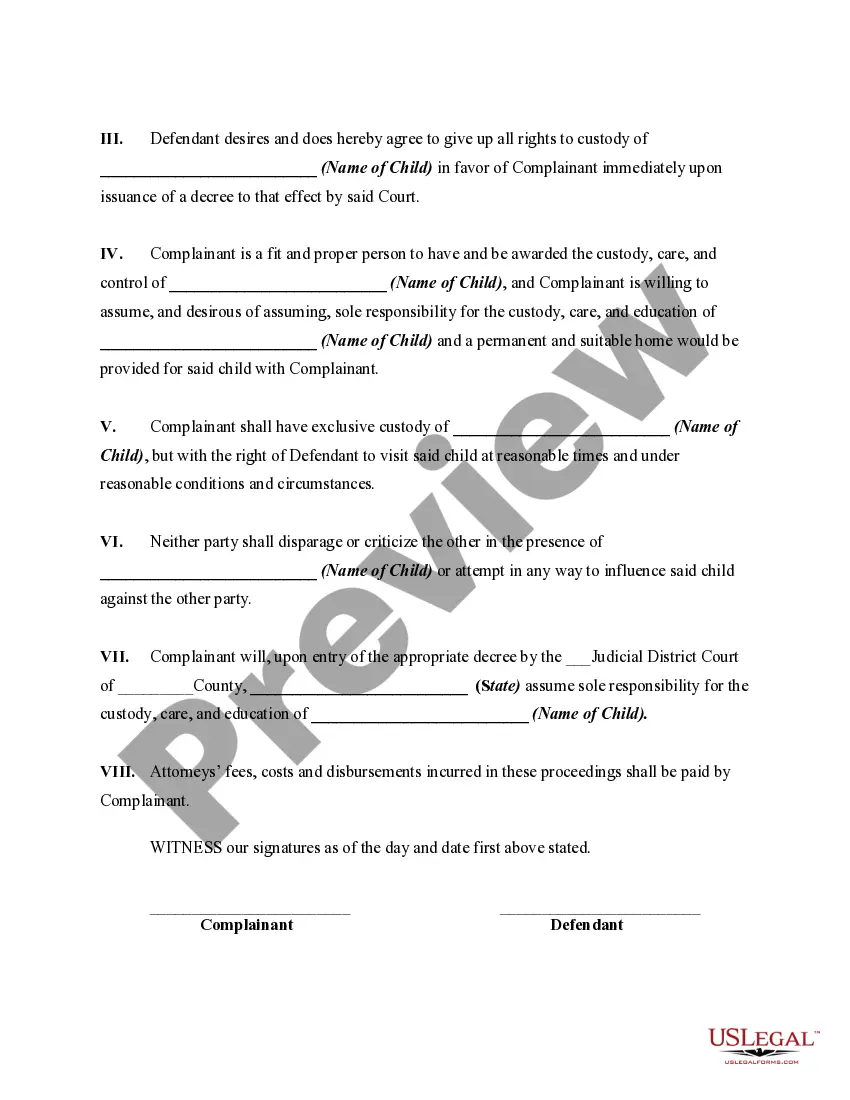
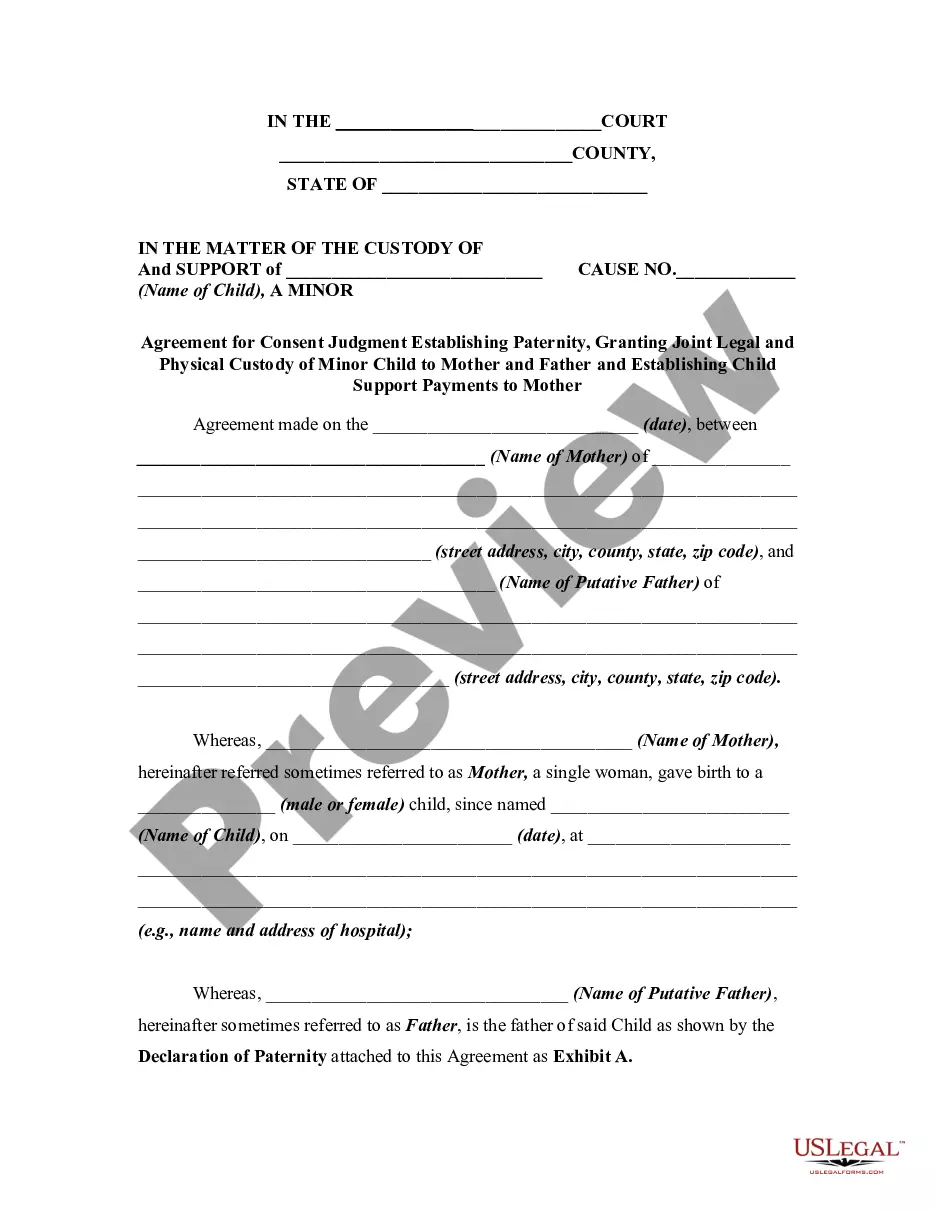
The following form is a sample of an agreement for a consent judgment granting sole custody of a minor child to the father.
Kansas Agreement for Consent Judgment Granting Sole Custody of Minor Child to Father
State:
Multi-State
Control #:
US-00774BG
Format:
Word;
Rich Text
Instant download
Description
Free preview

Get your form ready online
Our built-in tools help you complete, sign, share, and store your documents in one place.
Built-in online Word editor
Make edits, fill in missing information, and update formatting in US Legal Forms—just like you would in MS Word.
Export easily
Download a copy, print it, send it by email, or mail it via USPS—whatever works best for your next step.
E-sign your document
Sign and collect signatures with our SignNow integration. Send to multiple recipients, set reminders, and more. Go Premium to unlock E-Sign.
Notarize online 24/7
If this form requires notarization, complete it online through a secure video call—no need to meet a notary in person or wait for an appointment.
Store your document securely
We protect your documents and personal data by following strict security and privacy standards.

Make edits, fill in missing information, and update formatting in US Legal Forms—just like you would in MS Word.

Download a copy, print it, send it by email, or mail it via USPS—whatever works best for your next step.

Sign and collect signatures with our SignNow integration. Send to multiple recipients, set reminders, and more. Go Premium to unlock E-Sign.

If this form requires notarization, complete it online through a secure video call—no need to meet a notary in person or wait for an appointment.

We protect your documents and personal data by following strict security and privacy standards.
Looking for another form?





How to fill out Agreement For Consent Judgment Granting Sole Custody Of Minor Child To Father?
Are you presently in a situation where you require paperwork for either professional or personal purposes almost every day.
There are numerous legal document templates accessible online, yet finding ones you can trust is not simple.
US Legal Forms offers thousands of form templates, such as the Kansas Agreement for Consent Judgment Granting Sole Custody of Minor Child to Father, designed to comply with state and federal regulations.
Utilize US Legal Forms, one of the largest collections of legal forms, to save time and avoid errors.
The service provides properly crafted legal document templates that can be used for a variety of purposes. Create your account on US Legal Forms and begin making your life a bit easier.
- If you are already familiar with the US Legal Forms website and have an account, simply Log In.
- After that, you can download the Kansas Agreement for Consent Judgment Granting Sole Custody of Minor Child to Father template.
- If you do not have an account and wish to start using US Legal Forms, follow these steps.
- Select the form you need and ensure it is for the correct state/region.
- Use the Preview button to view the form.
- Read the description to confirm you have selected the right form.
- If the form is not what you are looking for, utilize the Search field to find the form that suits your needs and requirements.
- Once you have found the correct form, click Buy now.
- Choose the pricing plan you prefer, complete the necessary information to create your account, and complete the purchase using your PayPal or credit card.
- Select a convenient file format and download your copy.
- Find all the document templates you have purchased in the My documents list. You can obtain another copy of the Kansas Agreement for Consent Judgment Granting Sole Custody of Minor Child to Father at any time, if needed. Just select the desired form to download or print the document template.
Form popularity
FAQ
Under Kansas law, when a parent has legal custody (meaning, the right to make important decisions about a child's life) or physical custody (the child lives with that parent some or all of the time), or when a parent has a right to parenting time (visitation), that parent can't just move away with the kids without the ...
To award sole legal custody to a parent, the judge must find that it is not in the child's best interests for both parents to have equal rights in making decisions about the child. The court record must include specific findings of fact supporting the decision to award sole legal custody.
It's a common misconception that older children can refuse visitation with a non-custodial parent. On the contrary, until the child turns 18, the custodial parent must follow the visitation order and send the child for visitation. The only exception is if the parent believes the child is in immediate danger.
The court may order the sole legal custody of a child with one of the parties when the court finds that it is not in the best interests of the child that both of the parties have equal rights to make decisions pertaining to the child.
Sole, joint, or divided? Judges can award either type of custody to one parent, both parents, or a combination. Joint legal custody means that both parents have an equal right to make decisions regarding the child's wellbeing. If parents can't agree on a particular issue, the court will decide for them.
The Kansas statute lists the following factors, among others: the child's adjustment to home, school and community; the wishes of the parents and the child; which parent will most cooperate in helping the child keep a bond with the other parent; and evidence of spousal abuse.
Sole custody means that one parent makes the major decisions about issues such as the child's education, religion and health care. Generally, the child would live primarily with this parent. This parent would now have sole decision-making responsibility and the majority of parenting time.
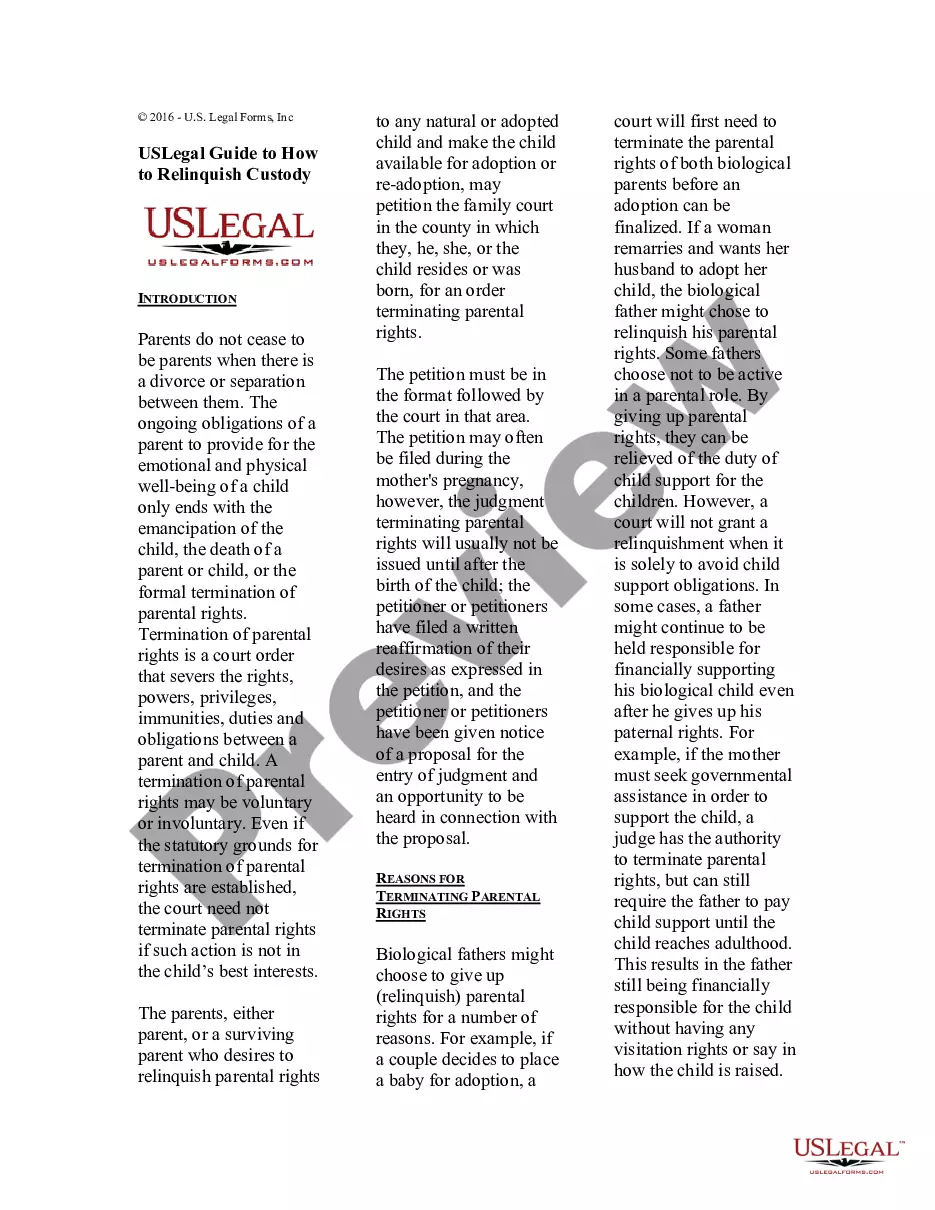
Involuntary relinquishment: The natural parent's rights may be terminated on several grounds, such as abandonment without financial or emotional support for six months.