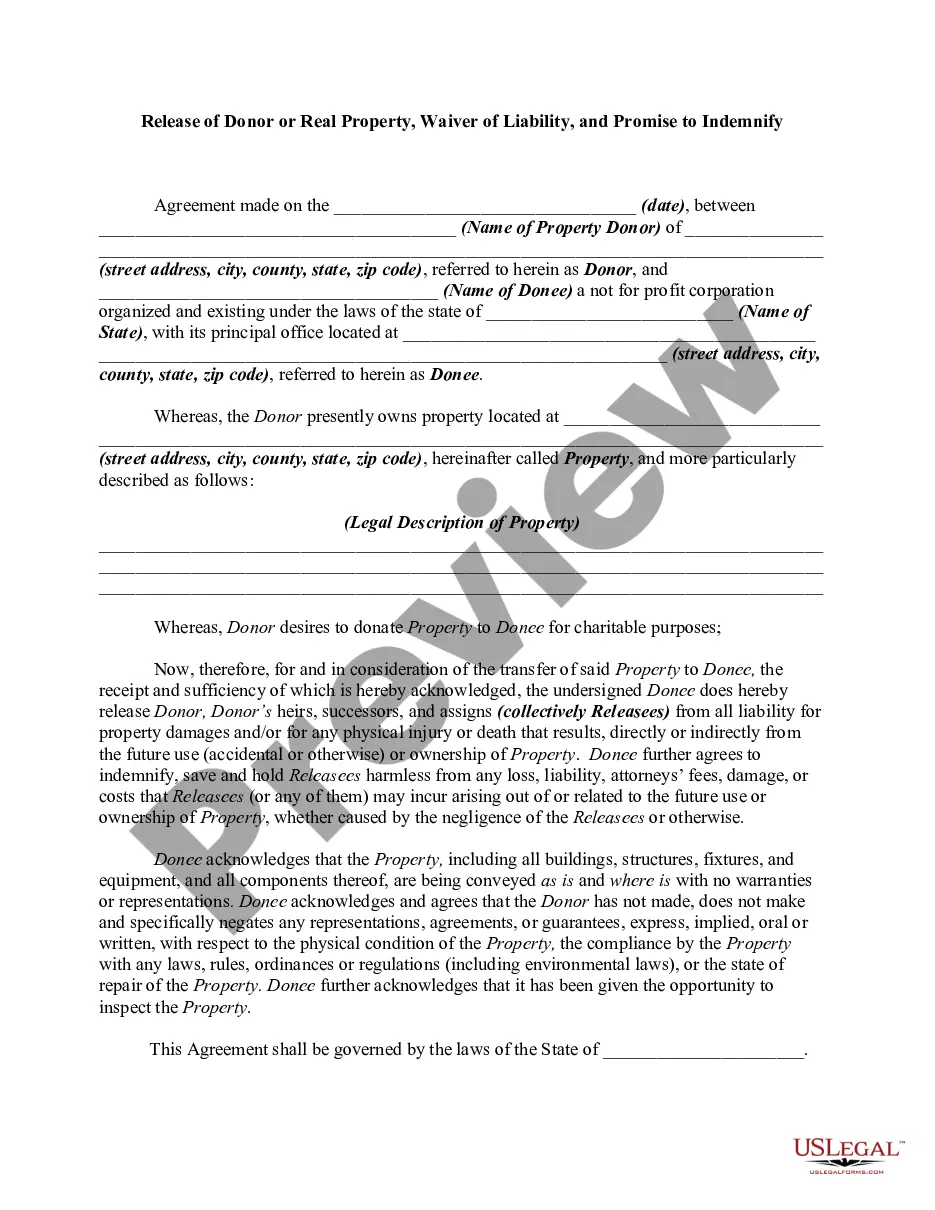
Indiana Company Confidentiality Agreement made in Order to Review System of Customer as a Potential System for Automation of its Functions
Description
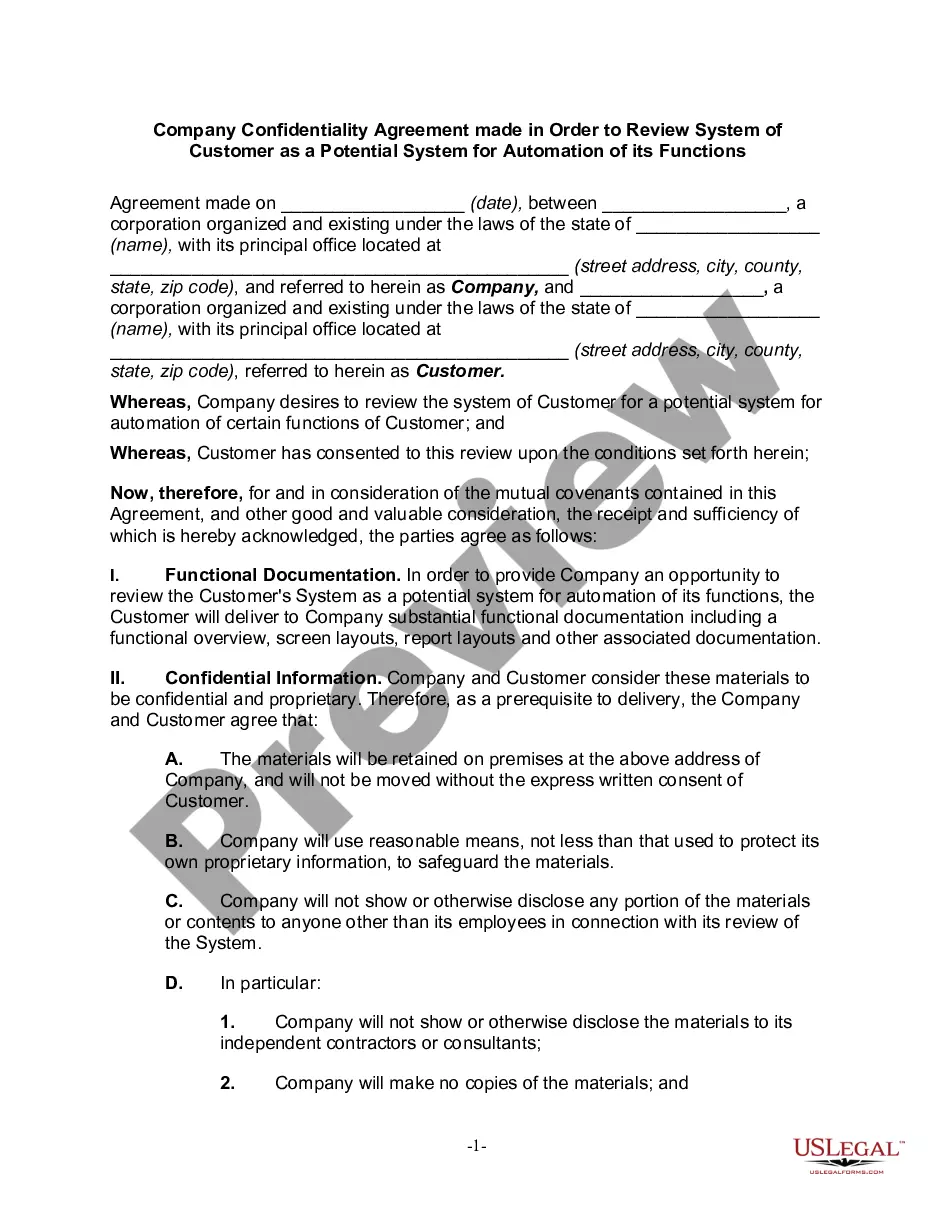
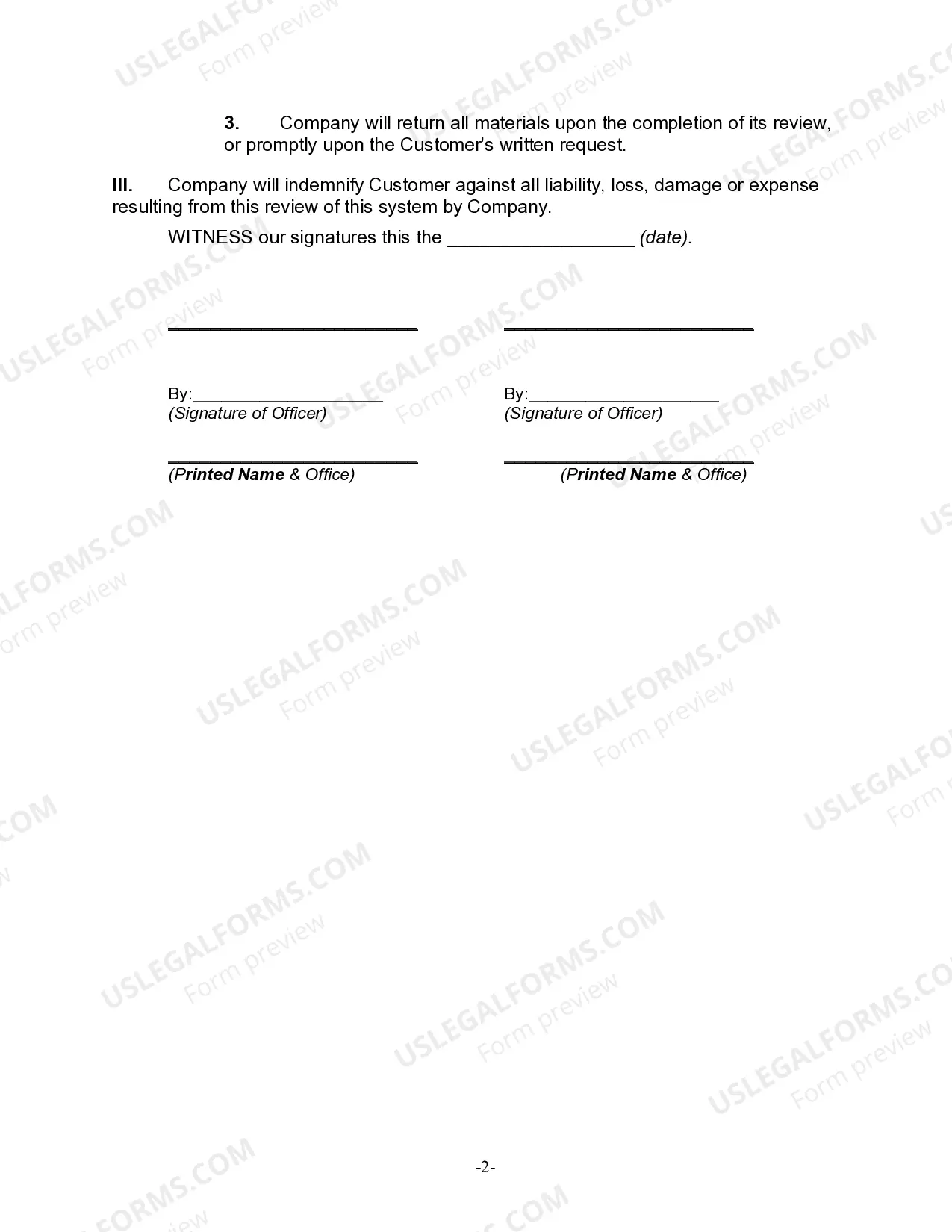
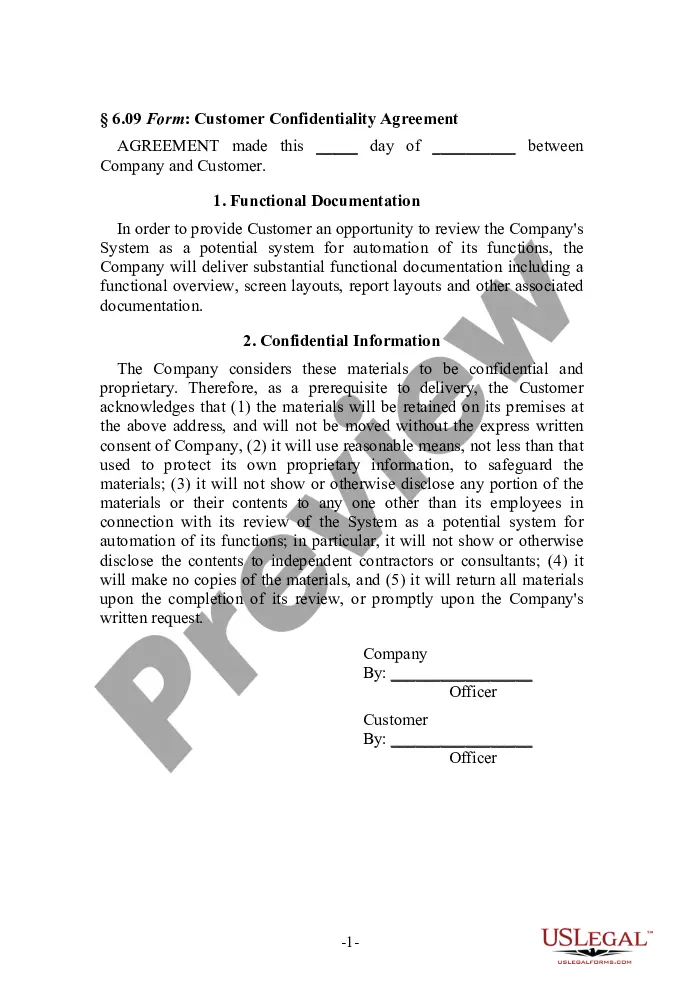
How to fill out Company Confidentiality Agreement Made In Order To Review System Of Customer As A Potential System For Automation Of Its Functions?
Are you in a situation where you often require documents for both professional and personal purposes.
There is a multitude of legal document templates accessible online, but finding reliable ones can be challenging.
US Legal Forms offers numerous template options, such as the Indiana Company Confidentiality Agreement created to evaluate a customer's system as a potential means for automating its processes, crafted to comply with federal and state regulations.
Leverage US Legal Forms, which boasts the most extensive collection of legal forms, to save time and minimize errors.
This service provides properly crafted legal document templates that can be utilized for a variety of purposes. Create an account on US Legal Forms and begin simplifying your life.
- If you are already familiar with the US Legal Forms website and have an account, simply Log In.
- Subsequently, you can download the Indiana Company Confidentiality Agreement created to evaluate a customer's system as a potential means for automating its processes template.
- If you do not possess an account and wish to start using US Legal Forms, follow these instructions.
- Acquire the document you need and ensure it is appropriate for your city/county.
- Utilize the Review option to assess the form.
- Examine the summary to confirm that you have selected the correct document.
- If the form does not meet your needs, use the Search field to locate the template that fulfills your requirements.
- Once you find the correct form, click on Get now.
- Choose your preferred pricing plan, complete the necessary information to create your account, and purchase your order using PayPal or credit card.
- Select a suitable file format and download your copy.
- You can view all the document templates you have purchased in the My documents list. You can acquire another copy of the Indiana Company Confidentiality Agreement created to evaluate a customer's system as a potential means for automating its processes at any time if needed. Click the desired form to download or print the document template.
Form popularity
FAQ
When answering 'How do you ensure confidentiality?', emphasize the combination of legal and practical measures in place. Highlight the importance of having an Indiana Company Confidentiality Agreement made in Order to Review System of Customer as a Potential System for Automation of its Functions to solidify confidentiality expectations. You can also mention the use of technology, like encryption and access controls, as well as employee training as key aspects in maintaining confidentiality.
A legally-binding confidentiality agreement must feature the following components:A definition of confidential information.Who is involved.Why the recipient knows the information.Exclusions or limits on confidential information.Receiving party's obligations.Time frame or term.Discloser to the recipient.More items...
How to write a confidentiality statement?Use a standard format for contracts.Decide what type of confidentiality statement you should use.Identify the involved parties in the agreement.Define the information to keep confidential.List the information excluded from the agreement.
A Confidential Disclosure Agreement (CDA), also referred to as non-disclosure agreement (NDA) or secrecy agreement, is a legal agreement between a minimum of two parties which outlines information the parties wish to share with one another for certain evaluation purposes, but wish to restrict from wider use and
An NDA creates a confidential relationship between the parties, typically to protect any type of confidential and proprietary information or trade secrets. As such, an NDA protects non-public business information. Like all contracts, they cannot be enforced if the contracted activities are illegal.
The key elements of confidentiality agreements are: Identification of the parties. Definition of what is defined to be confidential. The scope of the confidentiality obligation by the receiving party.
Data sharing agreements are formal contracts that detail what data are being shared and the appropriate use for the data.
An NDA is a contract specifically dealing with how parties will handle the others' confidential information. A confidentiality clause is a section in a larger agreement essentially covering the same things as an NDA, only usually with less detail than in an NDA.
The agreement should identify the purpose to which the recipient can put the confidential information. All other uses of the confidential information should be prohibited. Sometimes a confidentiality agreement states that no rights are licensed by the confidentiality agreement. This is stating the obvious.
Confidentiality clauses are also known as non-disclosure agreements (NDAs). They prevent employees from making business secrets and sensitive information public or sharing them with competitors.