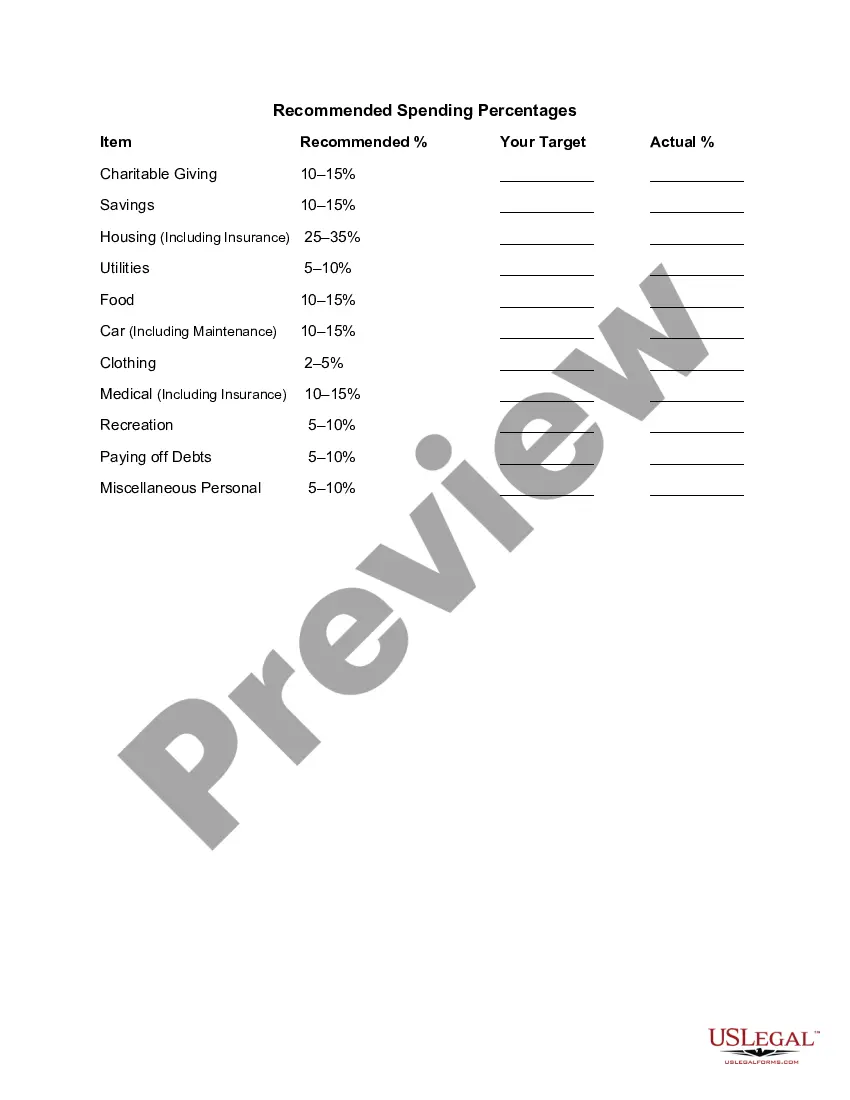
Indiana Recommended Spending Percentages
Description
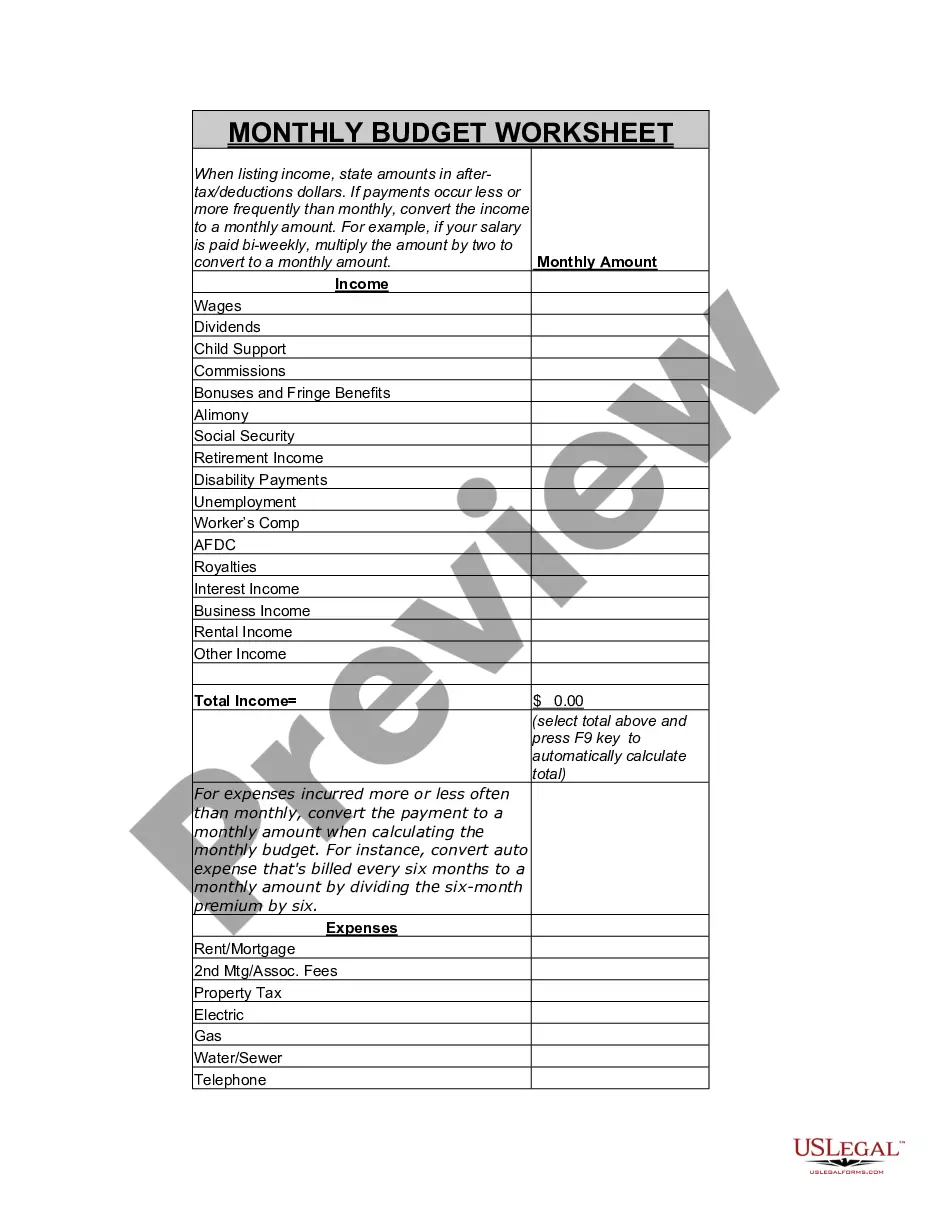
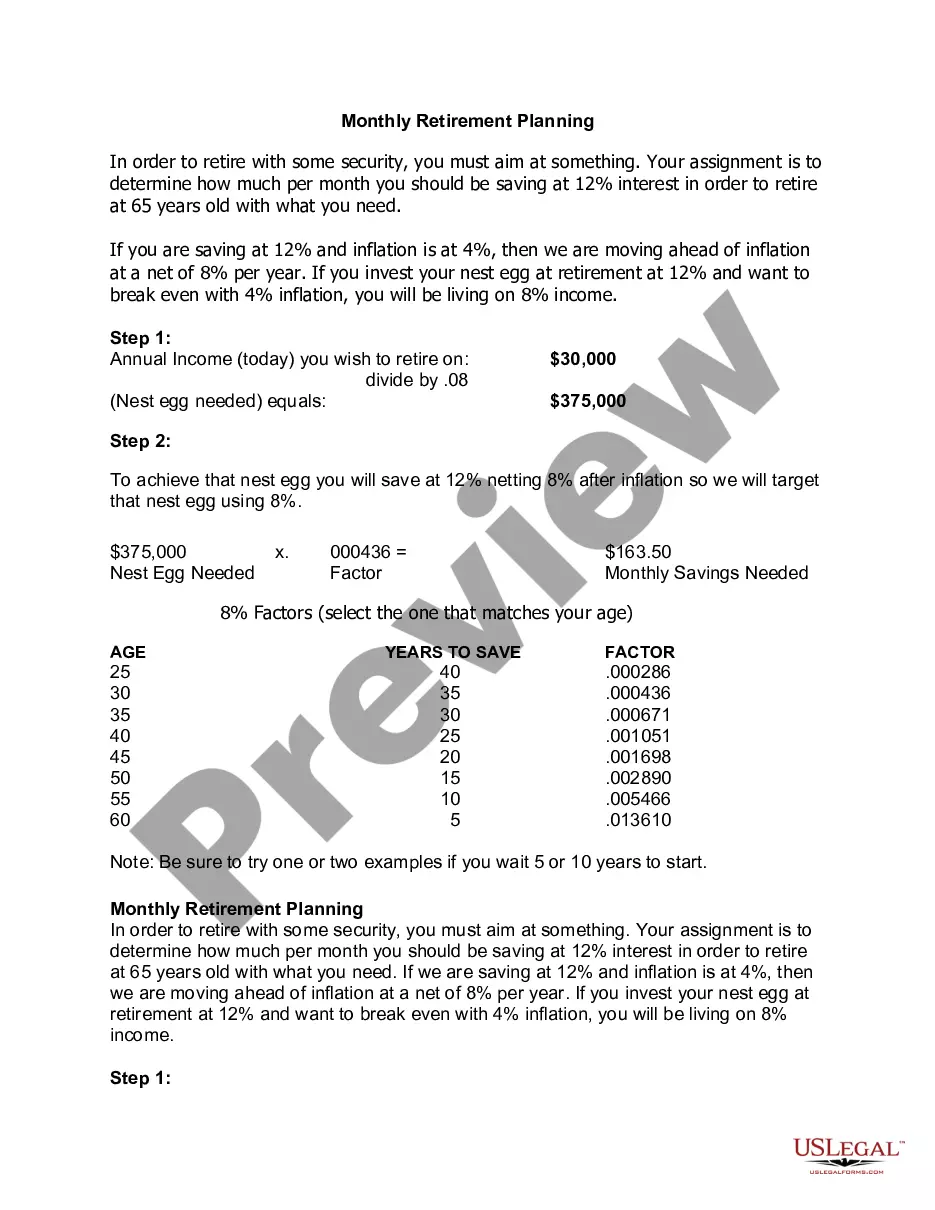

Get your form ready online
Our built-in tools help you complete, sign, share, and store your documents in one place.
Make edits, fill in missing information, and update formatting in US Legal Forms—just like you would in MS Word.
Download a copy, print it, send it by email, or mail it via USPS—whatever works best for your next step.
Sign and collect signatures with our SignNow integration. Send to multiple recipients, set reminders, and more. Go Premium to unlock E-Sign.
If this form requires notarization, complete it online through a secure video call—no need to meet a notary in person or wait for an appointment.
We protect your documents and personal data by following strict security and privacy standards.

Make edits, fill in missing information, and update formatting in US Legal Forms—just like you would in MS Word.

Download a copy, print it, send it by email, or mail it via USPS—whatever works best for your next step.

Sign and collect signatures with our SignNow integration. Send to multiple recipients, set reminders, and more. Go Premium to unlock E-Sign.

If this form requires notarization, complete it online through a secure video call—no need to meet a notary in person or wait for an appointment.

We protect your documents and personal data by following strict security and privacy standards.
Looking for another form?

How to fill out Recommended Spending Percentages?
Selecting the best official document template can be quite challenging.
Of course, there are numerous templates accessible online, but how do you locate the correct document you need.
Utilize the US Legal Forms website. This service offers a vast array of templates, such as the Indiana Suggested Spending Percentages, which you can apply for both business and personal purposes.
First, ensure you have selected the correct form for your city/county. You can preview the document using the Preview button and review the document details to confirm it is appropriate for you.
- All of the forms are reviewed by professionals and comply with federal and state regulations.
- If you are already registered, Log In to your account and click the Download button to access the Indiana Suggested Spending Percentages.
- Use your account to check the official forms you may have purchased previously.
- Visit the My documents section of your account to obtain another copy of the document you require.
- If you are a new user of US Legal Forms, here are simple instructions to follow.
Form popularity
FAQ
Indiana only has $31.3 billion of assets available to pay bills totaling $33.2 billion. Because Indiana doesn't have enough money to pay its bills, it has a $1.9 billion financial hole. To fill it, each Indiana taxpayer would have to send $900 to the state.
Some common reasons that a tax refund would take longer to process include incomplete or incorrect forms, calculation or clerical errors or filing duplicate returns. Be sure to sign your tax return electronically or on paper, and double-check account and routing numbers if receiving your refund via direct deposit.
A report presented to the State Budget Committee forecast tax collections growing nearly $1.9 billion, or 10.4%, more for this fiscal year than what was expected when the current state budget was approved in April. That would push Indiana's budget surplus to a whopping $5.1 billion by the end of next June.
Revenues come mainly from tax collections, licensing fees, federal aid, and returns on investments. Expenditures generally include spending on government salaries, infrastructure, education, public pensions, public assistance, corrections, Medicaid, and transportation.
Eric Holcomb confirmed Wednesday the value of the automatic taxpayer refund paid next year to Hoosiers will be $125. Altogether, some 4.3 million Hoosiers will receive the payment that's required by law to be distributed to taxpayers when the state's budget reserve exceeds projected state spending by more than 12.5%.
Indiana officials are projecting booming growth in the state budget surplus, setting up a debate during the upcoming legislative session over possible tax cuts. Dec. 16, 2021, at p.m.
Indiana's budget basics According to the National Association of State Budget Officers (NASBO), Indiana's total expenditures in fiscal year (FY) 2021 were $44.7 billion, including general funds, other state funds, bonds, and federal funds.
Taxes collected on behalf of local units of government are distributed to those units for such diverse activities as public safety, economic development, education and many others. Did you know your tax dollars are used to help veterans, support K-12 education and encourage clean water and air, to name a few?
What do state and local governments spend money on? State and local governments spend most of their resources on education, health, and social service programs. In 2019, about one-third of state and local spending went toward combined elementary and secondary education (22 percent) and higher education (9 percent).
Depending on the size of a state's budget that might not be very much but in at least 29 of those states, the surplus was actually more than $1 billion. The total for those 29 states is more than $173.9 billion in additional funds. In many cases, the surplus is from state tax revenue that went far beyond projections.