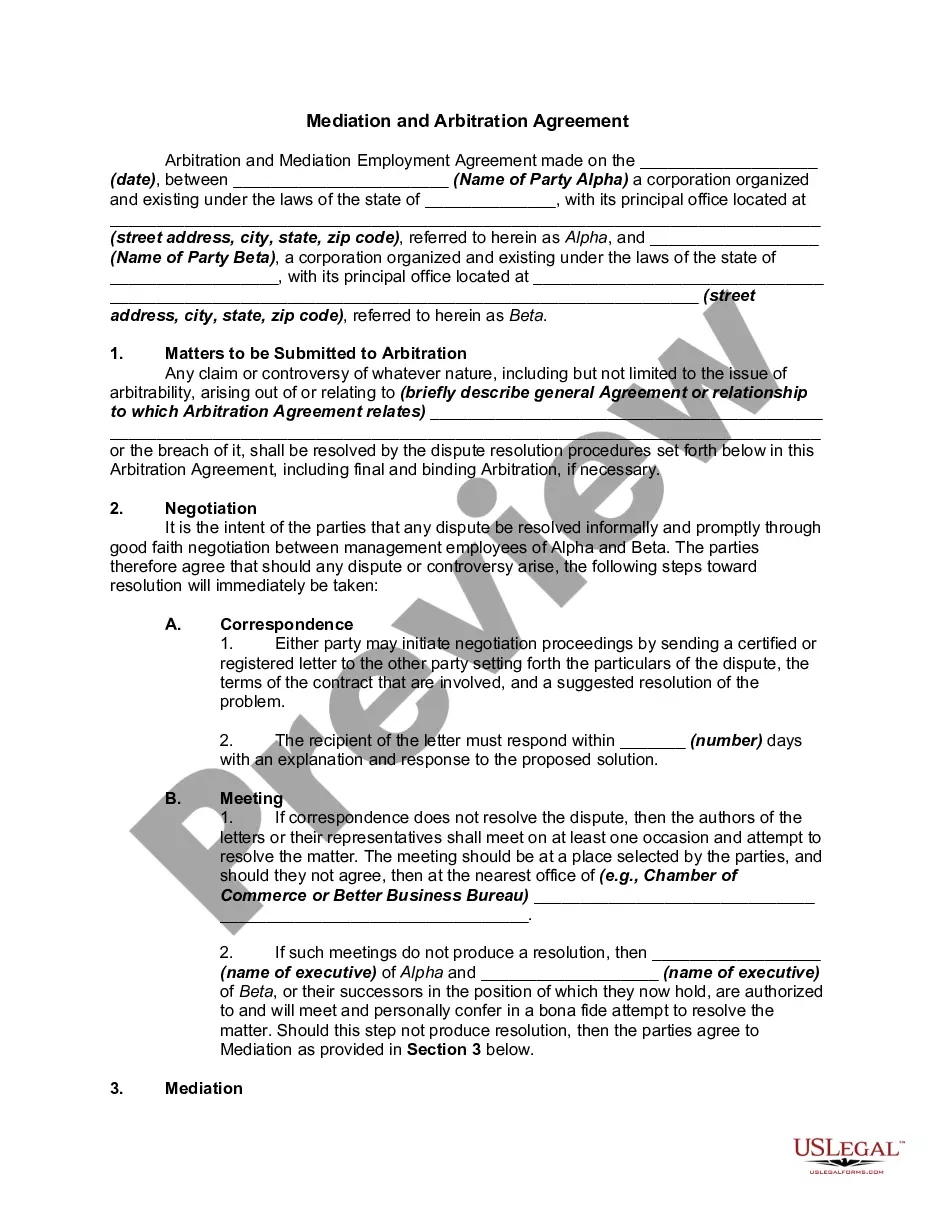
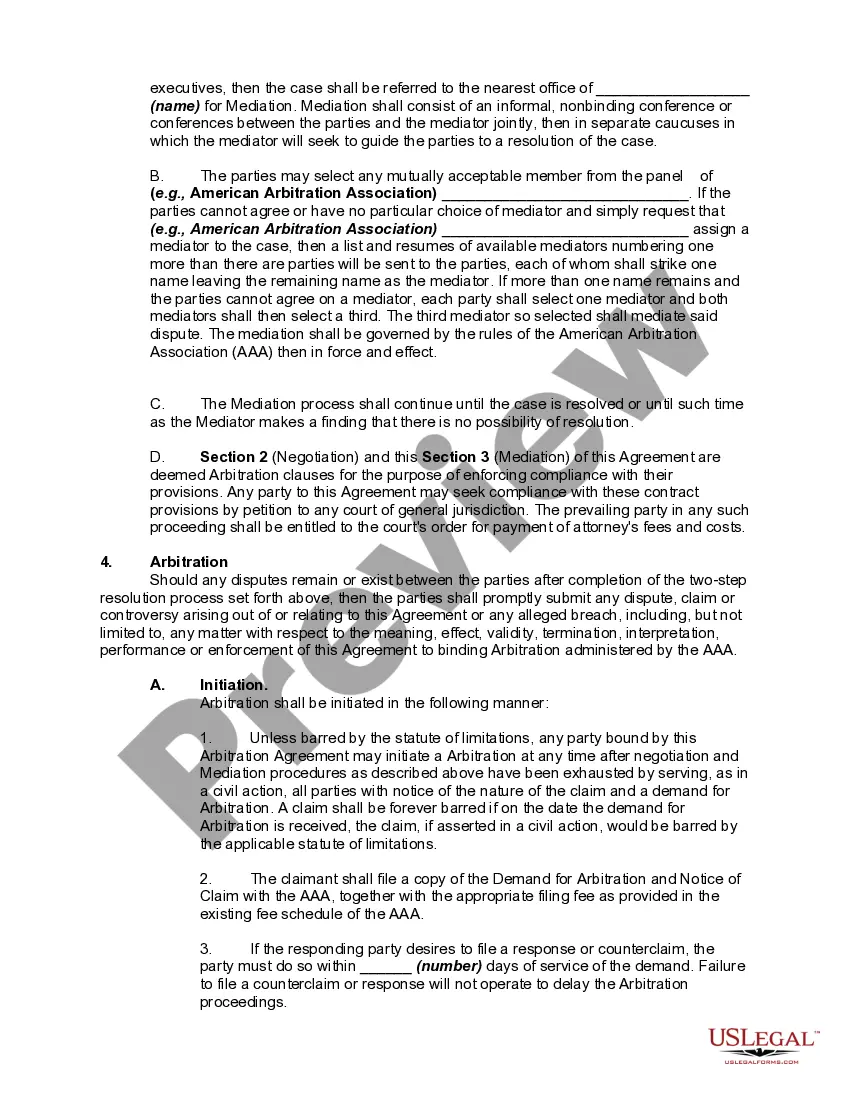
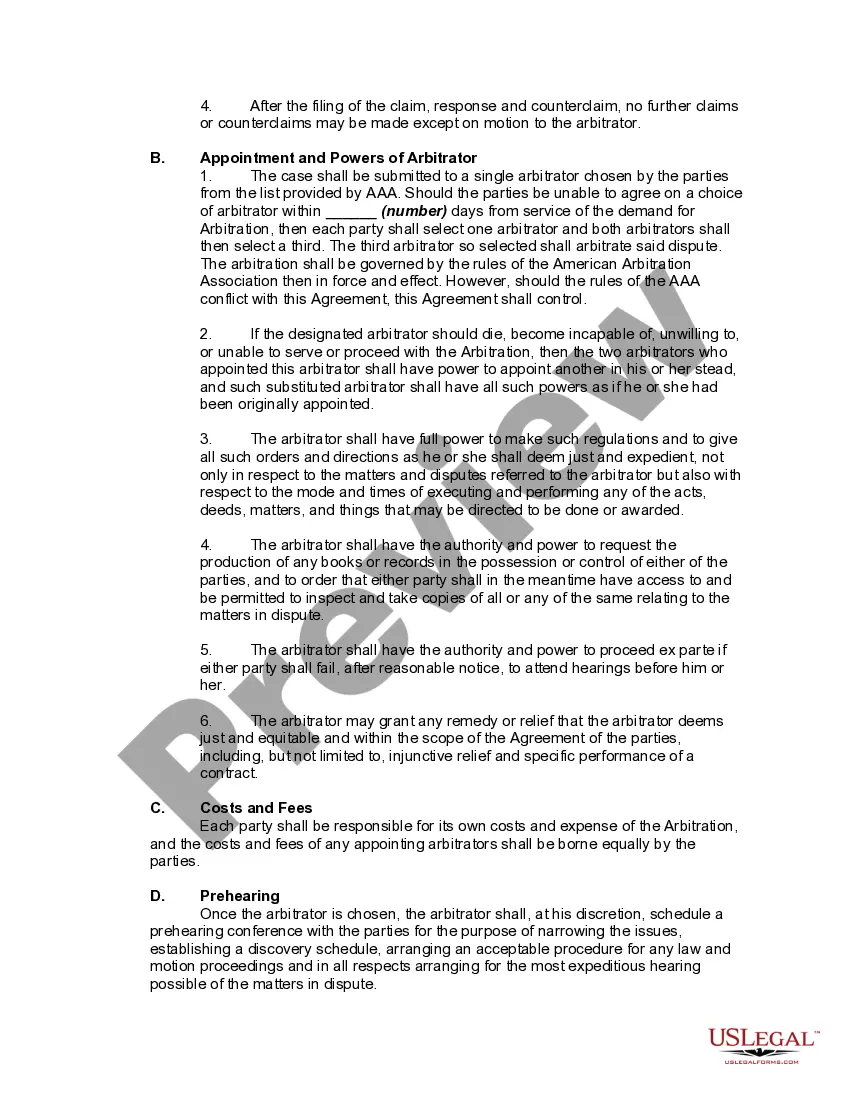
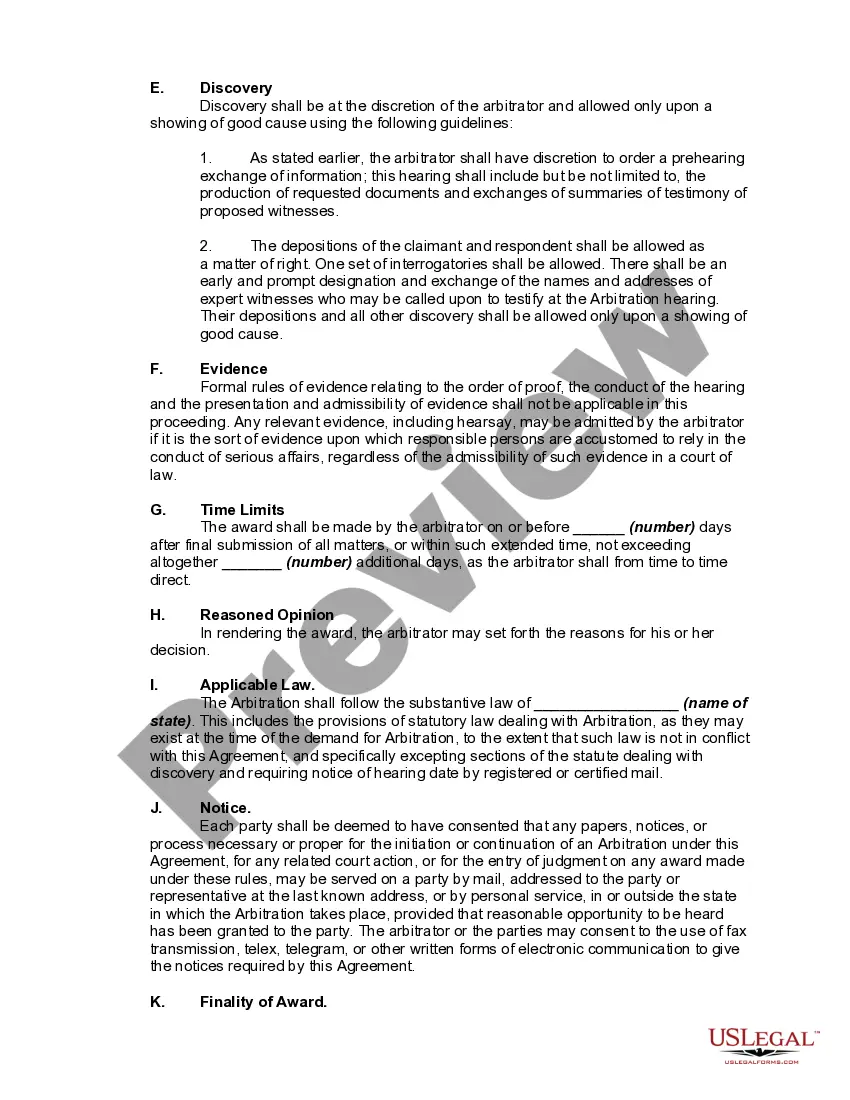
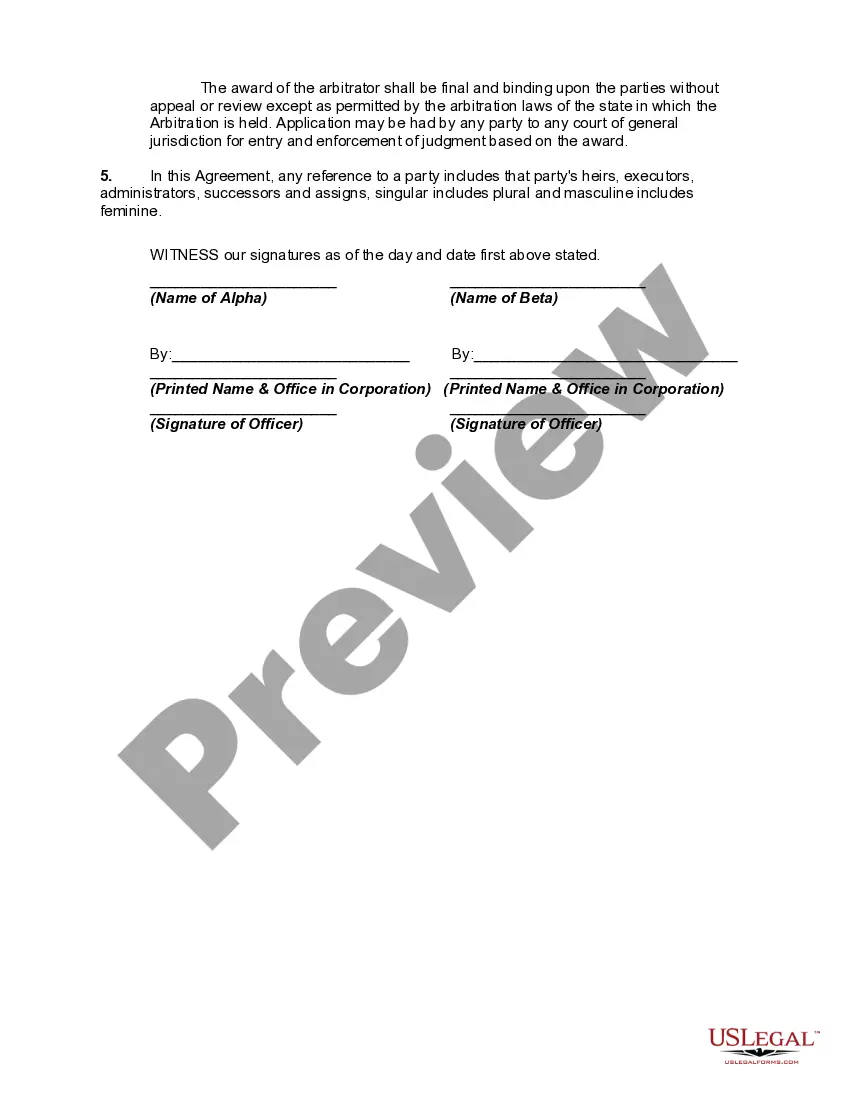
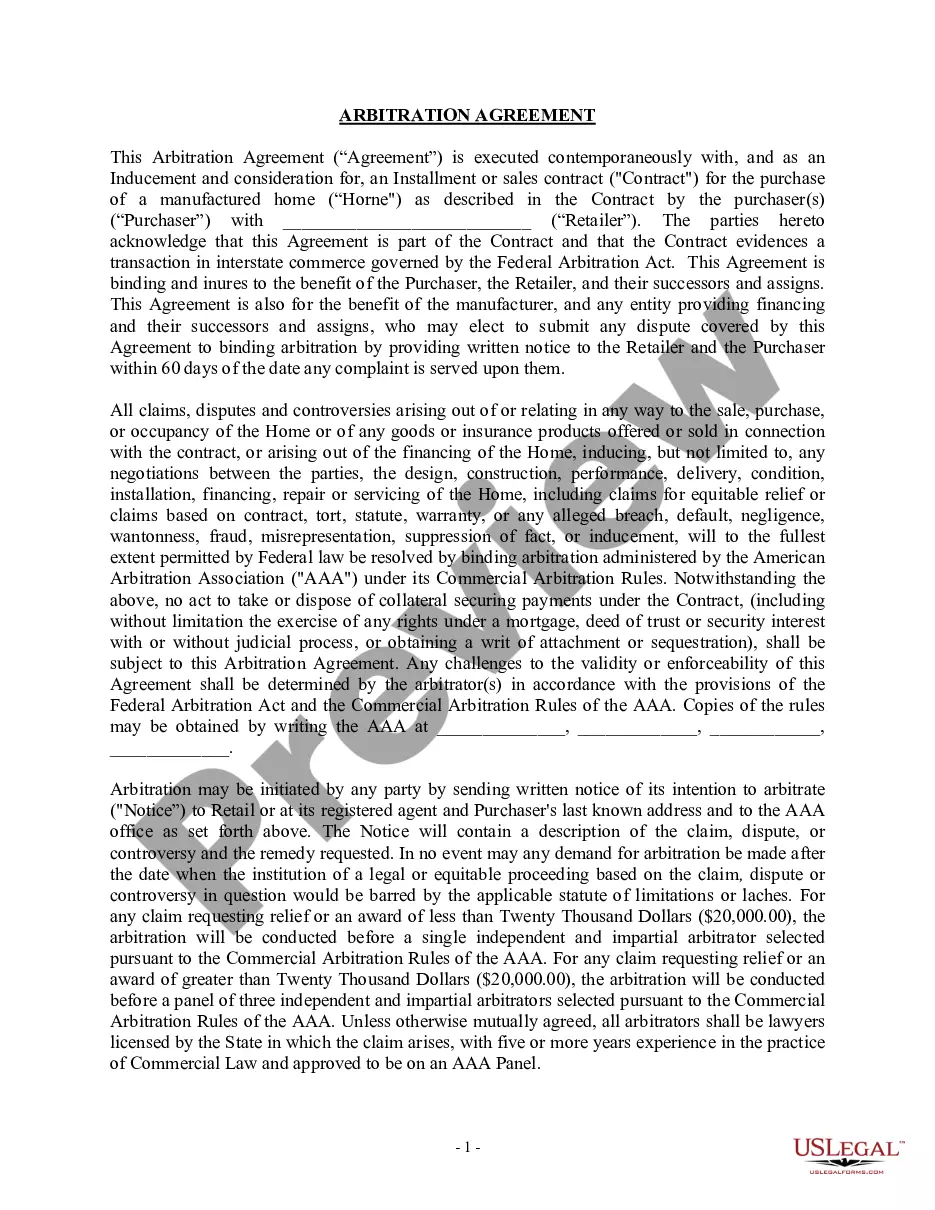
Arbitration is an alternative means of settling a dispute by impartial persons without proceeding to a court trial. It is sometimes preferred as a means of settling a matter in order to avoid the expense, delay, and acrimony of litigation. Discovery is with the discretion of the Arbitrator and there are simplified rules of evidence in arbitration.
Mediation is a non-adversarial method of alternative dispute resolution (ADR) in which a neutral third party helps resolve a dispute. The mediator does not have the power to render a decision on the matter or order an outcome. If a satisfactory resolution cannot be reached, the parties can pursue a lawsuit or arbitration.
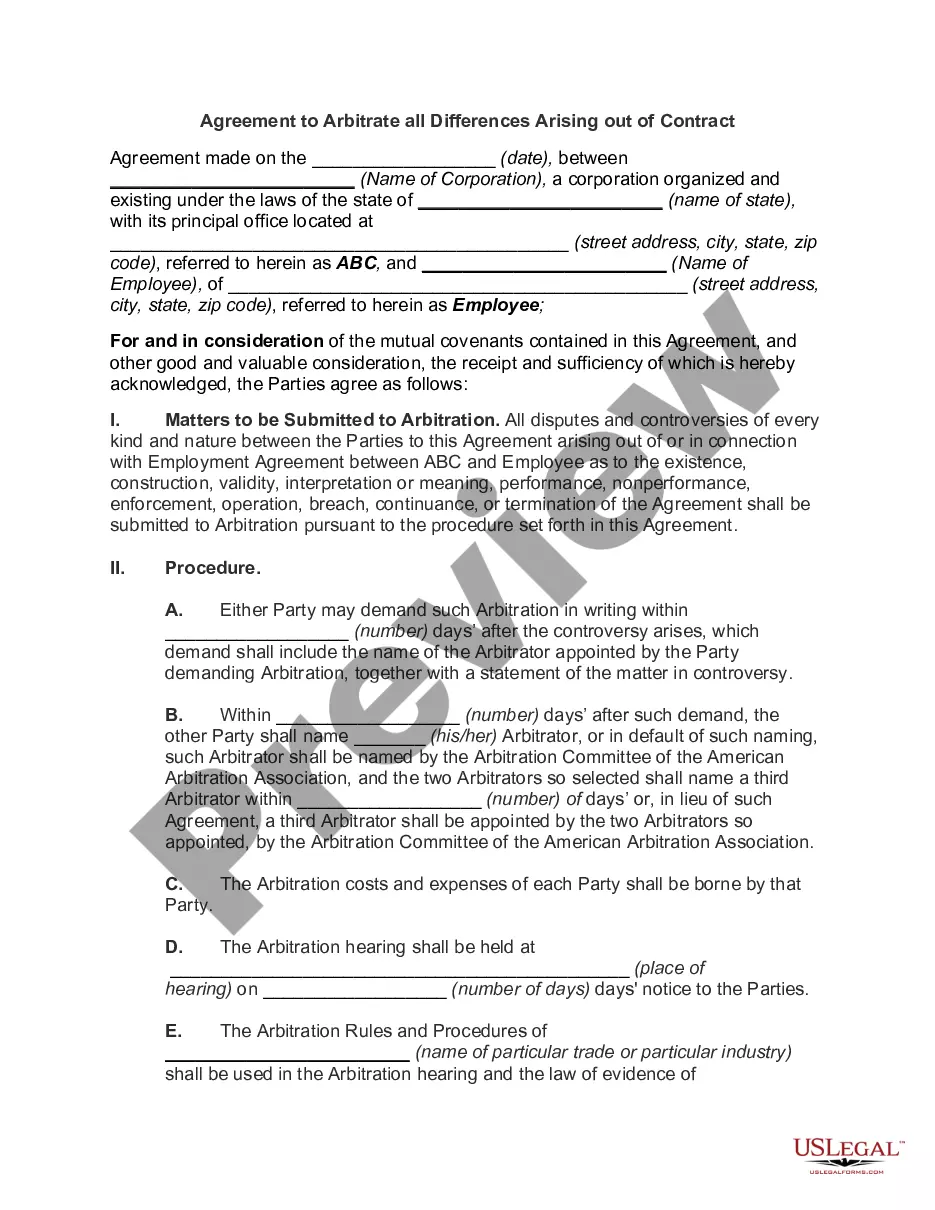
This form provides for negotiation, then mediation if the negotiation fails to resolve the issues. If both negotiation and mediation fail to resolve the issues, the parties arbitrate the dispute.
Indiana Mediation and Arbitration Agreement
State:
Multi-State
Category:
Control #:
US-02980BG
Format:
Word;
Rich Text
125 downloads
Description
Free preview



Get your form ready online
Our built-in tools help you complete, sign, share, and store your documents in one place.
Built-in online Word editor
Make edits, fill in missing information, and update formatting in US Legal Forms—just like you would in MS Word.
Export easily
Download a copy, print it, send it by email, or mail it via USPS—whatever works best for your next step.
E-sign your document
Sign and collect signatures with our SignNow integration. Send to multiple recipients, set reminders, and more. Go Premium to unlock E-Sign.
Notarize online 24/7
If this form requires notarization, complete it online through a secure video call—no need to meet a notary in person or wait for an appointment.
Store your document securely
We protect your documents and personal data by following strict security and privacy standards.

Make edits, fill in missing information, and update formatting in US Legal Forms—just like you would in MS Word.

Download a copy, print it, send it by email, or mail it via USPS—whatever works best for your next step.

Sign and collect signatures with our SignNow integration. Send to multiple recipients, set reminders, and more. Go Premium to unlock E-Sign.

If this form requires notarization, complete it online through a secure video call—no need to meet a notary in person or wait for an appointment.

We protect your documents and personal data by following strict security and privacy standards.
Looking for another form?



How to fill out Mediation And Arbitration Agreement?
If you need to acquire, obtain, or print legal document templates, utilize US Legal Forms, the largest array of legal forms available online.
Take advantage of the site's straightforward and easy-to-use search to find the documents you require.
Various templates for business and personal purposes are categorized by types and states, or keywords.
Step 4. After you have found the form you need, click the Buy now button. Choose the payment plan you prefer and enter your credentials to register for an account.
Step 5. Process the transaction. You can use your credit card or PayPal account to complete the transaction.
- Use US Legal Forms to find the Indiana Mediation and Arbitration Agreement in just a few clicks.
- If you are already a US Legal Forms client, Log In to your profile and click the Download button to get the Indiana Mediation and Arbitration Agreement.
- You can also access forms you previously saved in the My documents tab of your profile.
- If you are using US Legal Forms for the first time, follow the steps below.
- Step 1. Ensure you have selected the form for the correct area/country.
- Step 2. Use the Preview option to review the form's content. Remember to read the description.
- Step 3. If you are not satisfied with the form, use the Search section at the top of the screen to find other versions of the legal form template.
Form popularity
FAQ
In the context of an Indiana Mediation and Arbitration Agreement, mediation typically comes first. Mediation allows the parties to discuss their issues and seek a mutually agreeable solution with the help of a mediator. If mediation fails to resolve the dispute, arbitration follows as a more formal process where an arbitrator makes a binding decision. This step-by-step approach helps to maintain communication and potentially saves time and resources.
The average settlement offer during mediation depends on various factors, including the nature of the dispute and the parties involved. While there is no definitive amount, mediation often leads to offers that reflect the realities of the situation rather than inflated expectations. By engaging in mediation with an Indiana mediation and arbitration agreement, you may achieve a settlement that meets your needs and reflects the situation's nuances.
While many mediations do conclude with a settlement, not all result in an agreement. The success of mediation often relies on the willingness of both parties to compromise. If an agreement is not reached, the process can still clarify issues and prepare all parties for potential next steps. Utilizing an Indiana mediation and arbitration agreement can simplify this decision-making process.
Mediation and arbitration are distinct processes for resolving disputes. Mediation is collaborative and seeks a mutual agreement, while arbitration involves a third party making a binding decision after hearing both sides. Choosing an Indiana mediation and arbitration agreement allows you to opt for a more flexible resolution or a decisive conclusion, depending on your situation. Understanding these differences is crucial for effective dispute management.
Settlement negotiations in mediation typically involve open dialogue facilitated by the mediator. The mediator helps identify each party's interests, allowing them to explore options that may satisfy both sides. This collaborative approach often leads to innovative solutions that are acceptable to all. With an Indiana mediation and arbitration agreement, you can document these negotiations securely.
An acceptable settlement offer in mediation varies based on the specifics of a case. Factors such as damages, responsibility, and the potential costs of litigation all play a role in determining what is reasonable. By discussing these aspects during mediation, parties can work toward a fair agreement that reflects their needs. Utilizing an Indiana mediation and arbitration agreement can help formalize such offers.
In Indiana, mediation is not automatically binding. Instead, it serves as a process for parties to negotiate a resolution with the help of a neutral mediator. If both parties reach an agreement, they can draft a mediation and arbitration agreement to make it enforceable. This option provides a structured way to settle disputes without going to court.
During arbitration, avoid making personal attacks or emotional statements, as these can undermine your credibility. Stick to the facts and maintain professionalism while focusing on issues relevant to the dispute. Remember, the Indiana Mediation and Arbitration Agreement emphasizes a structured approach, so keep your communication aligned with that framework.
Writing an arbitration statement involves detailing your position on the dispute and outlining the supporting evidence clearly and logically. Begin with a summary of the case, followed by specific arguments and references to the Indiana Mediation and Arbitration Agreement where applicable. This statement will guide the arbitrator in understanding your case.
A good arbitration clause includes clear language specifying that all disputes will be resolved through arbitration, identifies the governing rules, and outlines the selection process for the arbitrator. It should also address the rights of the parties involved, ensuring both parties understand their obligations under the Indiana Mediation and Arbitration Agreement. This clarity can prevent conflicts later on.