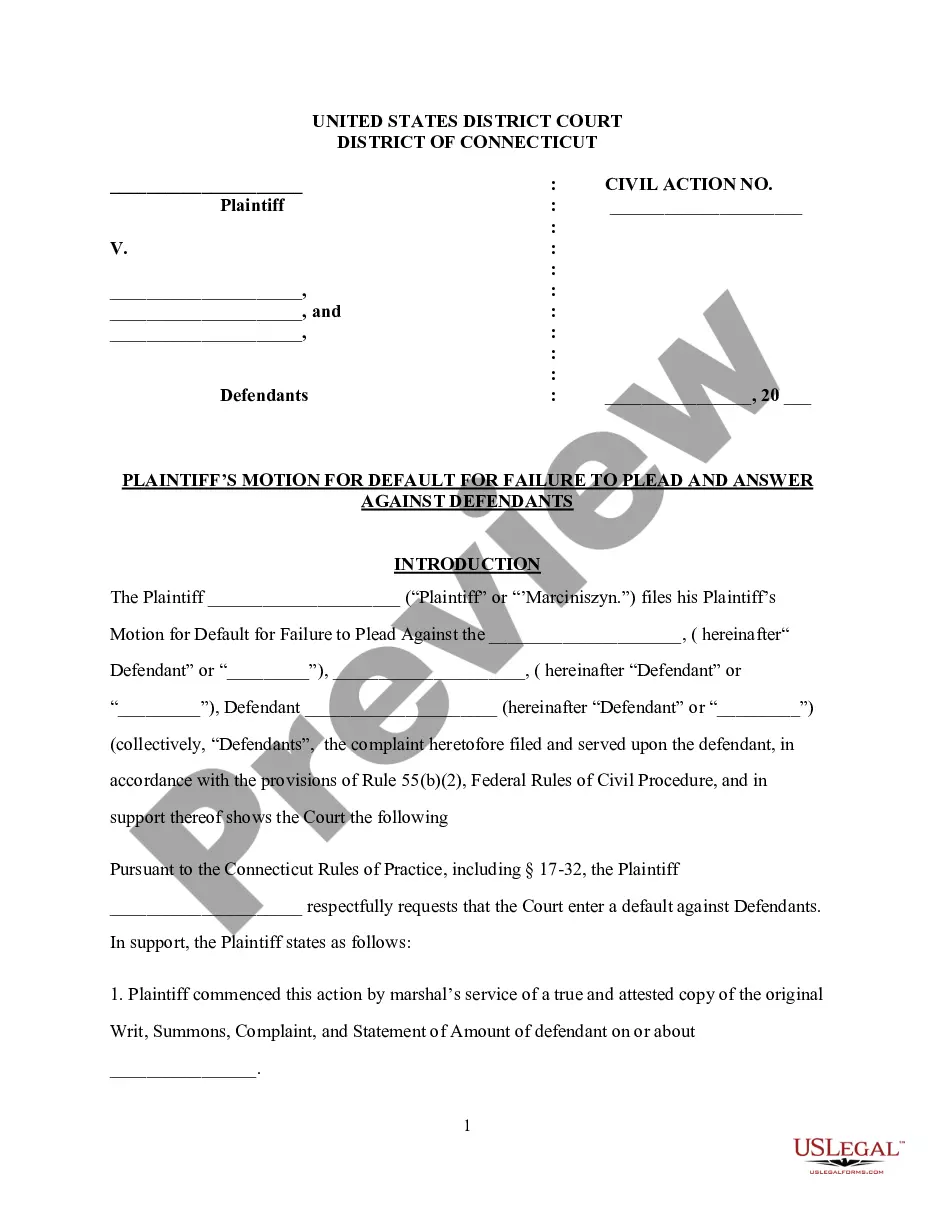
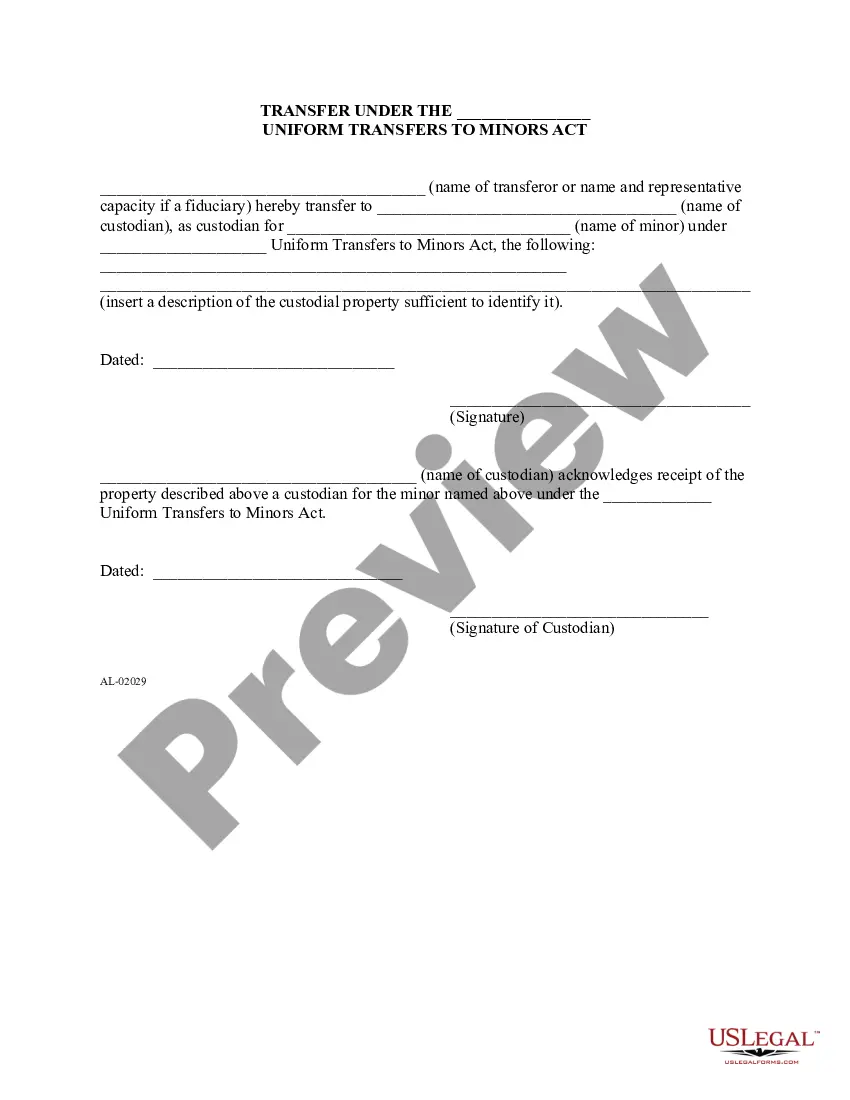
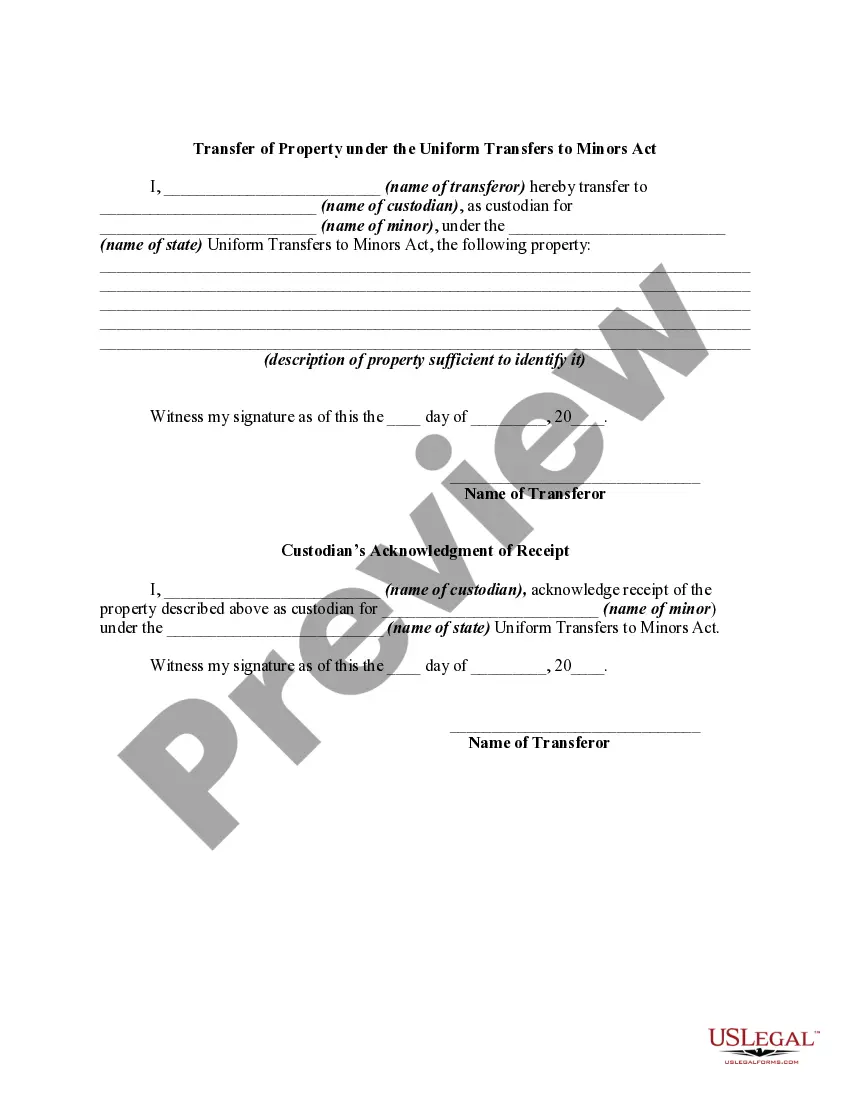
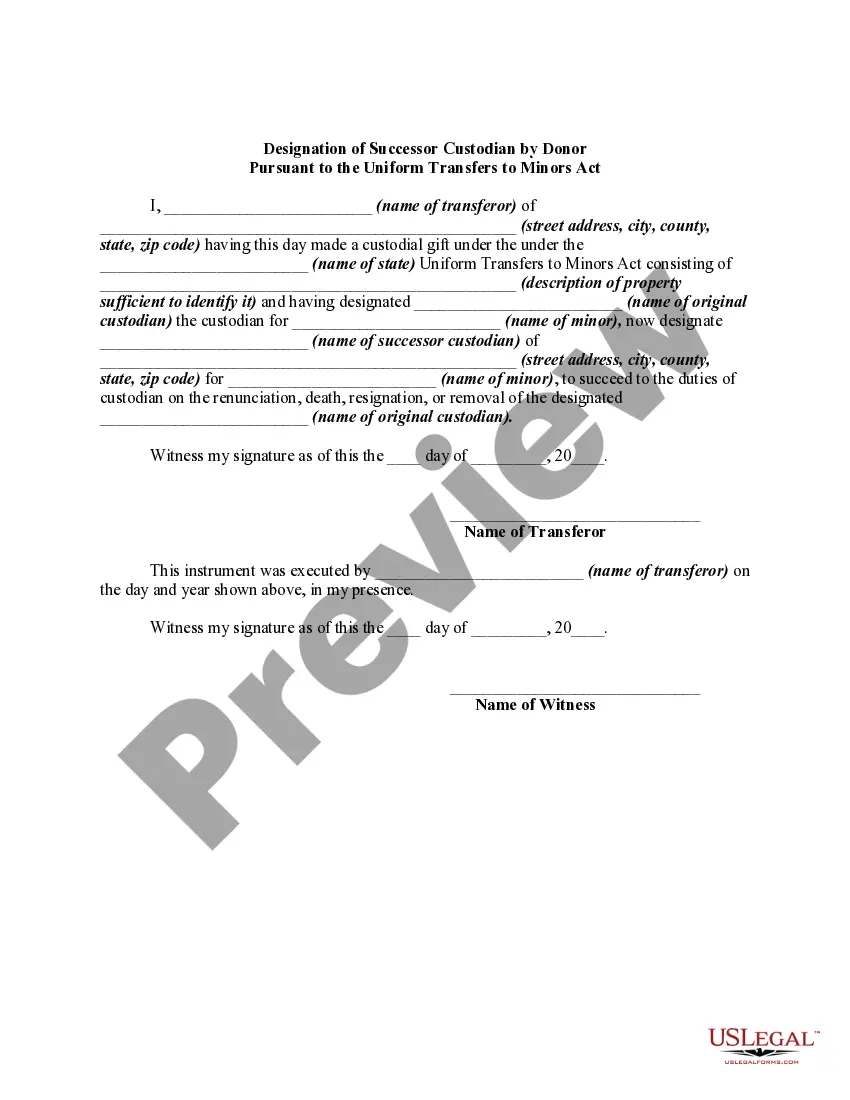
Indiana Transfer under the Uniform Transfers to Minors Act - Multistate Form
Description
Get your form ready online
Our built-in tools help you complete, sign, share, and store your documents in one place.
Make edits, fill in missing information, and update formatting in US Legal Forms—just like you would in MS Word.
Download a copy, print it, send it by email, or mail it via USPS—whatever works best for your next step.
Sign and collect signatures with our SignNow integration. Send to multiple recipients, set reminders, and more. Go Premium to unlock E-Sign.
If this form requires notarization, complete it online through a secure video call—no need to meet a notary in person or wait for an appointment.
We protect your documents and personal data by following strict security and privacy standards.

Make edits, fill in missing information, and update formatting in US Legal Forms—just like you would in MS Word.

Download a copy, print it, send it by email, or mail it via USPS—whatever works best for your next step.

Sign and collect signatures with our SignNow integration. Send to multiple recipients, set reminders, and more. Go Premium to unlock E-Sign.

If this form requires notarization, complete it online through a secure video call—no need to meet a notary in person or wait for an appointment.

We protect your documents and personal data by following strict security and privacy standards.
Looking for another form?




How to fill out Transfer Under The Uniform Transfers To Minors Act - Multistate Form?
If you need to finalize, download, or print valid document templates, utilize US Legal Forms, the premier collection of legal forms available online.
Take advantage of the site’s straightforward and user-friendly search to locate the documents you require.
Various templates for business and personal purposes are categorized by types and states, or keywords. Use US Legal Forms to locate the Indiana Transfer under the Uniform Transfers to Minors Act - Multistate Form with just a few clicks.
Step 5. Complete the transaction. You can use your credit card or PayPal account to finalize the payment.
Step 6. Choose the format of your legal form and download it to your device. Step 7. Complete, modify, and print or sign the Indiana Transfer under the Uniform Transfers to Minors Act - Multistate Form. Each legal document template you purchase is yours permanently. You will have access to every form you downloaded within your account. Select the My documents section and choose a form to print or download again. Complete and download, and print the Indiana Transfer under the Uniform Transfers to Minors Act - Multistate Form with US Legal Forms. There are thousands of professional and state-specific forms available for your business or personal requirements.
- When you are already a US Legal Forms user, Log In to your account and click on the Download button to access the Indiana Transfer under the Uniform Transfers to Minors Act - Multistate Form.
- You can also access forms you previously downloaded in the My documents tab of your account.
- If you are using US Legal Forms for the first time, refer to the instructions below.
- Step 1. Ensure you have selected the form for the correct city/state.
- Step 2. Use the Preview option to review the form’s content. Don’t forget to read the description.
- Step 3. If you are not satisfied with the form, utilize the Search area at the top of the screen to find other versions of the legal form template.
- Step 4. Once you have found the form you need, click the Get now button. Choose the payment plan you prefer and enter your details to register for an account.
Form popularity
FAQ
Depending on the state a UTMA account is handed over to a child when they reach either age 18 or age 21. In some jurisdictions, at age 18 a UTMA account can only be handed over with the custodian's permission, and at 21 is transferred automatically.
By law, a minor cannot inherit directly from your estate. Therefore, an adult must protect and manage a child's inheritance and/or gifts made to a minor until the child is old enough to inherit directly.
If a minor has reached the age of twenty-one (21) and seeks to withdraw the funds from the UTMA account of which he/she is the beneficiary, the minor must contact the custodian, as the custodian is the only person authorized to make withdrawals or close the account.
Generally, the UTMA account transfers to the beneficiary when they become a legal adult, which is usually age 18 or 21, but it can be later. The age of adulthood may be defined differently for custodial accounts, like UTMAs or 529 plans, depending on your state.
Once the minor on a UGMA/UTMA account reaches the applicable state's age of termination, the custodian or the former minor may transfer the shares in the account(s) to the former minor's sole name. Instructions are acceptable from either the custodian or the former minor.
Because money placed in an UGMA/UTMA account is owned by the child, earnings are generally taxed at the child's?usually lower?tax rate, rather than the parent's rate. For some families, this savings can be significant. Up to $1,050 in earnings tax-free. The next $1,050 is taxable at the child's tax rate.
Once the minor reaches the age of majority, they have the option to convert a UTMA to an individual account. In the meantime, the custodian is responsible for investing or managing the assets on the minor's behalf.
Both are held in the name of the minor, but controlled by a parent or other relative until the child reaches adulthood (the age of majority in your state). UTMA stands for Uniform Transfers to Minors Act, and UGMA stands for Uniform Gifts to Minors Act.