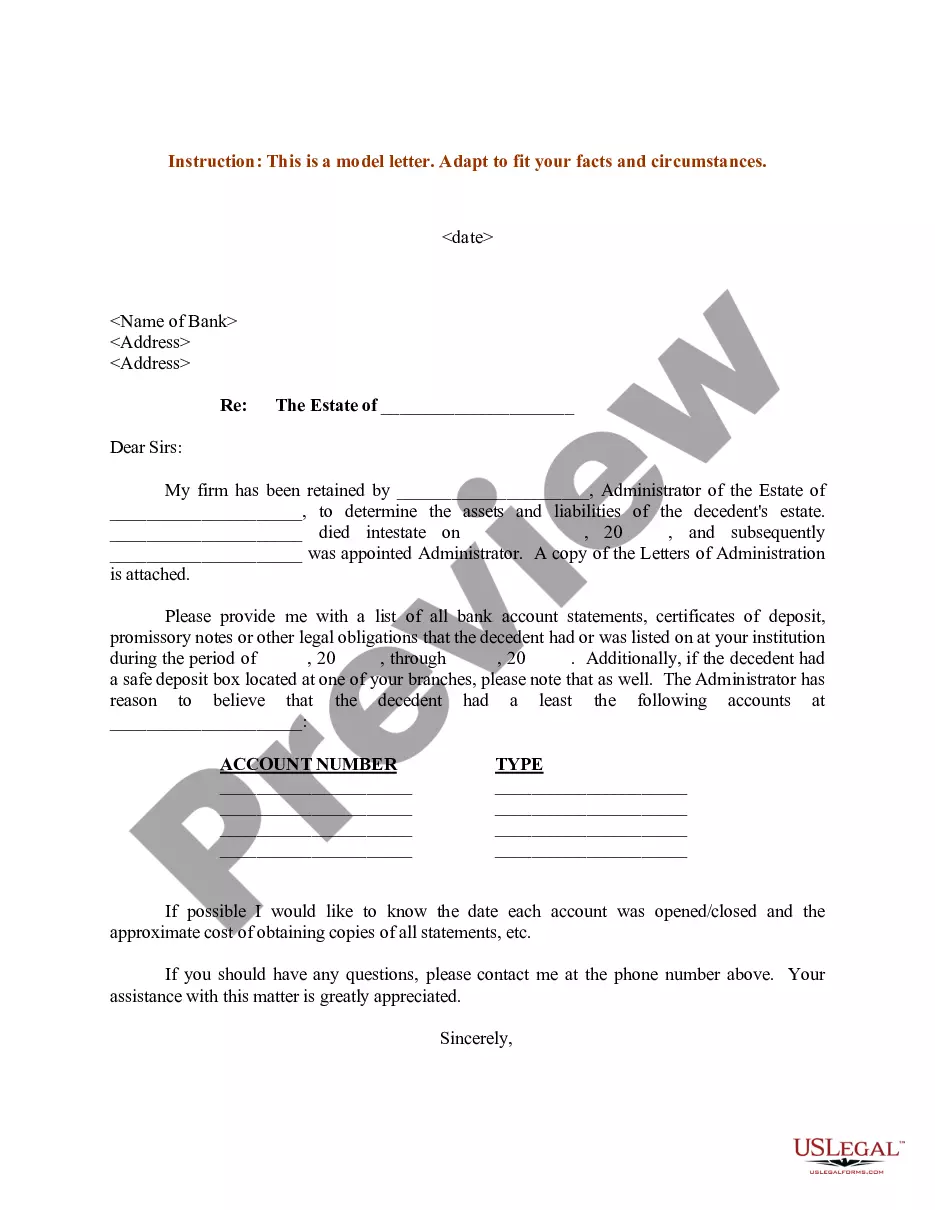
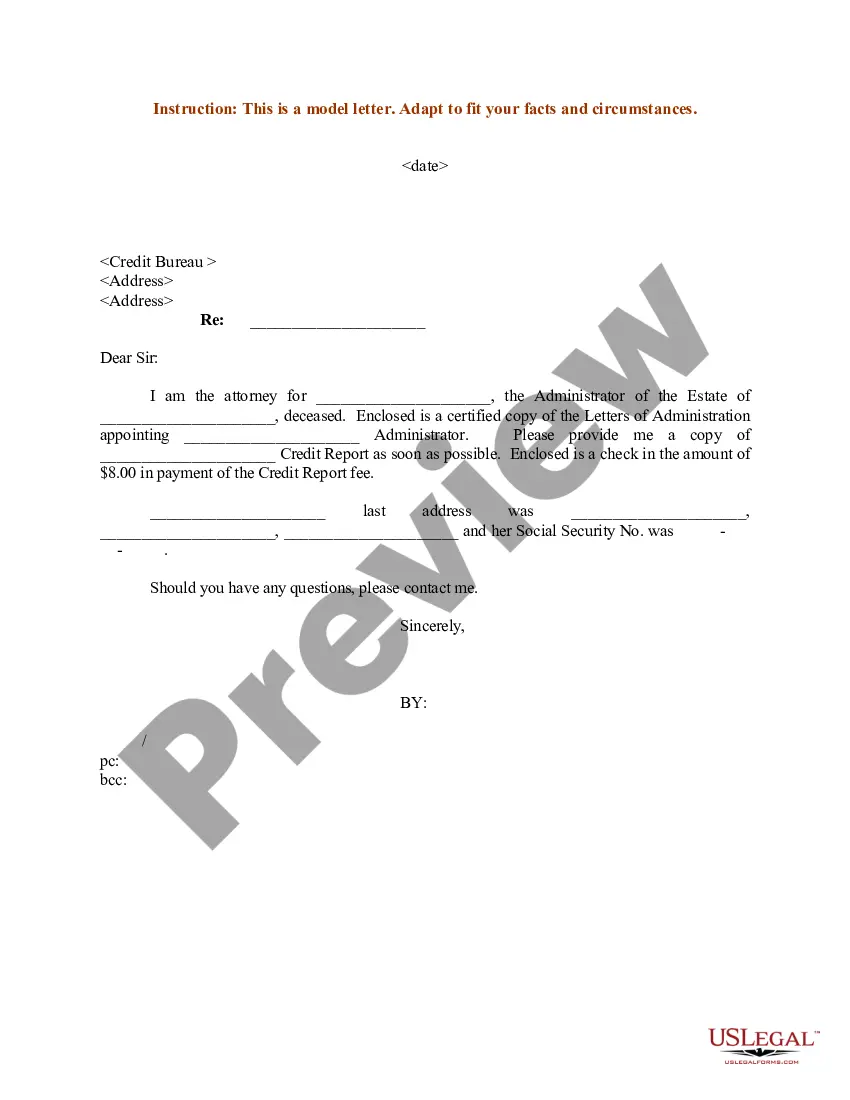
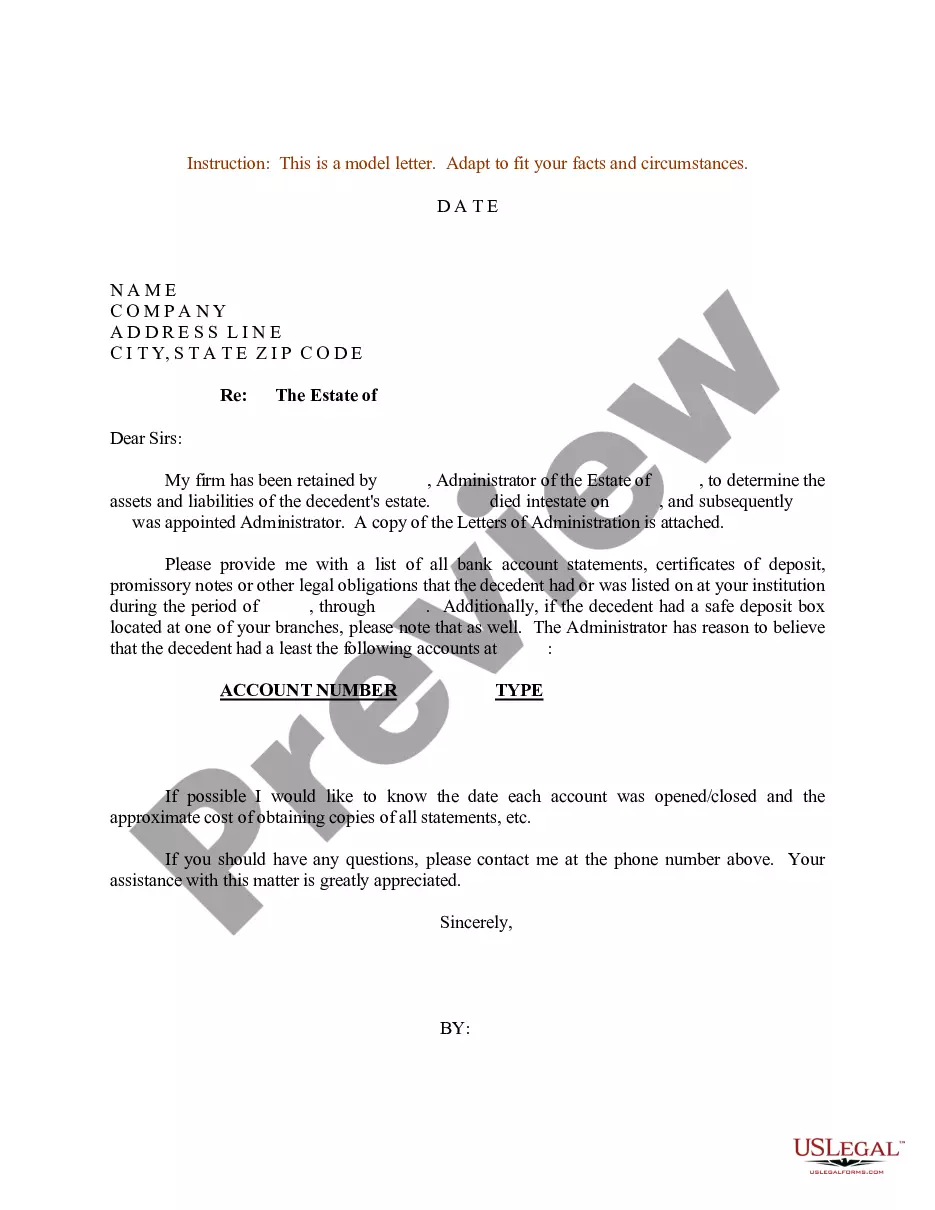
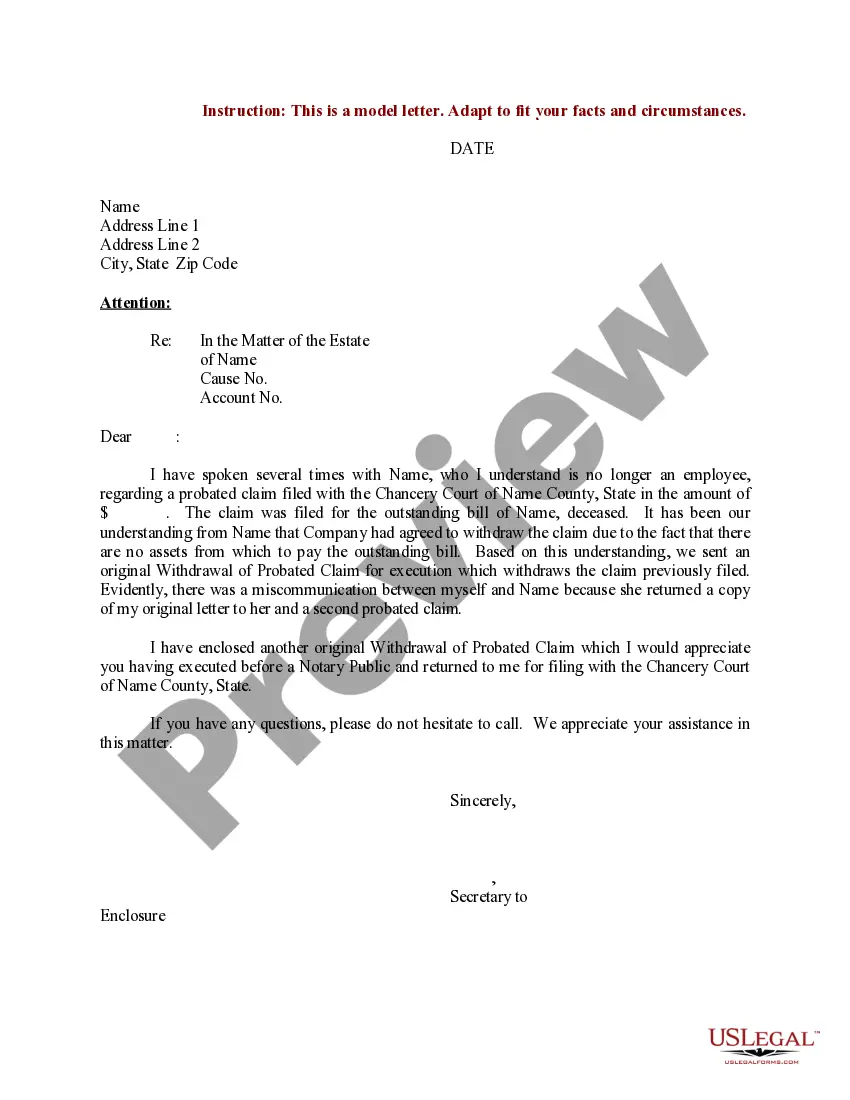
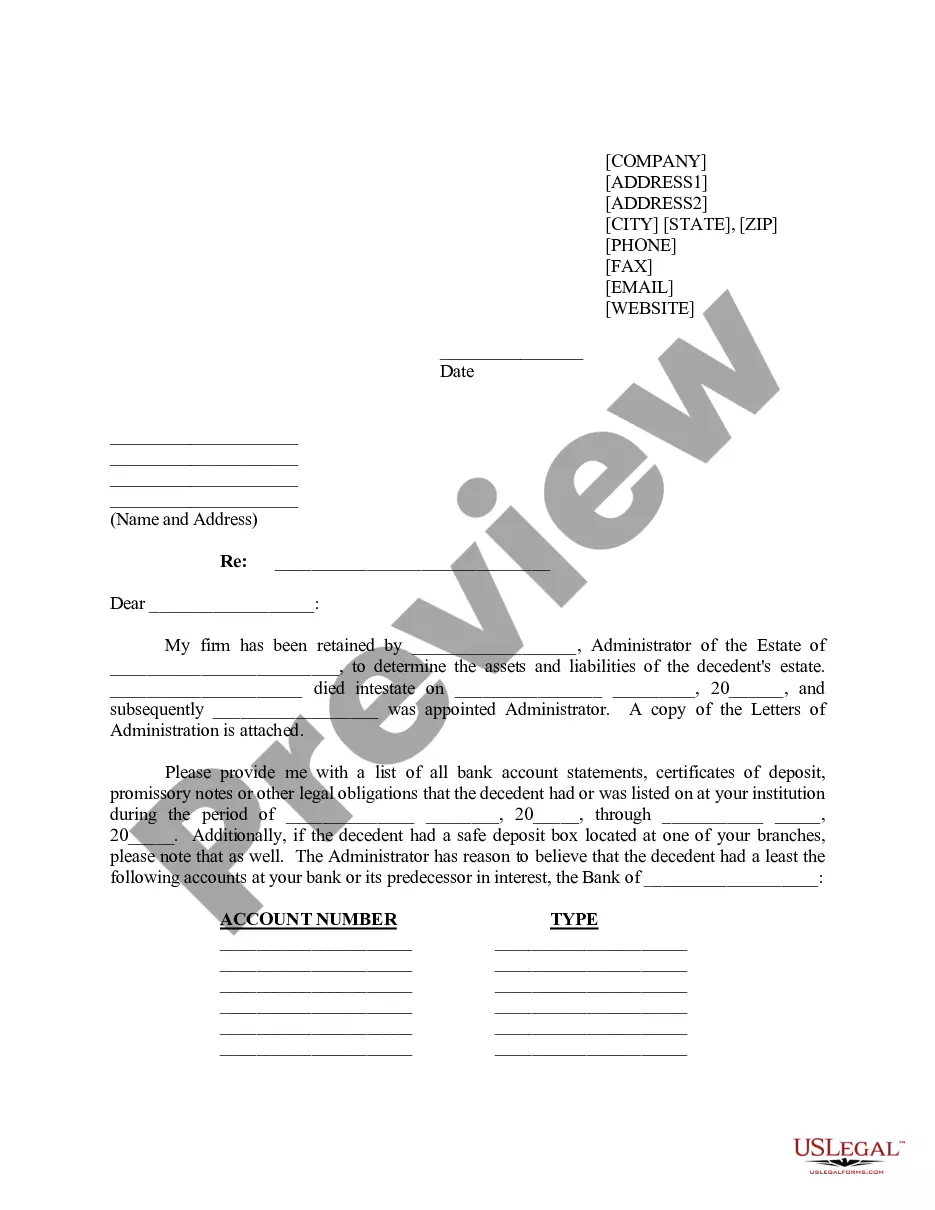
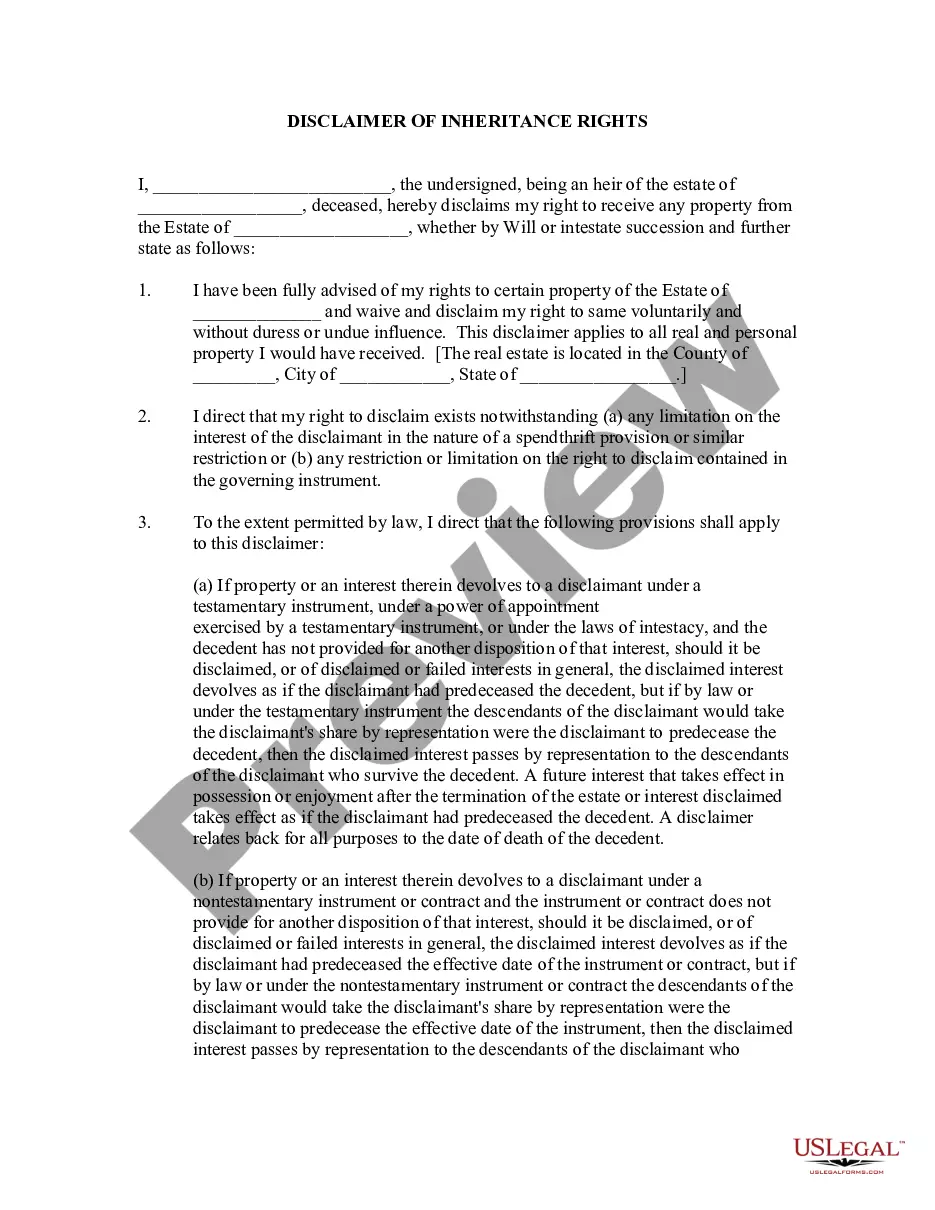
This form is a sample letter in Word format covering the subject matter of the title of the form.
Indiana Sample Letter to Bank concerning Accounts of Decedent
State:
Multi-State
Category:
Control #:
US-0034LTR
Format:
Word;
Rich Text
48 downloads
Description
Free preview

Get your form ready online
Our built-in tools help you complete, sign, share, and store your documents in one place.
Built-in online Word editor
Make edits, fill in missing information, and update formatting in US Legal Forms—just like you would in MS Word.
Export easily
Download a copy, print it, send it by email, or mail it via USPS—whatever works best for your next step.
E-sign your document
Sign and collect signatures with our SignNow integration. Send to multiple recipients, set reminders, and more. Go Premium to unlock E-Sign.
Notarize online 24/7
If this form requires notarization, complete it online through a secure video call—no need to meet a notary in person or wait for an appointment.
Store your document securely
We protect your documents and personal data by following strict security and privacy standards.

Make edits, fill in missing information, and update formatting in US Legal Forms—just like you would in MS Word.

Download a copy, print it, send it by email, or mail it via USPS—whatever works best for your next step.

Sign and collect signatures with our SignNow integration. Send to multiple recipients, set reminders, and more. Go Premium to unlock E-Sign.

If this form requires notarization, complete it online through a secure video call—no need to meet a notary in person or wait for an appointment.

We protect your documents and personal data by following strict security and privacy standards.
Looking for another form?
How to fill out Sample Letter To Bank Concerning Accounts Of Decedent?
US Legal Forms - one of the largest collections of legal documents in the United States - offers a broad array of legal form templates that you can download or print. By utilizing the website, you can access thousands of forms for both business and personal purposes, organized by categories, states, or keywords.
You can obtain the latest versions of forms such as the Indiana Sample Letter to Bank regarding Decedent Accounts in just minutes. If you already have a subscription, Log In and download the Indiana Sample Letter to Bank regarding Decedent Accounts from your US Legal Forms library. The Download button will be visible on every form you view. You can access all previously obtained forms in the My documents section of your account.
If you are using US Legal Forms for the first time, here are simple steps to get started: Ensure you have selected the correct form for your city/state. Click on the Review button to examine the form's contents. Read the form description to confirm that you have chosen the right document. If the form does not meet your requirements, use the Search field at the top of the screen to find one that does. If you are satisfied with the form, confirm your choice by clicking the Buy now button. Then, select the pricing plan you prefer and provide your details to register for an account. Process the transaction. Use your Visa or Mastercard or PayPal account to complete the transaction. Choose the format and download the form to your device. Make edits. Complete, modify, print, and sign the downloaded Indiana Sample Letter to Bank regarding Decedent Accounts. Every template you add to your account has no expiration date and is yours indefinitely. Therefore, if you wish to download or print another copy, simply go to the My documents section and click on the form you need.
- Access the Indiana Sample Letter to Bank regarding Decedent Accounts with US Legal Forms, one of the most extensive collections of legal document templates.
- Utilize a multitude of professional and state-specific templates that meet your business or personal requirements.
- Download forms quickly and easily.
- Access forms categorized by type or state.
- Manage your documents efficiently in your account.
- Ensure compliance with local regulations.
Form popularity
FAQ
When writing a letter to the bank manager for a death claim, start with a polite greeting and introduce yourself, mentioning your relationship to the deceased. Clearly outline your request for the account information and any actions required to settle the estate. Attaching relevant documents, such as the death certificate and your identification, is crucial. You can refer to the Indiana Sample Letter to Bank concerning Accounts of Decedent to help you format your request effectively and ensure clarity.
Writing a letter to the bank for the claim settlement of a deceased account involves several key steps. First, clearly state your relationship to the deceased and provide the account details. Include necessary documents, such as the death certificate and any legal documentation proving your authority to act on behalf of the estate. For a detailed guide, consider using the Indiana Sample Letter to Bank concerning Accounts of Decedent, which can simplify the process and ensure that you include all essential information.
If a beneficiary requests access to financial institution statements and the executor refuses to provide them, the beneficiary can take legal action. They can follow the court for an order compelling the executor to reveal the requested information.
A court must grant you the power to withdraw money from the account if you're neither a joint owner or an account beneficiary. For example, an executor must produce proof of executor status and a certified copy of the death certificate to collect funds and place them in an estate account.
Most banks have their own rules, however, in most cases if the amount of money is not significant, funds will be released immediately once a death certificate and Will has been provided.
The bank is likely to ask for two forms of your identification (usually a passport or driver's licence, or a proof of address with a utility bill) and a copy of the will. If there's no will, the bank could ask for evidence of your relationship to the deceased. You'll also need the death certificate.
I am the personal representative of [deceased] who died on [date]. I enclose a copy of the death certificate, which I'd be grateful if you would return once you have noted the details. Please can you let me know: the balance on the account at the date of death.
Closing Deceased Accounts The probate court will appoint an executor or administrator if one is not named in the deceased's will or if the deceased didn't leave a will. This person will have the authority to close the deceased accounts and distribute the funds therein to heirs and creditors.
If the account holder established someone as a beneficiary, the bank releases the funds to the named person once it learns of the account holder's death. After that, the financial institution typically closes the account. If the owner of the account didn't name a beneficiary, the process can be more complicated.
I enclose a copy of their death certificate. They didn't leave behind any assets and there is no money to pay what they owe. You could include a paragraph about the deceased person's circumstances. For example, if they were living in rented accommodation and were receiving only benefit income.