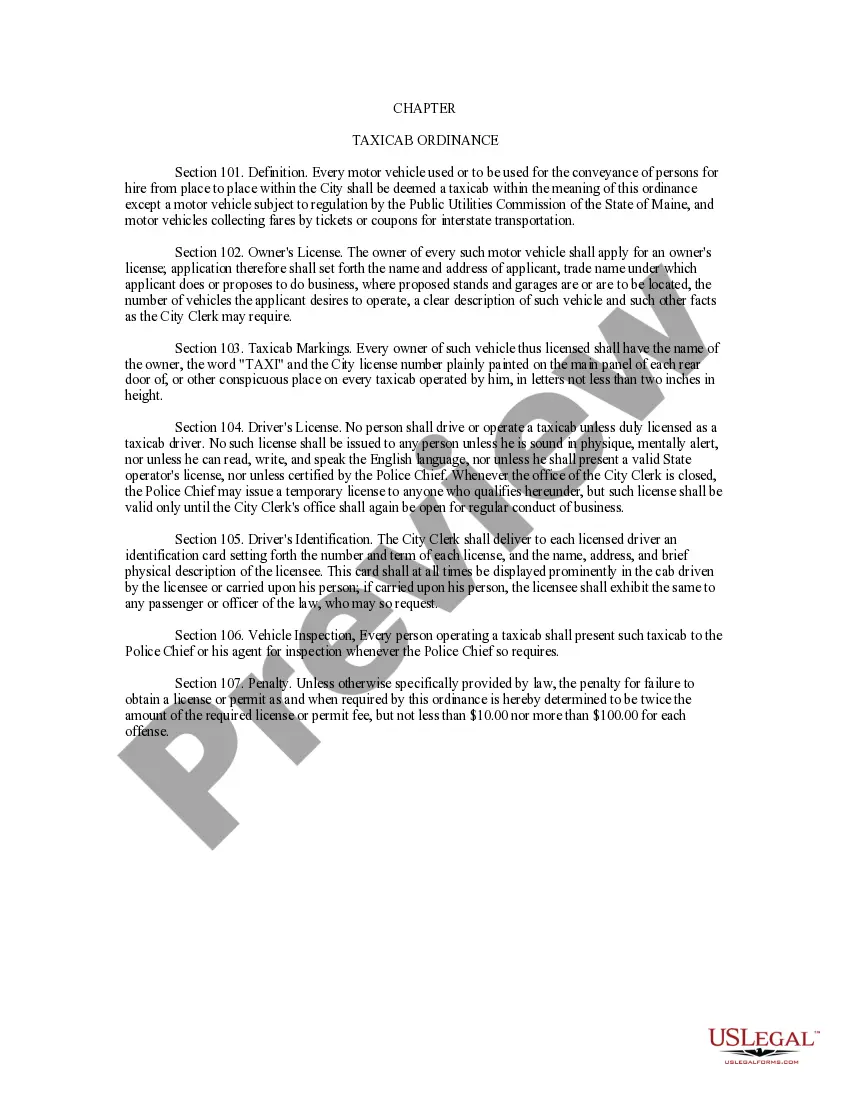
Illinois Taxicab Ordinance
Description
Get your form ready online
Our built-in tools help you complete, sign, share, and store your documents in one place.
Make edits, fill in missing information, and update formatting in US Legal Forms—just like you would in MS Word.
Download a copy, print it, send it by email, or mail it via USPS—whatever works best for your next step.
Sign and collect signatures with our SignNow integration. Send to multiple recipients, set reminders, and more. Go Premium to unlock E-Sign.
If this form requires notarization, complete it online through a secure video call—no need to meet a notary in person or wait for an appointment.
We protect your documents and personal data by following strict security and privacy standards.

Make edits, fill in missing information, and update formatting in US Legal Forms—just like you would in MS Word.

Download a copy, print it, send it by email, or mail it via USPS—whatever works best for your next step.

Sign and collect signatures with our SignNow integration. Send to multiple recipients, set reminders, and more. Go Premium to unlock E-Sign.

If this form requires notarization, complete it online through a secure video call—no need to meet a notary in person or wait for an appointment.

We protect your documents and personal data by following strict security and privacy standards.
Looking for another form?



How to fill out Taxicab Ordinance?
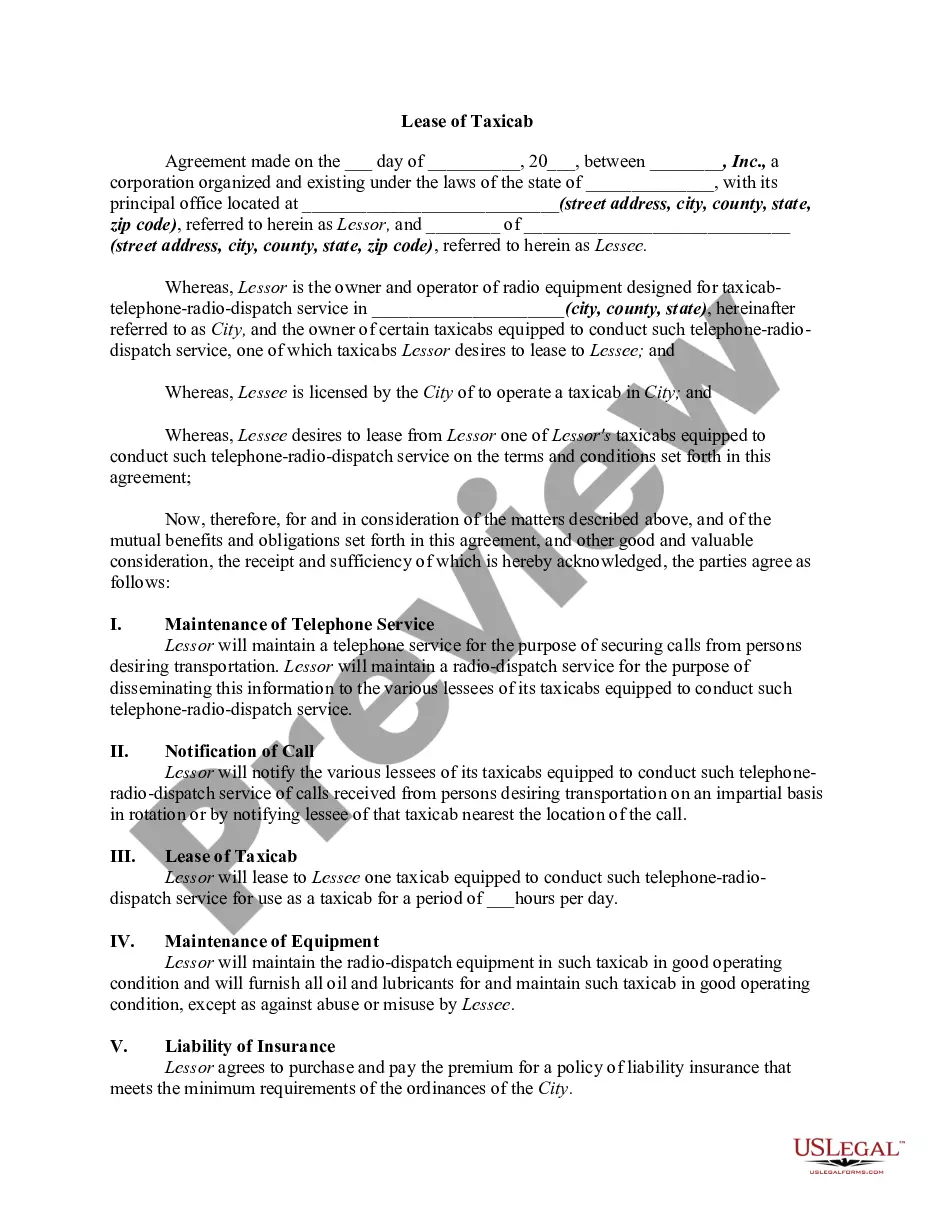
You can commit several hours on the Internet attempting to find the legal papers format that meets the federal and state needs you want. US Legal Forms provides 1000s of legal types which can be examined by pros. It is possible to download or printing the Illinois Taxicab Ordinance from our assistance.
If you already possess a US Legal Forms accounts, you may log in and then click the Acquire option. Afterward, you may full, modify, printing, or indication the Illinois Taxicab Ordinance. Every legal papers format you get is the one you have forever. To acquire one more version for any purchased type, visit the My Forms tab and then click the related option.
If you are using the US Legal Forms web site the very first time, keep to the simple guidelines listed below:
- Initial, ensure that you have chosen the best papers format for the county/city of your choice. Browse the type outline to ensure you have picked out the appropriate type. If offered, utilize the Preview option to look throughout the papers format as well.
- If you would like discover one more variation of your type, utilize the Lookup area to find the format that fits your needs and needs.
- When you have found the format you desire, click Acquire now to continue.
- Find the rates strategy you desire, type your qualifications, and register for a free account on US Legal Forms.
- Comprehensive the financial transaction. You should use your Visa or Mastercard or PayPal accounts to fund the legal type.
- Find the formatting of your papers and download it for your device.
- Make alterations for your papers if possible. You can full, modify and indication and printing Illinois Taxicab Ordinance.
Acquire and printing 1000s of papers web templates making use of the US Legal Forms Internet site, that offers the largest selection of legal types. Use skilled and state-specific web templates to take on your business or specific demands.
Form popularity
FAQ
Taxis are driven by licensed public chauffeurs. Review the comprehensive guide on CHICAGO'S GUIDE TO LICENSING PUBLIC PASSENGER VEHICLES. NEW: Tool Kit for Taxi Medallion License Holders!
One of the easiest ways to get a Chicago taxi is by hailing one from the street. If you're in the downtown area, simply lookout for the yellow cabs and stick out your arm if it's empty. If you'd prefer, you can also walk to a taxi rank and take a cab from there.
Scott's Law mandates that when approaching any police or other emergency vehicle stopped along the roadway, you must: Change lanes if possible. Always reduce speed, but reduce greatly if unable to change lanes. Proceed with increased caution.
The Department of Business Affairs and Consumer Protections (BACP) processes, investigates and prosecutes complaints filed through the City's 311 system related to consumer fraud, business licensees, and cabs and ride share operators.
As of November 2022, there were 2,669 active taxi drivers in Chicago, ing to the Business Affairs Department; that's a drop of 47% since 2019. By comparison, there were 44,259 active ride-hail drivers in the city as of November. That's where Curb comes into play.
Also known as "Scott's Law" or the "Move Over Law", the law requires that upon approaching a stationary police or emergency vehicle using audible or visual signals, you must: Proceed with due caution. If possible, yield the right-of-way by making a full lane change not adjacent to the police or emergency vehicle.
Sec. 11-907. Operation of vehicles and streetcars on approach of authorized emergency vehicles. stop such car clear of any intersection and keep it in such position until the authorized emergency vehicle has passed, unless otherwise directed by a police officer.
When an emergency vehicle is approaching: Pull over to the edge of the roadway, clear of intersections, and stop. Remain there until the emergency vehicle has passed. Watch for others.
Police/Emergency Vehicles When being approached by an emergency vehicle using audible and visual sig- nals (lights and/or sirens), Illinois law requires you to immediately pull to the right side of the road and allow the emergency vehicle to pass. A complete stop may be necessary to allow the emergency vehicle to pass.
Forty percent of the city's cabs are currently not in operation. Unlike in New York, where regulations and the density of the city core have partially shielded yellow cabs from the effects of competition from ride-hailing companies, the taxi industries in Chicago and other cities have been devastated by Uber and Lyft.