Illinois Covenant
What is this form?
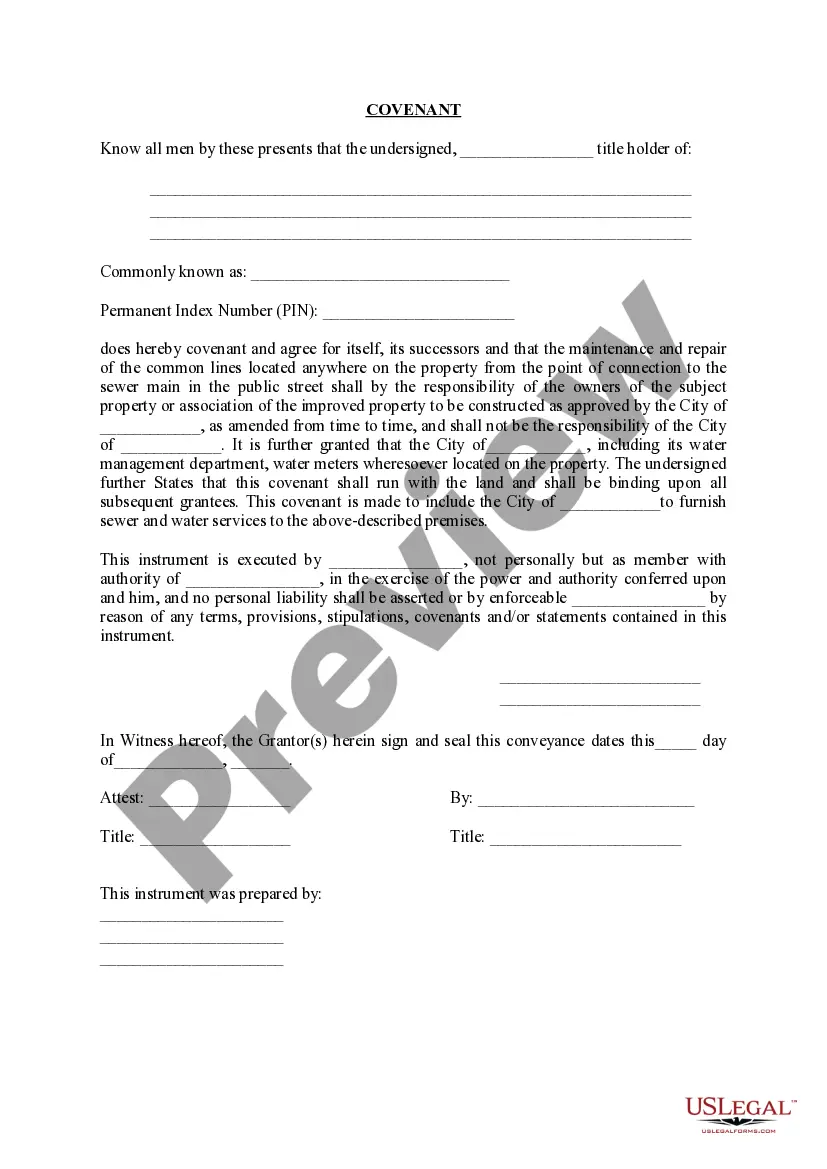
A covenant is a legal agreement that outlines the rights and responsibilities associated with a property, specifically related to the operation of a sewer system in this case. This Covenant specifies that the property owners are responsible for maintaining the sewer connections instead of the city. It is important for property buyers and owners to understand the implications of such covenants, as they bind future owners to these obligations, differentiating it from other property agreements that may not carry the same legal weight.
Key parts of this document
- Parties involved: Identification of the title holder and property details.
- Property description: Clear identification of the property through a common name and permanent index number (PIN).
- Covenant terms: Details regarding the maintenance and repair responsibilities for sewer lines.
- City involvement: Specifies the obligations of the city in relation to sewer services.
- Binding nature: States that the covenant runs with the land and is binding on future property owners.
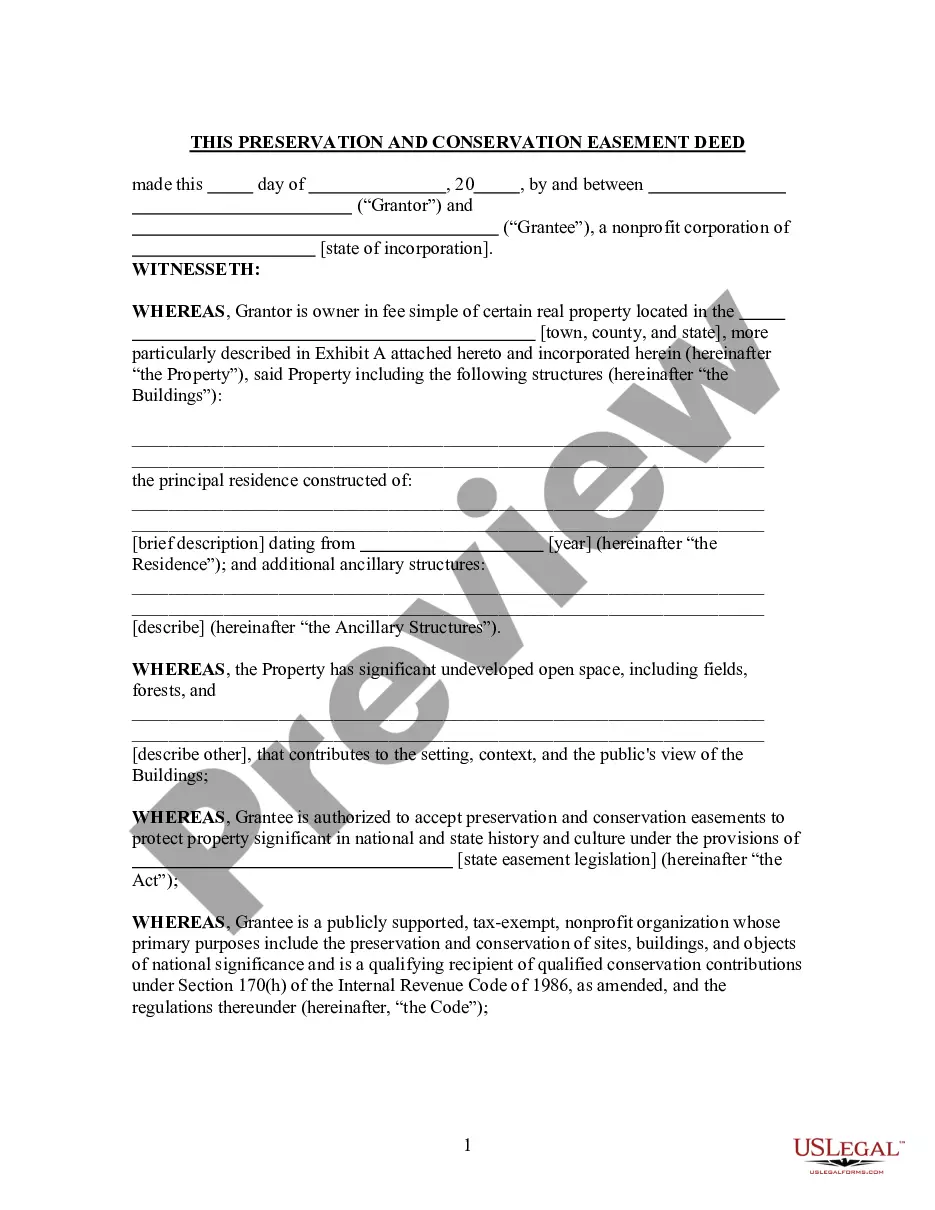
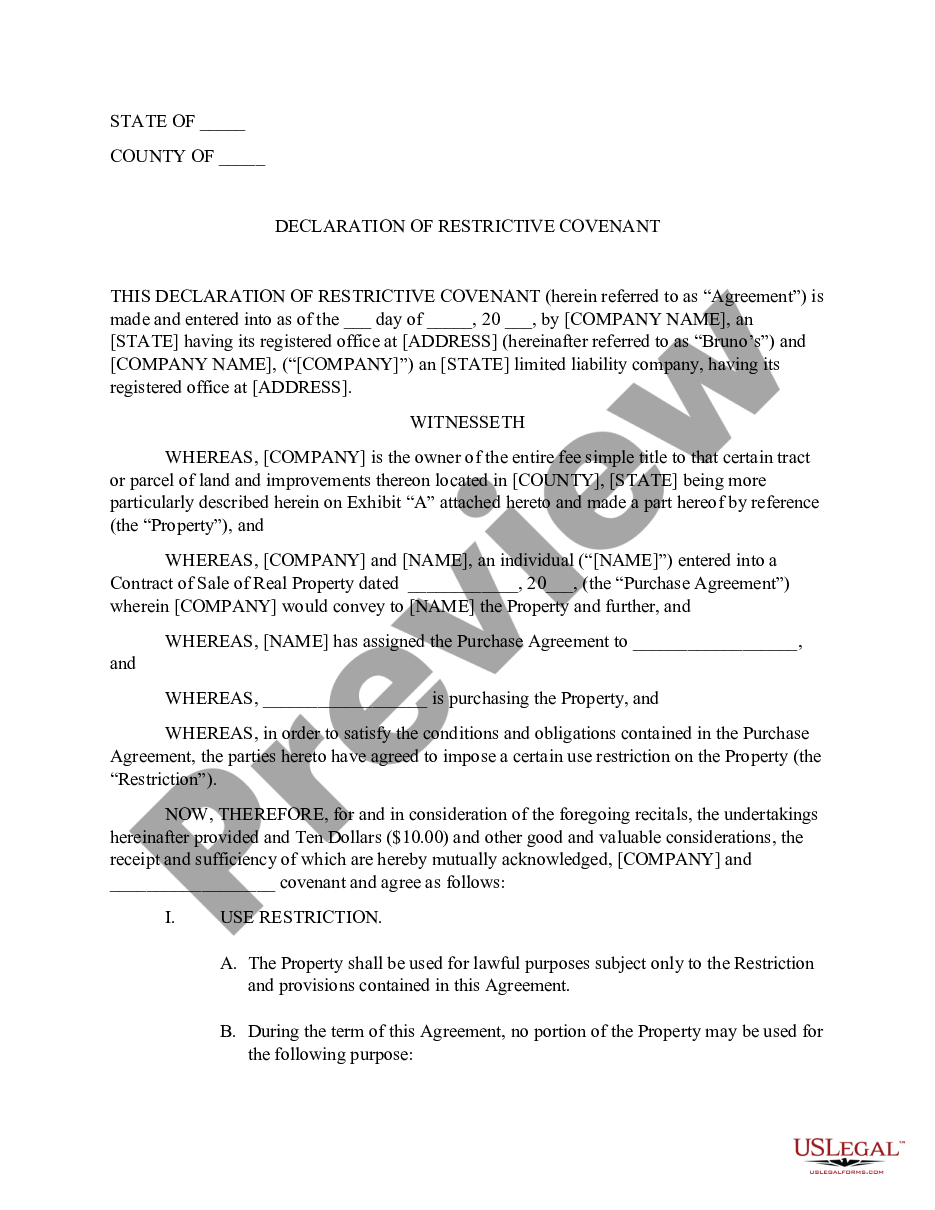
When this form is needed
This form should be used when a property owner wishes to establish a covenant related to sewer system operations. It is particularly useful in new developments where properties are connected to a public sewer main, ensuring clarity about maintenance responsibilities among current and future property owners.
Who needs this form
- Property owners and developers establishing a new property or development.
- Homeowners associations overseeing common sewer line maintenance.
- Real estate professionals assisting clients with property agreements.
- Legal representatives helping clients draft or review property covenants.
Instructions for completing this form
- Identify the parties involved by filling in the title holder's name and the property description.
- Specify the property by providing its common name and permanent index number (PIN).
- Detail the maintenance responsibilities for the sewer lines connected to the property.
- State the cityâs role in providing sewer services and the binding nature of the covenant.
- Require signatures from authorized representatives and ensure the form is dated.
Notarization guidance
This form does not typically require notarization unless specified by local law. However, having it notarized can add a level of legitimacy and help avoid disputes about the authenticity of the signatures.
Get your form ready online
Our built-in tools help you complete, sign, share, and store your documents in one place.
Make edits, fill in missing information, and update formatting in US Legal Forms—just like you would in MS Word.
Download a copy, print it, send it by email, or mail it via USPS—whatever works best for your next step.
Sign and collect signatures with our SignNow integration. Send to multiple recipients, set reminders, and more. Go Premium to unlock E-Sign.
If this form requires notarization, complete it online through a secure video call—no need to meet a notary in person or wait for an appointment.
We protect your documents and personal data by following strict security and privacy standards.

Make edits, fill in missing information, and update formatting in US Legal Forms—just like you would in MS Word.

Download a copy, print it, send it by email, or mail it via USPS—whatever works best for your next step.

Sign and collect signatures with our SignNow integration. Send to multiple recipients, set reminders, and more. Go Premium to unlock E-Sign.

If this form requires notarization, complete it online through a secure video call—no need to meet a notary in person or wait for an appointment.

We protect your documents and personal data by following strict security and privacy standards.
Common mistakes to avoid
- Failing to accurately identify the parties and property details.
- Not specifying the obligations for maintenance and repair clearly.
- Omitting the required signatures or not dating the form.
- Overlooking local laws that may necessitate additional provisions.
Benefits of completing this form online
- Convenient access to legally sound templates drafted by licensed attorneys.
- Editable formats allow for customization according to specific needs.
- Instant downloading means you can complete the process at your own pace.
- Ensures compliance with legal requirements specific to your jurisdiction.
Looking for another form?
Form popularity
FAQ
There is no specific salary threshold for non-compete agreements in Illinois; however, a reasonable salary may enhance enforceability. Employers often consider the employee's compensation and the nature of their role when drafting an Illinois Covenant. High-salaried positions may have more leeway in enforcing non-compete agreements, making it crucial for both parties to understand the terms clearly.
Enforceability of Covenants As a result of a legal principle called privity of contract, the covenant will always be enforceable as between the original covenantor and covenantee, even after either or both have parted with the land in question.
Can a restrictive covenant be removed? For prospective land or property purchasers, it may be possible to speak to the vendor or 'successor in title' with a view to having any restriction lifted. In other words, you may be able to remove your restrictive covenant- but there are no guarantees.
What happens if I breach a restrictive covenant? If you own a property and unknowingly (or otherwise) breach a restrictive covenant then you could be forced to undo any offending work (such as having to pull down an extension), pay a fee (often running into thousands of pounds) or even face legal action.
What happens if I breach a restrictive covenant? If you own a property and unknowingly (or otherwise) breach a restrictive covenant then you could be forced to undo any offending work (such as having to pull down an extension), pay a fee (often running into thousands of pounds) or even face legal action.
Illinois prohibits non-compete agreements between an employer and low-wage employees (see Question 1). A non-compete agreement entered into after January 1, 2017 is illegal and void if it restricts a low-wage employee from performing any of the following: 220e Any work for another employer for a specified period of time.
If the covenant is attached to the land it is said to 'run with the land'. That means it continues to apply to the land regardless of whether either the burdened or neighbouring lands have been sold on. This means a restrictive covenant can last indefinitely even if its purpose now seems obsolete.
Typically, courts tend to enforce restrictions of between 6 and 12 months, depending upon the seniority of the employee concerned and their access to confidential information and clients. This is subject, of course, to the covenants being reasonable and necessary to protect a legitimate business interest.
In respect of covenants, for them to be enforceable, both the benefit and burden must run in common law or both must run in equity. So if the benefit runs in common law but the burden only runs in equity (or vice versa) the covenant will not be enforceable.
In other words, you may be able to remove your restrictive covenant- but there are no guarantees.If you can agree to have the covenant removed, a 'Deed of Release of Restrictive Covenant' should be drawn up and signed by the dominant and servient owners.