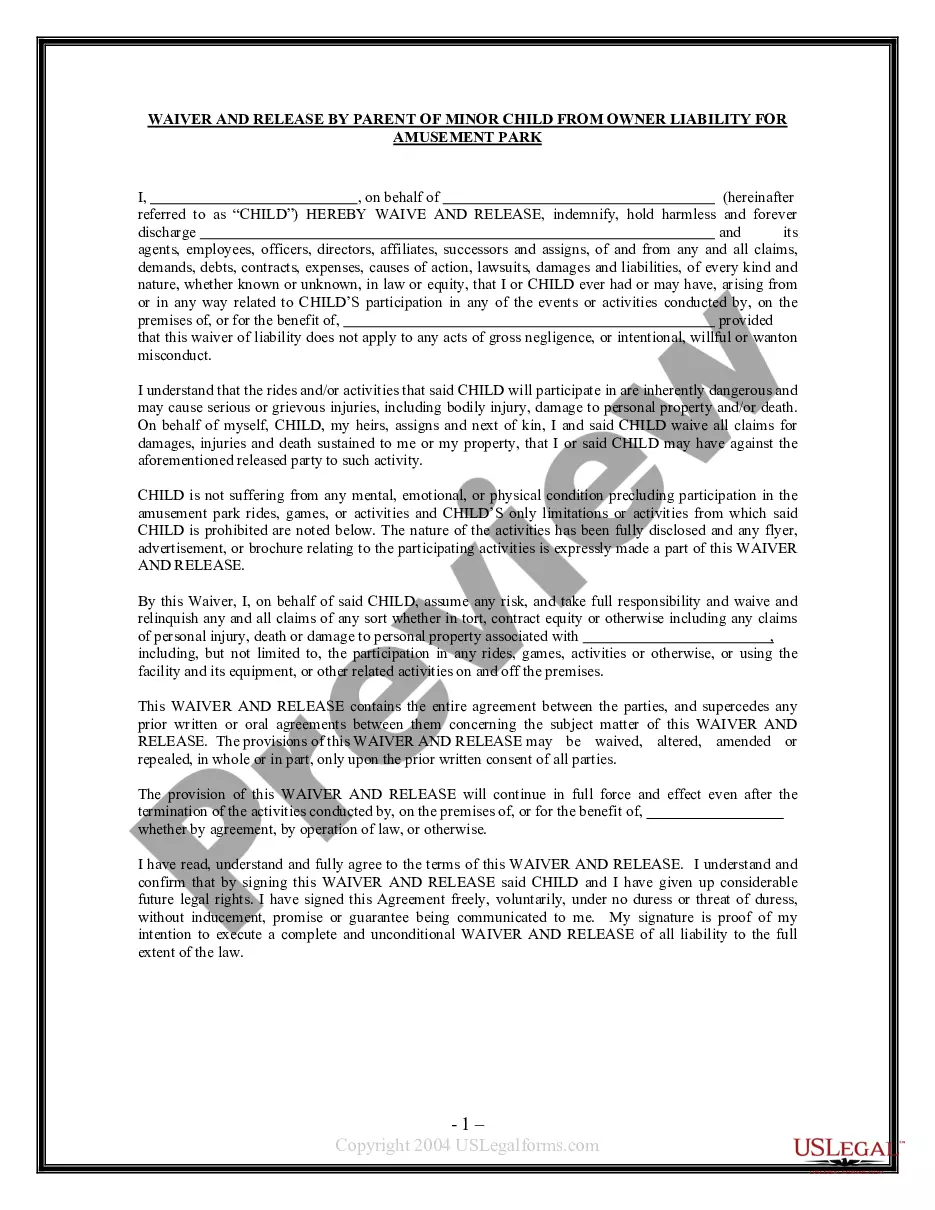
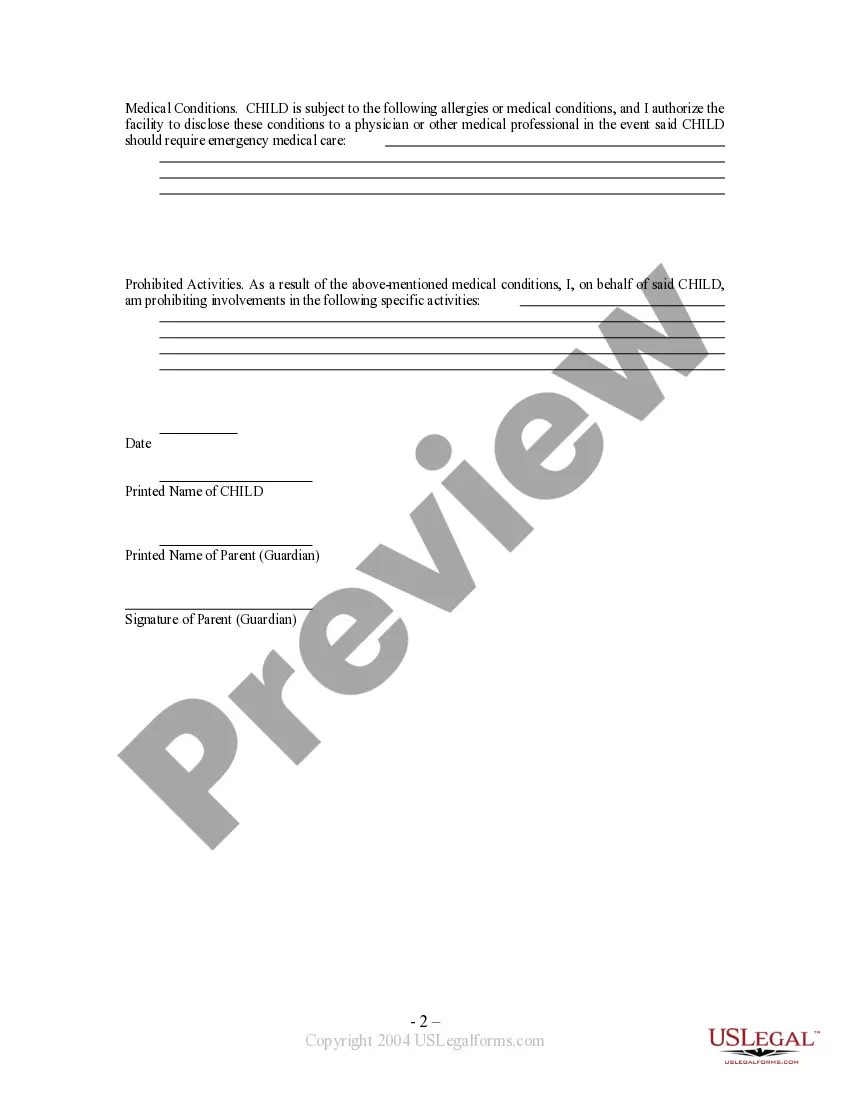
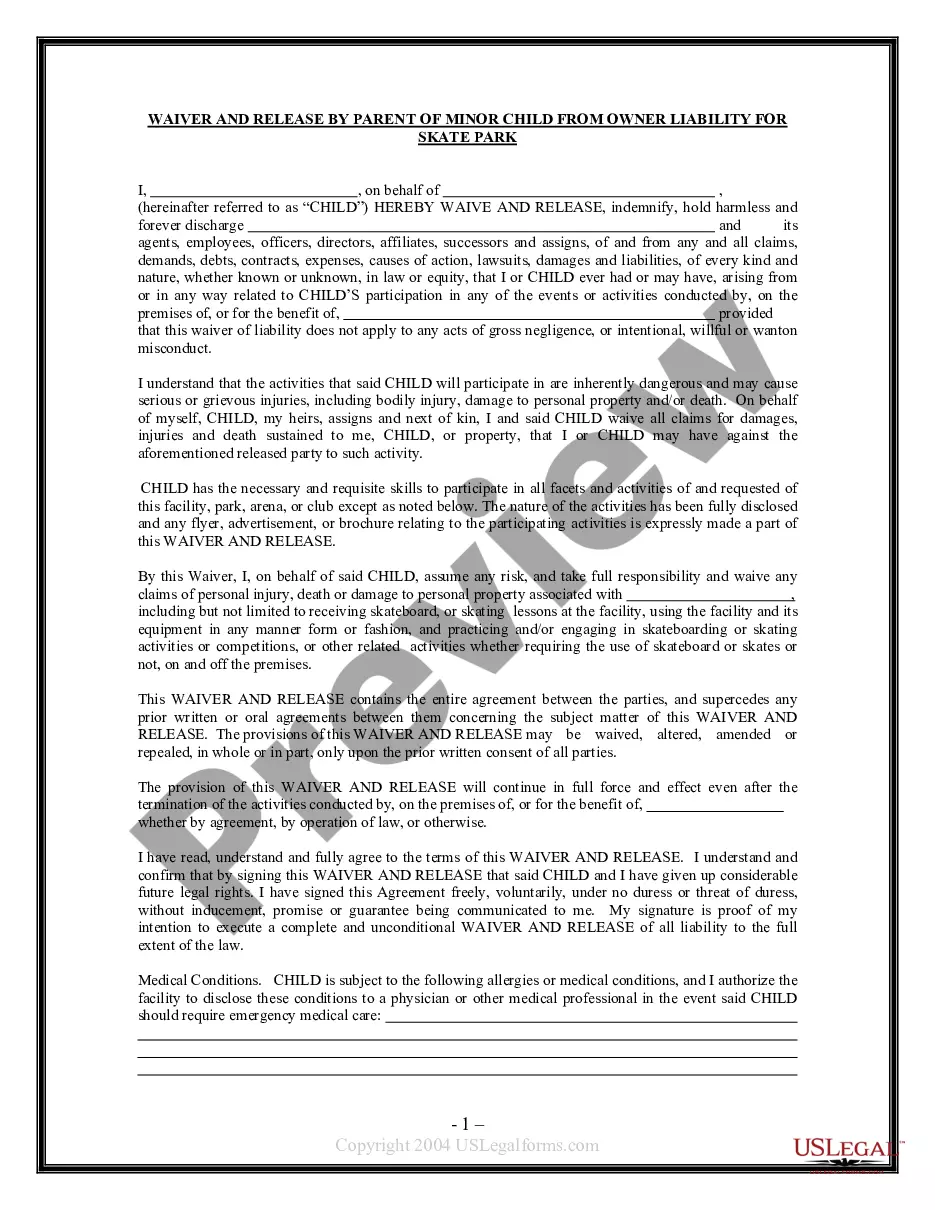
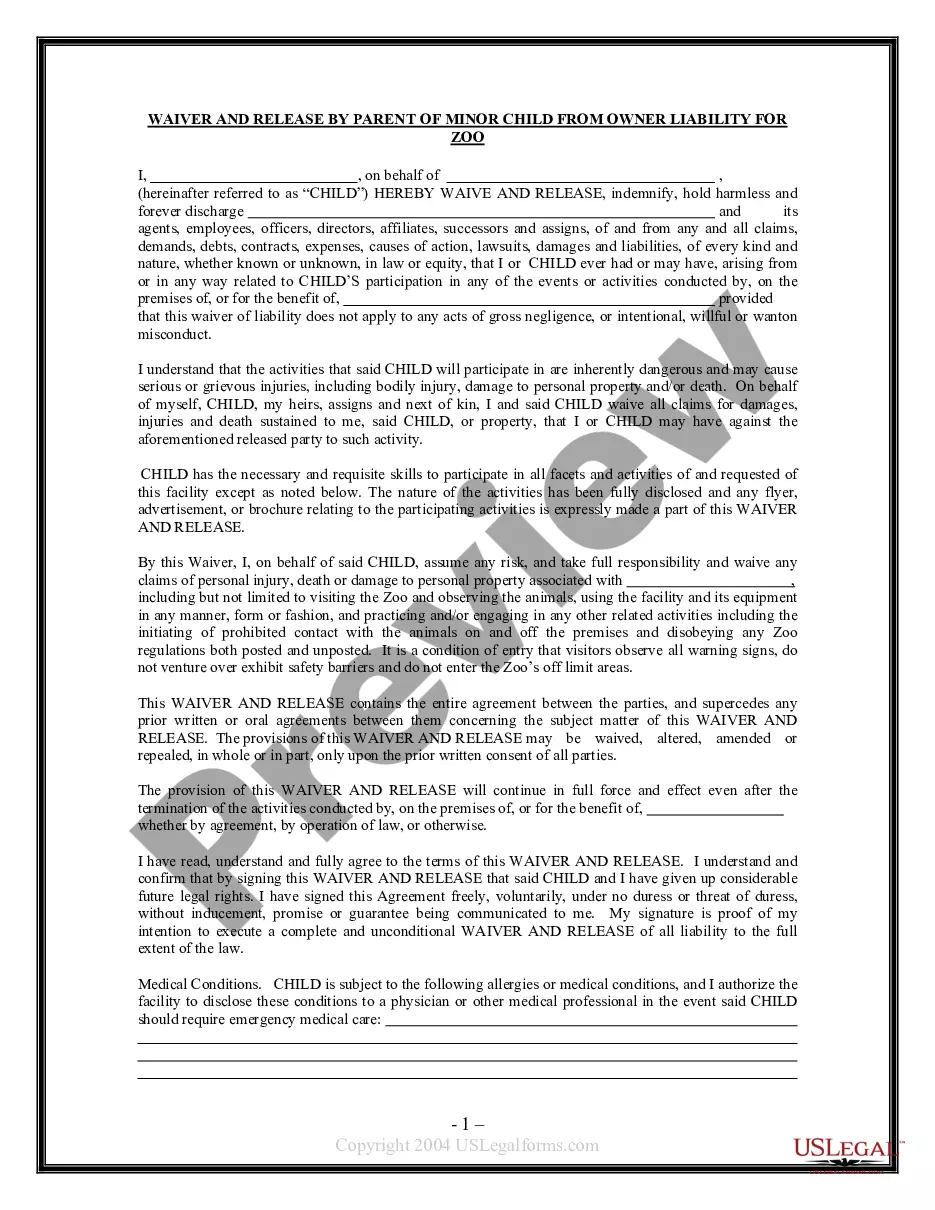
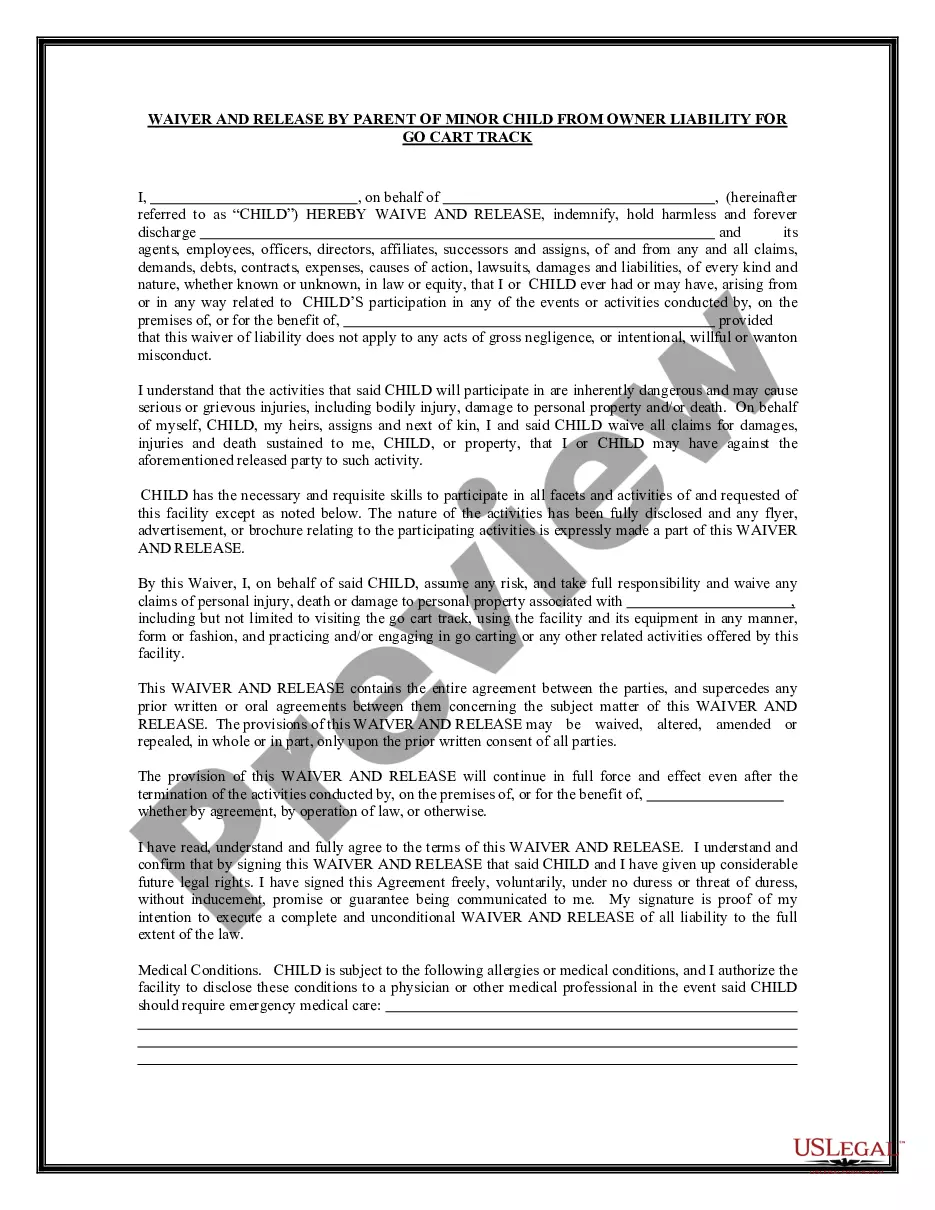
This form allows a parent or guardian to release an amusement park from liability for injuries which may be incurred by a minor child while on the premises, taking part in activities, etc.
Idaho Waiver and Release From Liability For Minor Child for Amusement Park
Category:
State:
Multi-State
Control #:
US-WAV-35M
Format:
Word;
Rich Text
Instant download
Description
Free preview

How to fill out Waiver And Release From Liability For Minor Child For Amusement Park?
You are capable of dedicating hours online trying to find the appropriate document format that meets the state and federal regulations you require.
US Legal Forms offers a vast collection of legal documents that are assessed by experts.
You can easily download or print the Idaho Waiver and Release From Liability For Minor Child for Amusement Park from my service.
If available, use the Preview button to examine the format as well. If you want to find another version of the document, utilize the Search field to locate the format that fits your needs and requirements. Once you have found the document you desire, click on Acquire now to proceed. Select the pricing plan you prefer, enter your details, and register for your account on US Legal Forms. Complete the transaction. You can use your Visa or Mastercard or PayPal account to pay for the legal document. Choose the format of the file and download it to your system. Make modifications to your document if necessary. You can complete, modify, sign, and print the Idaho Waiver and Release From Liability For Minor Child for Amusement Park. Download and print thousands of document templates using the US Legal Forms website, which provides the largest selection of legal forms. Utilize professional and state-specific templates to address your business or personal needs.
- If you possess a US Legal Forms account, you can Log In and click on the Download button.
- Then, you can complete, modify, print, or sign the Idaho Waiver and Release From Liability For Minor Child for Amusement Park.
- Each legal document you acquire is yours permanently.
- To obtain another copy of a purchased form, go to the My documents tab and click on the corresponding button.
- If you are using the US Legal Forms website for the first time, follow the simple instructions below.
- First, ensure that you have selected the correct format for the county/region of your choice.
- Review the form description to confirm you have chosen the right document.
Form popularity
FAQ
The duration of liability waivers can vary based on the jurisdiction and the specific terms of the waiver itself. Generally, a waiver remains in effect as long as the activity continues or until a new waiver is signed. For the Idaho Waiver and Release From Liability For Minor Child for Amusement Park, it is essential to check the details to understand its validity. Always ensure you are aware of the terms to protect your rights and responsibilities during recreational activities.
An exculpatory clause and a waiver are closely related but not identical concepts. An exculpatory clause releases one party from liability for certain actions, while a waiver, like the Idaho Waiver and Release From Liability For Minor Child for Amusement Park, is a broader agreement where participants agree not to hold the organization responsible for injuries. Both tools are important in managing risk, especially in high-adventure settings like amusement parks.
Yes, amusement parks typically require participants to sign waivers before engaging in activities. These waivers, including the Idaho Waiver and Release From Liability For Minor Child for Amusement Park, aim to protect the park from legal claims related to injuries. By signing a waiver, you acknowledge the potential risks and agree to assume responsibility for any incidents that may occur. This practice helps ensure a safer environment for everyone involved.
Indemnity and waiver of liability serve different purposes in legal agreements. An indemnity clause protects one party from losses or damages caused by another party's actions. In contrast, a waiver of liability, like the Idaho Waiver and Release From Liability For Minor Child for Amusement Park, allows participants to relinquish their right to sue for injuries or damages that may occur during activities. Understanding these differences can help you make informed decisions when engaging in recreational activities.
A Release of Liability is an agreement between two parties in which one gives up the right to hold the other legally responsible for current or future injuries, losses, and damages. The party waiving their right receives monetary or non-monetary compensation, also known as consideration.
Although legal in their own right, waivers can't be used to completely shield event organisers from liability as a result of their negligence. Under the Unfair Contract Terms Act, activity providers can't exclude or restrict liability for injury or death caused as a result of their negligence.
A release of liability, also known as a liability waiver or a hold harmless agreement, is a contract in which one party agrees not to hold another party liable for damages or injury. These contracts are common in fields that involve some risk to property, finances, or health.
A release of liability is a legal agreement between two parties in which one party waives the right to hold another party responsible for potential damages or injuries.
written waiver, signed voluntarily by an adult participant, will, under certain circumstances, protect a service provider from liability for negligence in at least 45 states. In fact, a number of states now enforce waivers signed by a parent on behalf of a minor participant.
In California, a liability waiver must be clear, unambiguous, and explicit. In other words, waivers cannot be printed in faded ink, in small font, on the back of a paper, or in an otherwise ambiguous form. If the waiver that you sign is not represented clearly, it may not hold up in the event of a lawsuit.