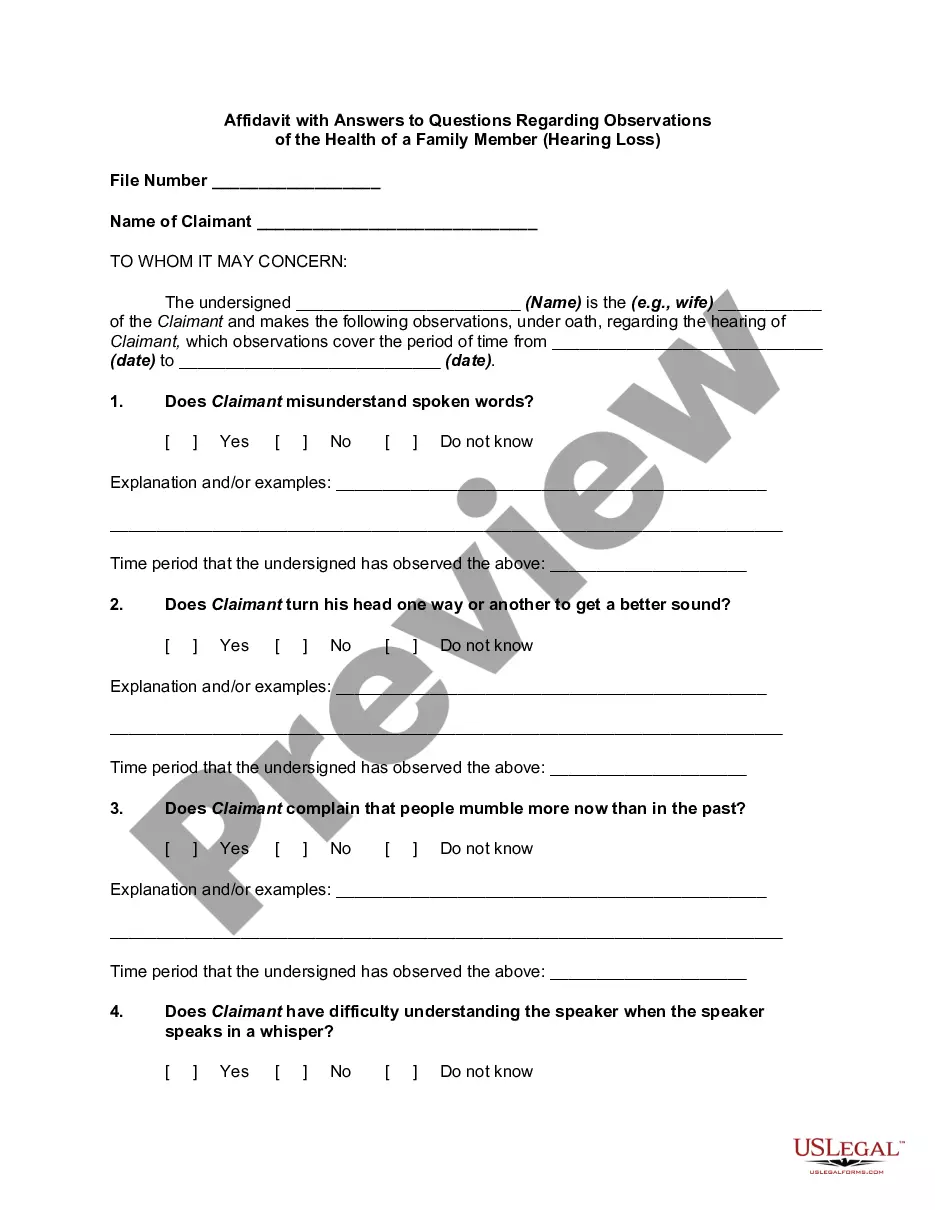
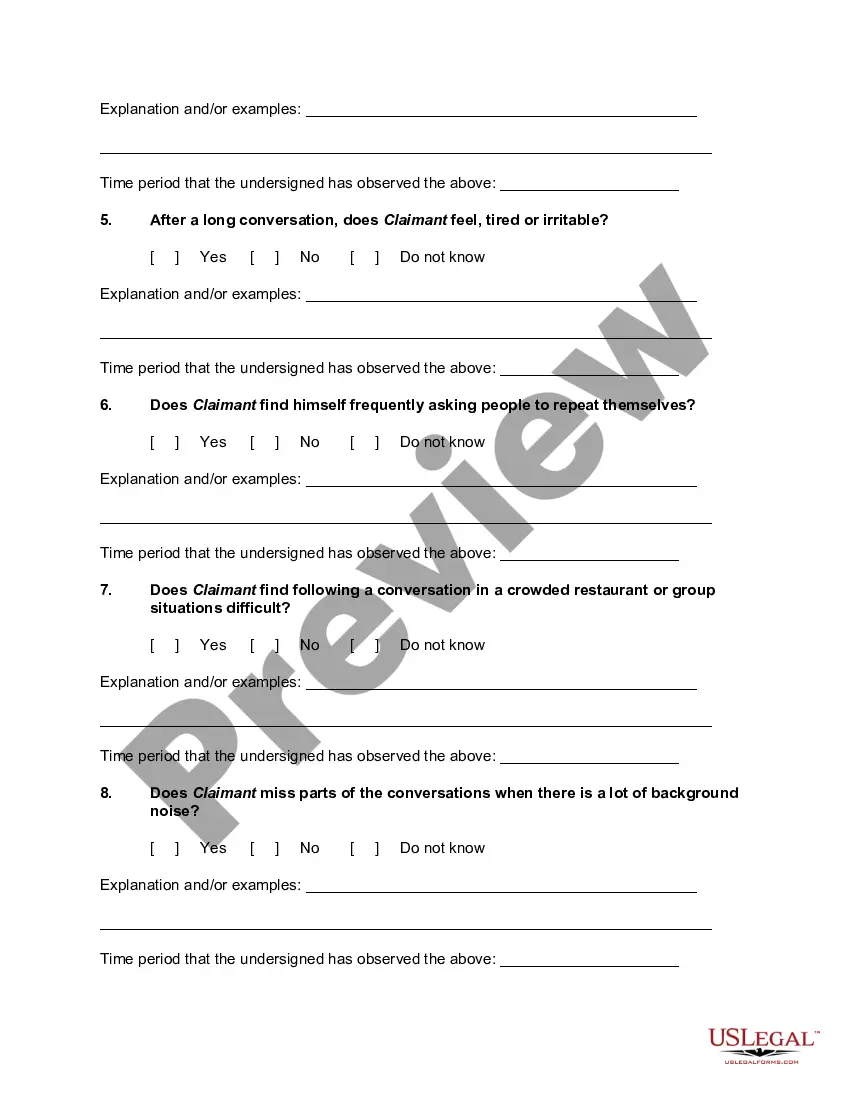
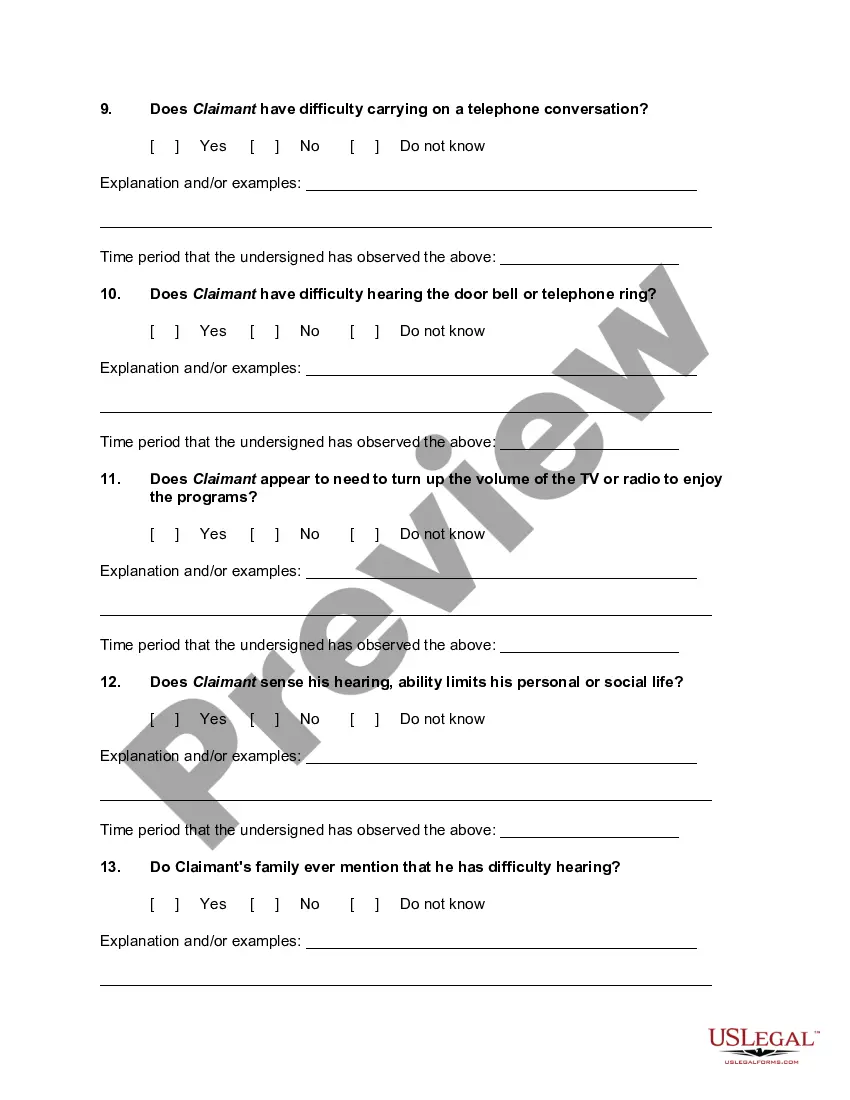
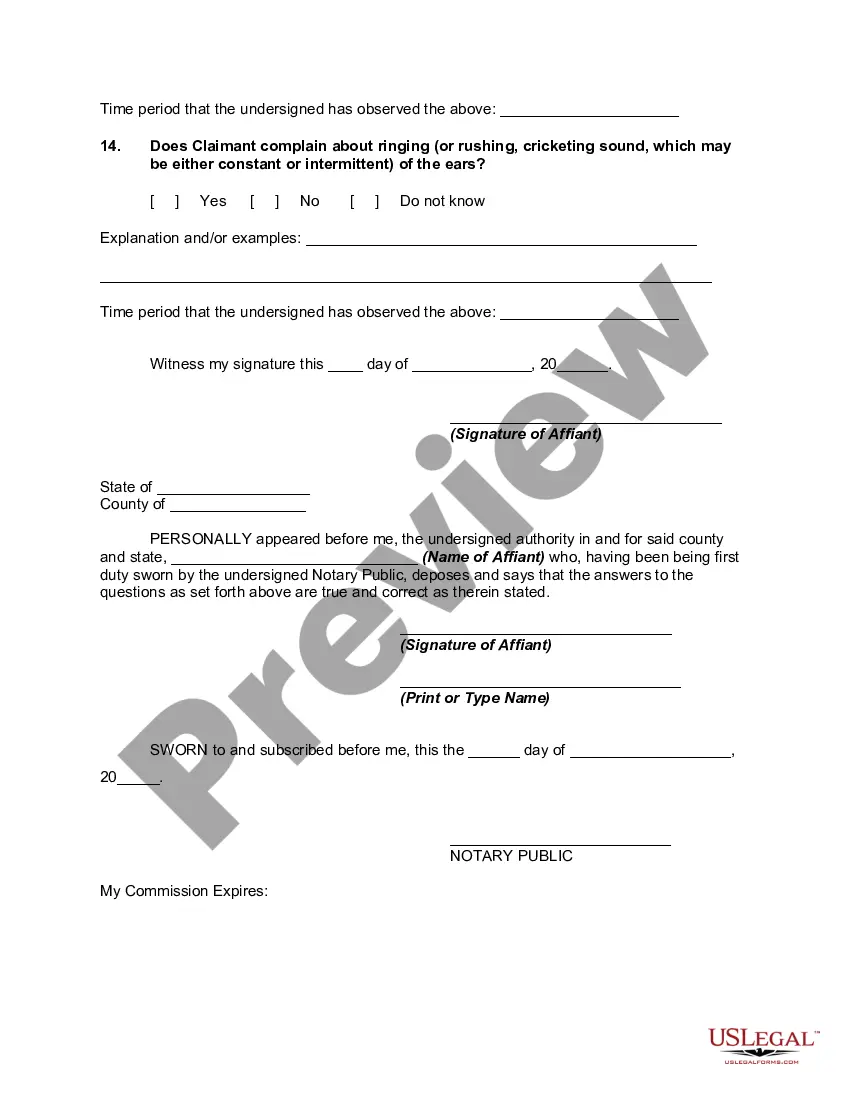
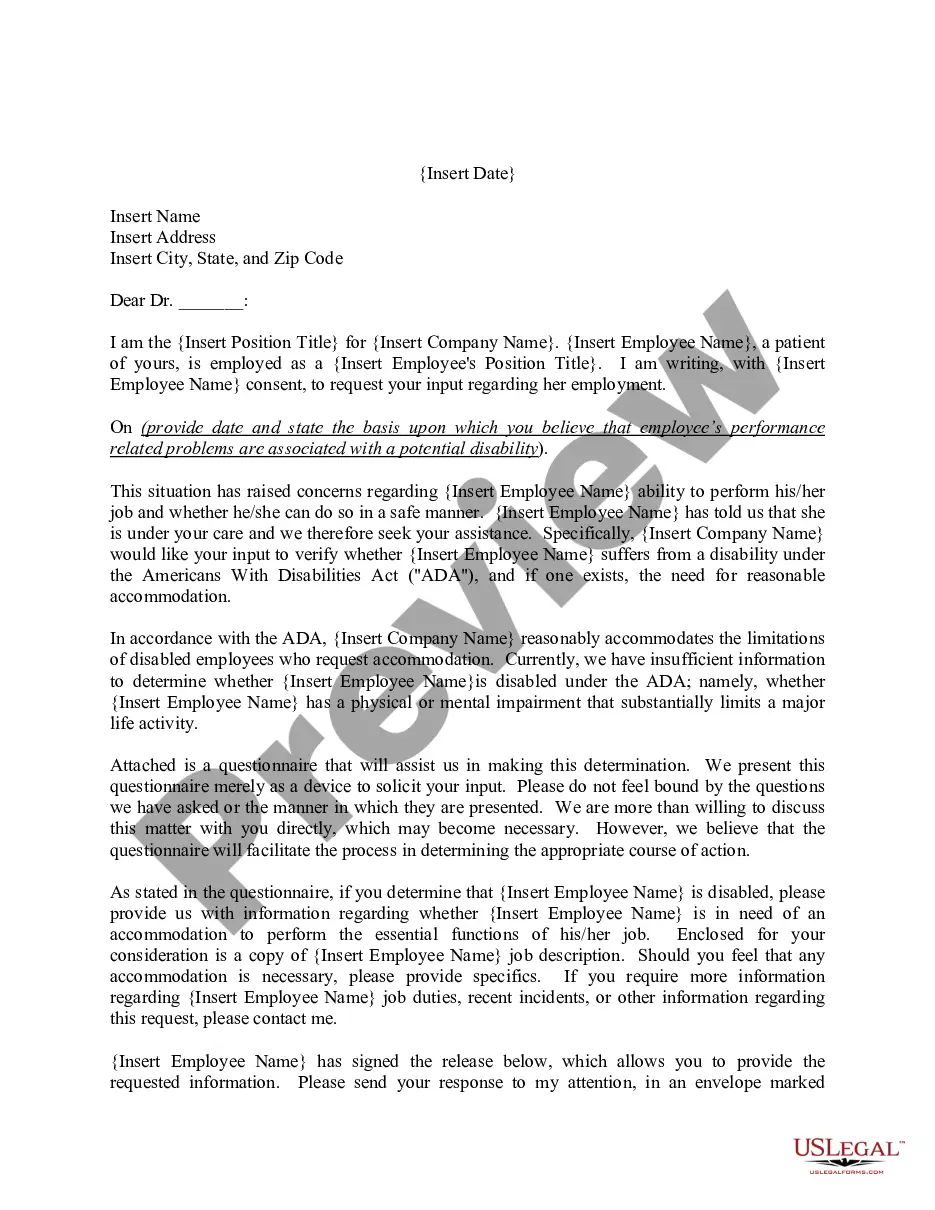
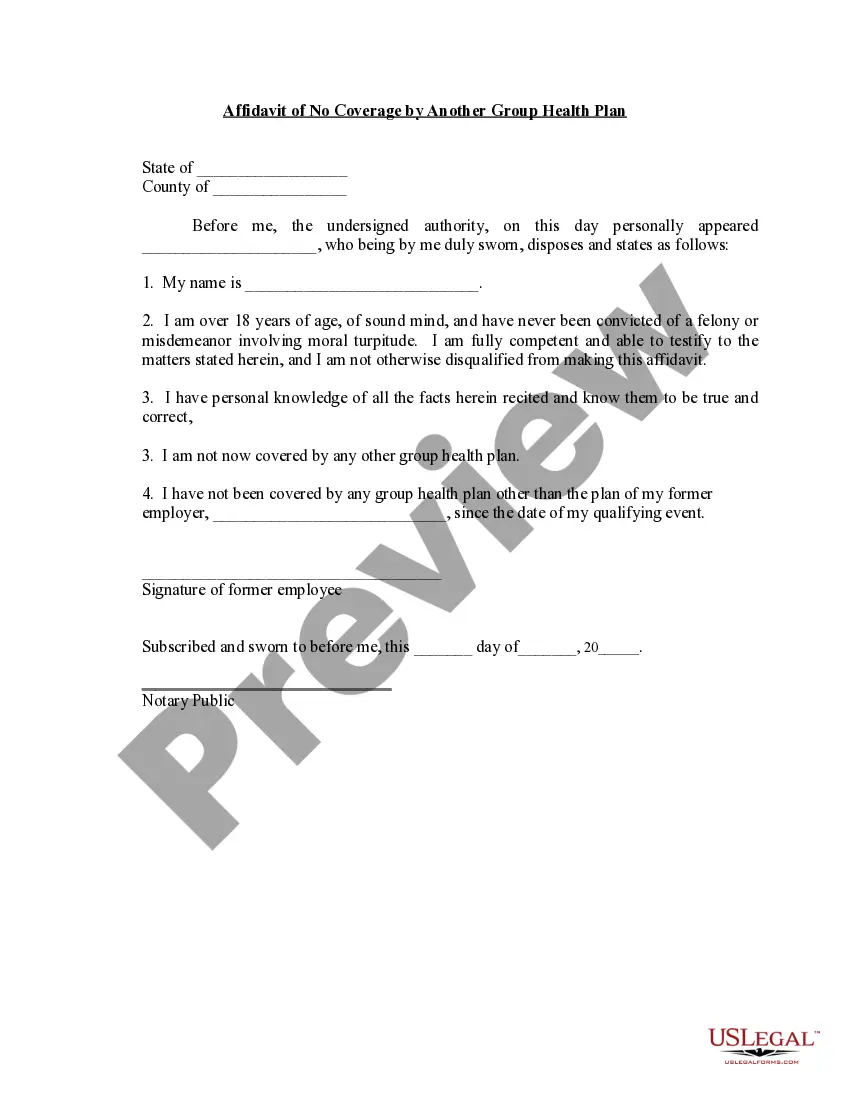
An affidavit is statement of facts which is sworn to (or affirmed) before an officer who has authority to administer an oath (e.g. a notary public). The person making the signed statement (affiant) takes an oath that the contents are, to the best of their knowledge, true. It is also signed by a notary or some other judicial officer that can administer oaths, affirming that the person signing the affidavit was under oath when doing so. This form is a generic example that may be referred to when preparing such a form for your particular state. It is for illustrative purposes only. Local laws should be consulted to determine any specific requirements for such a form in a particular jurisdiction
Idaho Affidavit with Answers to Questions Regarding Observations of the Health of a Family Member - Hearing Loss
48 downloads
Description
Free preview

Get your form ready online
Our built-in tools help you complete, sign, share, and store your documents in one place.
Built-in online Word editor
Make edits, fill in missing information, and update formatting in US Legal Forms—just like you would in MS Word.
Export easily
Download a copy, print it, send it by email, or mail it via USPS—whatever works best for your next step.
E-sign your document
Sign and collect signatures with our SignNow integration. Send to multiple recipients, set reminders, and more. Go Premium to unlock E-Sign.
Notarize online 24/7
If this form requires notarization, complete it online through a secure video call—no need to meet a notary in person or wait for an appointment.
Store your document securely
We protect your documents and personal data by following strict security and privacy standards.

Make edits, fill in missing information, and update formatting in US Legal Forms—just like you would in MS Word.

Download a copy, print it, send it by email, or mail it via USPS—whatever works best for your next step.

Sign and collect signatures with our SignNow integration. Send to multiple recipients, set reminders, and more. Go Premium to unlock E-Sign.

If this form requires notarization, complete it online through a secure video call—no need to meet a notary in person or wait for an appointment.

We protect your documents and personal data by following strict security and privacy standards.
Looking for another form?

How to fill out Affidavit With Answers To Questions Regarding Observations Of The Health Of A Family Member - Hearing Loss?
Selecting the appropriate legal document template can be quite challenging. Clearly, there is a multitude of online templates accessible on the web, but how can you find the legal type you require? Utilize the US Legal Forms website. The service provides an extensive array of templates, including the Idaho Affidavit with Responses to Inquiries Concerning Observations of a Family Member's Health - Hearing Loss, which can be used for business and personal purposes. All the forms are reviewed by experts and comply with state and federal regulations.
If you are currently registered, Log In to your account and click on the Download button to obtain the Idaho Affidavit with Responses to Inquiries Concerning Observations of a Family Member's Health - Hearing Loss. Use your account to review the legal forms you may have purchased previously. Navigate to the My documents section of your account and retrieve another copy of the document you require.
If you are a new user of US Legal Forms, here are simple steps for you to follow: First, ensure you have selected the correct type for the city/county. You can browse the form using the Preview button and read the form description to confirm it is suitable for you. If the form does not meet your requirements, use the Search area to find the appropriate form. Once you are certain that the form is suitable, click the Get now button to obtain the form. Choose the pricing plan you desire and enter the necessary information. Create your account and complete the transaction using your PayPal account or credit card. Select the file format and download the legal document template to your device. Complete, modify, and print and sign the obtained Idaho Affidavit with Responses to Inquiries Concerning Observations of a Family Member's Health - Hearing Loss.
Utilize US Legal Forms to acquire properly designed legal documents that meet state specifications.
- US Legal Forms is the largest collection of legal forms where you can find a variety of document templates.
- Use the service to obtain well-crafted documents that adhere to state requirements.
- All templates available have been vetted for compliance.
- You can easily access your previous purchases through your account.
- The platform offers a wide range of legal document types.
- Ensure to select forms specific to your location for best results.
Form popularity
FAQ
Untreated hearing loss may affect your social life, lower your quality of life and cause mental anguish. Hearing aids do not cure hearing loss, but in most cases they can help hearing impaired people live normal lives. For many hearing impaired people hearing aids open up a whole new world.
Let your family and friends know you have a hearing problem. Ask people to face you and to speak louder and more clearly. Ask them to repeat themselves or reword what they're saying. Pay attention to what is being said and to facial expressions or gestures.
Stage 4: Severe hearing loss Severe, or stage 4, hearing loss is the diagnosis when the quietest sounds you can detect fall between 65 and 79 dB. With severe hearing loss, you need strong hearing aids to navigate daily life since this stage is considered very hard of hearing.
For some people, power hearing aids might not be the best option. Other treatments for severe-to-profound hearing loss include bone-anchored hearing systems and cochlear implants. Contrary to common perception, cochlear implants can be used in older adults.
Hearing Loss Ranges (in decibels) There are different levels of hearing loss. Some forms of hearing loss can be treated with a hearing aid. If your hearing falls into the 26-70 dB range (mild to moderate), a hearing aid can be very effective in restoring sounds for your daily life.
Mild hearing loss: Hearing loss of 20 to 40 decibels. Moderate hearing loss: Hearing loss of 41 to 60 decibels. Severe hearing loss: Hearing loss of 61 to 80 decibels. Profound hearing loss or deafness: Hearing loss of more than 81 decibels.
Speak clearly, slowly, distinctly, but naturally, without shouting or exaggerating mouth movements. Shouting distorts the sound of speech and may make speech reading more difficult. Say the person's name before beginning a conversation.
Degrees of Hearing Loss Degrees of Hearing LossHearing Threshold in Decibels (dB)Mild Hearing Loss25-40 dBModerate Hearing Loss40-60 dBSevere Hearing Loss60-80 dBSevere-to-Profound Hearing Loss80-90 dB2 more rows
Not every person with hearing loss can receive a cochlear implant. Good candidates are patients who are deaf, have moderate-to-profound hearing loss in both ears, or have profound and severe hearing loss in one ear.
Many people with hearing loss experience a drop in self-esteem and confidence because of their impaired ability to communicate with other people. Having hearing loss can also limit one's ability to learn to speak a new language.