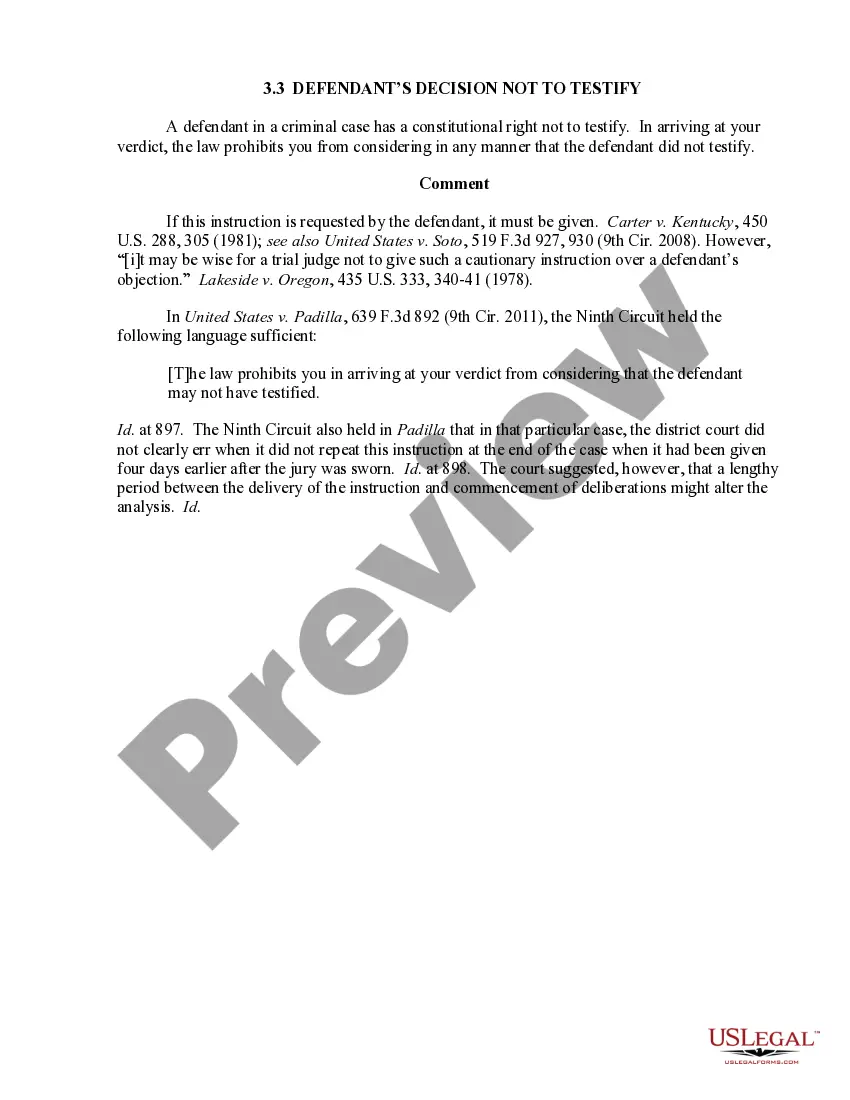
Idaho Jury Instructions - Defendant's Failure to Testify
Description
Get your form ready online
Our built-in tools help you complete, sign, share, and store your documents in one place.
Make edits, fill in missing information, and update formatting in US Legal Forms—just like you would in MS Word.
Download a copy, print it, send it by email, or mail it via USPS—whatever works best for your next step.
Sign and collect signatures with our SignNow integration. Send to multiple recipients, set reminders, and more. Go Premium to unlock E-Sign.
If this form requires notarization, complete it online through a secure video call—no need to meet a notary in person or wait for an appointment.
We protect your documents and personal data by following strict security and privacy standards.

Make edits, fill in missing information, and update formatting in US Legal Forms—just like you would in MS Word.

Download a copy, print it, send it by email, or mail it via USPS—whatever works best for your next step.

Sign and collect signatures with our SignNow integration. Send to multiple recipients, set reminders, and more. Go Premium to unlock E-Sign.

If this form requires notarization, complete it online through a secure video call—no need to meet a notary in person or wait for an appointment.

We protect your documents and personal data by following strict security and privacy standards.
Looking for another form?
How to fill out Jury Instructions - Defendant's Failure To Testify?
Have you ever found yourself in a situation where you need documents for both professional or personal purposes almost all the time.
There are many legitimate document templates accessible online, but locating ones you can trust is not easy.
US Legal Forms provides thousands of form templates, such as the Idaho Jury Instructions - Defendant's Failure to Testify, that are designed to comply with state and federal regulations.
Once you find the correct form, click on Acquire now.
Choose the pricing plan you prefer, fill out the required information to create your account, and make the purchase using your PayPal or Visa or Mastercard.
- If you are already familiar with the US Legal Forms website and have an account, simply Log In.
- Then, you can download the Idaho Jury Instructions - Defendant's Failure to Testify template.
- If you do not have an account and wish to start using US Legal Forms, follow these steps.
- Find the form you need and ensure it is for the correct state/region.
- Utilize the Review button to evaluate the form.
- Check the description to confirm that you have selected the right form.
- If the form is not what you are looking for, use the Search field to find the form that meets your needs.
Form popularity
FAQ
A party must persuade you, by the evidence presented in court, that what he or she is required to prove is more likely to be true than not true. This is referred to as "the burden of proof."
When a party has the burden of proving any claim [or affirmative defense] by a preponderance of the evidence, it means you must be persuaded by the evidence that the claim [or affirmative defense] is more probably true than not true.
Your duty as a juror is to listen to the judge, witness and attorneys; to deliberate calmly and fairly; and to decide intelligently and justly. Your decision must be made upon the evidence presented to you in court. be informed of the trial process and of the applicable law.
(a) Disqualification of Judge Without Cause. In any felony or misdemeanor criminal action, excluding actions before drug courts or mental health courts, any party may disqualify one judge by filing a motion for disqualification without stating any grounds, and the motion must be granted if timely filed.
Proof beyond a reasonable doubt is proof that leaves you firmly convinced the defendant is guilty. It is not required that the government prove guilt beyond all possible doubt. A reasonable doubt is a doubt based upon reason and common sense and is not based purely on speculation.
The burden of proof is a legal standard that requires parties to provide evidence to demonstrate that a claim is valid. Three levels of the burden of proof, "beyond a reasonable doubt," a "preponderance of the evidence," and "clear and convincing" determine the level of evidence required for a claim.
There are three burdens of proof that exist for most cases: proof beyond a reasonable doubt, clear and convincing evidence, and preponderance of the evidence.
The judge instructs the jury about the relevant laws that should guide its deliberations. (In some jurisdictions, the court may instruct the jury at any time after the close of evidence. This sometimes occurs before closing arguments.) The judge reads the instructions to the jury.