Iowa Pre-Purchase Recommendations - Horse Equine Forms
What this document covers
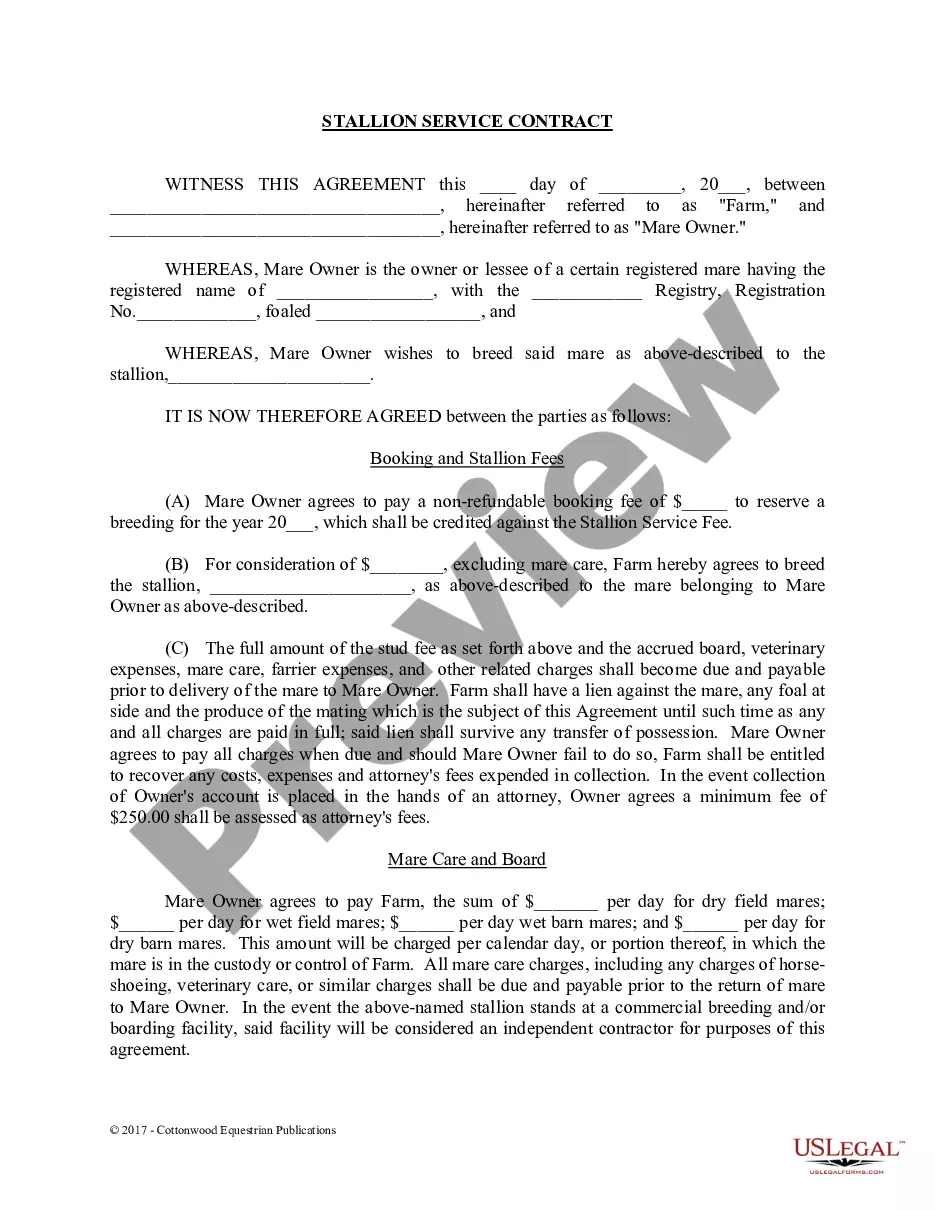
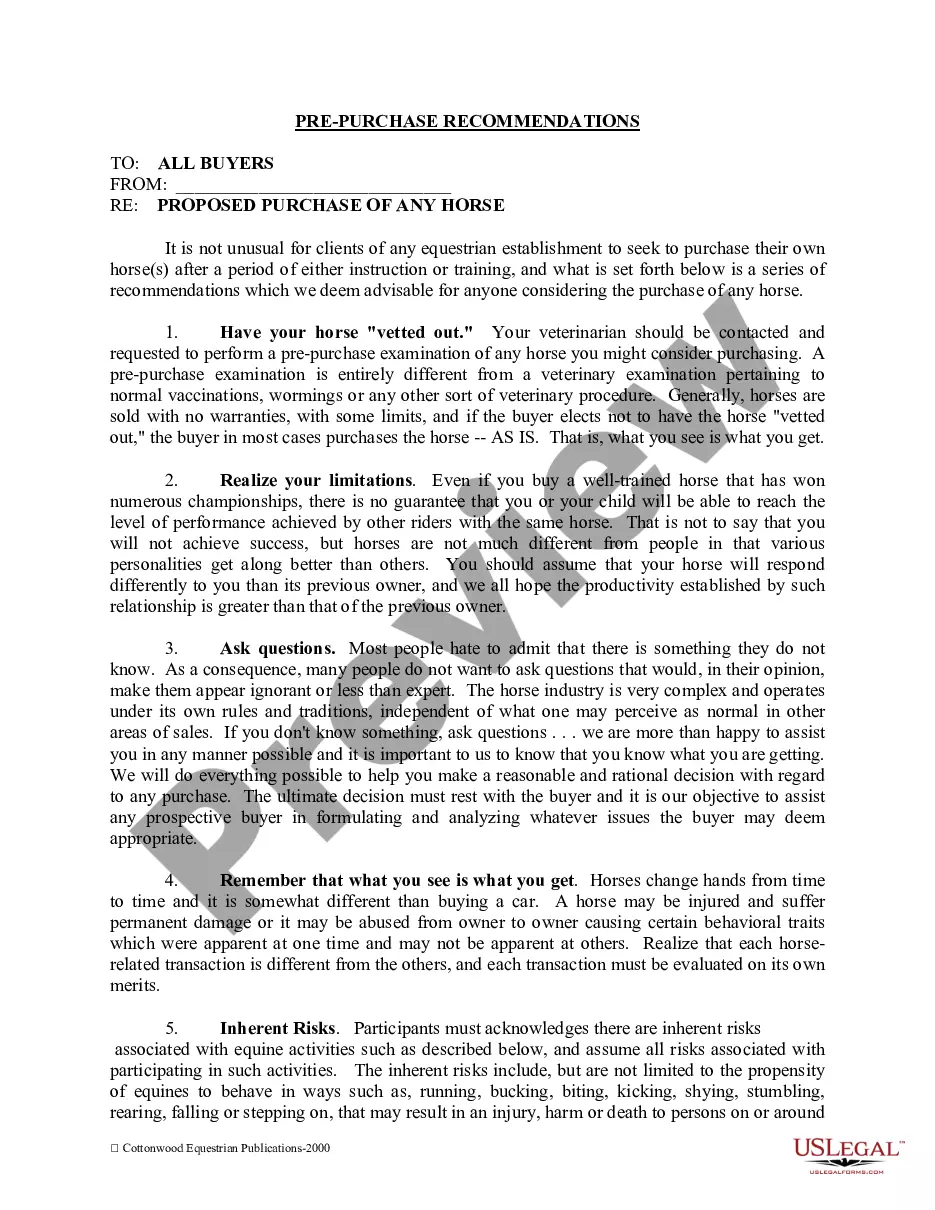
The Pre-Purchase Recommendations form is a useful document for prospective horse buyers. It provides essential advice and considerations that should be taken into account before making a purchase. This form is distinct from purchase agreements or contracts, as it focuses solely on guiding the buyer through the decision-making process and ensuring they are well-informed about the considerations involved in acquiring a horse.
Main sections of this form
- Recommendation for a pre-purchase veterinary examination.
- Advice on the buyer's limitations and the importance of compatibility with the horse.
- Encouragement to ask questions about the horse and transaction.
- Warning regarding the "as is" nature of horse sales.
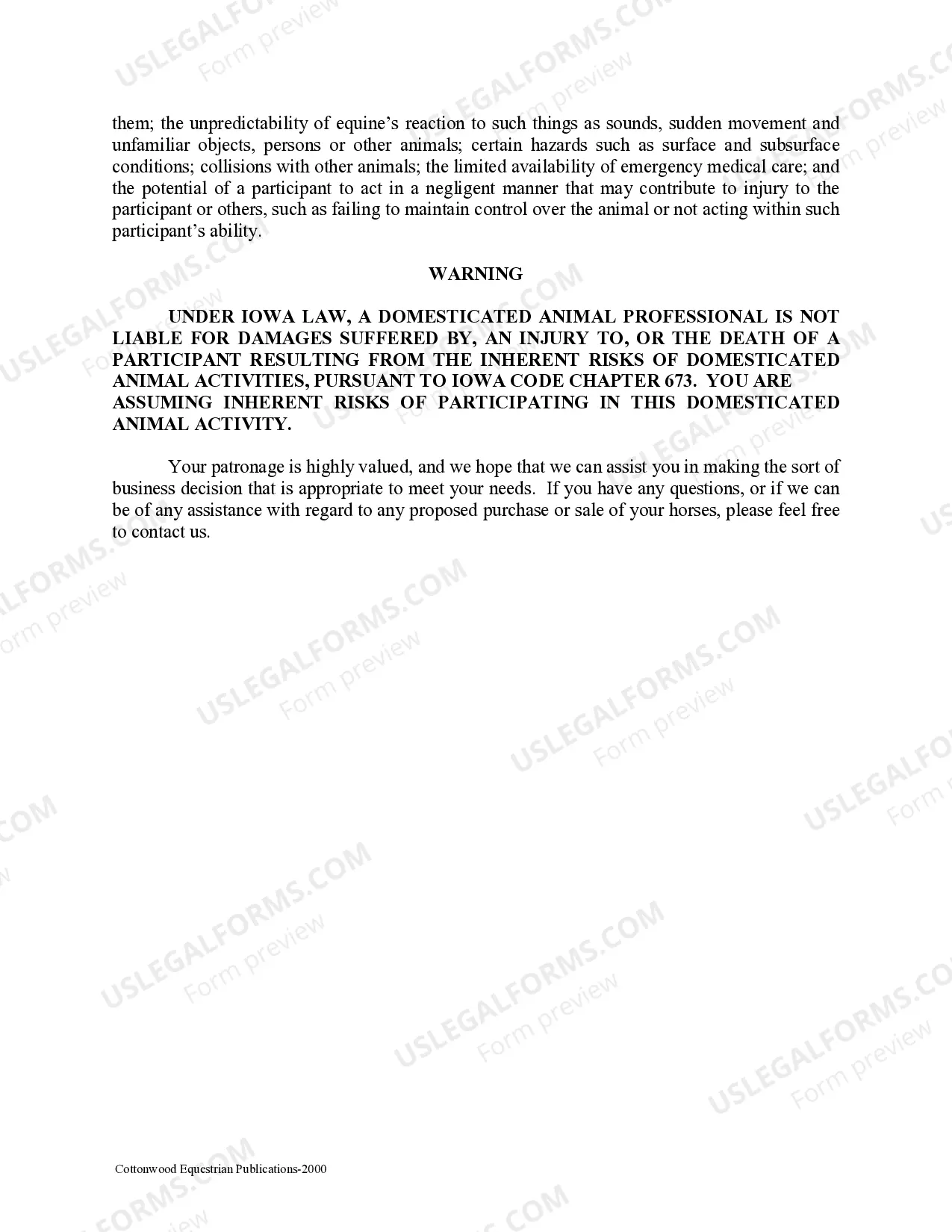
- Disclosure of the inherent risks associated with equine activities.
When to use this form
This form should be used when you are considering the purchase of a horse. It is particularly relevant when you want to ensure that you make an informed decision, understand the risks involved, and take steps to protect yourself and your investment. Utilizing this form can help clarify your thoughts and prepare you for discussions with sellers and veterinarians.
Who can use this document
- Individuals planning to purchase a horse for personal use or competitive riding.
- First-time horse buyers seeking guidance and recommendations.
- Experienced equestrians looking for a refresher on pre-purchase considerations.
- Horse trainers assisting clients with potential purchases.
How to prepare this document
- Fill in your name and contact information at the start of the form.
- Clearly state the horse's details, including its name and any identifying information.
- Review each recommendation carefully and take notes as necessary.
- Consider including questions or additional advice you want to address regarding the purchase.
- Sign and date the document to acknowledge your understanding of the recommendations provided.
Does this form need to be notarized?
In most cases, this form does not require notarization. However, some jurisdictions or signing circumstances might. US Legal Forms offers online notarization powered by Notarize, accessible 24/7 for a quick, remote process.
Get your form ready online
Our built-in tools help you complete, sign, share, and store your documents in one place.
Make edits, fill in missing information, and update formatting in US Legal Forms—just like you would in MS Word.
Download a copy, print it, send it by email, or mail it via USPS—whatever works best for your next step.
Sign and collect signatures with our SignNow integration. Send to multiple recipients, set reminders, and more. Go Premium to unlock E-Sign.
If this form requires notarization, complete it online through a secure video call—no need to meet a notary in person or wait for an appointment.
We protect your documents and personal data by following strict security and privacy standards.

Make edits, fill in missing information, and update formatting in US Legal Forms—just like you would in MS Word.

Download a copy, print it, send it by email, or mail it via USPS—whatever works best for your next step.

Sign and collect signatures with our SignNow integration. Send to multiple recipients, set reminders, and more. Go Premium to unlock E-Sign.

If this form requires notarization, complete it online through a secure video call—no need to meet a notary in person or wait for an appointment.

We protect your documents and personal data by following strict security and privacy standards.
Avoid these common issues
- Not obtaining a veterinary examination before purchasing.
- Failing to ask important questions due to embarrassment or lack of knowledge.
- Assuming previous training will translate to similar success with a new owner.
- Overlooking the importance of compatibility between the horse and the rider.
Why complete this form online
- Immediate access to crucial recommendations and advice.
- The ability to customize the form to your specific needs and circumstances.
- Convenient download option for easy record-keeping and sharing.
- Reliable information drafted by licensed attorneys with expertise in equine law.
Legal use & context
- This form serves as a precautionary measure for buyers, creating awareness of potential risks.
- Your signed acknowledgment of these recommendations may assist in liability matters later.
- It is important to understand that recommendations do not provide any warranties or guarantees about the horse.
What to keep in mind
- The form provides crucial recommendations for anyone buying a horse.
- It is important to vet horses and understand their health status before purchase.
- Understanding your own abilities and asking questions is essential in the buying process.
- Be aware of the legal implications and risks involved in owning a horse.
Looking for another form?


Form popularity
FAQ
Stage 1: Preliminary examination. Stage 2: Walk and trot, in hand. Stage 3: Exercise phase. Stage 4: Period of rest and re-examination. Stage 5: Second trot up.
Since the type of horse and reason for purchase varies so much, the cost is also just as broad. The cost can range from a couple of hundred dollars to several thousands of dollars. For regular recreational use, the average cost is around $3,000, according to the University of Maine.
The Price Tag The price of a basic pre-purchase exam will vary from one veterinary practice to another, but in general you can expect to pay from $250 to $500. It's a good idea to ask the veterinarian the base cost up front.
There are five main criteria to evaluate when examining a horse's conformation: balance, structural correctness, way of going, muscling, and breed/sex character (also known as type). Balance is arguably the most critical aspect to evaluate when examining the horse.
Together with your experienced advisor, look at the horse's teeth to check the age, do a thorough conformation check, feel the legs, look at the feet (ask the owner to pick up the feet), ask about the farrier, notice any lumps and bumps and query them. If the horse passes your inspection, ask to see it ridden.
It includes an examination of the incisor teeth, a thorough examination of the horse's eyes in a darkened area and auscultation of the horse's heart and lungs at rest. Examination of the eyes does not include dilating the pupil but will include examination of internal and external structures.
So whats the difference? The simple answer is the exercise phase. A stage 2 vetting includes a thorough examination of the horse at rest, which includes eyes, heart, lungs, conformation, teeth and skin.The 5 stage vetting goes on to see the horse exercised.
Step 1 Date and Parties. Enter the date in which the document is being created. Step 2 Horse Description. Horse's Name (if named) Step 3 Purchase Price Information. Step 4 Security Deposit. Step 5 Signatures. Step 6 Acknowledgement of Notary Public.
General. How long have you owned this horse? Health. Have they ever had an injury? Riding. What level rider do they need? Training. Does the horse load easily? Care. What is their current living situation? Feed. What feed and supplements is the horse on now? Hooves. Have their hooves been trimmed regularly? Breeding (mare)