Georgia 30 Day Notice to Terminate At-Will Lease from Tenant to Landlord
Overview of this form
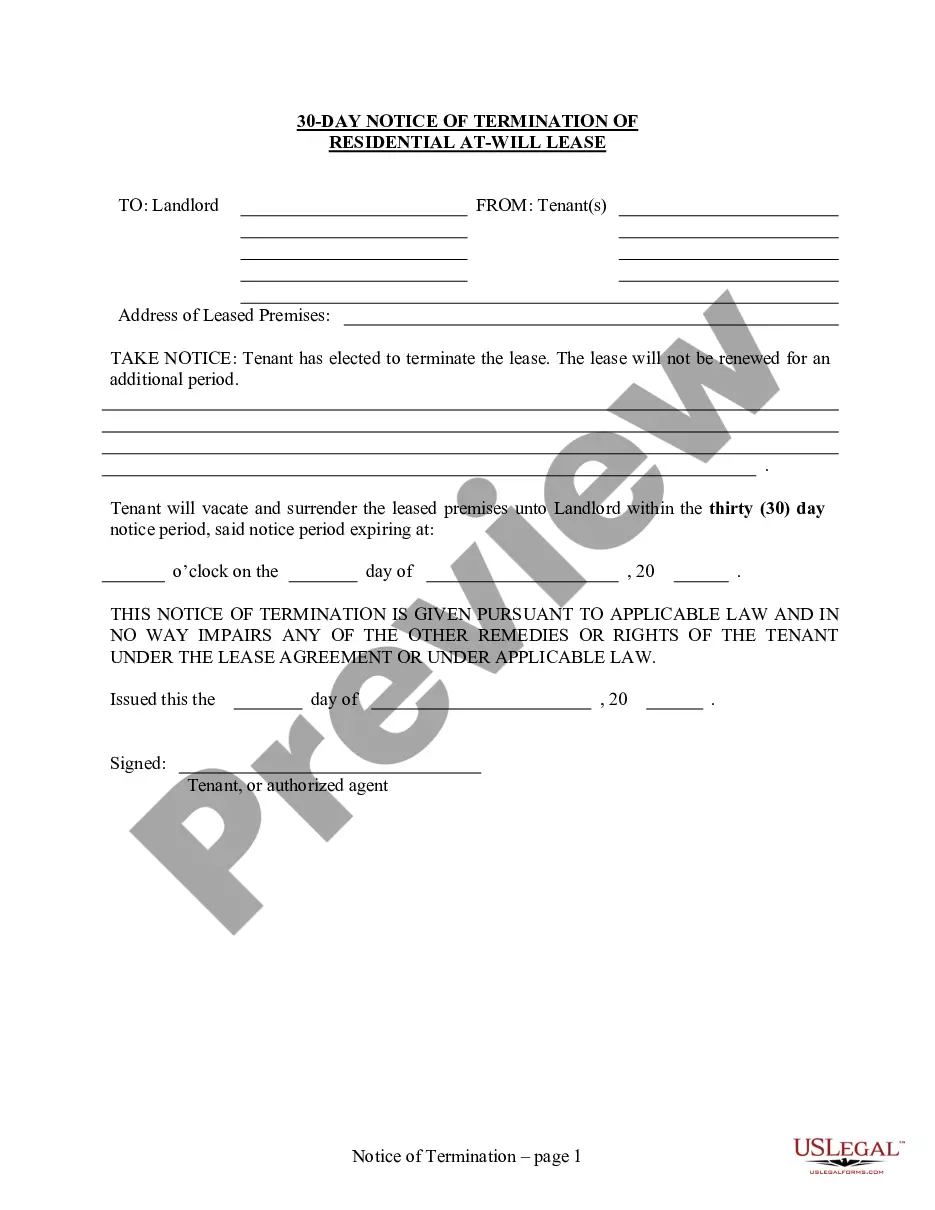
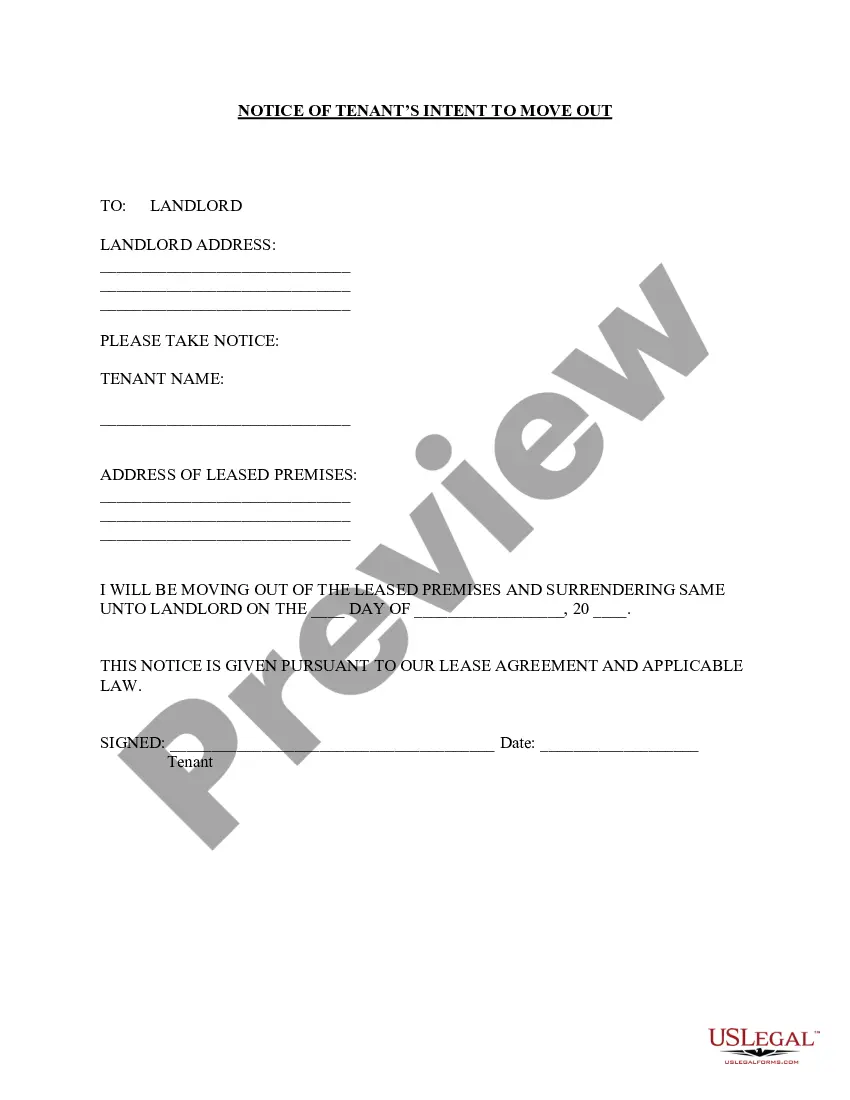
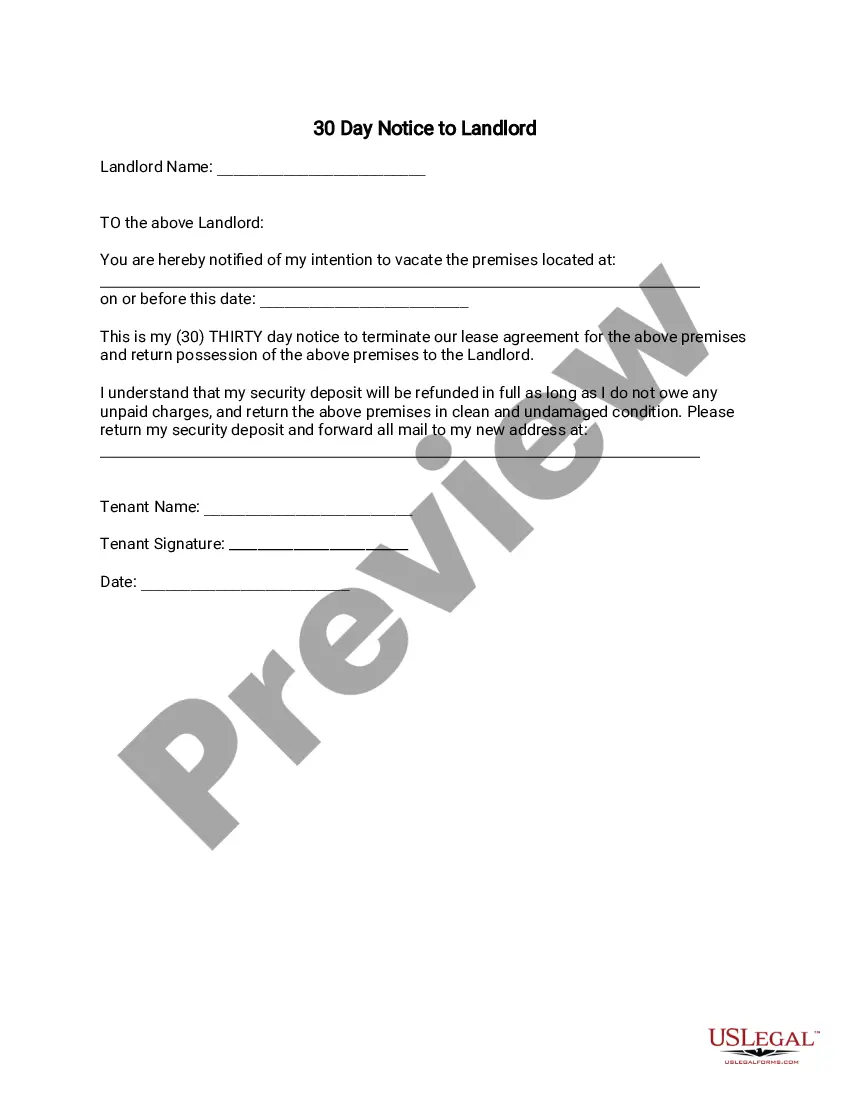
The 30 Day Notice to Terminate at-Will Lease from Tenant to Landlord is a legal document used by tenants to formally end an at-will lease agreement. This type of lease continues until either the landlord or tenant decides to terminate it. Providing this notice allows the lease to terminate thirty days after it is delivered, ensuring both parties are aware of the intent to end the rental agreement.
Form components explained
- Identification of the tenant and landlord
- Address of the leased premises
- Statement of lease termination and notice period
- Signatures of the tenant or authorized agent
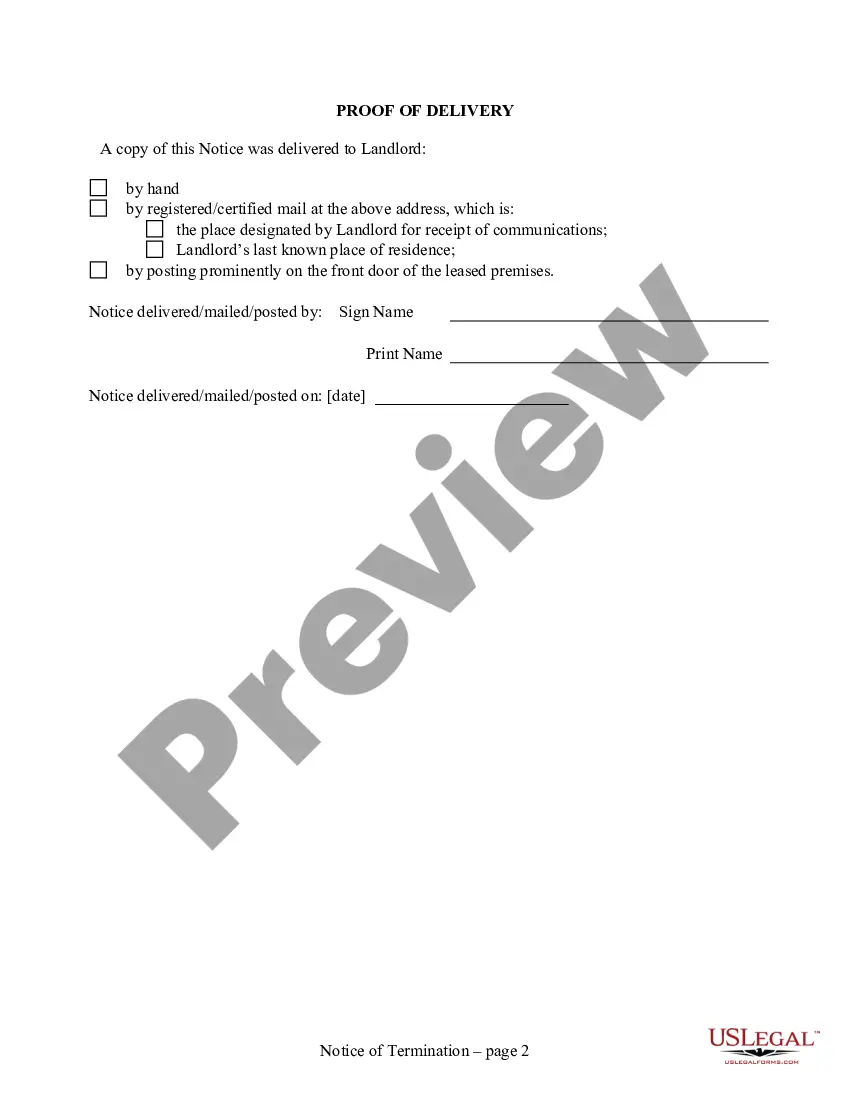
- Proof of delivery options
When to use this document
You should use this form when you, as a tenant, wish to terminate an at-will lease agreement. This is typically applicable in situations where you need to leave your rental property for personal reasons, such as relocating for a job, financial difficulties, or other personal circumstances. It is crucial to give your landlord formal notice to comply with legal requirements.
Intended users of this form
- Tenants currently in an at-will lease agreement
- Individuals looking to provide formal notice of lease termination
- Anyone seeking to ensure compliance with local rental laws
How to complete this form
- Identify the parties involved: Enter the names of both tenant(s) and landlord.
- Specify the property: Fill in the address of the leased premises.
- State your intention: Clearly indicate that you are terminating the lease.
- Enter the effective date: Include the date thirty days after the notice is served.
- Sign the form: Ensure it is signed by the tenant or an authorized agent.
- Choose a delivery method: Select one of the options for delivering the notice to the landlord.
Is notarization required?
In most cases, this form does not require notarization. However, some jurisdictions or signing circumstances might. US Legal Forms offers online notarization powered by Notarize, accessible 24/7 for a quick, remote process.
Get your form ready online
Our built-in tools help you complete, sign, share, and store your documents in one place.
Make edits, fill in missing information, and update formatting in US Legal Forms—just like you would in MS Word.
Download a copy, print it, send it by email, or mail it via USPS—whatever works best for your next step.
Sign and collect signatures with our SignNow integration. Send to multiple recipients, set reminders, and more. Go Premium to unlock E-Sign.
If this form requires notarization, complete it online through a secure video call—no need to meet a notary in person or wait for an appointment.
We protect your documents and personal data by following strict security and privacy standards.

Make edits, fill in missing information, and update formatting in US Legal Forms—just like you would in MS Word.

Download a copy, print it, send it by email, or mail it via USPS—whatever works best for your next step.

Sign and collect signatures with our SignNow integration. Send to multiple recipients, set reminders, and more. Go Premium to unlock E-Sign.

If this form requires notarization, complete it online through a secure video call—no need to meet a notary in person or wait for an appointment.

We protect your documents and personal data by following strict security and privacy standards.
Common mistakes to avoid
- Failing to provide the required thirty days' notice.
- Not delivering the notice in an acceptable manner.
- Forgetting to sign the form.
- Incorrectly filling in the property address.
Benefits of using this form online
- Convenient access to downloadable files for immediate use.
- Editability allows you to customize the form as needed.
- Reliability, as forms are drafted by licensed attorneys.
Legal use & context
- This form protects the tenant's rights by documenting the decision to terminate the lease.
- It helps avoid potential disputes by providing a clear timeline for vacating the property.
Quick recap
- The form allows tenants to legally terminate an at-will lease.
- Providing formal notice helps ensure compliance with local rental laws.
- It's essential to follow proper procedures for delivering this notice.
Looking for another form?
Form popularity
FAQ
Writing a termination of lease letter to your landlord includes specifying your intention to terminate, along with your contact details and the landlord's information. Clearly state the effective date of termination, ensuring it aligns with the 30-day notice period required under Georgia law. This letter serves as your formal Georgia 30 Day Notice to Terminate At-Will Lease from Tenant to Landlord.
To give a 30 day notice on a lease, write a formal letter that states your intent to terminate the lease. Include the date when the notice is given and the final date of occupancy. Providing a Georgia 30 Day Notice to Terminate At-Will Lease from Tenant to Landlord ensures that you've officially communicated your plans and helps avoid potential misunderstandings.
Writing a letter to remove someone from a lease involves drafting a clear document listing the tenant to be removed and stating your intent to update the lease agreement. This letter should also include the effective date for this change. If necessary, it could complement a Georgia 30 Day Notice to Terminate At-Will Lease from Tenant to Landlord to ensure compliance and clarity.
To write a termination notice letter to your landlord, start with your contact information and the date. Follow up with the landlord’s details, then clearly present your intention to terminate the lease. A well-structured 30 Day Notice to Terminate At-Will Lease from Tenant to Landlord will mention the term end date and be polite yet clear in your communication.
When writing a letter to your landlord to terminate a lease, begin with your personal information, then include the landlord's information. State clearly that you are providing a Georgia 30 Day Notice to Terminate At-Will Lease from Tenant to Landlord, and include the intended termination date. Make it formal and professional, and keep a copy for your records.
In Georgia, a 30 Day Notice does not have to be notarized to be effective. However, providing a notarized document may add an extra layer of assurance and proof of intent. Focus on delivering the notice correctly to comply with your rental agreement and Georgia's law related to the 30 Day Notice to Terminate At-Will Lease from Tenant to Landlord.
To terminate a tenancy at will in Georgia, you must provide written notice to your landlord. This notice should be a proper 30 Day Notice to Terminate At-Will Lease from Tenant to Landlord, clearly stating your intention to end the lease. Ensure that you deliver this notice in person or via a method that provides proof of delivery to ensure clarity and compliance.
To write a letter of termination of agreement, start with your name and address, then the landlord's name and address. Clearly state the date of your notice in the letter, followed by a direct mention of your intention to terminate the lease. For a proper Georgia 30 Day Notice to Terminate At-Will Lease from Tenant to Landlord, include the effective date of termination, and remember to keep a copy for your records.
Tenancies at-will can often lead to uncertainty for both tenants and landlords, as either party can terminate the agreement with a 30-day notice. This unpredictable nature may not provide the stability that some tenants desire. Furthermore, without a lease agreement, there are fewer protections in place. Understanding your rights, particularly through the Georgia 30 Day Notice to Terminate At-Will Lease from Tenant to Landlord, can better arm you against potential disadvantages.
To evict a tenant at-will in Georgia, you must follow the legal process which begins with providing the appropriate notice, typically a 30-day notice. If the tenant does not vacate after the notice period, you can file for eviction in court. This step is crucial when dealing with the Georgia 30 Day Notice to Terminate At-Will Lease from Tenant to Landlord. It’s wise to consult legal resources or platforms like uslegalforms to ensure you have the correct documentation.