Georgia Quitclaim Deed - Individual to a Trust
About this form
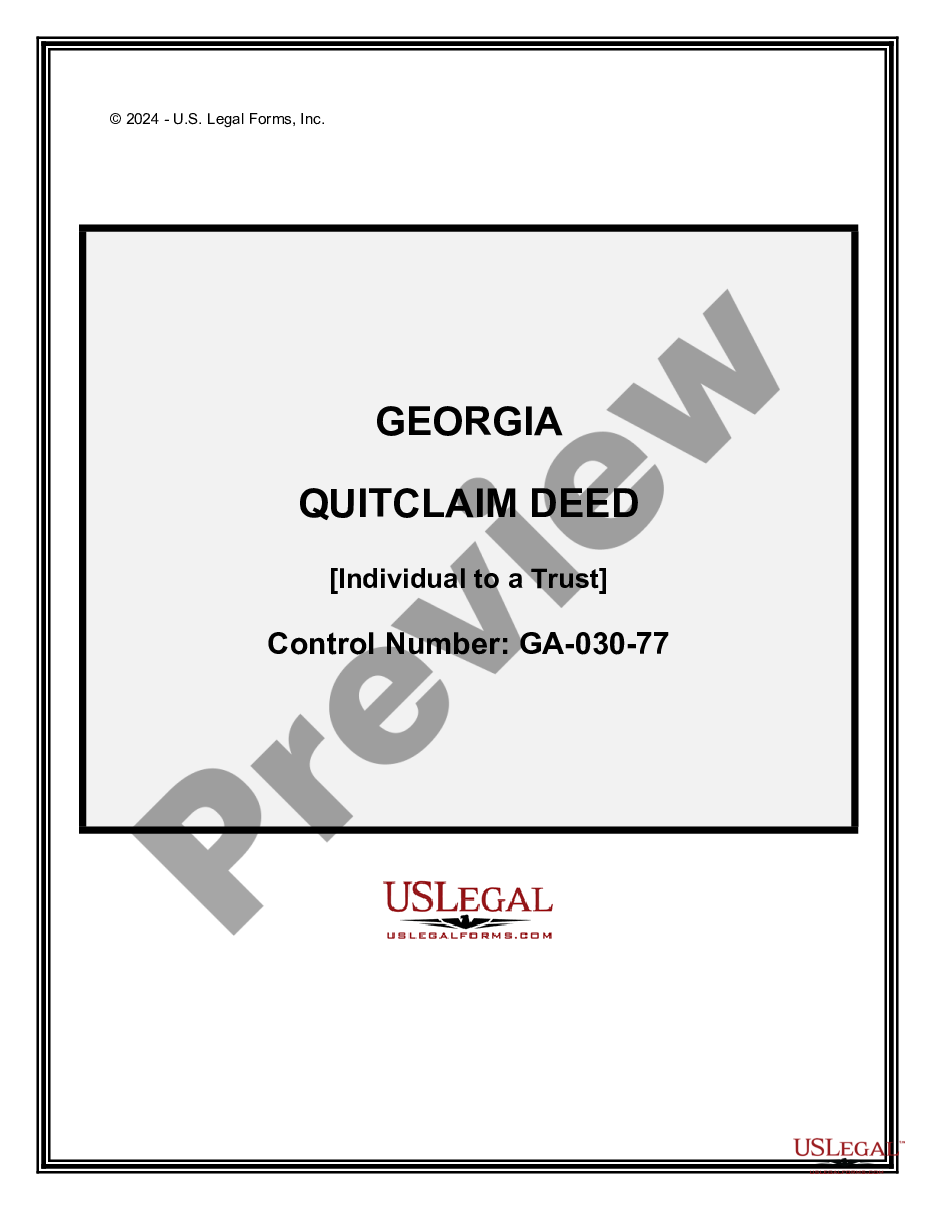
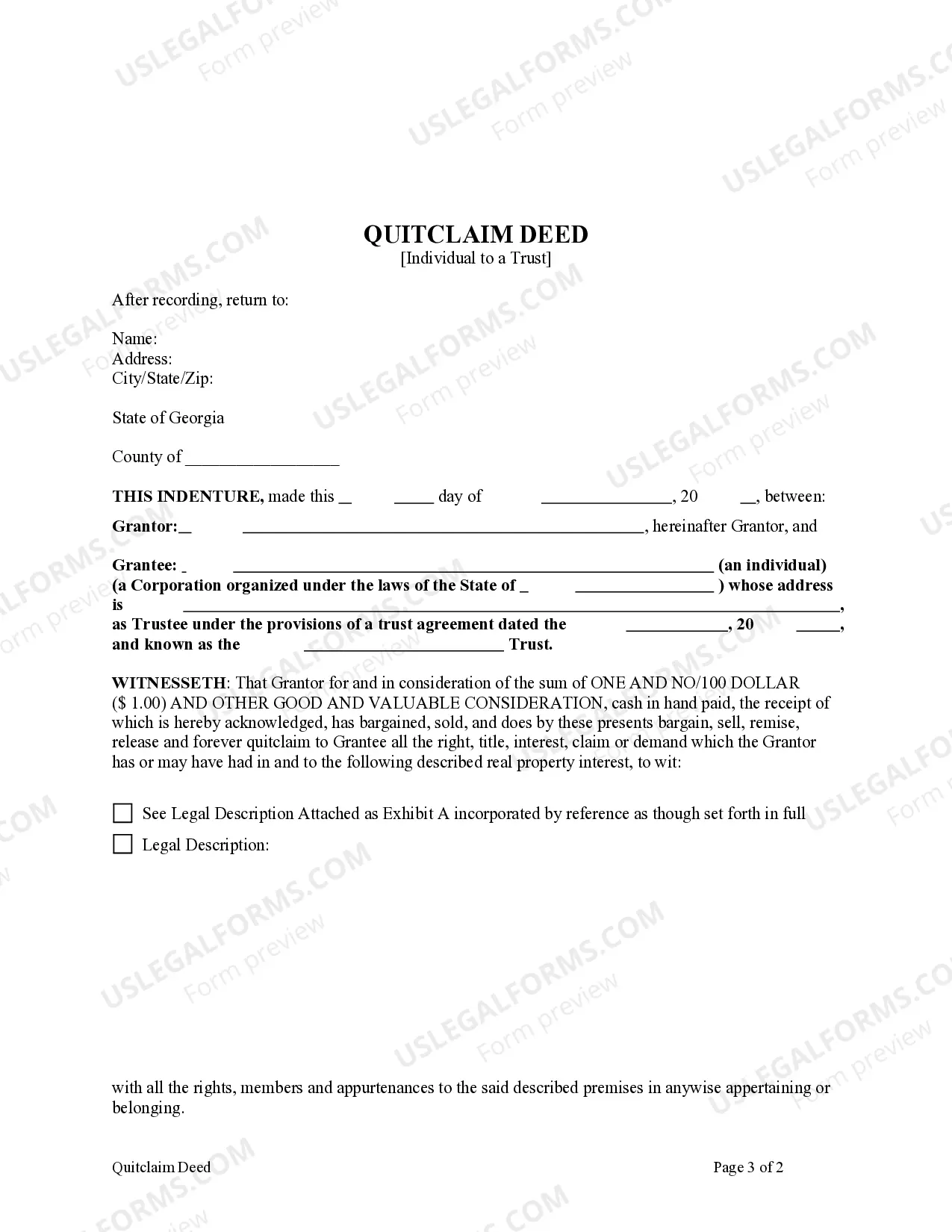
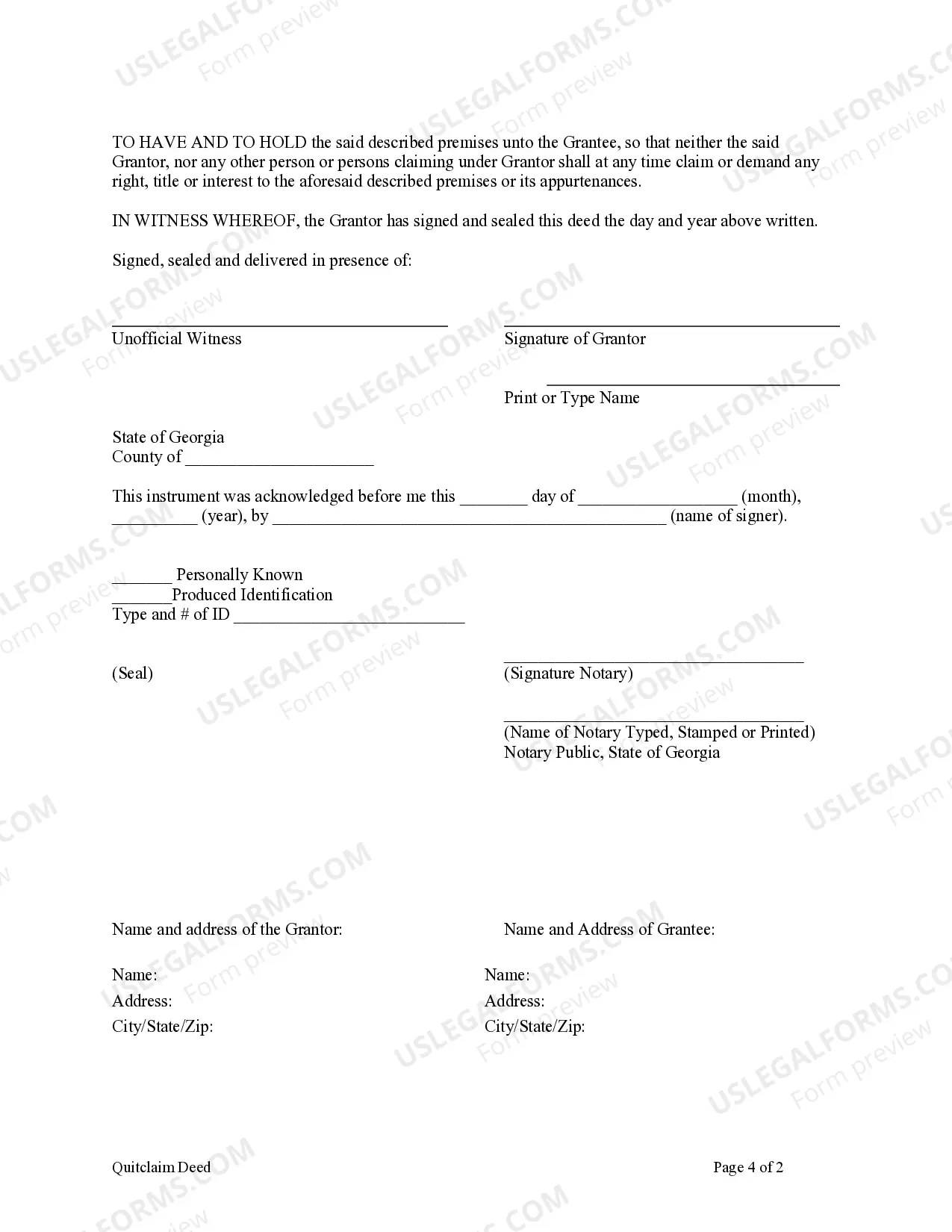
This form is a Quitclaim Deed used to transfer property ownership from an individual to a trust. Unlike warranty deeds, a quitclaim deed does not guarantee that the property is free from liens or claims. It simply conveys the Grantor's interest in the property to the Grantee, in this case, a trust.
Main sections of this form
- Identification of the Grantor (individual) transferring the property.
- Identification of the Grantee (trust) receiving the property.
- Legal description of the property being transferred.
- Signature of the Grantor to execute the deed.
- Requirements for witnesses and notary authorization.




Common use cases
This form is useful when an individual wishes to transfer property ownership to a trust, often for estate planning or asset protection purposes. It can be used when transferring a home, land, or any real estate property to ensure that the property is held within a trust framework.
Intended users of this form
This form is intended for:
- Individuals looking to transfer property they own into a trust.
- Trustees managing property on behalf of a trust.
- Estate planners seeking to streamline asset management.
Instructions for completing this form
- Identify the Grantor and provide their full name and address.
- Specify the name of the Grantee, ensuring it is the correct legal title of the trust.
- Include a legal description of the property being transferred.
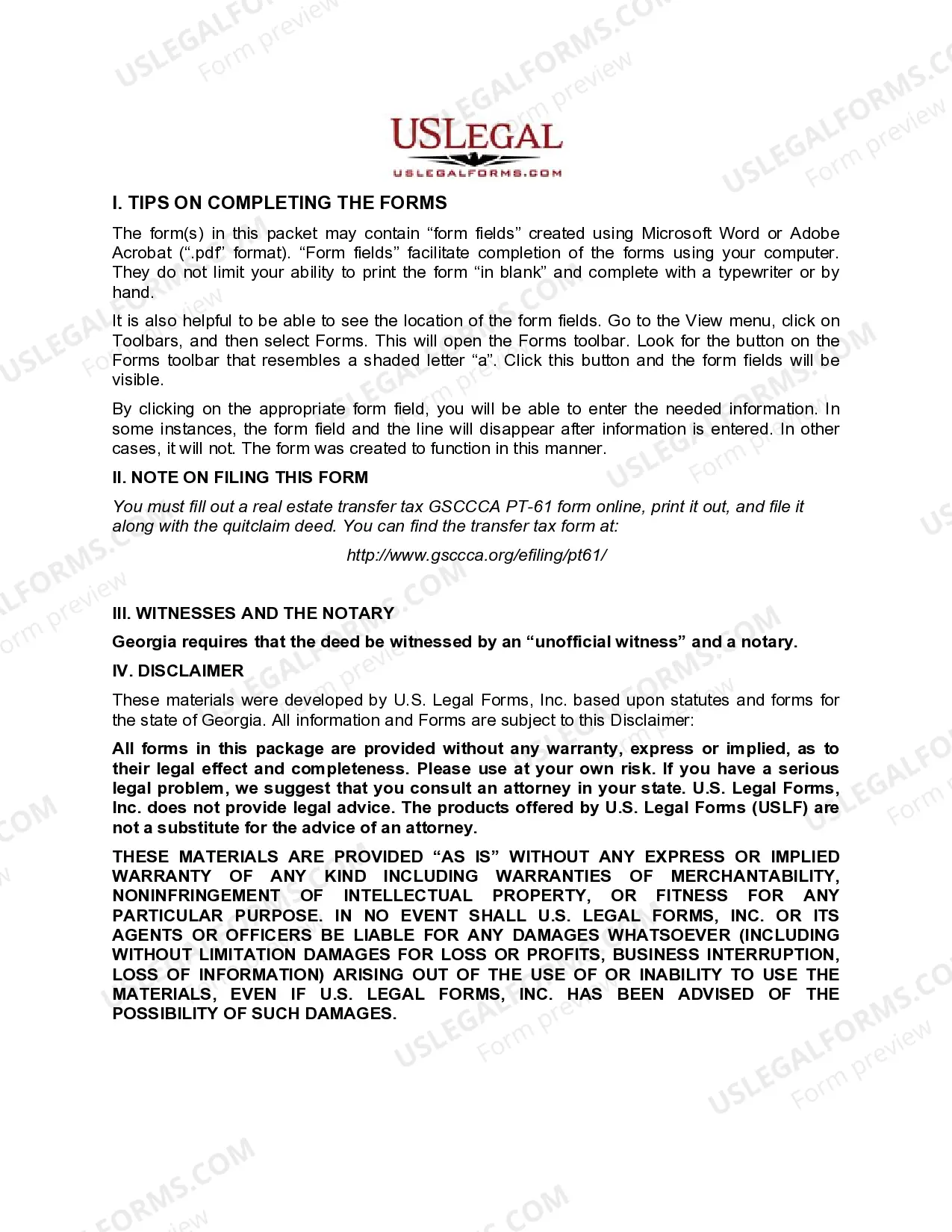
- Sign and date the deed in the presence of an unofficial witness and a notary public.
- File the quitclaim deed along with the required real estate transfer tax form.
Does this form need to be notarized?
Yes, this form must be notarized to be legally valid. Verifying the Signature of the Grantor through a notary creates an official record of the transaction, providing legal protection for both parties involved.
Get your form ready online
Our built-in tools help you complete, sign, share, and store your documents in one place.
Make edits, fill in missing information, and update formatting in US Legal Forms—just like you would in MS Word.
Download a copy, print it, send it by email, or mail it via USPS—whatever works best for your next step.
Sign and collect signatures with our SignNow integration. Send to multiple recipients, set reminders, and more. Go Premium to unlock E-Sign.
If this form requires notarization, complete it online through a secure video call—no need to meet a notary in person or wait for an appointment.
We protect your documents and personal data by following strict security and privacy standards.

Make edits, fill in missing information, and update formatting in US Legal Forms—just like you would in MS Word.

Download a copy, print it, send it by email, or mail it via USPS—whatever works best for your next step.

Sign and collect signatures with our SignNow integration. Send to multiple recipients, set reminders, and more. Go Premium to unlock E-Sign.

If this form requires notarization, complete it online through a secure video call—no need to meet a notary in person or wait for an appointment.

We protect your documents and personal data by following strict security and privacy standards.
Mistakes to watch out for
- Failing to provide a complete legal description of the property.
- Not having the deed properly notarized.
- Omitting the transfer tax form when filing.
- Incorrectly identifying the trust's name or terms.
Advantages of online completion
- Convenience of completing the form from home at your own pace.
- Editability to ensure accurate filling without needing to start over.
- Accessibility to legal templates drafted by licensed attorneys.
- Immediate download for prompt transaction execution.
Key takeaways
- The Quitclaim Deed allows for the transfer of property to a trust without warranties.
- This form is essential for smooth estate planning and property management.
- Witnessing and notarization are legally required for the deed's validity in Georgia.
- Filing a real estate transfer tax form is necessary alongside this quitclaim deed.
Looking for another form?
Form popularity
FAQ
Filling out a quitclaim deed in Georgia requires several key details. First, you need to include the names of the grantor and grantee, the property description, and the signature of the grantor. You should also specify that the deed is a Georgia Quitclaim Deed - Individual to a Trust if you're transferring property into a trust. Once completed, ensure you file the deed with your local county office to validate the transfer.
While placing your house in a trust has benefits, such as avoiding probate, there are also disadvantages. For instance, you might face initial setup costs for creating the trust and need to file additional paperwork like the Georgia Quitclaim Deed - Individual to a Trust. Furthermore, you may lose some control over your property if you appoint a trustee to manage it. It's essential to weigh these factors carefully before deciding.
To transfer your property into a trust in Georgia, you first need to create a trust document that outlines the trust's terms and conditions. Next, you will complete a Georgia Quitclaim Deed - Individual to a Trust, which allows you to transfer the title of your property. After signing the deed, you must record it with the county's clerk office to make the transfer official. This process protects your property and can simplify the transfer of assets in the future.
Yes, you can prepare a quitclaim deed yourself in Georgia, but there are important details to consider. Ensure that you include all necessary information, such as grantor and grantee names, property description, and notary acknowledgment. However, for peace of mind and accuracy, using a platform like USLegalForms can help you create a Georgia Quitclaim Deed - Individual to a Trust efficiently and correctly.
To transfer your property into a trust in Georgia, you must first create the trust document. Then, execute a Georgia Quitclaim Deed - Individual to a Trust to formally transfer the property title. This deed should include all relevant details, such as the property’s legal description and the trustee's name. It’s recommended to use a legal service to help ensure all documents are correctly prepared and filed.
Generally, people use a quitclaim deed to transfer property without warranty of title. This is particularly useful in situations like family transfers, estate settlements, or placing property into a trust. It simplifies the ownership transfer process, ensuring that the new owner's rights are clear. Utilizing a Georgia Quitclaim Deed - Individual to a Trust can streamline this transaction.
Yes, a quitclaim deed can effectively transfer property from a trust. By preparing a Georgia Quitclaim Deed - Individual to a Trust, you can convey the property to another party. Make sure the deed includes all necessary details, including the trust’s name and the property’s legal description. Consider consulting an expert to facilitate the transfer correctly.
Yes, you can transfer property from a trust to an individual. This process often involves executing a Georgia Quitclaim Deed - Individual to a Trust that specifies the transfer details. It is vital to follow the trust’s guidelines and ensure that all beneficiaries are informed of the transfer. Using a professional service can help you manage the process effectively.
Filing a Georgia Quitclaim Deed - Individual to a Trust requires a few steps. First, prepare the deed by including the names of the granter and grantee, along with a legal description of the property. Next, you must sign the deed in front of a notary public, then file it with the Clerk of Superior Court in the county where the property is located. It's essential to keep a copy for your records.
An individual can have a trustee manage their trust, especially when utilizing a Georgia Quitclaim Deed - Individual to a Trust. This arrangement offers the individual the advantage of having a responsible party oversee property management and decision-making. Engaging ulegalforms can help facilitate the establishment of this trust structure smoothly.