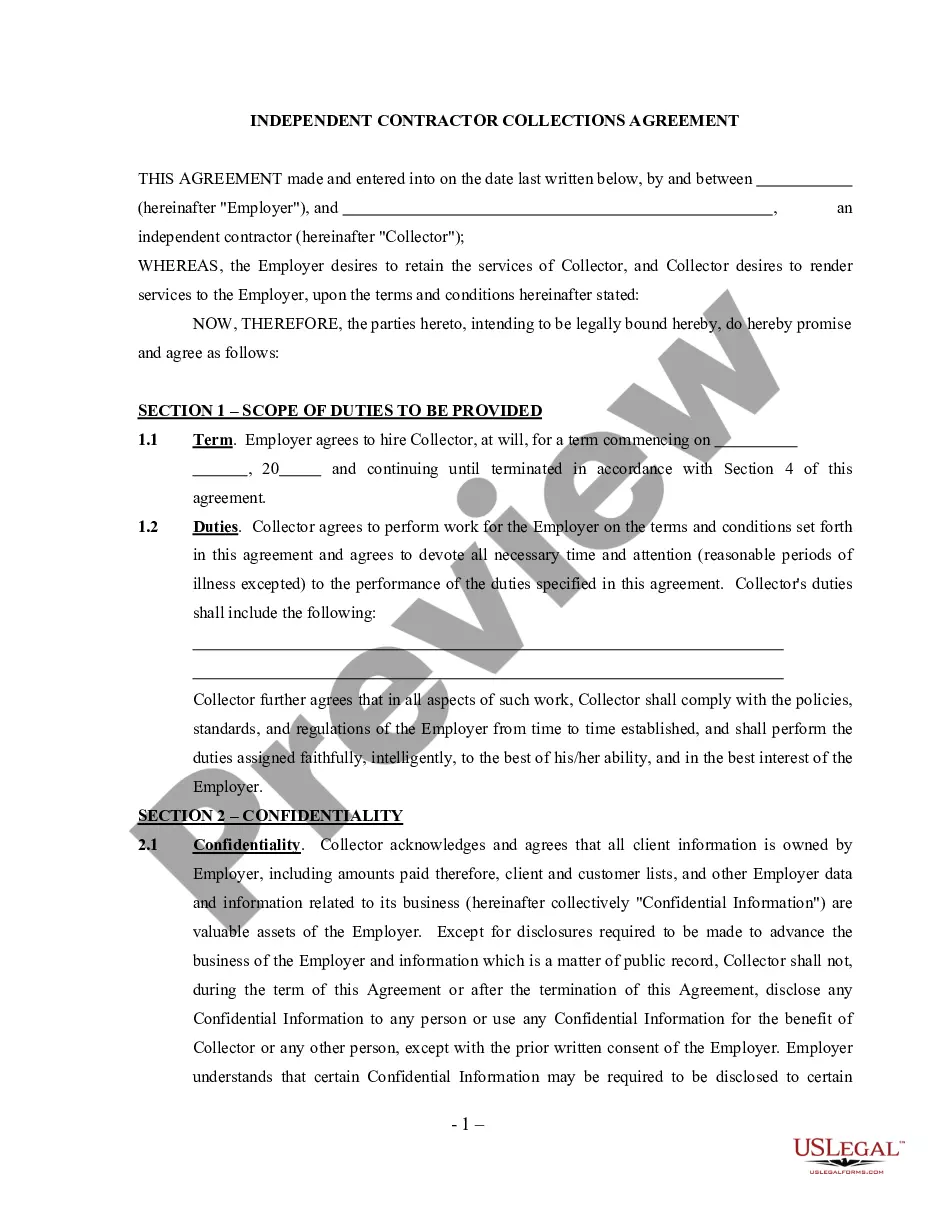
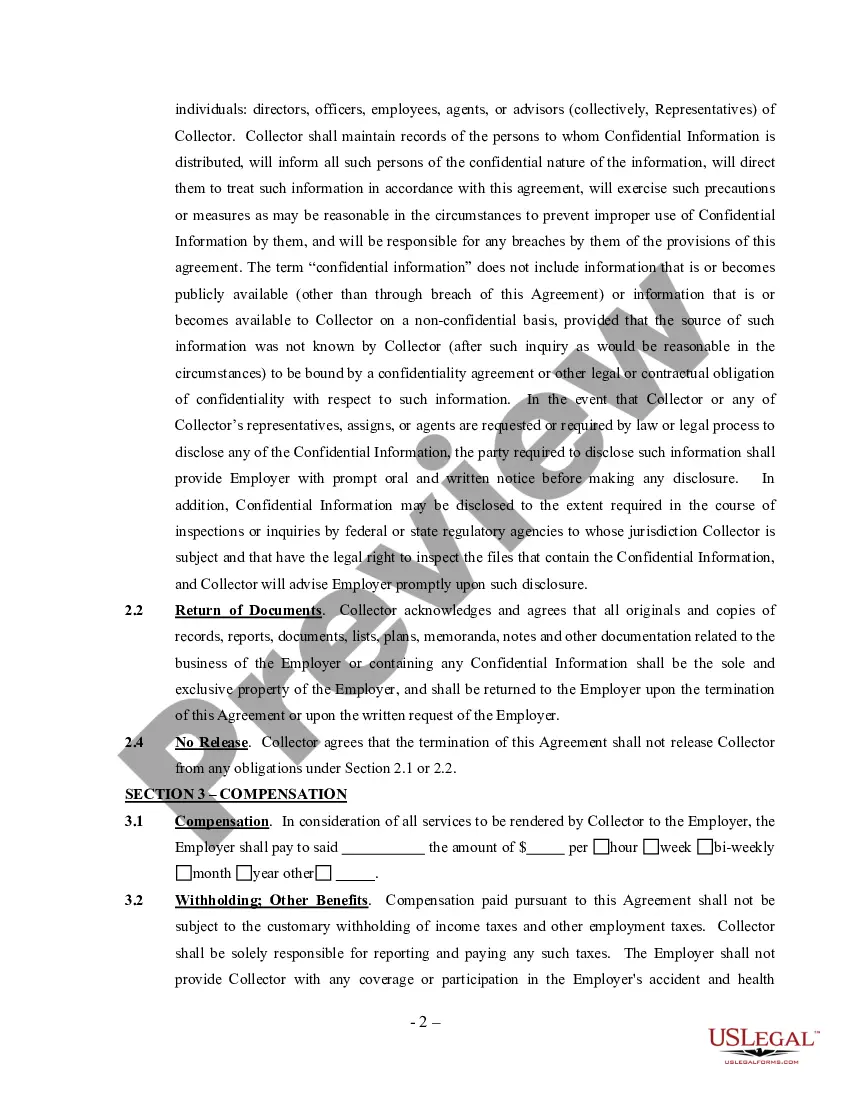
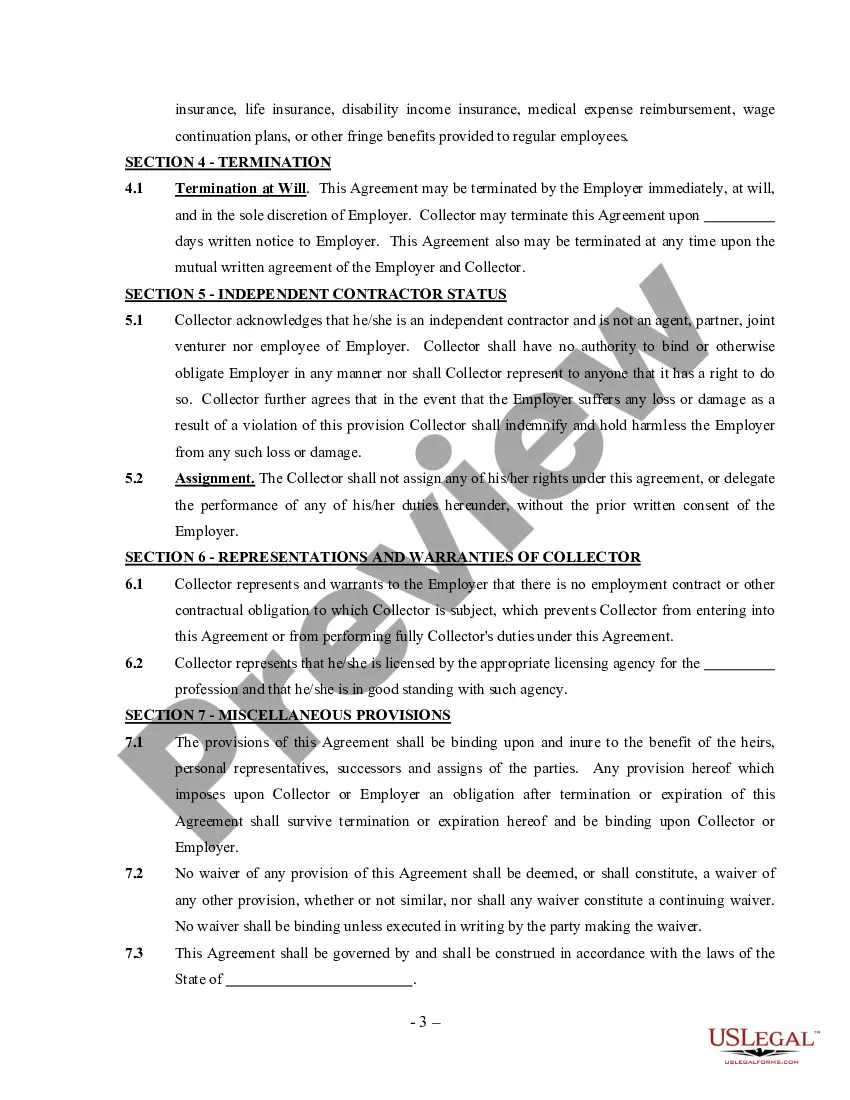
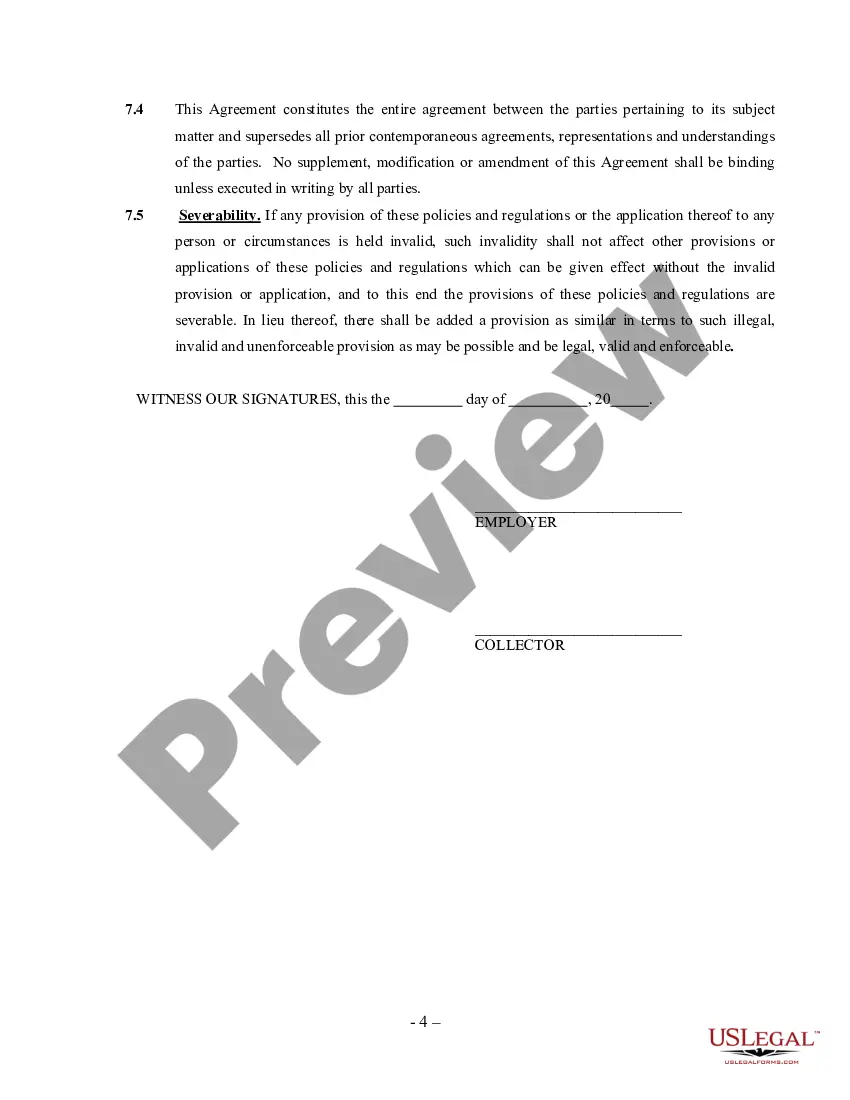
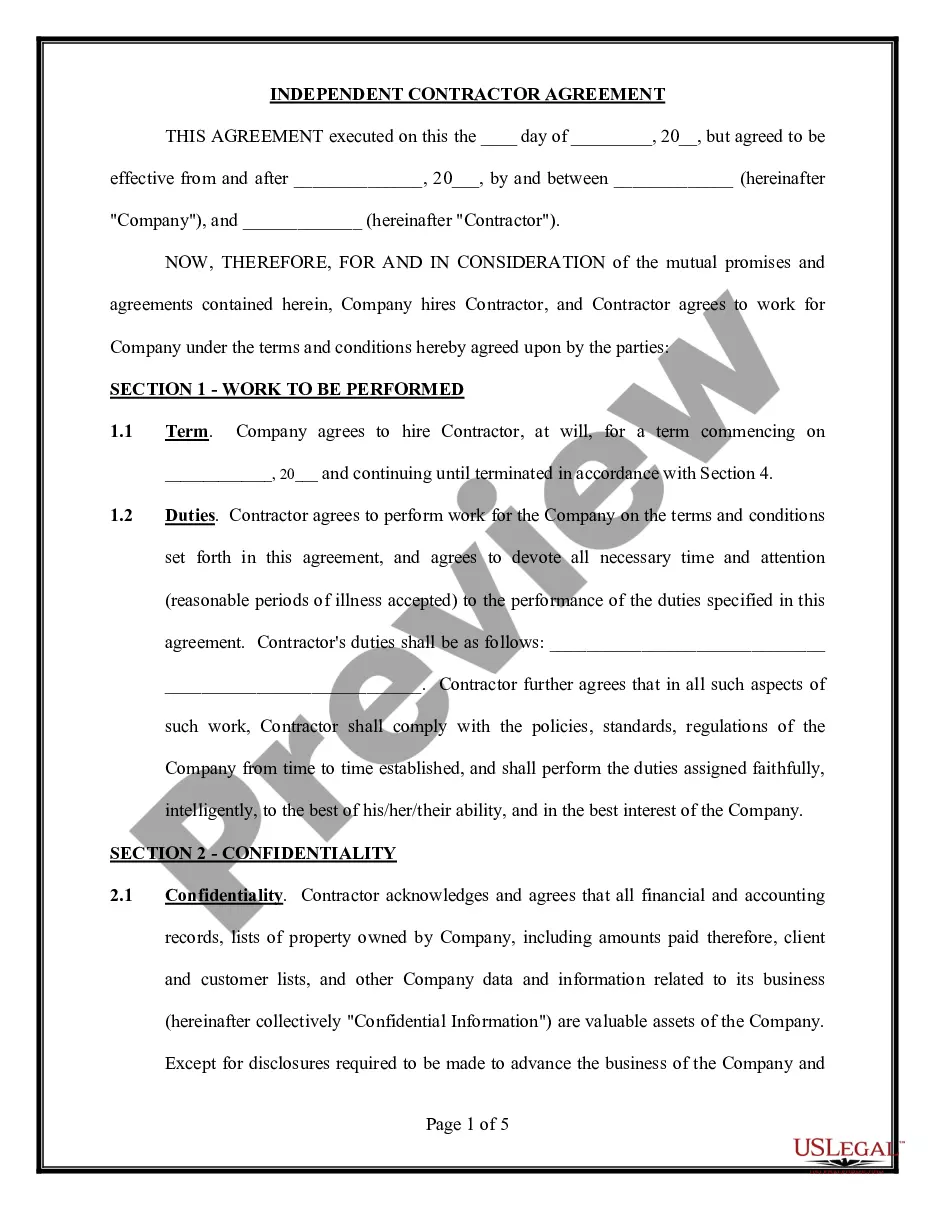
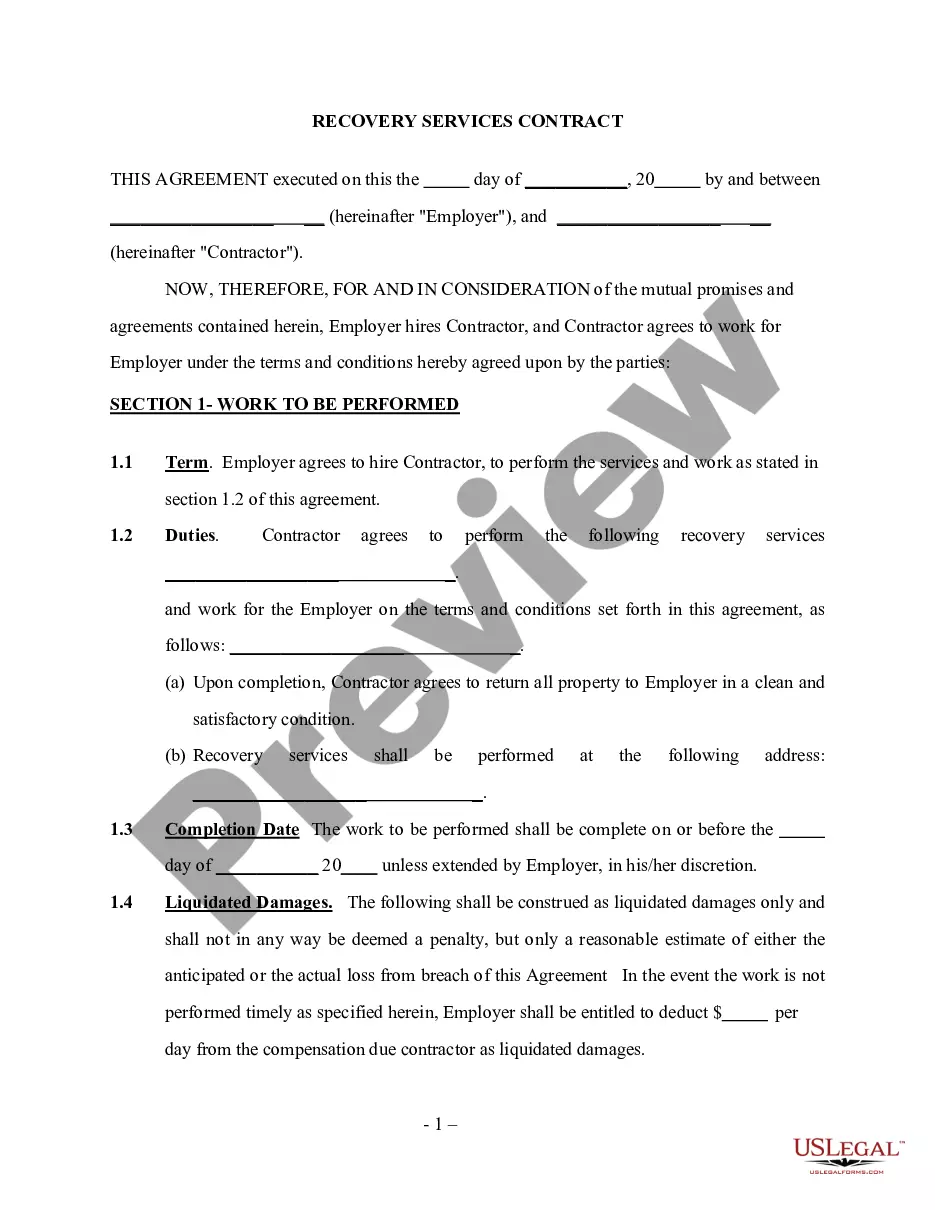
Employer hires a collections specialist on an independent contractor basis to provide collection services for employer as specified in the contract.
Florida Collections Agreement - Self-Employed Independent Contractor
State:
Multi-State
Control #:
US-INDC-237
Format:
Word;
Rich Text
Instant download
Description
Free preview
Get your form ready online
Our built-in tools help you complete, sign, share, and store your documents in one place.
Built-in online Word editor
Make edits, fill in missing information, and update formatting in US Legal Forms—just like you would in MS Word.
Export easily
Download a copy, print it, send it by email, or mail it via USPS—whatever works best for your next step.
E-sign your document
Sign and collect signatures with our SignNow integration. Send to multiple recipients, set reminders, and more. Go Premium to unlock E-Sign.
Notarize online 24/7
If this form requires notarization, complete it online through a secure video call—no need to meet a notary in person or wait for an appointment.
Store your document securely
We protect your documents and personal data by following strict security and privacy standards.

Make edits, fill in missing information, and update formatting in US Legal Forms—just like you would in MS Word.

Download a copy, print it, send it by email, or mail it via USPS—whatever works best for your next step.

Sign and collect signatures with our SignNow integration. Send to multiple recipients, set reminders, and more. Go Premium to unlock E-Sign.

If this form requires notarization, complete it online through a secure video call—no need to meet a notary in person or wait for an appointment.

We protect your documents and personal data by following strict security and privacy standards.
Looking for another form?
How to fill out Collections Agreement - Self-Employed Independent Contractor?
Locating the appropriate sanctioned document template can be challenging. Of course, there are numerous templates accessible online, but how do you discover the sanctioned form you require? Utilize the US Legal Forms website. This service provides a vast array of templates, including the Florida Collections Agreement - Self-Employed Independent Contractor, which you can utilize for business and personal requirements. All of the forms are reviewed by experts and comply with federal and state regulations.
If you are already registered, Log In to your account and click on the Acquire button to obtain the Florida Collections Agreement - Self-Employed Independent Contractor. Use your account to review the sanctioned forms you have previously ordered. Visit the My documents tab in your account and download an additional copy of the document you need.
If you are a new user of US Legal Forms, here are straightforward instructions that you should follow: First, make sure you have selected the correct form for your city/state. You can explore the form using the Preview button and read the form description to confirm this is the right one for you. If the form does not meet your requirements, use the Search field to find the appropriate form. Once you are confident that the form will work, click on the Purchase now button to acquire the form. Choose the pricing plan you prefer and enter the necessary information. Create your account and pay for your order using your PayPal account or credit card. Select the file format and download the sanctioned document template to your device. Finally, complete, modify, print, and sign the acquired Florida Collections Agreement - Self-Employed Independent Contractor.
- US Legal Forms is the largest repository of sanctioned forms where you can access a variety of document templates.
- Utilize the service to acquire professionally crafted paperwork that comply with state regulations.
- Find the necessary templates for both personal and business purposes.
- All forms are vetted by professionals to ensure legal compliance.
- Explore various pricing plans for your convenience.
- Easily manage your purchased forms within your account.
Form popularity
FAQ
In Florida, an independent contractor agreement is a formal document that specifies the directives and expectations for a self-employed worker. This agreement typically includes terms related to payment, work scope, and liability. Utilizing the right template from a platform like USLegalForms can streamline the process of creating a Florida Collections Agreement - Self-Employed Independent Contractor that meets legal standards.
The primary purpose of an independent contractor agreement is to outline the expectations, responsibilities, and any financial terms between the contractor and the client. This agreement protects both parties by clarifying the nature of the relationship and the scope of work. Crafting a sound Florida Collections Agreement - Self-Employed Independent Contractor is essential for ensuring a mutual understanding.
If you sustain an injury as an independent contractor in Florida, you generally do not qualify for workers' compensation benefits, as these are reserved for employees. Instead, you may need to pursue other options for coverage, such as personal insurance or liability claims. Being aware of these scenarios when establishing a Florida Collections Agreement - Self-Employed Independent Contractor is crucial for addressing liability.
The new independent contractor law in Florida aims to clarify the rules surrounding the classification of workers in the gig economy. This law emphasizes the importance of maintaining independent contractor status while ensuring that workers are not misclassified as employees. It’s vital for contractors and businesses to review their agreements and consider how this impacts their Florida Collections Agreement - Self-Employed Independent Contractor.
In general, an independent contractor in Florida must earn at least $600 from a client to receive a 1099 form. This form is used to report income to the IRS and serves as essential documentation for tax purposes. If you’re navigating the financial aspects of your work, understanding the thresholds can help when drafting a Florida Collections Agreement - Self-Employed Independent Contractor.
In Florida, an independent contractor is someone who performs work according to a contract without being subject to the direction and control of an employer. These individuals typically manage their own business operations, offer their services to multiple clients, and are responsible for their own taxes. Understanding this classification is key for both contractors and clients engaging in a Florida Collections Agreement - Self-Employed Independent Contractor.
To create a comprehensive independent contractor agreement, start by defining the scope of work, including specific duties and responsibilities. Incorporate payment terms, specifying the amount and schedule for compensation. Additionally, include clauses addressing confidentiality, termination conditions, and dispute resolution. For a reliable resource, consider using the US Legal platform, which offers templates for a Florida Collections Agreement - Self-Employed Independent Contractor, ensuring you meet all necessary legal requirements.
Absolutely, if you are classified as a 1099 employee, your wages can still face garnishment under specific circumstances. The Florida Collections Agreement - Self-Employed Independent Contractor governs these situations, allowing creditors to obtain legal permission to garnish your income. It's vital to keep track of your debts and understand your rights to manage potential garnishment effectively.
Certain accounts may be exempt from garnishment, offering you some protection against creditors. Accounts such as retirement accounts, certain trust accounts, and accounts dedicated to specific government benefits can often remain untouched under the Florida Collections Agreement - Self-Employed Independent Contractor guidelines. Knowing which accounts are safe helps you plan your finances more effectively.
Yes, your wages can be garnished even if you are an independent contractor, as outlined in the Florida Collections Agreement - Self-Employed Independent Contractor. While your income is not withheld automatically, creditors may approach the court to obtain a garnishment order against your earnings. Therefore, it is critical to understand the possible implications of any outstanding debts.