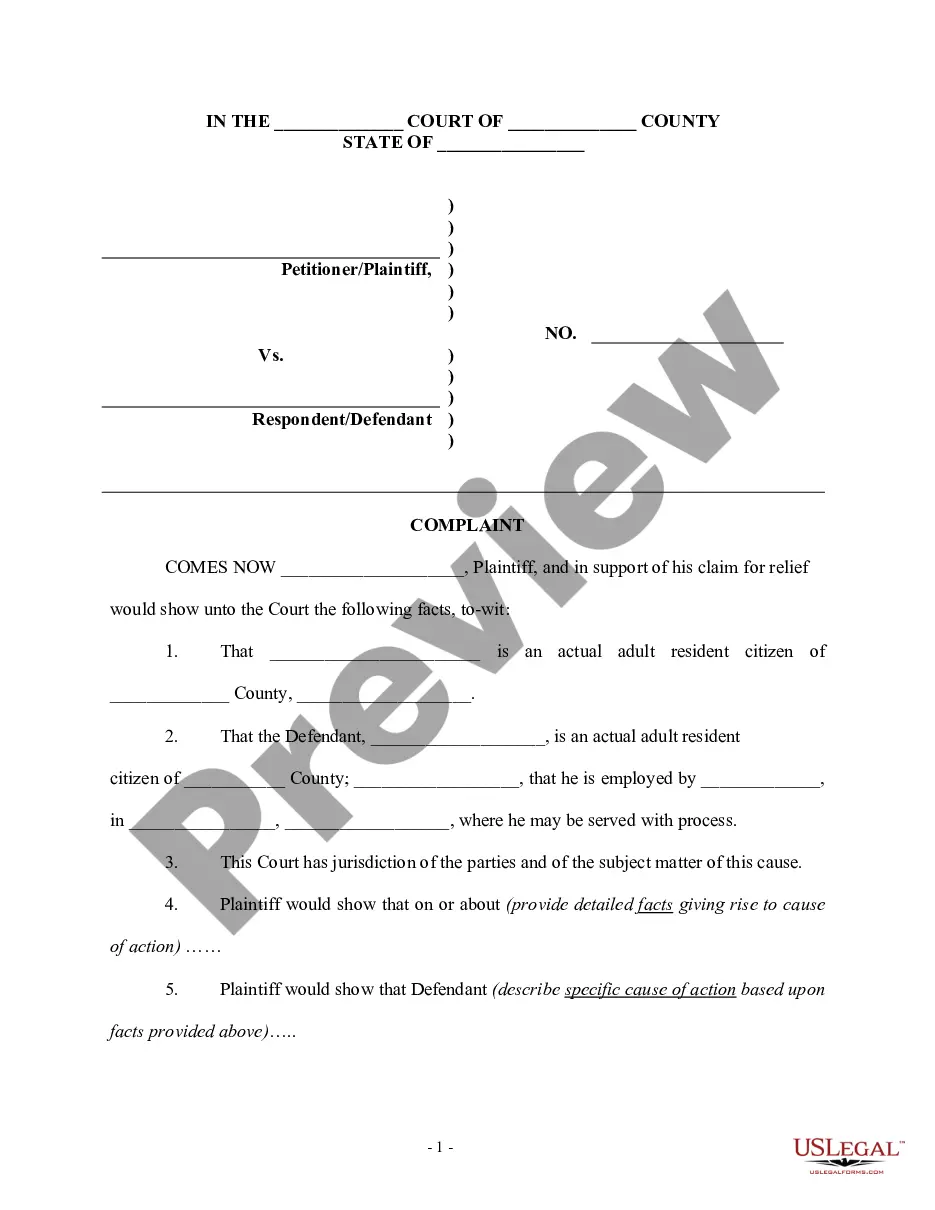
This form is a listing of various Causes of Action. This form lists a variety of lawsuits which may be filed against a tortfeasor.
Florida List of Causes of Action
140 downloads
Description
Free preview


Get your form ready online
Our built-in tools help you complete, sign, share, and store your documents in one place.
Built-in online Word editor
Make edits, fill in missing information, and update formatting in US Legal Forms—just like you would in MS Word.
Export easily
Download a copy, print it, send it by email, or mail it via USPS—whatever works best for your next step.
E-sign your document
Sign and collect signatures with our SignNow integration. Send to multiple recipients, set reminders, and more. Go Premium to unlock E-Sign.
Notarize online 24/7
If this form requires notarization, complete it online through a secure video call—no need to meet a notary in person or wait for an appointment.
Store your document securely
We protect your documents and personal data by following strict security and privacy standards.

Make edits, fill in missing information, and update formatting in US Legal Forms—just like you would in MS Word.

Download a copy, print it, send it by email, or mail it via USPS—whatever works best for your next step.

Sign and collect signatures with our SignNow integration. Send to multiple recipients, set reminders, and more. Go Premium to unlock E-Sign.

If this form requires notarization, complete it online through a secure video call—no need to meet a notary in person or wait for an appointment.

We protect your documents and personal data by following strict security and privacy standards.
Looking for another form?
How to fill out List Of Causes Of Action?
Are you in a position where you require documents for various organizations or particular purposes almost every day? There are numerous legal document templates accessible online, but finding reliable versions is challenging. US Legal Forms offers thousands of template options, such as the Florida List of Causes of Action, that are crafted to satisfy both federal and state requirements.
If you are already acquainted with the US Legal Forms website and possess an account, simply Log In. After that, you can download the Florida List of Causes of Action template.
If you do not have an account and wish to start using US Legal Forms, follow these steps: Locate the form you require and verify it is for the correct city/state. Utilize the Review button to inspect the form. Read the summary to ensure that you have selected the appropriate template. If the form does not meet your requirements, use the Search field to find the form that fits your needs. Once you find the correct form, click on Purchase now. Choose the payment plan you prefer, complete the necessary information to create your account, and complete the transaction using your PayPal or credit card. Select a convenient document format and download your copy.
- Access all the document templates you have purchased in the My documents section. You can obtain an additional copy of the Florida List of Causes of Action anytime, if necessary. Just click on the desired form to download or print the document template.
- Utilize US Legal Forms, the most comprehensive collection of legal templates, to save time and reduce mistakes. The service provides properly crafted legal document templates that can be used for various purposes. Create an account on US Legal Forms and start making your life easier.
Form popularity
FAQ
A legal claim of malicious prosecution arises when one person (the plaintiff) brings a criminal or civil action against another person (the defendant) with malice and without probable cause.
Lawsuits for accountings are generally considered equitable proceedings. Under Florida law, a party that wants an equitable accounting must prove that: (1) a fiduciary relationship exists between the parties or the subject transaction is complex; and (2) the remedy at law is inadequate.
What must a plaintiff show to sue for malicious prosecution? To sue for malicious prosecution, you must show that criminal or civil proceedings were initiated against you or continued without probable cause and that the case against you terminated in your favor.
A Standard Clause providing model language to plead a cause of action for specific performance under Florida law. It has integrated notes with important explanations and tips for pleading a count for specific performance and the required elements of the claim.
In Florida, you have to prove that the other person's negligence (breach) caused significant damages. The most common damage that results from a breach of contract is the loss of money. You may also be entitled to expectation damages, which means you lost certain benefits that were promised as part of the agreement.
The cause of action for an account stated is based on the agreement of the parties to pay the amount due upon the accounting, and not any written instrument.
To prove a case of abuse of process in Florida, a plaintiff must typically show the following elements: Illegal or improper use of the legal process by Defendant: The plaintiff must prove the defendant did not simply use the process to further justice or get a legal remedy.
For example, in a case where a former employer sought to bring criminal charges to its employee to recover stolen money, while knowing that the employee was not responsible for the theft, the court held the employer liable for abuse of process for initiating criminal charges while knowing that the charges were ...