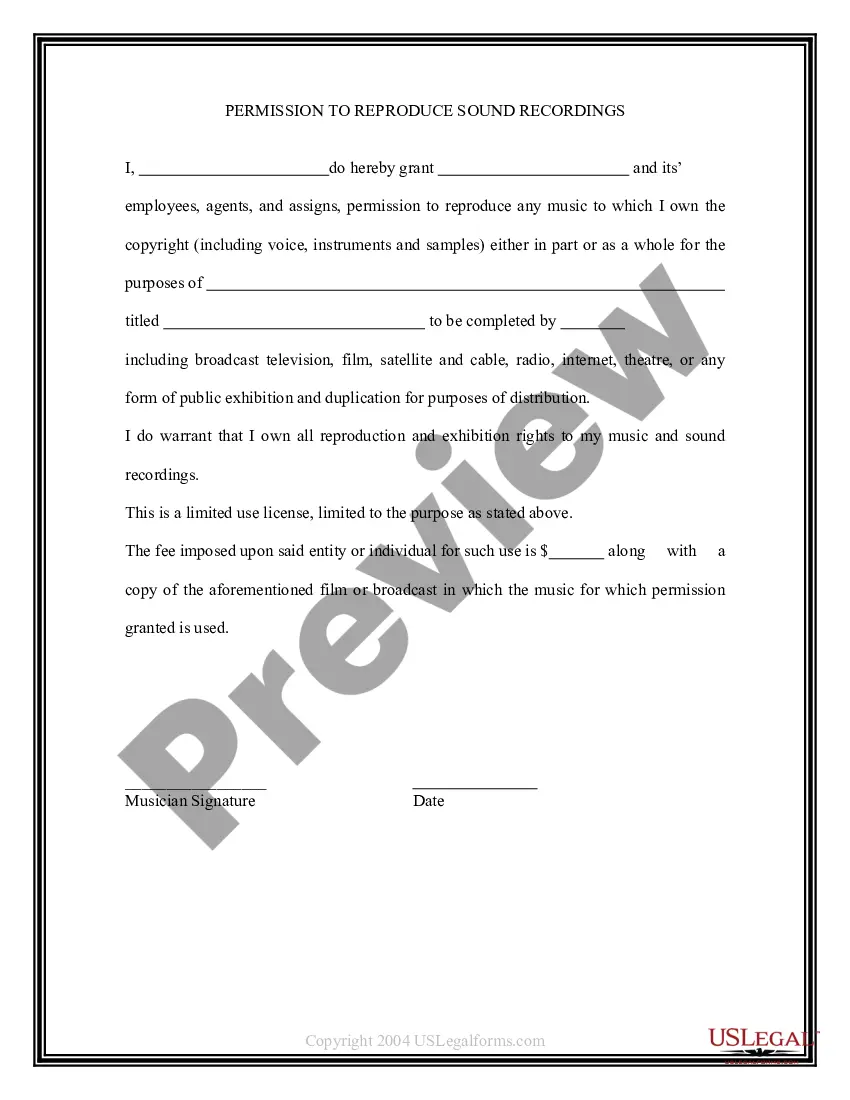
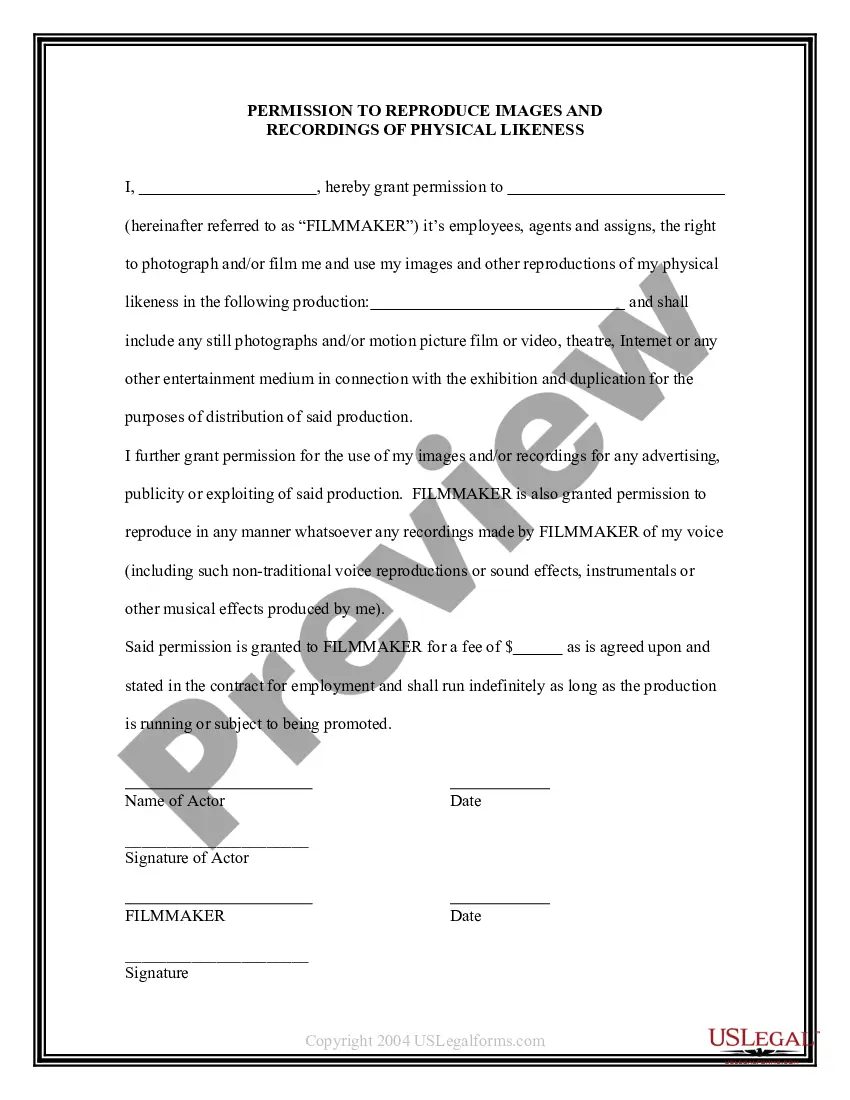
This is a form signed by a musician or owner of music granting permission to reproduce copyrighted music for use in a film, television, Internet, radio etc.
Delaware Permission To Reproduce Sound Recordings
State:
Multi-State
Control #:
US-PRM-23
Format:
Word;
Rich Text
Instant download
Description

How to fill out Permission To Reproduce Sound Recordings?
US Legal Forms - one of the largest collections of legal documents in the United States - provides a broad selection of legal document templates that you can download or print. By using the website, you can acquire thousands of forms for business and personal purposes, organized by categories, states, or keywords. You can find the latest editions of forms such as the Delaware Permission To Reproduce Sound Recordings in just minutes.
If you already have a subscription, Log In and retrieve the Delaware Permission To Reproduce Sound Recordings from your US Legal Forms library. The Download button will appear on every form you view. You can access all previously saved forms in the My documents section of your account.
To use US Legal Forms for the first time, here are simple instructions to get you started: Ensure you have selected the correct form for your city/state. Click on the Preview button to review the form's content. Check the form details to make sure you have chosen the right form. If the form does not meet your requirements, utilize the Search area at the top of the screen to find the one that does. When you are satisfied with the form, confirm your choice by clicking on the Purchase now button. Then, select the pricing plan you prefer and provide your information to register for an account. Complete the transaction. Use your credit card or PayPal account to finalize the purchase. Choose the format and download the form to your device. Make modifications. Fill out, edit, print, and sign the saved Delaware Permission To Reproduce Sound Recordings. Each template you add to your account has no expiration date and is yours permanently. Therefore, if you wish to download or print another copy, simply visit the My documents section and click on the form you need.
- Access the Delaware Permission To Reproduce Sound Recordings with US Legal Forms, the most extensive collection of legal document templates.
- Utilize thousands of professional and state-specific templates that meet your business or personal needs and requirements.
- Easily navigate through the categories to find the forms you need.
- Enjoy the convenience of downloading forms directly to your device.
- Benefit from the user-friendly interface that simplifies the process of obtaining legal papers.
- Store and manage your documents in one secure location.
Form popularity
FAQ
Delaware has specific sound ordinances that regulate noise levels in various zones. These ordinances aim to minimize disturbances and maintain peace, particularly in residential areas. If you plan to reproduce sound recordings, it's crucial to be aware of these guidelines to avoid any legal issues. For more information and to ensure compliance with Delaware Permission To Reproduce Sound Recordings, consider utilizing resources from USLegalForms.
Yes, Delaware is a one-party consent state. This means that only one person involved in the conversation needs to consent to the recording. If you plan to record a conversation, ensure that you are either a participant or have consent from one of the participants. Understanding Delaware's regulations is essential, especially if you aim to navigate Delaware Permission To Reproduce Sound Recordings effectively.
United States (U.S.)'One Party Consent' state, where you must notify and get consent from at least one of the parties on the call.'Two Party Consent' or 'All Party' states, which prohibits recording of a call without the consent of all parties to the communication before recording the conversation.
California is an all-party consent state. It is illegal to record a confidential conversation, including private conversations or telephone calls, without consent in California.
Under the federal Wiretap Act, it is illegal for any person to secretly record an oral, telephonic, or electronic communication that other parties to the communication reasonably expect to be private. (18 U.S.C. § 2511.)
In California, all parties to any confidential conversation must give their consent to be recorded. For calls occurring over cellular or cordless phones, all parties must consent before a person can record, regardless of confidentiality. Both civil and criminal penalties are available to victims of illegal recordings.
Under the federal Wiretap Act, it is illegal for any person to secretly record an oral, telephonic, or electronic communication that other parties to the communication reasonably expect to be private. (18 U.S.C. § 2511.)
Delaware Recording Law Summary: Delaware recording law stipulates that it is a two-party consent state. In Delaware it is a criminal offense to use any device to record communications, whether they are wire, oral or electronic, without the consent of all parties taking part in the communication.
California call recording laws In California, call recording is a strictly two-person matter, meaning both parties must consent to being recorded otherwise the recording is illegal. The law is applicable to confidential communication and applies when either party has a clear expectation to their right to privacy.
Delaware recording law stipulates that it is a two-party consent state. In Delaware it is a criminal offense to use any device to record communications, whether they are wire, oral or electronic, without the consent of all parties taking part in the communication.