Delaware Corporate Resolution for Nonprofit Organizations
Description

Get your form ready online
Our built-in tools help you complete, sign, share, and store your documents in one place.
Make edits, fill in missing information, and update formatting in US Legal Forms—just like you would in MS Word.
Download a copy, print it, send it by email, or mail it via USPS—whatever works best for your next step.
Sign and collect signatures with our SignNow integration. Send to multiple recipients, set reminders, and more. Go Premium to unlock E-Sign.
If this form requires notarization, complete it online through a secure video call—no need to meet a notary in person or wait for an appointment.
We protect your documents and personal data by following strict security and privacy standards.

Make edits, fill in missing information, and update formatting in US Legal Forms—just like you would in MS Word.

Download a copy, print it, send it by email, or mail it via USPS—whatever works best for your next step.

Sign and collect signatures with our SignNow integration. Send to multiple recipients, set reminders, and more. Go Premium to unlock E-Sign.

If this form requires notarization, complete it online through a secure video call—no need to meet a notary in person or wait for an appointment.

We protect your documents and personal data by following strict security and privacy standards.
Looking for another form?
How to fill out Corporate Resolution For Nonprofit Organizations?
Have you ever been in a situation where you require documentation for both commercial or personal reasons almost every time.
There are numerous lawful document templates available online, but locating ones you can trust is challenging.
US Legal Forms provides thousands of document templates, such as the Delaware Corporate Resolution for Nonprofit Organizations, designed to comply with federal and state regulations.
Utilize US Legal Forms, the most comprehensive collection of legal documents, to save time and avoid errors.
The service offers properly drafted legal document templates that can be used for a variety of purposes. Create an account on US Legal Forms and start simplifying your life.
- If you are already acquainted with the US Legal Forms website and possess an account, simply Log In.
- Then, you can download the Delaware Corporate Resolution for Nonprofit Organizations template.
- If you do not have an account and wish to start using US Legal Forms, follow these instructions.
- Obtain the template you need and ensure it is for the correct city/county.
- Utilize the Preview button to review the form.
- Check the details to ensure you have selected the correct document.
- If the template is not what you are looking for, utilize the Search field to find the template that meets your criteria.
- When you locate the right template, click Get now.
- Choose the pricing plan you prefer, complete the required information to create your account, and pay using your PayPal or credit card.
- Select a convenient document format and download your copy.
- Find all the document templates you have purchased in the My documents menu.
- You can obtain an additional copy of the Delaware Corporate Resolution for Nonprofit Organizations anytime, if needed.
- Click on the necessary template to download or print the document.
Form popularity
FAQ
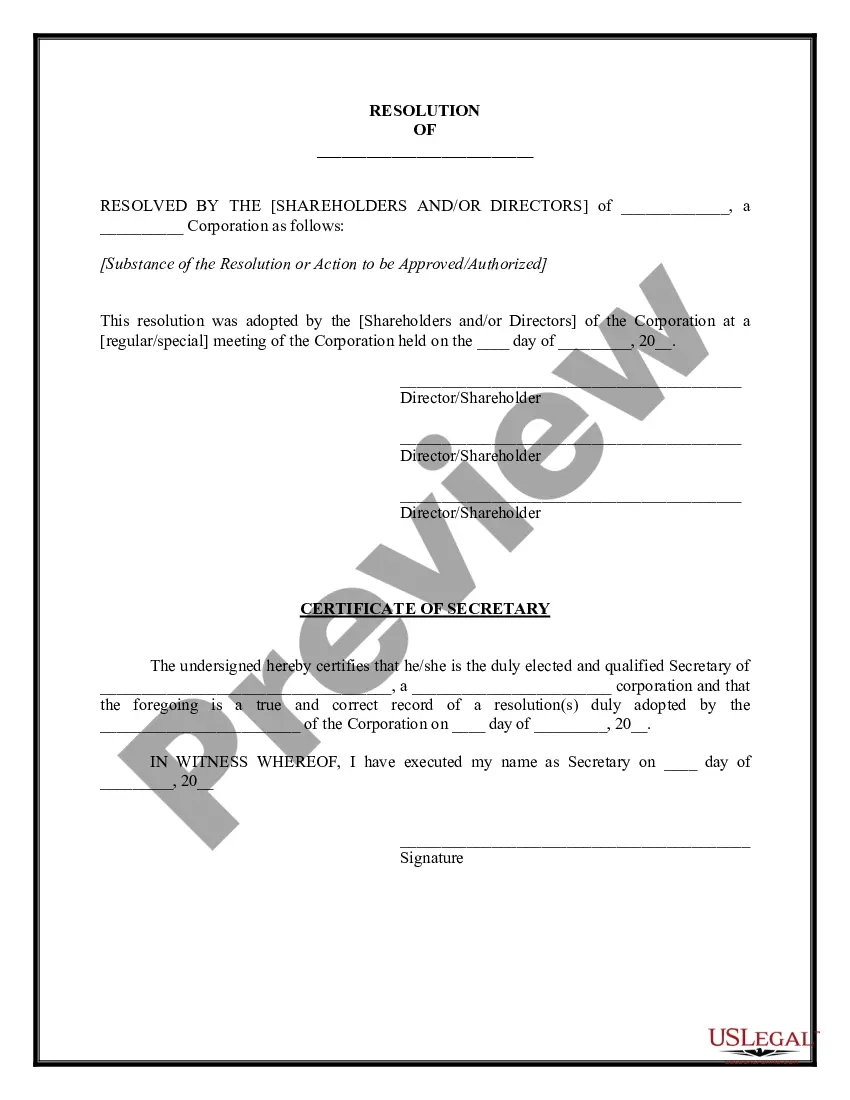
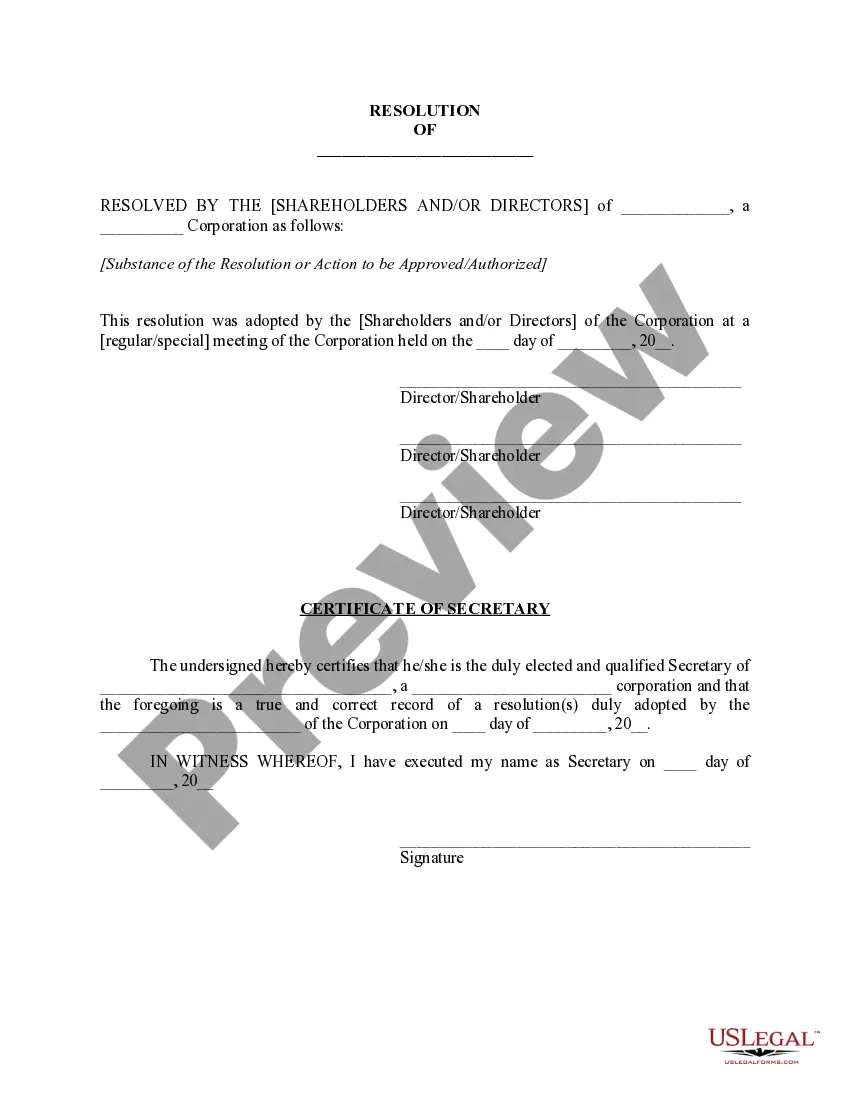
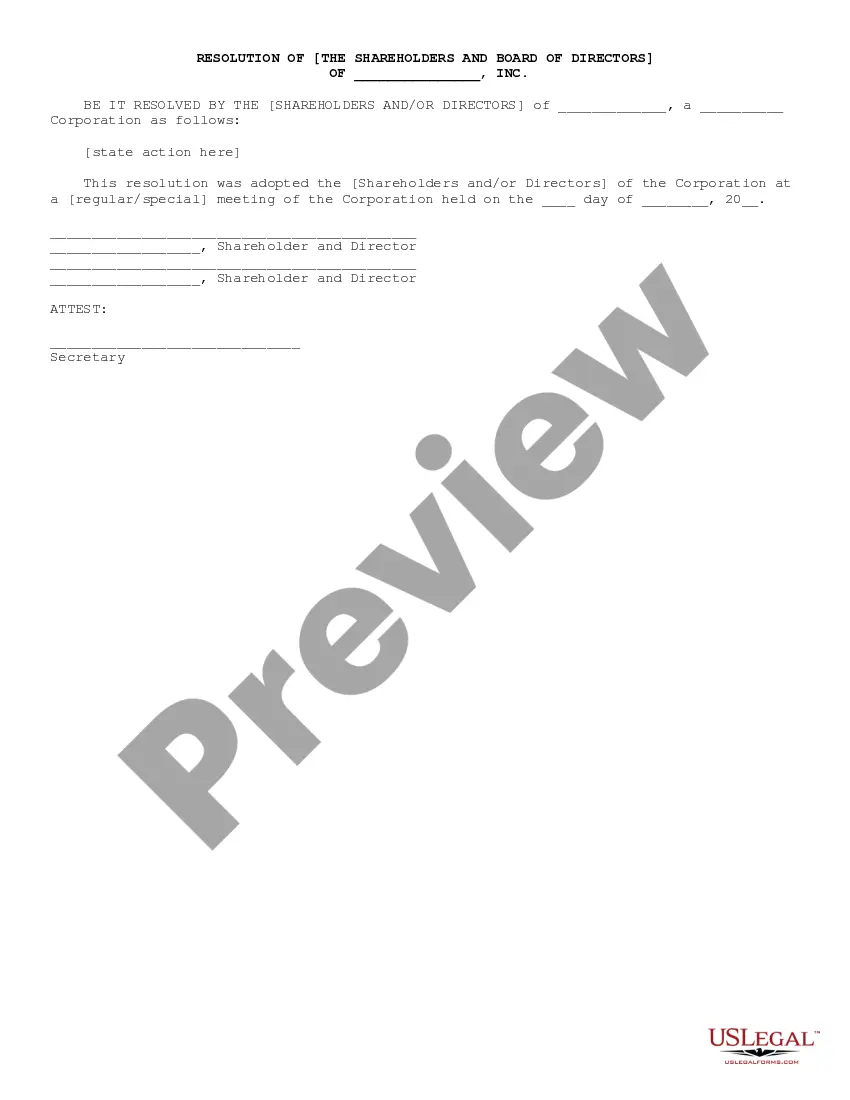
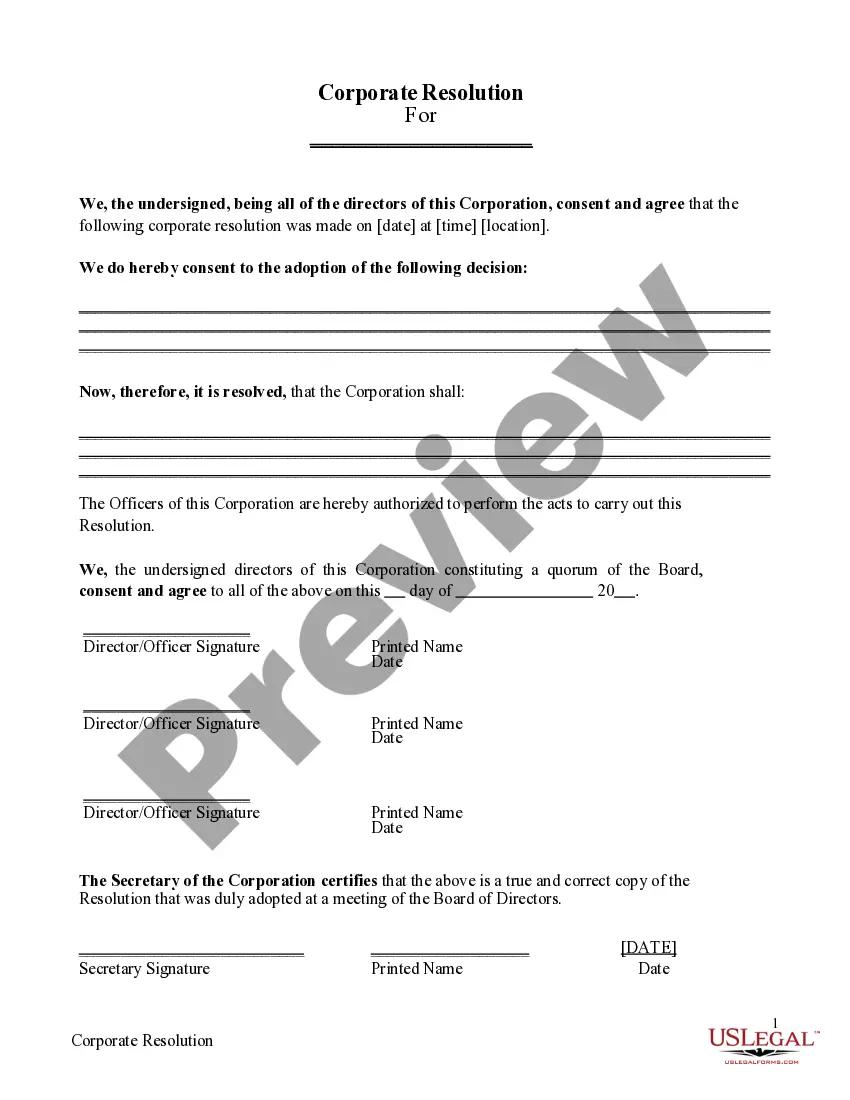
A corporate resolution is the legal document that provides the rules and framework as to how the board can act under various circumstances. Corporate resolutions provide a paper trail of the decisions made by the board and the executive management team.
They are only required when the board of directors makes a significant business decision. A corporate resolution creates a paper trail of an important decision in case it ever needs to be reviewed by shareholders, officers, or the IRS.
Your board of directors is the primary decision maker for your nonprofit and is responsible for overseeing its management. As a result, your board should approve any decision involving significant financial, legal, or tax issues, or any major program-related matter.
A corporate resolution is the document commonly used for this purpose. The resolution is generally drafted after a meeting and vote by the directors on an important issue for the corporation.
Both Texas and Delaware require every corporation to have Bylaws. You do not need to publicly file the Bylaws in either state, but you must create, retain, and follow them.
Nonprofit corporations often deal with government agencies on issues of public concern, which may involve applying for grants, loans or other governmental approvals. In many situations, the government agency requires a corporate resolution to verify the board's approval for making the government application.
Labeling a vote a resolution means that the board believed the issue was important enough to separate it from standard voting issues. A resolution is considered an official board action and it requires a quorum. Board directors must document all official board actions, including resolutions, in their meeting minutes.
Labeling a vote a resolution means that the board believed the issue was important enough to separate it from standard voting issues. A resolution is considered an official board action and it requires a quorum. Board directors must document all official board actions, including resolutions, in their meeting minutes.
In general, the SEC guidelines permit resolutions only from shareholders who have continuously held at least $2,000 of the company's stock for a year or longer. If a shareholder meets these requirements, then the board can choose to bring up the resolution for a vote at the next shareholder meeting.
A resolution can be made by a corporation's board of directors, shareholders on behalf of a corporation, a non-profit board of directors, or a government entity. The length of the resolution isn't important. It only needs to be as long as what you need to say.
