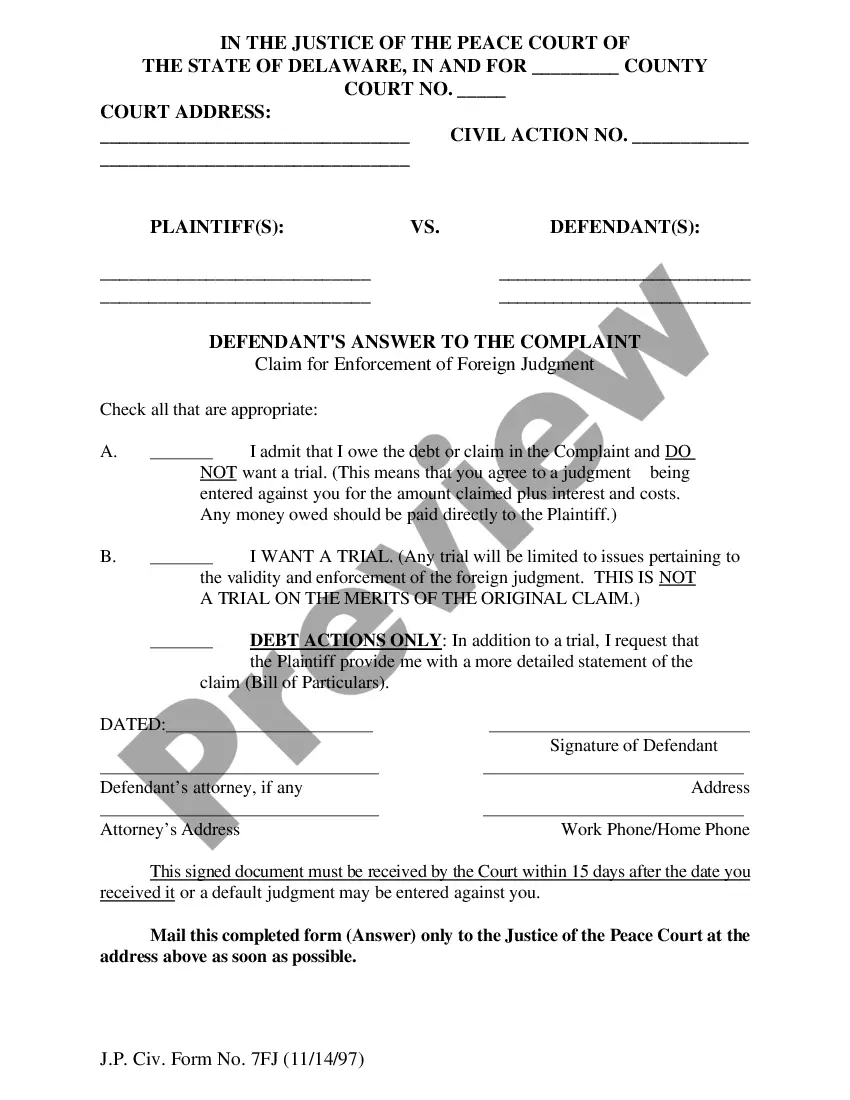
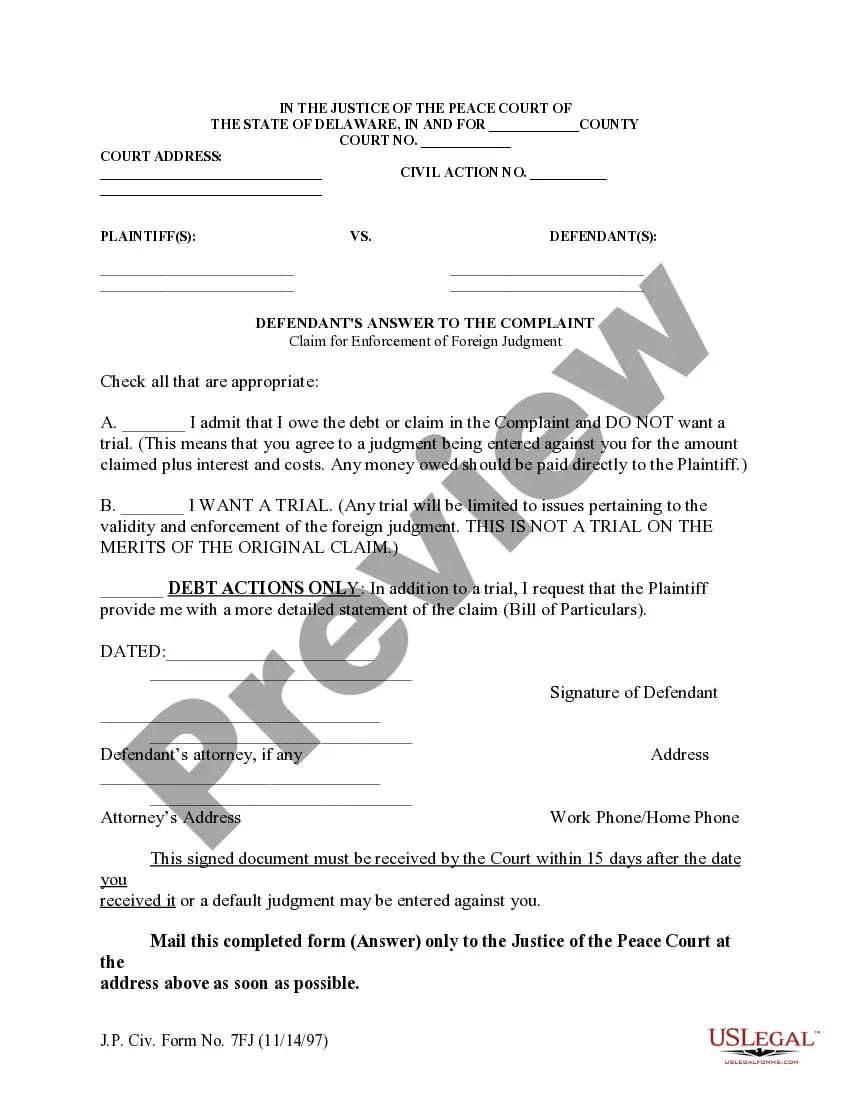
Delaware Defendant's Answer to the Complaint - Claim for Enforcement of Foreign Judgment
Description

Get your form ready online
Our built-in tools help you complete, sign, share, and store your documents in one place.
Make edits, fill in missing information, and update formatting in US Legal Forms—just like you would in MS Word.
Download a copy, print it, send it by email, or mail it via USPS—whatever works best for your next step.
Sign and collect signatures with our SignNow integration. Send to multiple recipients, set reminders, and more. Go Premium to unlock E-Sign.
If this form requires notarization, complete it online through a secure video call—no need to meet a notary in person or wait for an appointment.
We protect your documents and personal data by following strict security and privacy standards.

Make edits, fill in missing information, and update formatting in US Legal Forms—just like you would in MS Word.

Download a copy, print it, send it by email, or mail it via USPS—whatever works best for your next step.

Sign and collect signatures with our SignNow integration. Send to multiple recipients, set reminders, and more. Go Premium to unlock E-Sign.

If this form requires notarization, complete it online through a secure video call—no need to meet a notary in person or wait for an appointment.

We protect your documents and personal data by following strict security and privacy standards.
Looking for another form?

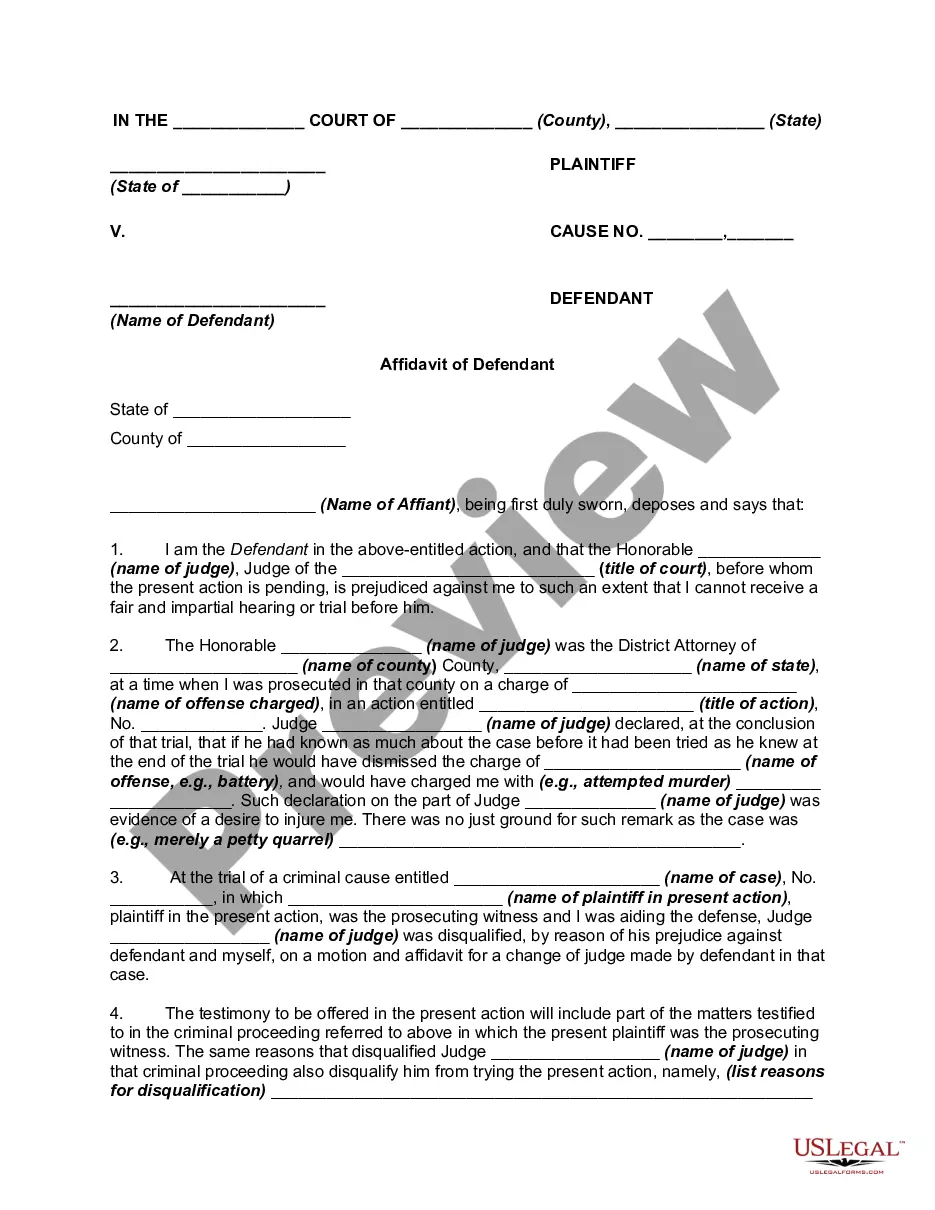
How to fill out Delaware Defendant's Answer To The Complaint - Claim For Enforcement Of Foreign Judgment?
The greater the number of documents you require to create - the more anxious you become.
You can discover an extensive array of Delaware Answer for Enforcement of Out of State Judgment templates online, but you are unsure which ones to trust.
Eliminate the stress and simplify the process of finding samples using US Legal Forms. Obtain expertly crafted forms designed to comply with state regulations.
Input the required information to create your account and complete the payment using your PayPal or credit card. Choose a suitable file format and download your copy. Access each document you download through the My documents section. Simply navigate there to create a new version of the Delaware Answer for Enforcement of Out of State Judgment. Even when utilizing professionally prepared forms, it remains crucial to consider consulting your local attorney to verify that your document is accurately completed. Achieve more for less with US Legal Forms!
- If you have a US Legal Forms membership, Log In to your account, and you'll see the Download option on the web page for the Delaware Answer for Enforcement of Out of State Judgment.
- If you haven’t utilized our platform before, follow the registration process with these steps.
- Ensure the Delaware Answer for Enforcement of Out of State Judgment is applicable in your state.
- Verify your choice by reading the description or by using the Preview feature if it is available for the selected document.
- Click on Buy Now to initiate the registration process and choose a pricing plan that meets your needs.
Form popularity
FAQ
Writs and Garnishments The employer must garnish wages to the extent permitted by state law and continue sending you the funds until the debt is satisfied. In most cases of business or commercial debts, writs of garnishment can only be enforced in the state where they are issued.
A judgment entered in any state can be enforced anywhere in California. In other words, the creditor can use an out-of-state judgment to collect from the debtor's assets located in California, in exactly the same manner as a judgment originally entered in California.
The only U.S. states which have not adopted the Uniform Enforcement of Foreign Judgments Act are California and Vermont.
Enforcing a judgment in NSW is made by application to the NSW Civil and Administrative Tribunal (NCAT). If your judgment was entered in another State, you must first register it as a judgment of the Local Court. The rules governing enforcing a judgment are in the Civil Procedure Act.
Original debtors may also turn accounts over to debt collectors located in another state, who will then file suit in the state where they are located instead of the county and state where the original debt occurred or where the debtor currently lives.
Rule 11: Collectors Can't Cross State LinesDebt collectors also don't want you to know that they cannot pursue you across state borders to enforce a judgment levied against you by a creditor who sued you for non-payment and won.
Most states have adopted the Uniform Enforcement of Foreign Judgments Act, which allows a judgment of one state to be enforced in another state, based on the constitutional requirement that "full faith and credit": be given to judgments rendered by other states.
A judgment entered in any state can be enforced anywhere in California. In other words, the creditor can use an out-of-state judgment to collect from the debtor's assets located in California, in exactly the same manner as a judgment originally entered in California.
This involves obtaining a certified copy of the original judgment and filing it with the local court along with a number of other documents detailing the terms of the judgment and notifying the debtor of the domestication.